


Key takeaways
- Poor inventory management costs small ecommerce brands 20 to 30 percent of annual inventory value through shrinkage, dead stock, and tied-up capital. For a brand carrying $50K in inventory, that is $10K to $15K a year lost to preventable inefficiency. Treat inventory as a core operational discipline, not an afterthought, before you cross $500K in revenue.
- Three foundational systems carry every product business: FIFO rotation to protect margin on perishables and seasonal lines, safety stock with reorder points calculated from demand and lead time, and weekly cycle counts using ABC analysis. Together they prevent the stockouts, dead stock, and accuracy drift that quietly erode unit economics as volume grows.
- Layout drives fulfillment speed more than square footage does. The 10 SKUs that generate 60 percent of orders belong within arm's reach of your packing station. A "perfect pack" photo at every station and a 99.5 percent pick accuracy target turn packing from an inconsistent task into a repeatable standard that protects retention and lowers return rates.
- Co-warehousing fits brands shipping 30 to 200 orders a day. Saltbox runs month-to-month warehouse suites across 12 locations in 9 markets, with loading docks, daily carrier pickups, on-site logistics teams, and pick accuracy tools built in. Brands match space to actual demand, recover 15 to 25 percent of warehousing cost a year, and skip the $10K to $30K build-out of an industrial lease.
Running a product business out of your garage or spare bedroom works until it doesn't. Orders increase, SKUs multiply, and suddenly you 're spending more time searching for inventory than actually growing your business. The difference between product-based businesses who stall and those who scale often comes down to how well they manage their stock. Strong inventory management practices for small businesses are not just about knowing what you have on hand: they determine your fulfillment speed, your cash flow, and your ability to meet customer expectations consistently.
For founders shipping 20 to 200 orders per day, the operational details matter more than most realize. A miscount here, a late reorder there, and you are staring at stockouts during your busiest sales window or tying up capital in products that sit on shelves for months. This guide covers the specific systems, spatial strategies, and infrastructure decisions that help product businesses move from reactive chaos to controlled growth. Whether you are managing inventory from a home setup or considering your first dedicated warehouse space, these principles apply at every stage.
The importance of inventory management for scaling product-based businesses
Poor inventory management costs small product-based businesses between 20% and 30% of their annual inventory value, according to industry estimates. That figure accounts for shrinkage, dead stock, storage costs, and the opportunity cost of capital locked in slow-moving products. For a brand carrying $50,000 in inventory, that equates to o$10,000 - $15,000 lost each year to preventable inefficiencies.
The financial impact extends beyond the warehouse. Stockouts directly reduce revenue: research from IHL Group estimates that global retailers lose $1.14 trillion annually to out-of-stock situations. For a small DTC brand, even a single weekend without your best-selling SKU can mean hundreds of lost orders and damaged customer trust that takes weeks to rebuild.
Accurate inventory data also affects your ability to negotiate with suppliers. If you can show consistent order volumes and predictable reorder cycles, you gain leverage to negotiate better terms, whether that means lower per-unit costs, extended payment windows, or priority production slots. Brands that guess at their inventory needs end up placing rush orders at premium prices.
Cash flow is the other critical factor. Every dollar sitting in unsold inventory is a dollar you cannot spend on marketing, product development, or hiring. Founders who track their inventory turnover ratio, the number of times they sell through their stock in a given period, can make smarter purchasing decisions. A healthy turnover ratio for most product-based businesses falls between 4 and 8 times per year. If yours is below 4, you are likely over-ordering. Above 8, you may be cutting it too close and risking stockouts.
The companies that scale past the $500,000 revenue mark almost always share one trait: they treat inventory management as a core operational discipline rather than an afterthought. Getting the fundamentals right early creates the foundation for everything that follows.
Establish core tracking methods for your product business
Before investing in software or warehouse space, you need reliable systems for tracking what comes in, what goes out, and what stays. These systems do not need to be complicated, but they do need to be consistent. A spreadsheet updated once a week will not cut it once you're processing more than 10 orders per day.
The three foundational tracking methods below form the backbone of inventory management best practices for small businesses at any stage. Each one addresses a specific failure point: product degradation, unexpected stockouts, and inventory accuracy drift.
Implementing First-In, First-Out (FIFO) systems
FIFO means the oldest inventory gets sold and shipped first. This principle matters most for perishable goods, but it applies to nearly every product category. Cosmetics expire. Packaging designs change. Even durable goods like apparel can yellow or develop warehouse odors if they sit too long.
The practical implementation is straightforward. When new stock arrives, place it behind or below existing inventory. Label each batch with a received date. If you are working in a small space, use color-coded stickers: red for oldest stock, yellow for mid-range, green for newest arrivals.
FIFO also protects your margins. Products that sit for six months or longer often end up discounted to clear shelf space. By rotating stock consistently, you reduce the percentage of inventory that requires markdowns. For brands with seasonal product lines, FIFO discipline is the difference between a 60% margin and a 35% margin on end-of-season clearance.
Setting safety stock levels and reorder points
Safety stock is the buffer inventory you keep on hand to account for demand spikes or supplier delays. Your reorder point is the inventory level at which you trigger a new purchase order. Together, these two numbers prevent both stockouts and overstock situations.
A simple formula for safety stock: multiply your maximum daily sales by your maximum lead time in days, then subtract the product of your average daily sales and average lead time. For example, if your top-selling SKU averages 15 units per day with a 14-day lead time, but can spike to 25 units during promotions with a lead time that stretches to 21 days, your safety stock would be (25 x 21) - (15 x 14) = 315 units.
Your reorder point equals your safety stock plus the product of average daily sales and average lead time. Using the same numbers: 315 + (15 x 14) = 525 units. When your stock hits 525 units, you place the order.
Review these numbers quarterly. Demand patterns shift, suppliers change lead times, and your product mix evolves. Static reorder points are a common cause of both stockouts and excess inventory.
Conducting regular cycle counts and audits

Full physical inventory counts are disruptive and time-consuming. Cycle counting offers a better approach: you count a small subset of your inventory each day or week, rotating through your entire catalog over a set period.
Organize your cycle counts using ABC analysis. Your A items, the top 15% to 20% of SKUs that generate 70% to 80% of revenue, get counted weekly. B items get counted biweekly. C items, your slow movers, get counted monthly.
Set a pick accuracy target of 99.5%. If your cycle counts reveal accuracy below that threshold, investigate the root cause immediately. Common culprits include receiving errors, mislabeled bins, and informal "borrowing" of stock for samples or photo shoots without updating the system. Every discrepancy you catch during a cycle count is a discrepancy that does not become a customer complaint.
Optimize your physical space to improve fulfillment speed
Your warehouse layout directly determines how fast you can pick, pack, and ship orders. A poorly organized 2,000-square-foot space will underperform a well-organized 800-square-foot one every time. The goal is not just to store inventory but to create a flow that moves products from receiving to shipping with minimal wasted motion.
Place your highest-velocity SKUs closest to your packing station. If 10 products account for 60% of your orders, those 10 products should be within arm's reach of where you pack. This single change can reduce pick times by 30% to 40% in a small operation.
Post a "perfect pack" photo at every packing station showing exactly how each product type should be boxed, wrapped, and labeled. This visual standard reduces packing errors and speeds up training for new team members. It also protects your unboxing experience, which is one of the few physical touchpoints your brand has with customers and a major driver of repeat purchases and social media sharing.
Transitioning from home-based storage to professional workspace
Most product-based business founders hit a wall between 20 and 50 orders per day. At that volume, a garage or spare bedroom cannot keep up. Inventory spills into living spaces, the line between work and personal life disappears, and the emotional toll of a home that doubles as a warehouse becomes real. Suppliers and retail partners also take notice: a residential address on your business profile does not inspire confidence during wholesale negotiations.
The traditional path from home to warehouse involves signing a 3- to 5-year industrial lease. That commitment comes with hidden costs most founders do not anticipate. Triple-net (NNN) lease structures mean you pay not just rent but also property taxes, insurance, and common area maintenance (CAM) charges. Build-out costs for racking, climate control, and basic infrastructure can run $10,000 to $30,000 before you ship a single order from the new space.
Co-warehousing offers a middle path. Saltbox, for example, provides dedicated warehouse suites with month-to-month terms across 12 locations in 9 major U.S. markets.
You get your own lockable space plus shared infrastructure like loading docks, enterprise-grade equipment, and professional meeting rooms, without the capital expenditure of a traditional lease. For a founder shipping 30 to 100 orders per day, this model eliminates the financial risk of overcommitting to space you might not need in 12 months.

Manage your stock better with Saltbox
Tour a location near you to discover the co-warehousing difference.
Book a tourUtilizing loading docks and carrier pickups for faster shipping
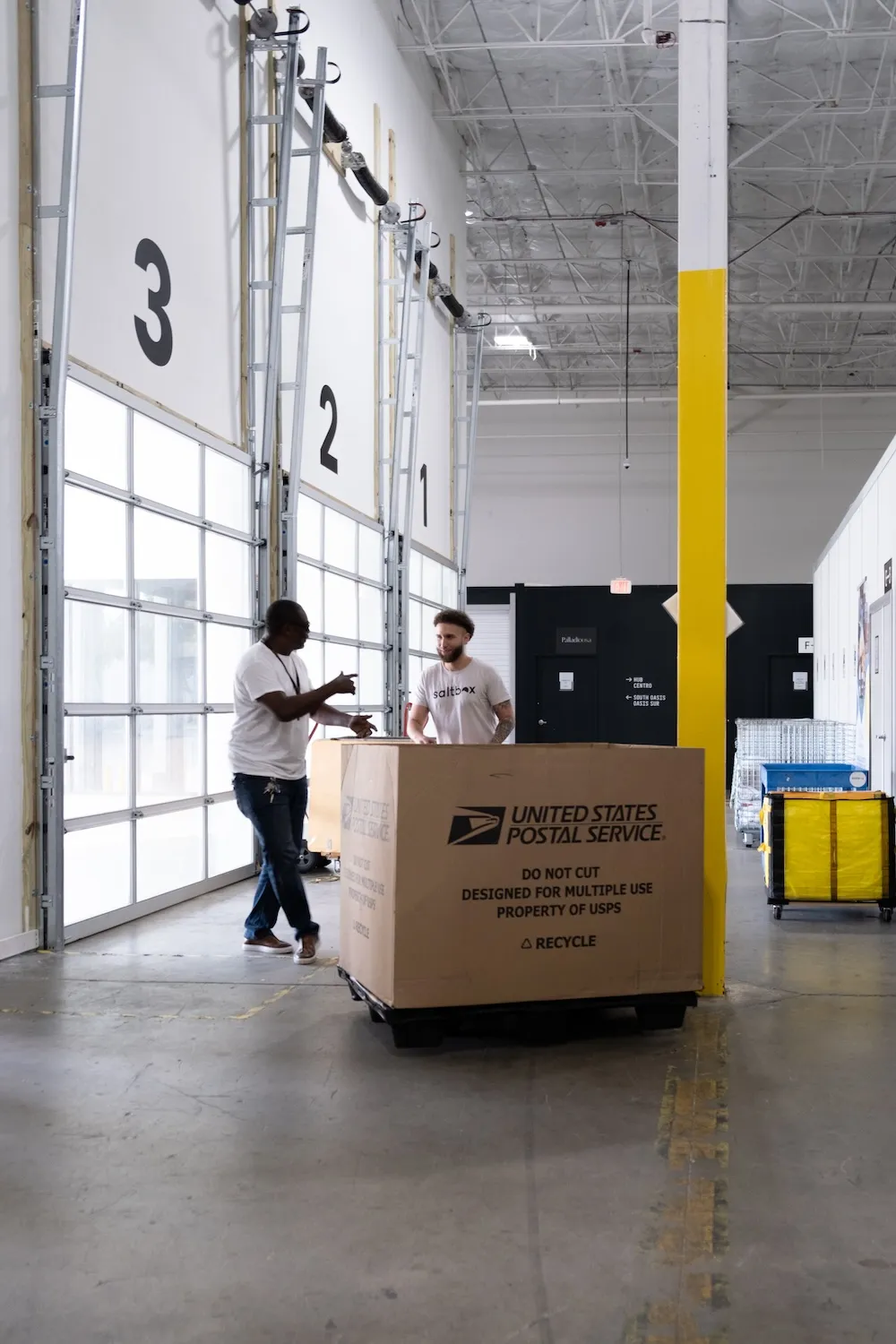
Carrier infrastructure is one of the most overlooked factors in warehouse selection. If your space does not have a loading dock, you will pay liftgate fees of $75 to $150 per pallet delivery. Those fees add up quickly when you are receiving weekly shipments from suppliers.
Daily carrier pickups are equally important. Shipping from a residential address usually means driving packages to a drop-off location, which caps your daily shipping window. A facility with scheduled pickups from UPS, FedEx, and USPS enables you to ship later in the day and still meet next-day delivery promises. The difference between a 2 PM cutoff and a 5 PM cutoff can mean an extra 30% of daily orders going out same-day.
Proximity to major shipping hubs also affects your transit times and costs. A package shipped from Dallas to New York crosses 4 to 5 shipping zones and takes 3 to 5 business days by ground. The same package from a New Jersey facility reaches New York in 1 zone and 1 to 2 days. If your customer base is concentrated in specific regions, your warehouse location should reflect that reality.
Leverage flexible infrastructure to manage seasonal demand
Ecommerce is not a steady-state business. Most product brands see 40% to 60% of their annual revenue concentrated in Q4, with secondary spikes around Valentine's Day, Mother's Day, or back-to-school season. Your inventory management approach needs to account for these swings without leaving you overextended during slow months.
The financial math is simple. If you lease a 3,000-square-foot warehouse to handle your November peak, you are paying for 3,000 square feet in February when you might only need 1,000. At $8 to $12 per square foot per month in most metro areas, that is $16,000 to $24,000 per year in wasted space costs.
Flexible infrastructure solves this problem. Month-to-month warehouse memberships, like those offered by Saltbox, allow you to scale your space up before peak season and scale down after. Some of our members operate with a smaller suite for nine months of the year and expand into adjacent space for their three busiest months. This approach keeps your per-order storage cost consistent rather than letting it balloon during slow periods.
Pre-season preparation should start 8 to 12 weeks before your anticipated demand spike. Use last year's sales data to forecast SKU-level demand, place supplier orders with enough lead time to account for delays, and confirm that your storage space can handle the incoming volume. Build a receiving schedule so that inventory arrives in waves rather than all at once, which prevents your workspace from becoming unmanageable.
During peak season, your reorder points should shift upward by 20% to 30% to account for faster sell-through rates. Adjust your safety stock calculations using peak-period demand data rather than annual averages. The brands that run out of their best sellers on Black Friday are almost always the ones that used their average daily sales rate to set November reorder points.
Integrate inventory software with your logistics operations
Software alone does not fix inventory problems. A $300-per-month inventory management platform connected to outdated processes will just give you a more detailed view of the same mess. The value of software comes from integration: connecting your sales channels, your physical inventory, and your shipping operations into a single source of truth.
For brands processing fewer than 50 orders per day, a platform like Shopify's built-in inventory tracking or a lightweight tool like inFlow or Cin7 provides sufficient functionality. Once you cross 50 orders daily, you will likely need a dedicated inventory management system that supports multi-channel selling, automated reorder alerts, and barcode scanning for receiving and picking.
The critical integrations to prioritize are:
- Sales channel sync: your inventory counts should update in real time across Shopify, Amazon, Walmart, and any other platform where you sell. Overselling on one channel because another channel's sale did not sync is a preventable error that damages customer trust.
- Shipping platform connection: tools like ShipStation or Pirate Ship should pull order data directly from your inventory system, eliminating manual data entry and reducing label errors.
- Receiving workflows: every inbound shipment should be scanned and reconciled against the purchase order before it hits your shelves. This catches supplier short-ships and damaged goods before they become inventory discrepancies.
- Reporting and analytics: your system should generate inventory turnover reports, dead stock alerts, and demand forecasting data without requiring you to build custom spreadsheets.
If you are operating out of a co-warehousing facility with on-site logistics staff, confirm that your software integrates with their receiving and fulfillment workflows. Saltbox locations, for instance, offer on-site teams that handle receiving, inventory management, and optional pick-and-pack fulfillment. Your software needs to talk to their systems so that every unit received and every order shipped reflects accurately in your dashboard.
Scale your operations without long-term industrial leases
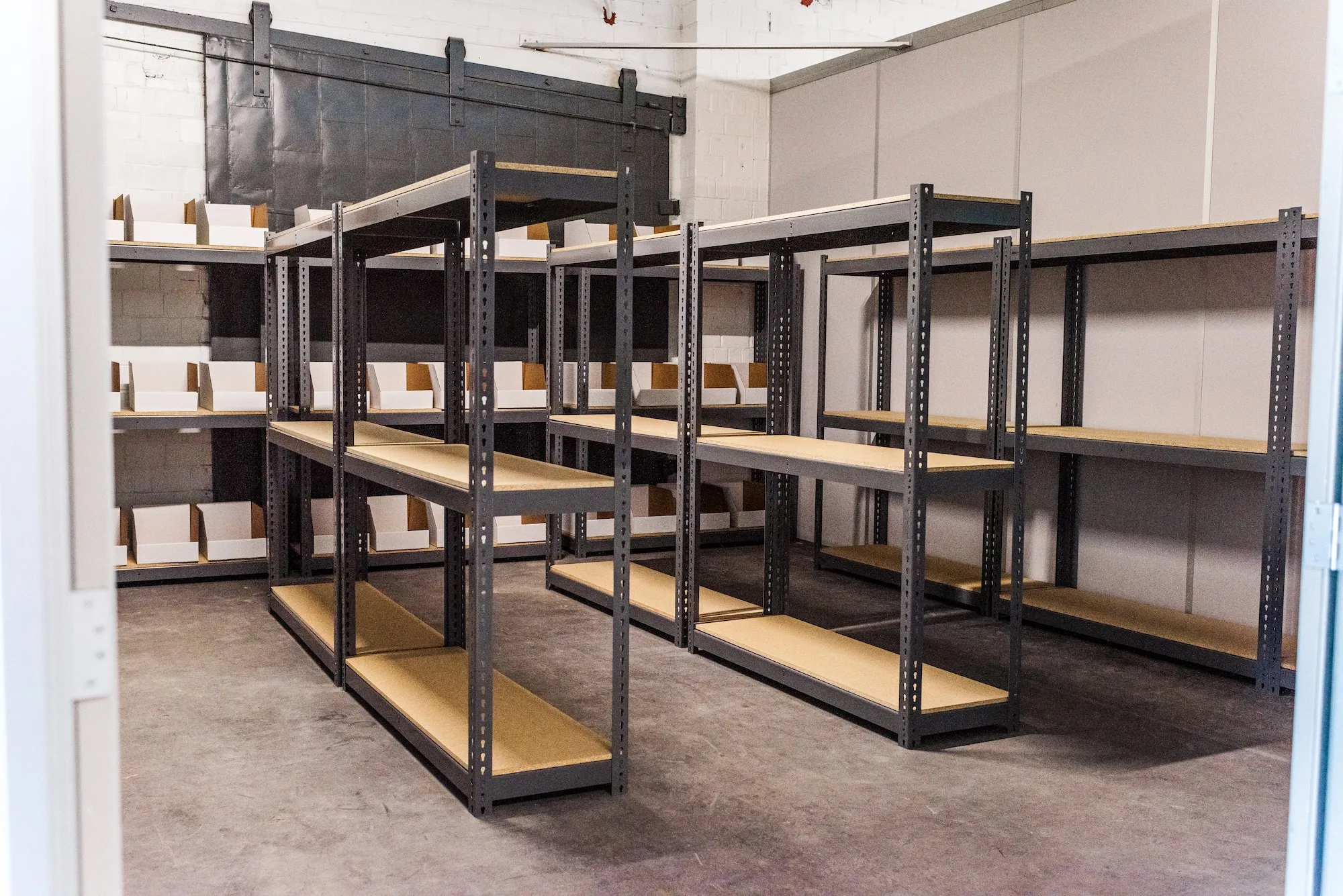
Growth should not require you to bet your business on a 5-year lease. The traditional warehouse model forces founders to predict their space needs years in advance, a nearly impossible task for brands growing 50% to 200% year over year. Sign a lease too small and you are scrambling for overflow space within months. Sign one too large and you are hemorrhaging cash on empty square footage.
The hidden costs of industrial leases compound this problem. A $5,000-per-month base rent often becomes $7,500 to $9,000 after NNN charges, CAM fees, and utility costs. You will need to purchase or lease your own racking, pallet jacks, and packing equipment. Internet, security systems, and janitorial services are your responsibility. Insurance requirements for industrial spaces are significantly higher than for shared facilities.
Flexible alternatives exist specifically for this stage of growth. Co-warehousing models give you dedicated space with shared infrastructure, meaning you get the loading docks, carrier pickups, and professional environment of a large warehouse operation without funding it all yourself. Saltbox has built this model across its 11 locations, earning recognition as one of Fast Company's Most Innovative Companies in 2022. Their 1,000-plus active members represent the exact founder profile that benefits most from this approach: past the garage stage but not yet ready for a 10,000-square-foot industrial commitment.
The right time to consider your next space upgrade depends on your daily order volume and inventory complexity. Brands shipping fewer than 50 orders per day can often operate from a small suite or shared space. Between 50 and 200 orders daily, you need dedicated space with proper racking, a defined workflow, and reliable carrier access. Above 200 orders, you are evaluating whether to expand your existing setup, open a second location for geographic coverage, or bring on fulfillment support to handle the volume.
Think of your warehouse strategy the same way you think about inventory: match your commitment to your actual demand, maintain a buffer for growth, and avoid locking capital into fixed costs that do not flex with your business.
Building your inventory foundation for long-term growth
The principles covered here, from FIFO discipline and safety stock calculations to space planning and flexible infrastructure, form an interconnected system. Weakness in one area creates problems in others. Inaccurate counts lead to wrong reorder points, which lead to stockouts, which lead to rush orders at premium prices, which eat into the margins you need to fund growth.
Start with the basics. Set up your cycle counting schedule this week. Calculate safety stock and reorder points for your top 10 SKUs. Evaluate whether your current space supports or hinders your fulfillment speed. These are not theoretical exercises: they are the operational decisions that separate brands doing $100,000 per year from those reaching $1 million.
If your current setup is holding you back, it might be time to see what purpose-built ecommerce infrastructure looks like in person. You can book a tour at any Saltbox location to walk through a facility designed specifically for product businesses at your stage of growth. The right space and systems can turn inventory management from your biggest headache into your strongest competitive advantage.
Frequently asked questions
Industry estimates put the cost at 20 to 30 percent of annual inventory value, factoring in shrinkage, dead stock, storage costs, and the opportunity cost of capital sitting in slow-moving products. For a brand carrying $50,000 in inventory, that is $10,000 to $15,000 lost every year to preventable inefficiency. The hit extends past the warehouse. Stockouts on a single best-selling SKU during a busy weekend can mean hundreds of lost orders and damaged customer trust that takes weeks to rebuild. Treating inventory as a core discipline pays back quickly.
Safety stock equals (max daily sales x max lead time) minus (average daily sales x average lead time). If a top SKU sells 15 units a day with a 14-day lead time, but spikes to 25 units with a 21-day lead time during promotions, your safety stock is (25 x 21) - (15 x 14), which equals 315 units. Your reorder point is safety stock plus (average daily sales x average lead time), so 315 + 210 = 525 units. Review these numbers quarterly because demand patterns and supplier lead times shift.
Use ABC analysis to prioritize. Your A items, the top 15 to 20 percent of SKUs that drive 70 to 80 percent of revenue, get counted weekly. B items get counted biweekly. C items, your slow movers, get counted monthly. Set a pick accuracy target of 99.5 percent. If counts come in below that threshold, investigate immediately. Common culprits include receiving errors, mislabeled bins, and stock pulled for samples or photo shoots without updating the system. Every discrepancy caught in a cycle count is a discrepancy that does not become a customer complaint.
Most brands hit the wall between 20 and 50 orders a day. Inventory creeps into living spaces, missed pickups become routine, and a residential address starts blocking wholesale conversations. The traditional industrial lease answer comes with $10,000 to $30,000 in build-out costs, triple-net charges, and three to five-year terms that punish slow seasons. Co-warehousing closes the gap. A dedicated month-to-month suite with shared loading docks, carrier pickups, and on-site staff gives you professional infrastructure without committing capital to space you may not need in 12 months.
Place your highest-velocity SKUs closest to your packing station. If 10 products account for 60 percent of orders, those 10 belong within arm's reach of the pack table. This single change typically cuts pick time by 30 to 40 percent in a small operation. Add a "perfect pack" photo at every packing station showing exactly how each product type should be wrapped, where the insert sits, and how the product is oriented. Visual standards reduce packing errors, speed up training for new staff, and protect the unboxing experience that drives repeat purchases.
Saltbox provides month-to-month warehouse suites across 11 locations in 9 major US markets, paired with loading docks, daily carrier pickups, enterprise-grade equipment, and on-site logistics teams who handle receiving and inventory checks. Members get a dedicated, lockable suite plus shared infrastructure without the $10,000 to $30,000 build-out of a traditional lease. Suites scale up and down with demand, which makes seasonal planning easier and protects cash during slow months. The combined setup gives growth-stage brands the operational base of a much larger company without the long-term commitment.