.webp)


Key takeaways
- Saltbox is the best alternative to DHL Supply Chain in 2026 with a co-warehousing model that hands you a private warehouse suite, on-site operations support, shipping discounts, and monthly billing, so you can run professional operations without locking into a multi-year contract.
- WareSpace, Portal Warehousing, FlexHQ, ReadySpaces, Loloft, Cubework, and WorkHub are the other co-warehousing solutions for founders who mainly want their own four walls for inventory.
- Flowspace and Flexe are the two 3PL picks for brands that would prefer to keep the whole operation outsourced, with Flexe coming closest to DHL Supply Chain's enterprise warehousing network.
The best DHL Supply Chain alternatives in 2026 fall into two groups: co-warehousing operators that keep your inventory in a suite you control, and traditional 3PLs that keep it outsourced the way DHL Supply Chain already does.
I will go through 10 of them so you can match the model to how your brand actually ships before you commit to anyone.
What are the best alternatives to DHL Supply Chain in 2026?
The best alternative to DHL Supply Chain in 2026 is Saltbox, a co-warehousing model with month-to-month memberships and on-demand fulfillment support that keeps your inventory and your customer experience in your own hands.
For brands set on staying with a 3PL, Flexe is the closest match to DHL Supply Chain's scale.
Here are all 10 side by side, with their location counts and also the services you can expect:
What are the best co-warehousing alternatives to DHL Supply Chain in 2026?
The best co-warehousing alternatives to DHL Supply Chain are Saltbox, WareSpace, Portal Warehousing, FlexHQ, ReadySpaces, Loloft, and Cubework.
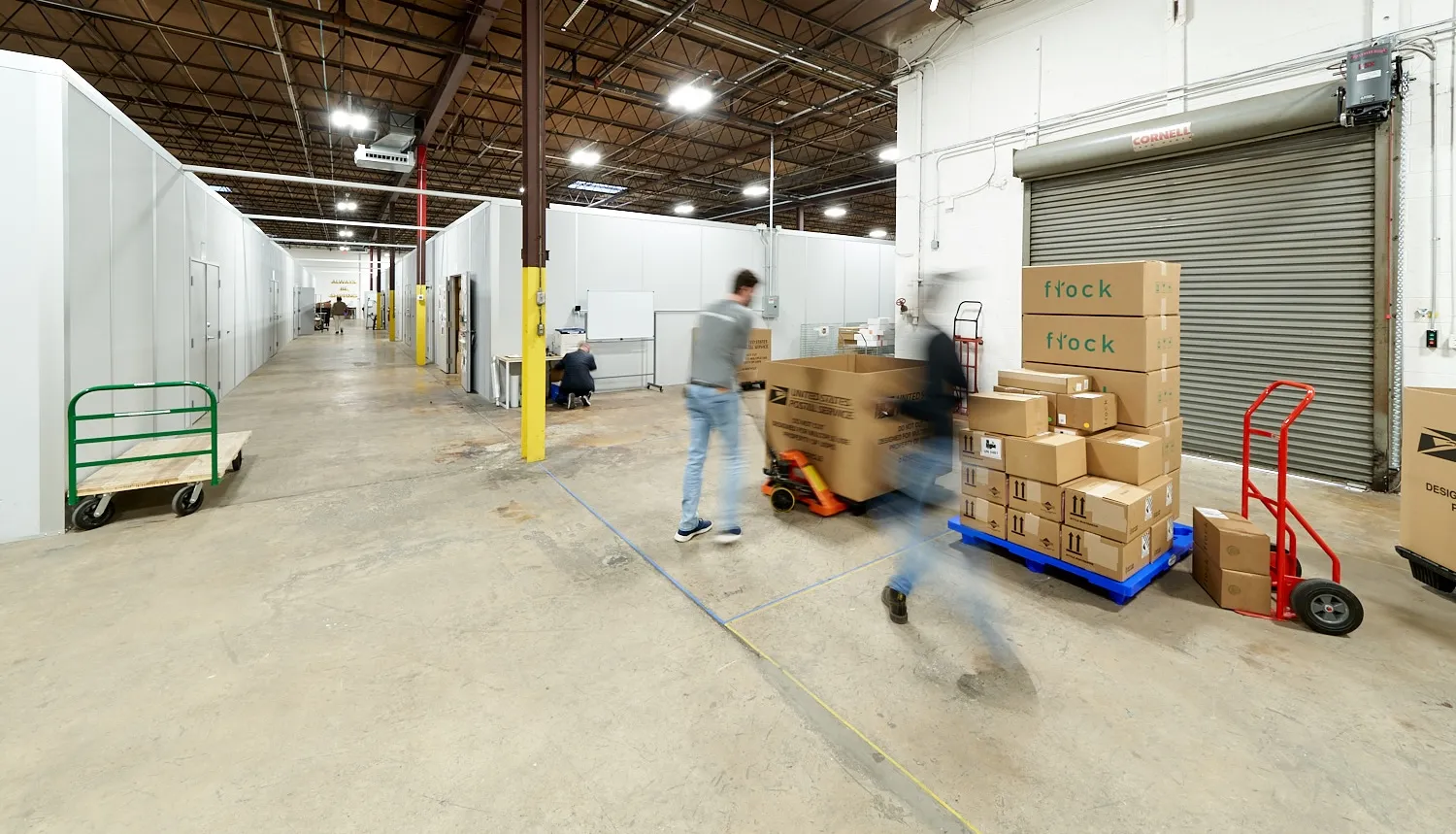
You rent a private suite and keep the keys yourself. The building and shipping infrastructure is shared with other brands (good for networking too!), but the space and the stock inside it stay yours to control.
Some days you pack every order at your own speed, and on the busy ones, you hand the work to an on-site crew.
Here are the best options on the market:
#1: Saltbox
For product-based brands that want the muscle of an operations partner without surrendering the keys to their stock, Saltbox is the best alternative to DHL Supply Chain in 2026.
Our setup puts a private warehouse suite at the core and builds operations support around it, so fulfillment stays in-house and you still have a safety net when a launch or a peak week arrives with our on-demand labor billed in 15-minute increments.
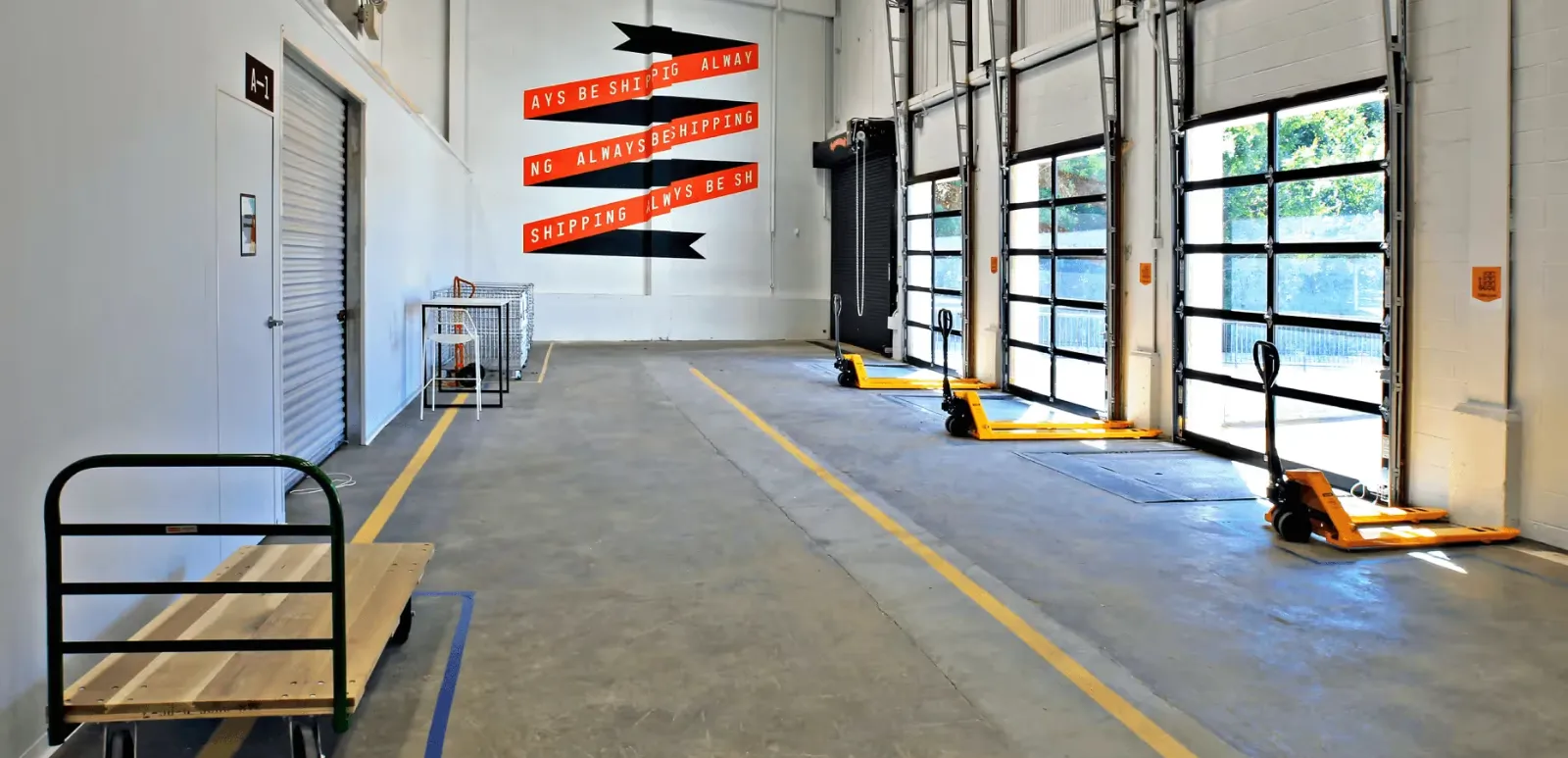
Unlike a contract logistics provider built around multi-year agreements, every part of Saltbox can run month to month without the lock-in.
And the best part? You decide how hands-on to be, whether that means packing every order or handing the entire operation to Saltbox Fulfillment.
Full disclosure: Saltbox is our own solution. I will keep this honest as to what makes us the best DHL Supply Chain alternative in 2026.
Warehouse suites that grow with your order volume
Every Saltbox location offers four suite sizes, and you can move between them as your order count rises or dips.
Billing stays monthly the whole time, with no multi-year lease hanging over you.
The four tiers are:
- Small: 70 to 250 sq. ft., 4 to 15 pallets, 1 to 2 people. A nice starting point for a founder or a two-person crew that needs space of its own.
- Medium: 250 to 500 sq. ft., 16 to 31 pallets, 1 to 4 people. Good room for a brand whose catalog and order count are both climbing.
- Large: 500 to 1,000 sq. ft., 32 to 62 pallets, up to 10 people. Enough floor for a deeper SKU range and steady daily shipping.
- Extra Large: 1,000 to 5,000+ sq. ft., 63 to 125 pallets, up to 50 people. Heavy storage plus a real team workspace for an established brand.
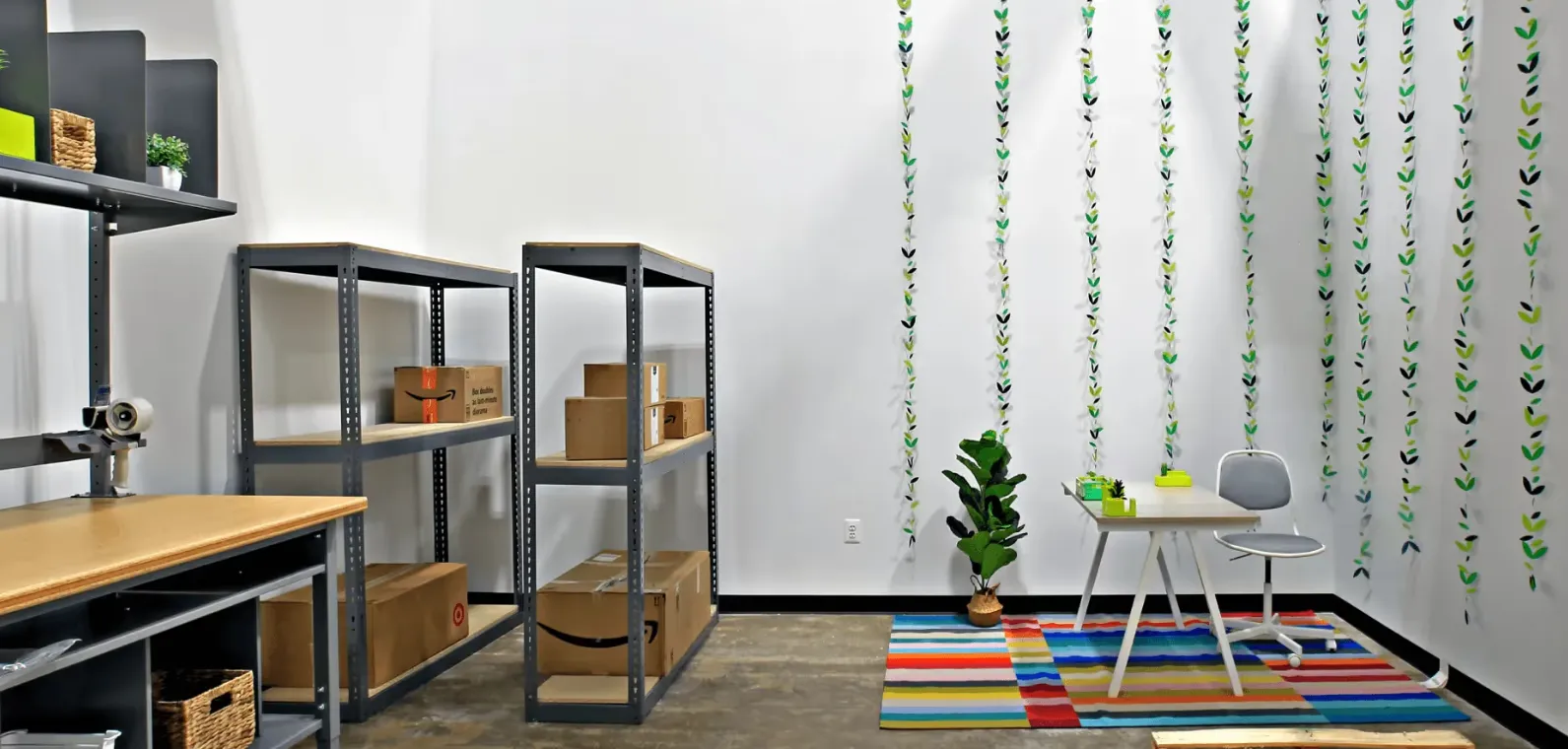
➡️ Book a tour and our team will help you land on the right size for your needs.

Not ready for a warehouse suite yet?
A Saltbox Access Plan gives you a mailing address, receiving services, discounted rates, on-site labor, and an entrepreneur network without a warehouse lease.
Explore Access PlansHow does fulfillment run day-to-day at Saltbox?
A suite operates in one of three modes:
- Self-service, where you handle every pick.
- Assisted, where you bring in help for launches and peak season.
- Fully managed, where Saltbox Fulfillment runs pick, pack, and ship from end to end.
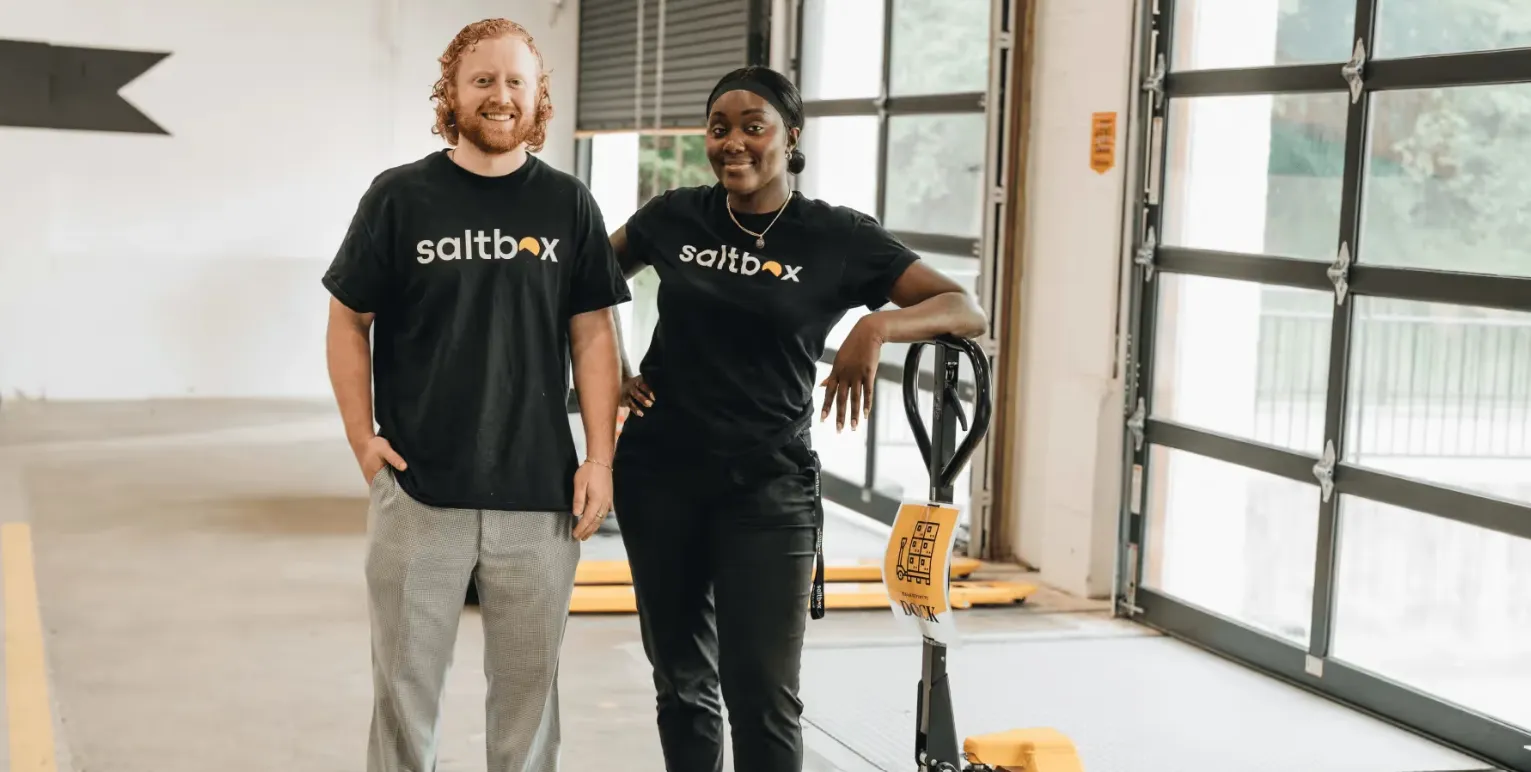
On-demand labor is billed by the hour in 15-minute blocks from $45/hour, with fulfillment at $3 per pick, so a busy stretch does not push you into a full-time hire you will regret in February.
The membership also comes with:
- Daily carrier pickups, so labeled orders go out without anyone making a post-office run.
- Free inbound receiving, so the team checks in and shelves your freight even on days when no one from your side is around.
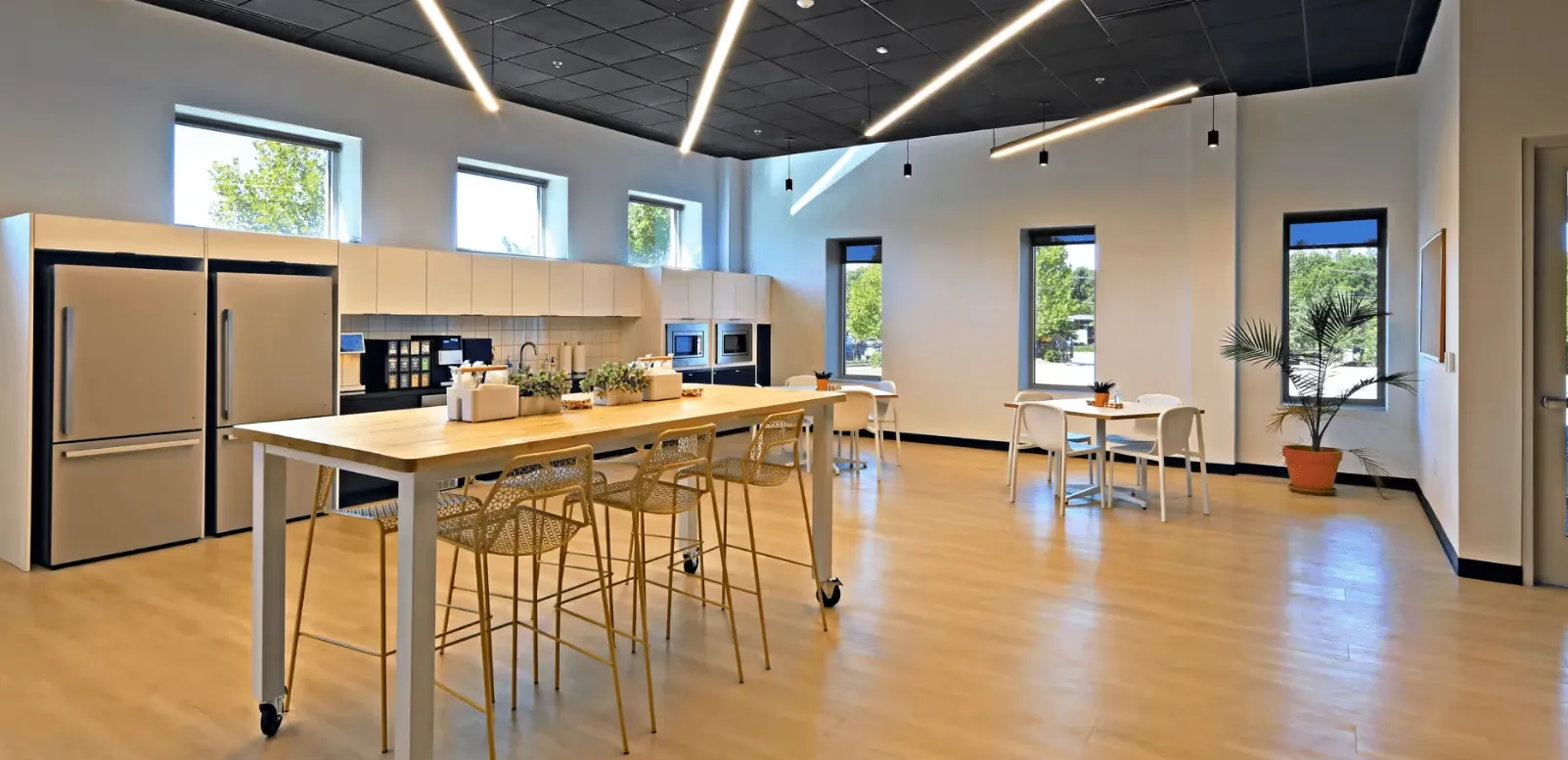
- An in-house content studio kitted out with lighting and backdrops for product shots and video.
- In-suite 120V power, high-speed Wi-Fi, meeting rooms, a kitchen and lounge area, printing, pallet jacks, shelving units, and round-the-clock security.
Lower shipping costs through Parsel
Parsel is our shipping app, and it comes free with every membership.
The app lets you compare live rates and run labels up to a 4:30 PM cutoff, and pickups get scheduled from the same screen.
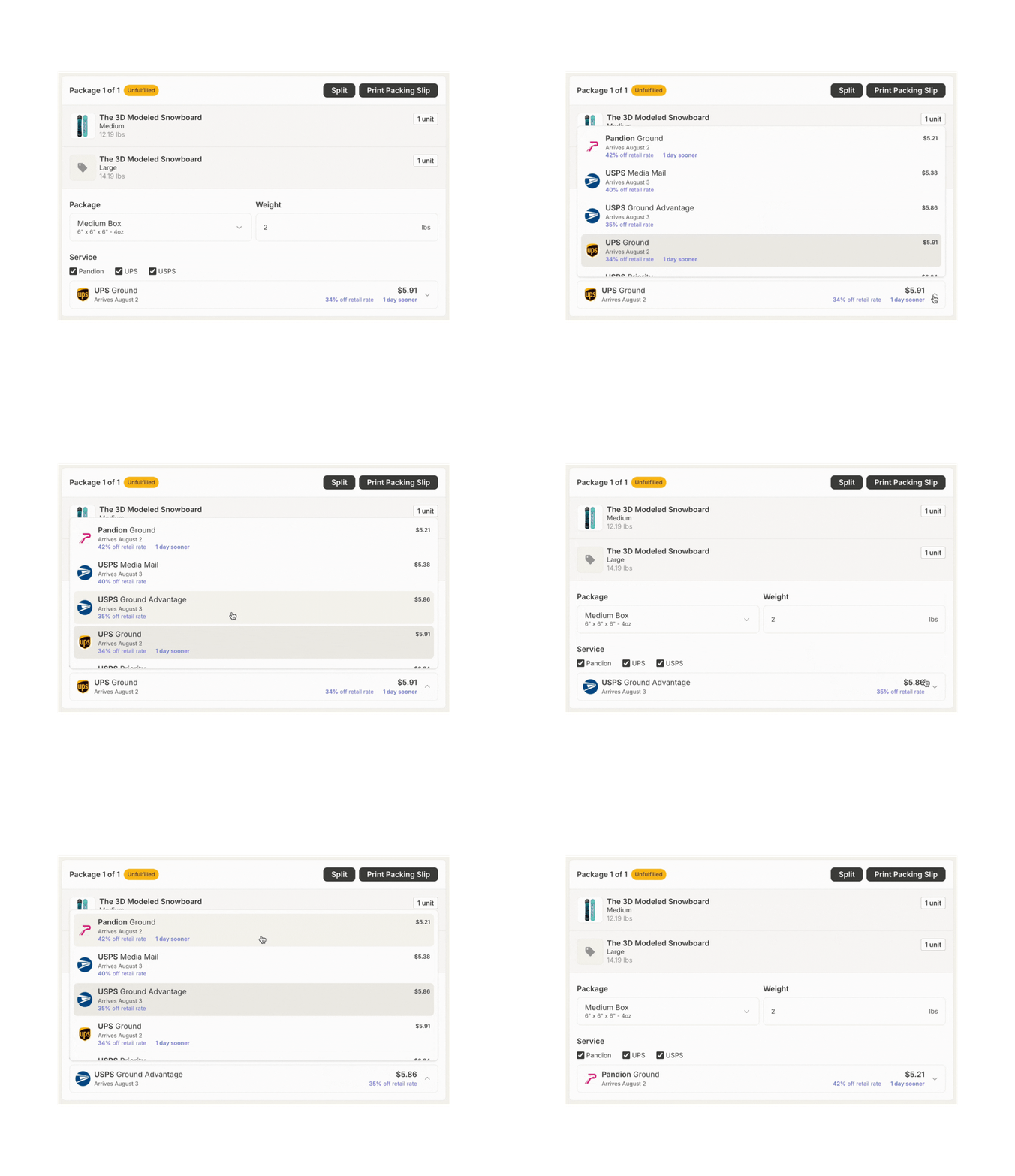
Parsel connects to national, regional, and emerging carriers, so each order can go out with whichever one fits best.
Saltbox locations across the U.S.
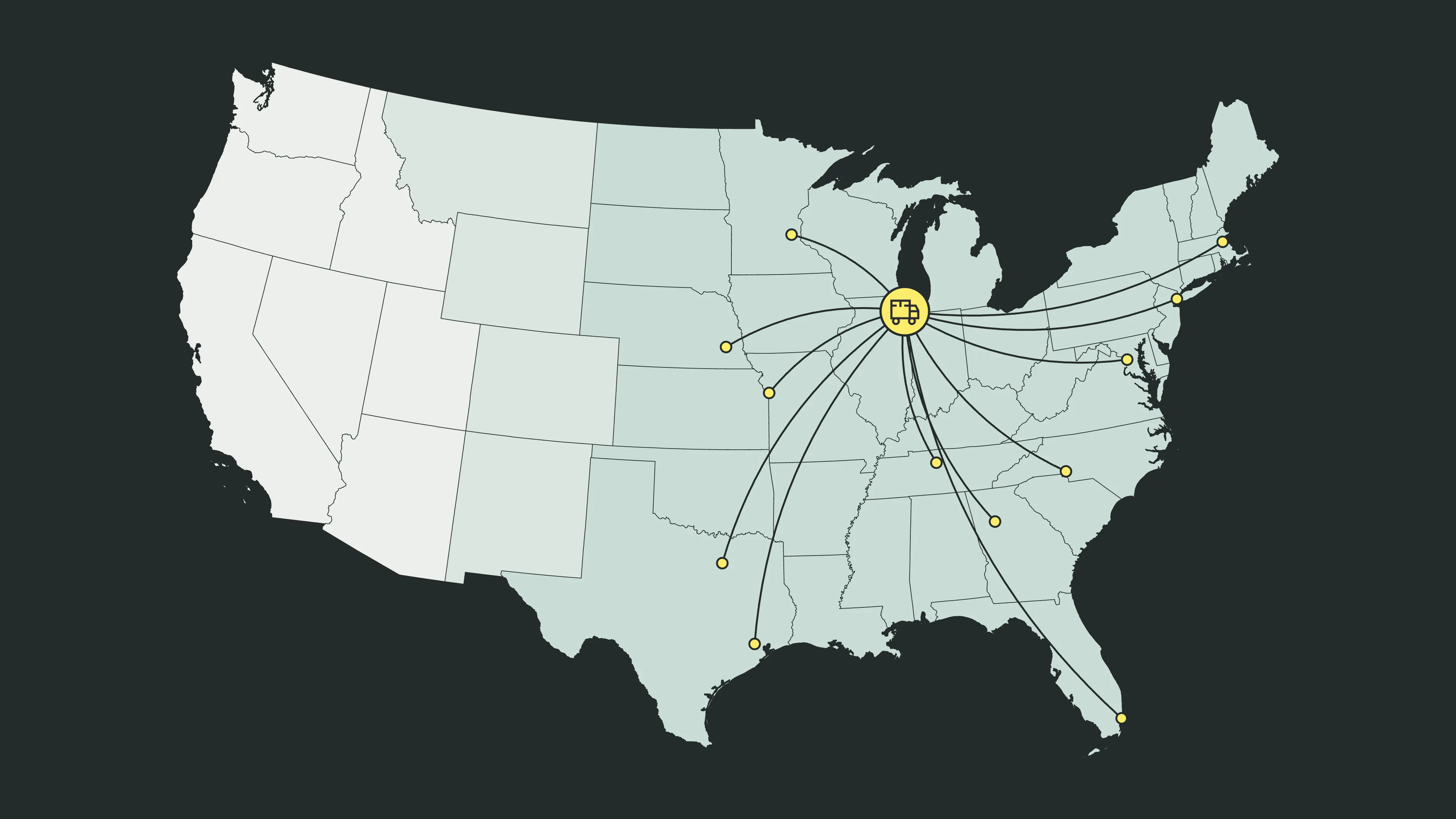
Saltbox runs 12+ U.S. locations across the West Coast, the East Coast, and the Central U.S.:
- Los Angeles, San Gabriel Valley.
- Los Angeles, Torrance.
- Phoenix.
- Seattle, SoDo Row.
- Denver, Park Hill.
- Dallas, Carrollton.
- Dallas, Farmers Branch.
- Atlanta, Upper Westside.
- Atlanta, Westside Park.
- Washington D.C., Alexandria.
- Miami, Doral.
- Atlanta, Chamblee.

Interested in one of our locations across the U.S?
You can book a tour to see it alongside our operations experts. Available Mon-Fri, 8:30 AM-4:30 PM Central Time.
Book a TourHow is Saltbox different from DHL Supply Chain?
Both DHL Supply Chain and Saltbox will get your orders out the door, but they diverge on who runs the daily operation and who holds the keys to the building.
DHL Supply Chain is a leading contract-logistics company, with roughly 1,300 warehouses across more than 50 countries and a workforce of nearly 188,000 people.
When you sign with them, your inventory moves into a company-run facility where a team backed by thousands of collaborative robots and smart wearables handles the work.
The relationship usually runs on a long-term contract, and you follow the operation through reporting and account management.
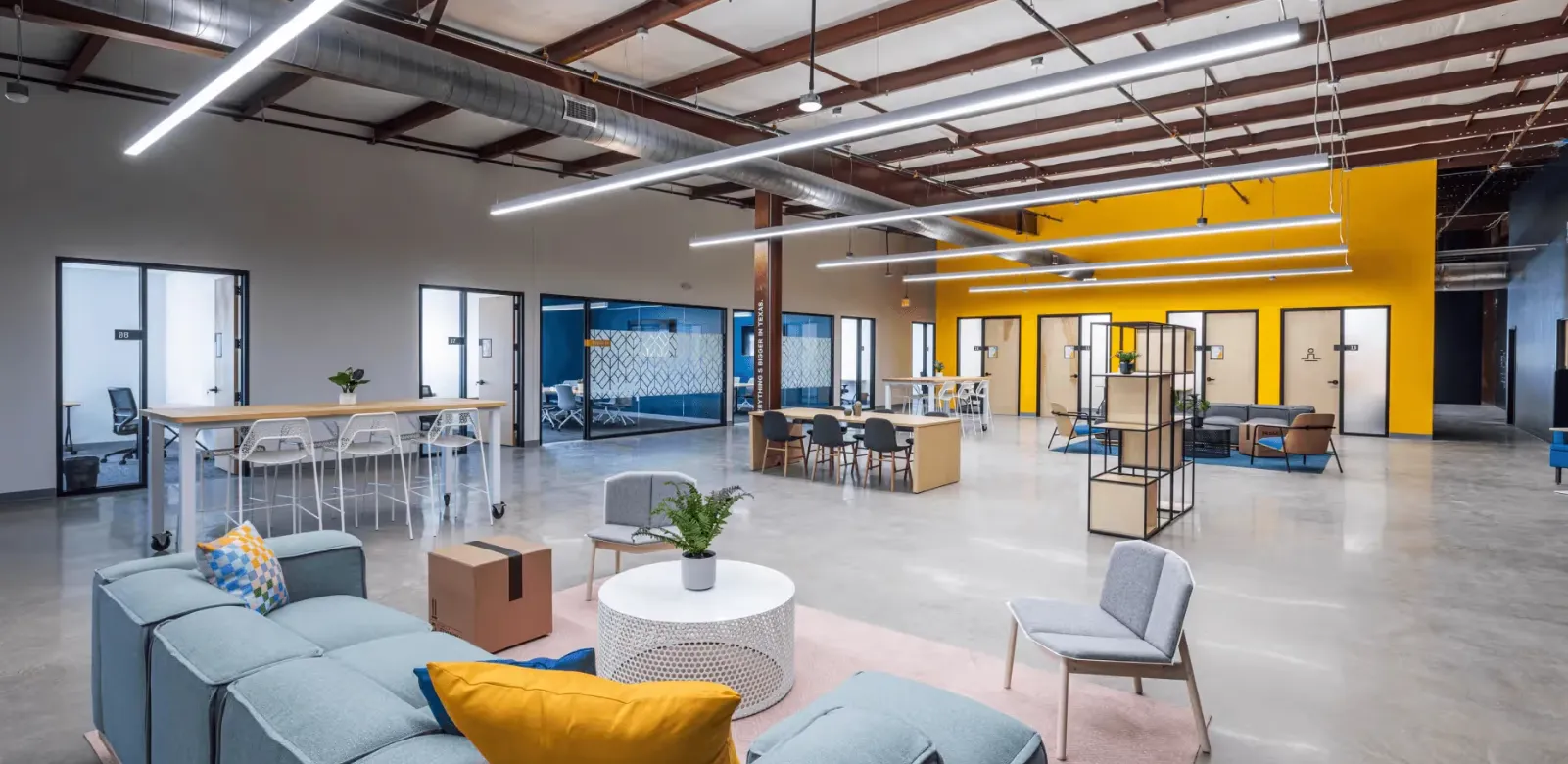
At Saltbox, your stock stays in a private suite that you hold the keys to.
And since you hold the keys, you can work orders yourself or pull in our on-site team when a week gets heavy.
The split produces a few practical differences:
- Counting stock means walking your own shelves, not refreshing a dashboard and waiting for a sync.
- Branding stays in your control, since your packaging and inserts get assembled in your own suite with no per-order kitting fee.
- Your bill is one flat monthly rate covering the suite and membership, not a contract broken into volume commitments and value-added service line items.
- On-demand labor starts at $45/hour billed in 15-minute increments, and fulfillment is a flat $3 per pick.
- A same-day rush still makes it out, because whoever walks the box to the dock is you or the on-site team.
- No order minimums are attached to the agreement.
- You’ll also join Upstream, our entrepreneur community built around shared resources and member networking.
In all fairness, DHL Supply Chain is the right call for large enterprises that ship at massive scale across many markets and want warehousing and transport bundled with value-added services under one global provider.
However, I believe that Saltbox is the better fit for a growth-stage brand that wants operations support and still wants to walk into its own suite during the day.
Saltbox membership, warehouse, and office plans
Saltbox pricing starts with a membership tier, then adds an optional warehouse suite and an optional office.
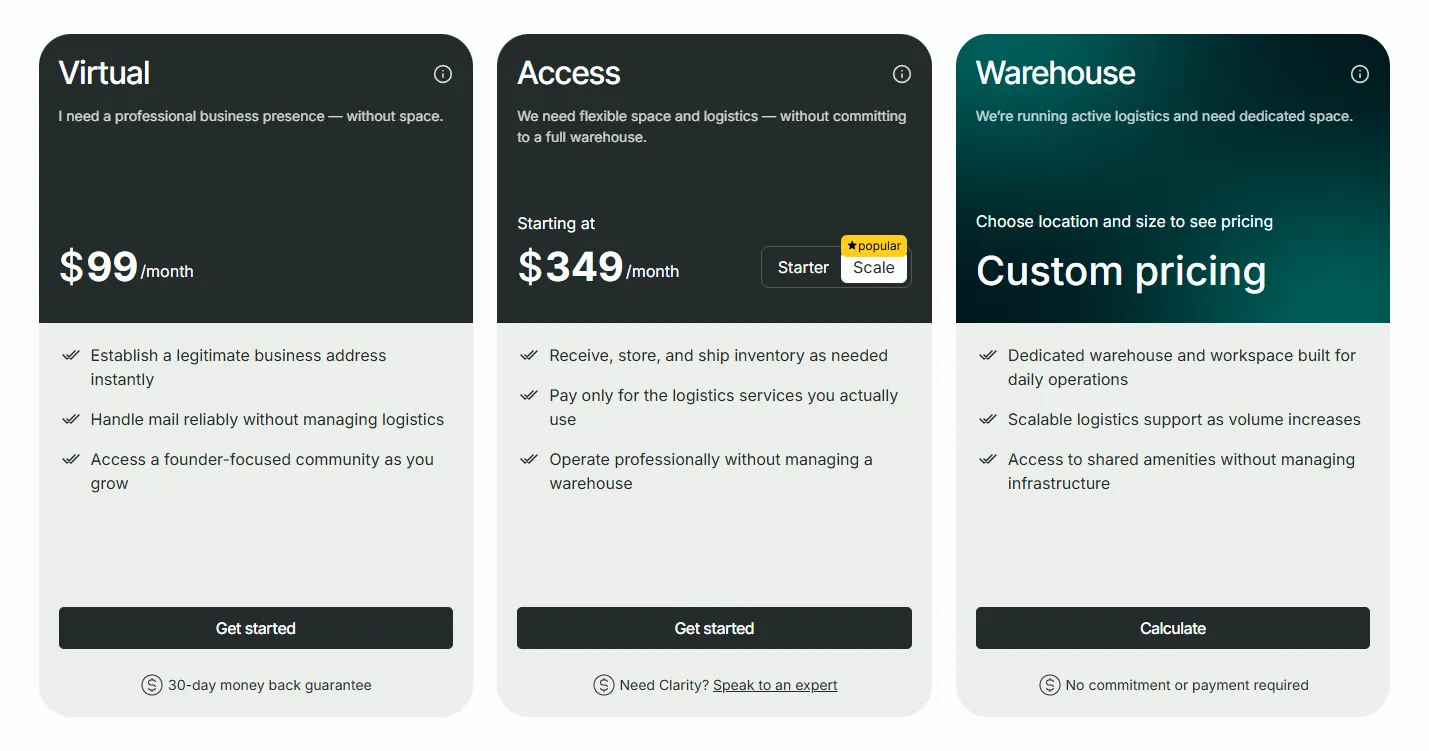
There are 3 membership tiers:
- Virtual ($99/month): a remote-only plan with a professional mailing address for letters (no packages), plus entry to the Upstream Entrepreneurs Club.
- Access (from $349/month): on-site entry to Saltbox buildings, including the loading dock, packing stations, meeting rooms, and content studio, before you take a suite.
- Warehouse (custom pricing): the full package, with a flexible suite, on-site operations help, shipping infrastructure, and the building's full amenity set.
Suite rates shift city to city. For example, Atlanta's Upper Westside looks like this:
- Small Warehouse, from $1,157/month when billed annually: 70 to 250 sq. ft., 4 to 15 pallets, 1 to 2 employees.
- Medium Warehouse, from $1,890/month when billed annually: 250 to 500 sq. ft., 16 to 31 pallets, 1 to 4 employees.
- Large Warehouse, from $3,591/month when billed annually: 500 to 1,000 sq. ft., 32 to 62 pallets, 1 to 10 employees.
- Extra Large Warehouse, from $4,581/month when billed annually: 1,000 to 5,000+ sq. ft., 63 to 125 pallets, up to 50 employees.
All of the warehouses and locations include:
- Loading docks.
- Daily carrier pickups.
- Secure mail and package receiving.
- Professional-grade equipment.
- Multiple conference rooms.
- A content studio.
- High-speed Wi-Fi.
- A fully equipped kitchen with community dining.
- 24/7 security.
- On-site operations staff.
- In-suite 120V power.
- Printing services.
Office pricing is regional, too. Here are the prices of Atlanta Upper Westside:
- 1-person office, $468/month when billed annually: one chair, one desk.
- 2-person office, $927/month when billed annually: two chairs, two desks.
- 3-person office, $1,305/month when billed annually: three chairs, three desks.
- 4-person office, $1,674/month when billed annually: four chairs, four desks.
Saltbox pros and cons
✅ Storage, shipping gear, and office space in one building, across 12+ U.S. sites.
✅ Inventory stays in a private suite, packed by you or by the crew on-site.
✅ Optional monthly billing.
✅ Preferential shipping rates through Parsel.
✅ Hourly labor in 15-minute blocks for the busy stretches.
❌ We will never be the cheapest, and we don't want to be.
#2: WareSpace
Best for: DTC brands with steady volume that want a single all-inclusive bill and a unit of their own, with nobody else running it.
Locations: 20 U.S. cities, including Atlanta, Chicago, Dallas, Denver, Philadelphia, and Phoenix.
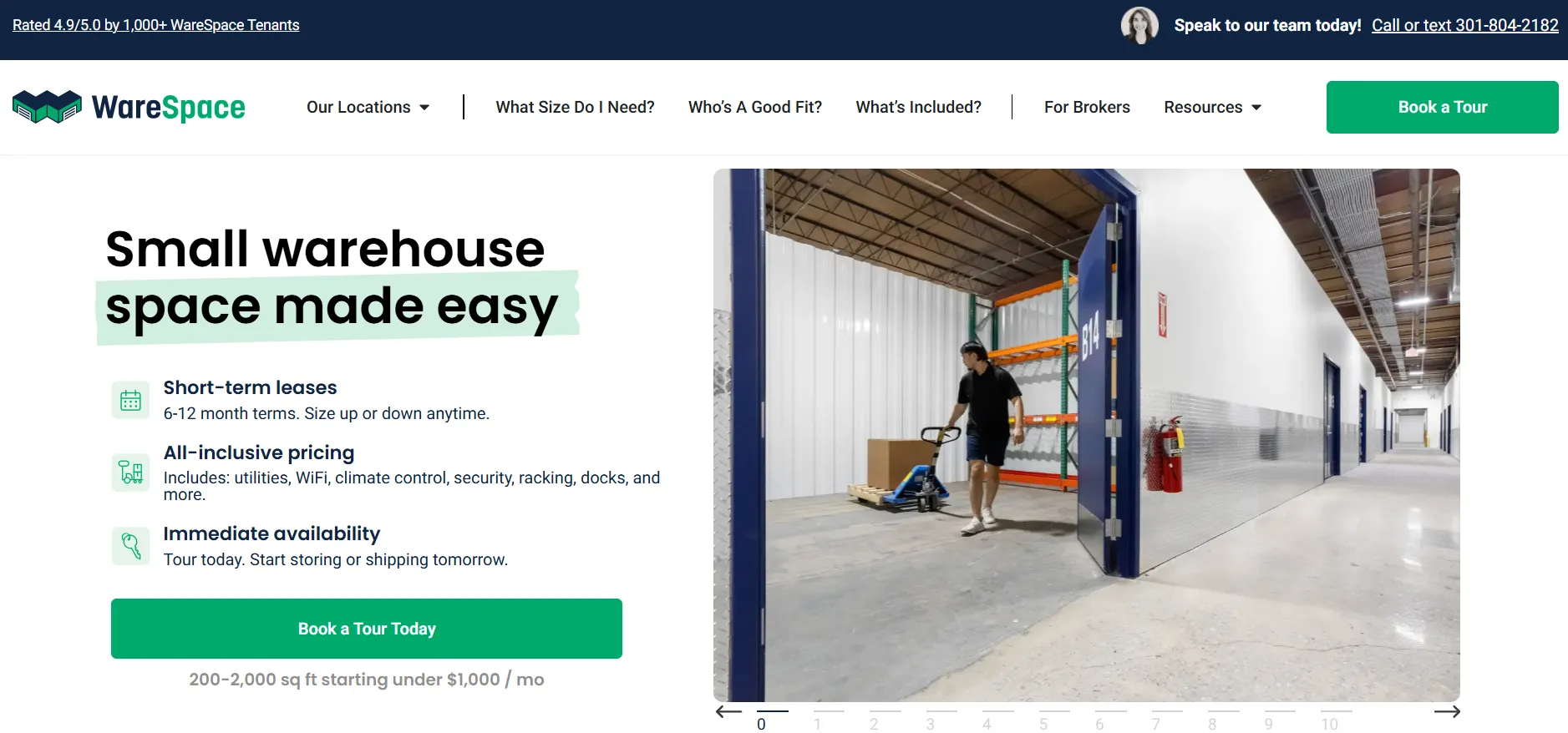
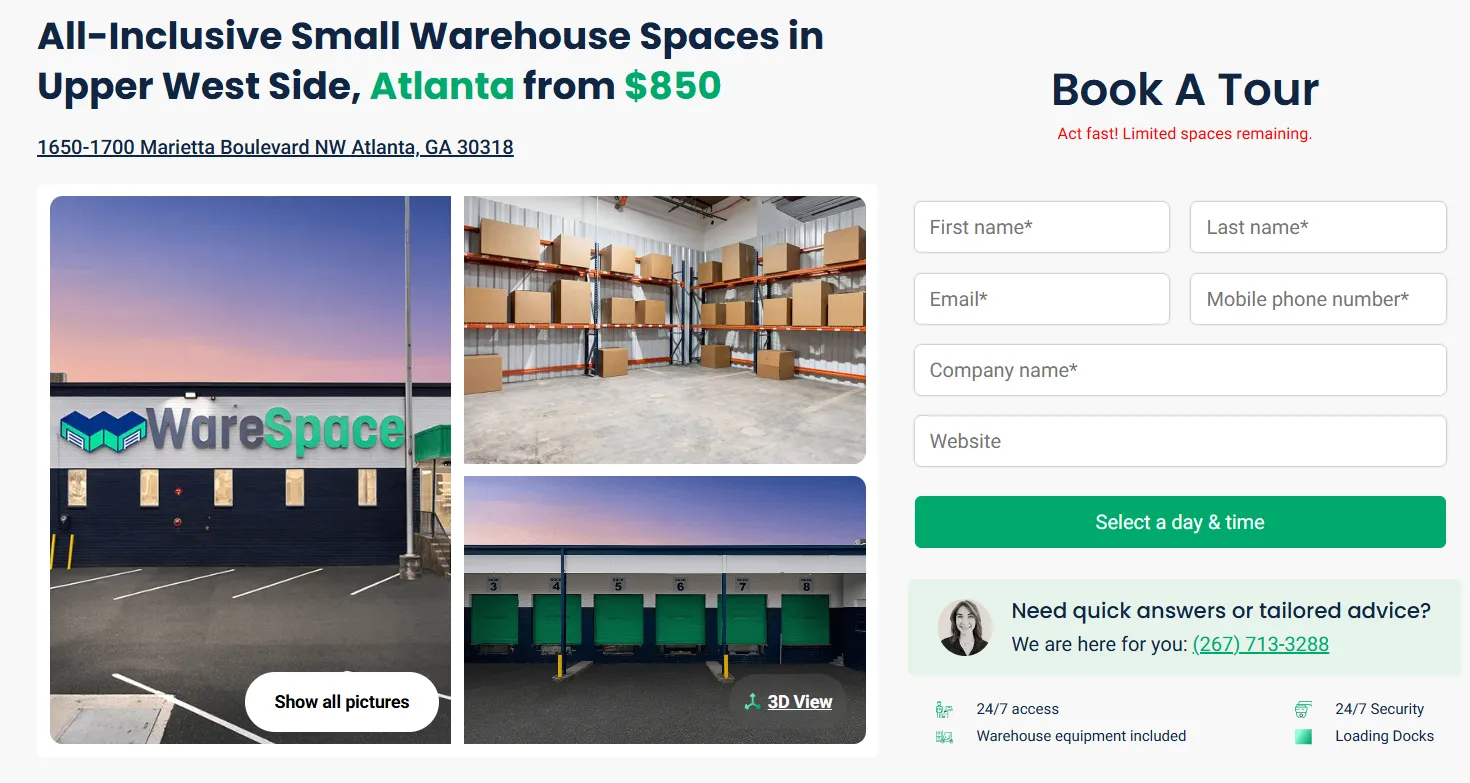
WareSpace rents small warehouse units from 200 to 2,000 sq. ft. that arrive ready to store stock and run light fulfillment, all under one flat fee.
If you are leaving a fully outsourced setup and want your own four walls with one predictable bill, WareSpace covers that across 20 metros.
Amenities and benefits
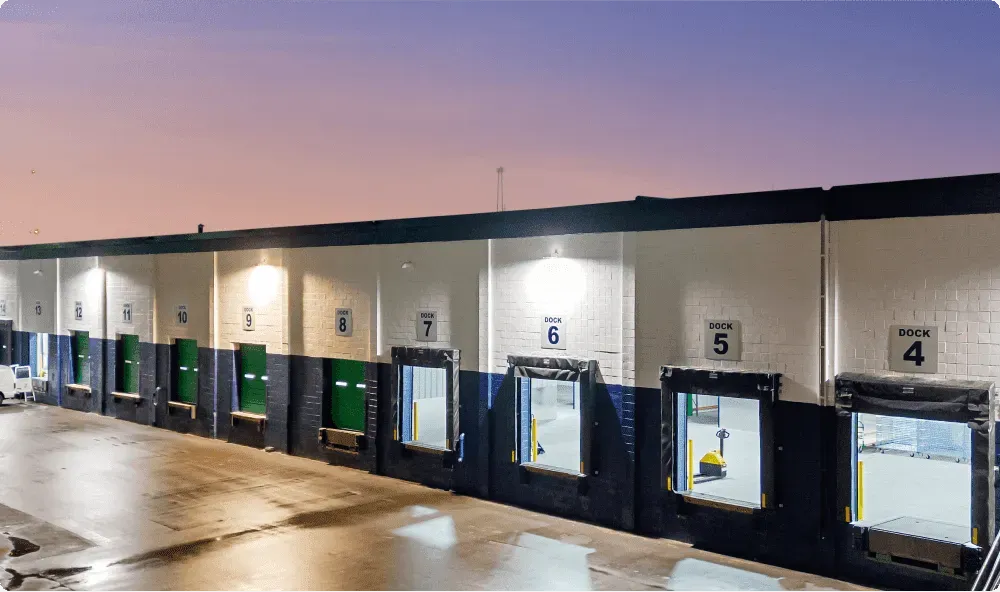
- Every unit comes with power, internet, a pallet jack, and access to the docks.
- Racking is already installed, and the building's warehouse equipment is shared.
- The shared spaces cover a kitchen, lounges, and conference rooms, with cleaning and security handled for you.
- The building stays climate-controlled all year, and you can get in at any hour.
Pricing
Rates open at $1,000/month for a 200 to 2,000 sq. ft. unit in some markets, and drop to around $850/month in others such as Atlanta, all-inclusive, with no surprise add-ons.
A tour pins down the final number based on the city and the space you need.
Pros and cons
✅ A single flat fee keeps budgeting simple.
✅ Units span 200 to 2,000 sq. ft. with shared amenities on top.
✅ Every site is laid out with enough docks to avoid a loading bottleneck.
❌ Standard contracts run 6 to 12 months, unlike some WareSpace alternatives.
#3: Portal Warehousing
Best for: Urban ecommerce founders who want a turnkey unit inside the city, not a long haul out to an industrial park.
Locations: 7 U.S. cities, including Salt Lake City, Phoenix, Orlando, Minneapolis, Manhattan, Los Angeles, and Brooklyn.
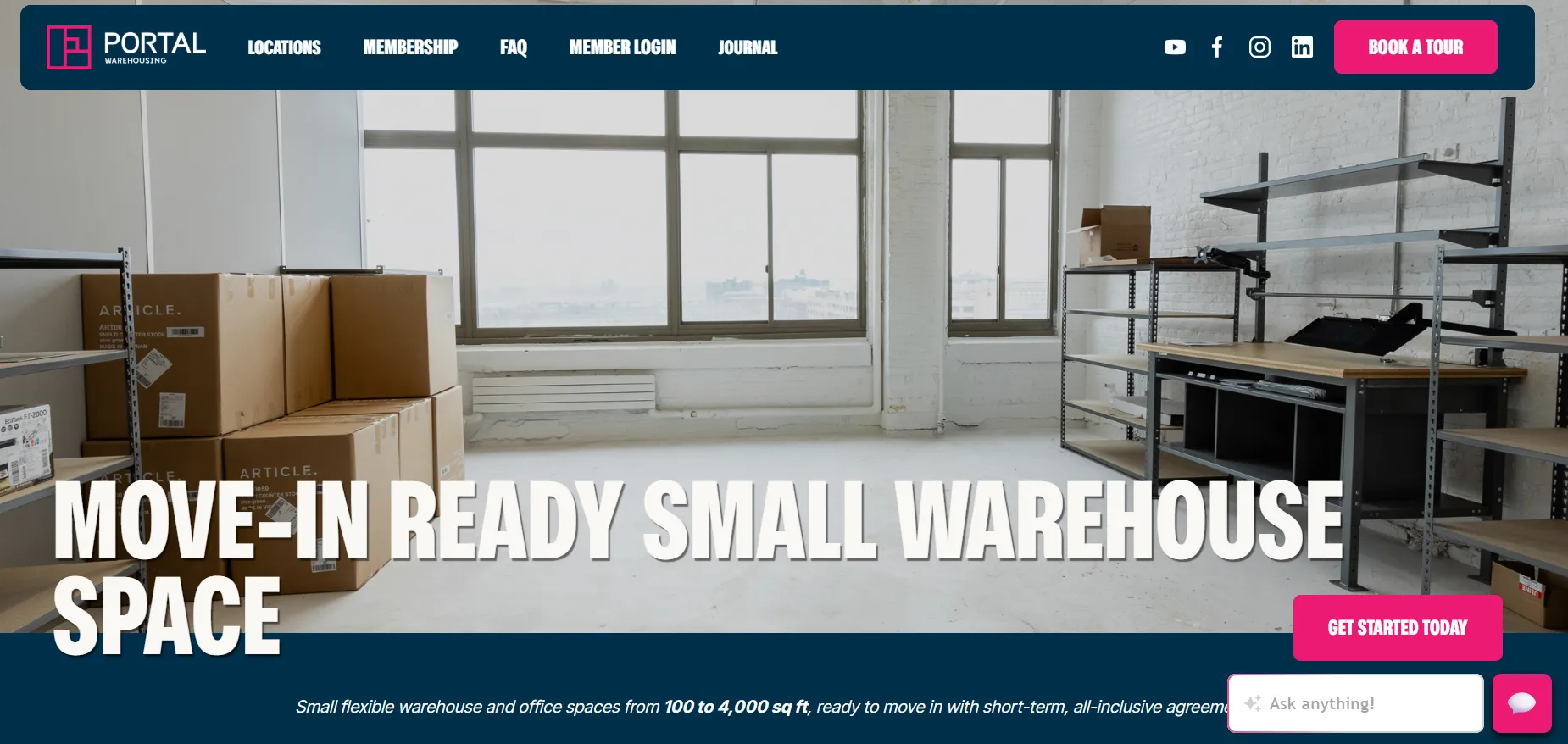
Inside dense markets like Manhattan and Brooklyn, Portal Warehousing offers turnkey units from 100 to 4,000 sq. ft. that fold storage, fulfillment, and office space together.
Staying close to your customers and your labor pool is the real draw, which is why urban founders gravitate to it as they scale.
Amenities and benefits
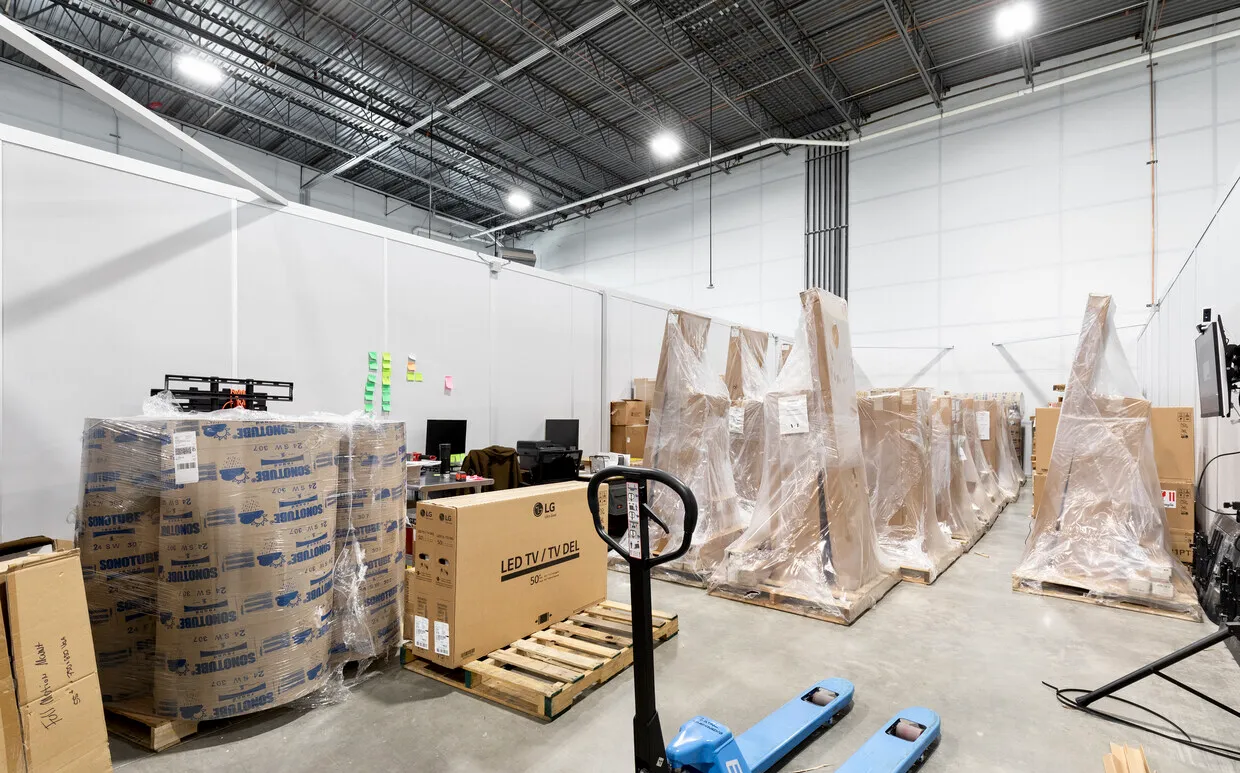
- Each unit bundles in the utilities, fast Wi-Fi, racking, and building security, with docks and daily carrier pickups on site.
- Beyond the unit, you get a staffed reception and private offices, plus shared lounges, and every member gets a dedicated shipping address.
- Units are ready to move into on flexible terms, and the buildings tend to be close to highways and labor pools.
- Regular community events make it easy to meet the other ecommerce operators in the building.
Pricing
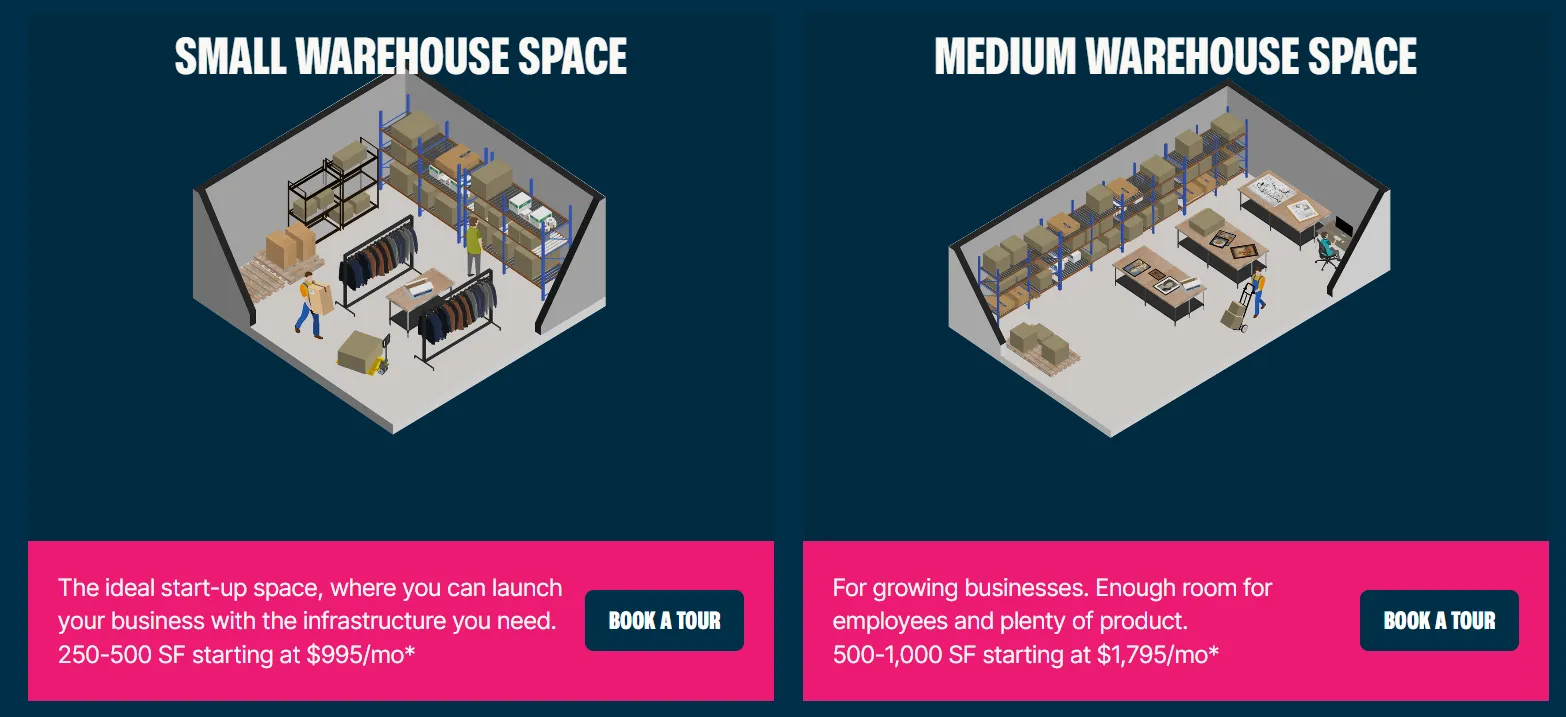
Portal Warehousing runs three tiers:
- Small, 250 to 500 sq. ft., from $995/month.
- Medium, 500 to 1,000 sq. ft., from $1,795/month.
- Large, 1,000+ sq. ft., from $2,995/month.
➡️ Final pricing shifts with location, availability, and the membership you pick.
Pros and cons
✅ Nothing to sign for the long term.
✅ You can add a private office next to your unit.
✅ Move-in-ready units from 100 to 4,000 sq. ft.
❌ Seven cities leave much of the country uncovered.
#4: FlexHQ (FlexEtc)
Best for: Teams that want the warehouse to double as a polished brand HQ, with designed offices and studios attached.
Locations: 6 U.S. locations, including Los Angeles, Denver, Plano, Salt Lake City, Nashville, and Charlotte.
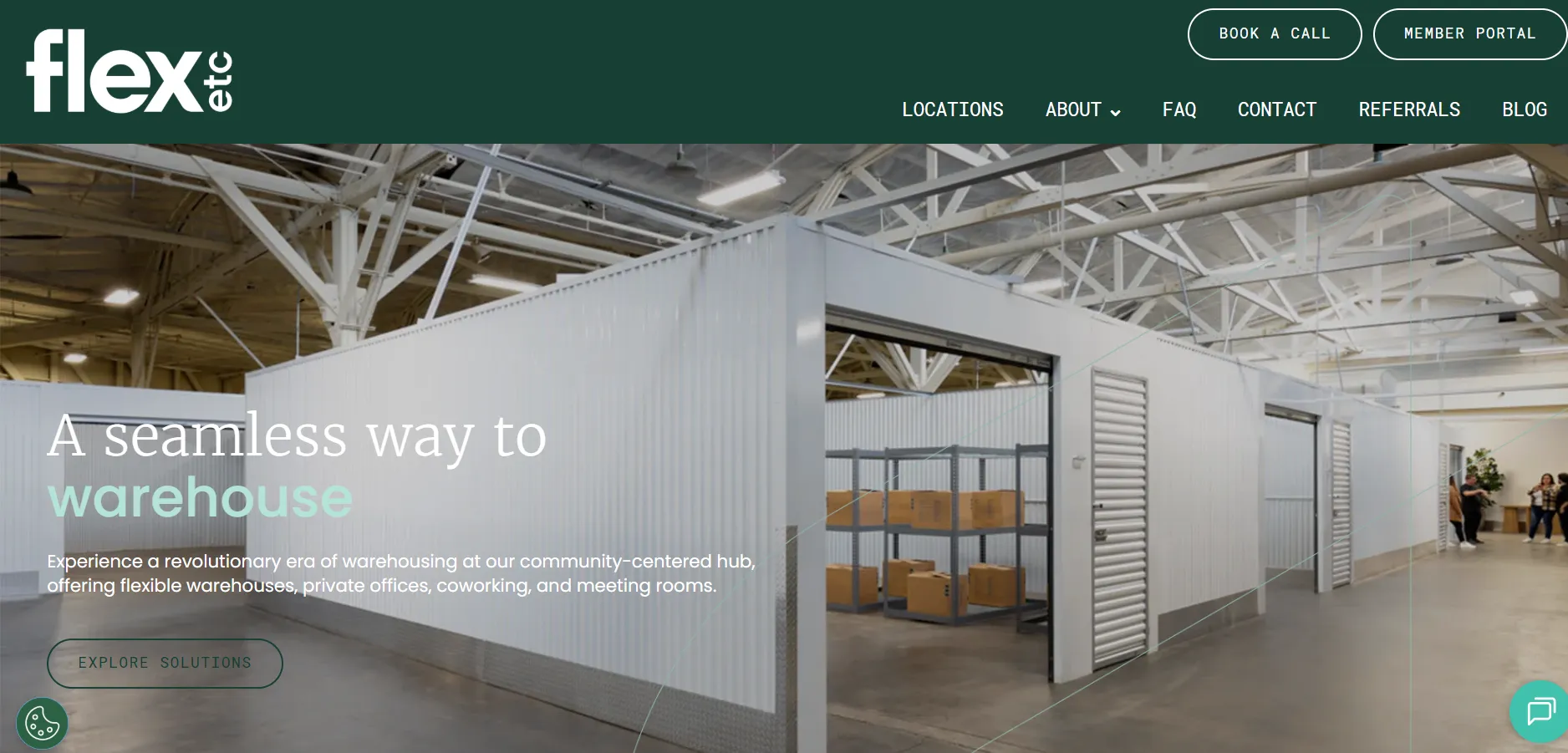
FlexHQ takes big industrial buildings and carves them into shared spaces, mixing smaller warehouse units with private offices and studios.
With offices designed by Ware Malcomb, it leans toward teams that treat the room itself as part of the brand.
Amenities and benefits
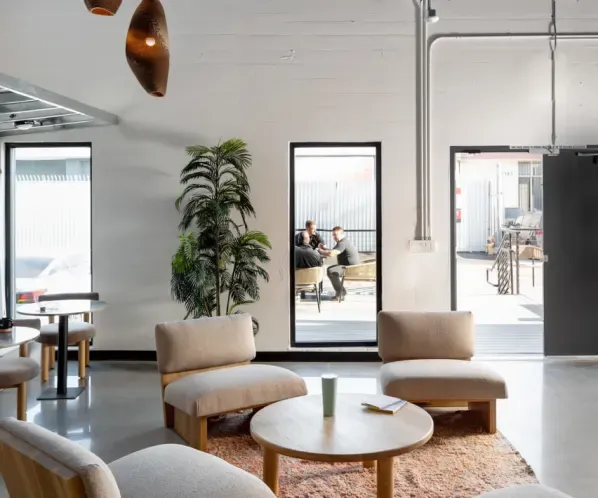
- Flexible coworking memberships and private offices share the building with the warehouse units.
- The office environment is built to a professional standard, useful for client-facing work.
- On-site staff keep the facility secured, and the amenities are baked into the membership.
- You also get content studios and bookable conference rooms.
Pricing
FlexHQ keeps its rates off the website, so you will need to contact the team for a quote.
Pros and cons
✅ Month-to-month terms with immediate move-in.
✅ Offices designed with professional input, which helps for client-facing brands.
✅ Coworking, offices, and warehouse units under one roof.
❌ Warehouse units open at 300 sq. ft., which can overshoot a very small operation.
#5: ReadySpaces
Best for: Brands that value national reach and industrial infrastructure over ecommerce extras like content studios.
Locations: 38 across the U.S. and Canada.
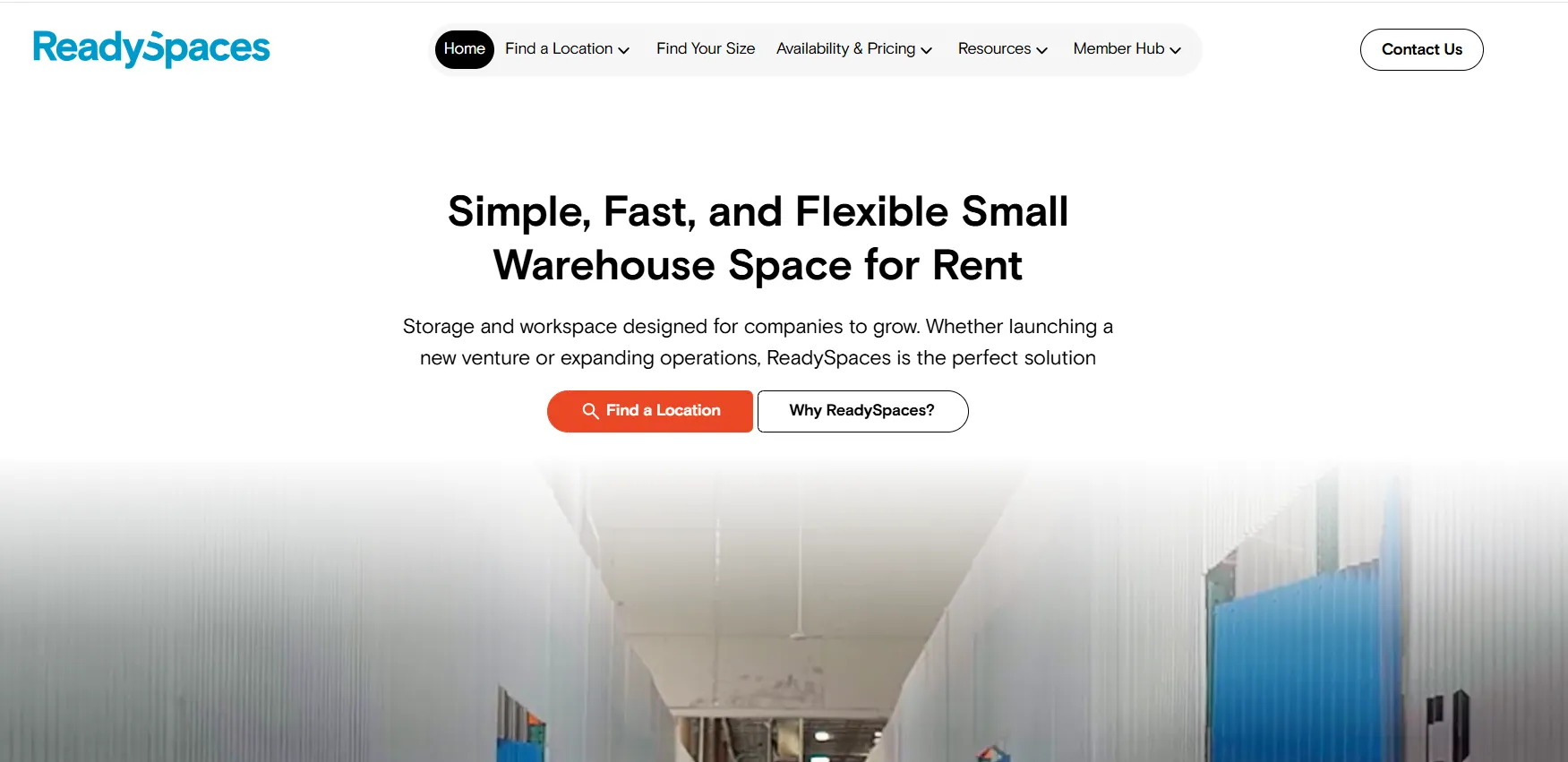
Across 38 facilities in the U.S. and Canada, ReadySpaces rents warehouse units from 100 to 5,000 sq. ft., each backed by forklifts and dock access.
You’ll get good reach and heavy infrastructure here, which is useful for a brand that needs industrial space in several regions without signing an enterprise contract.
Amenities and benefits
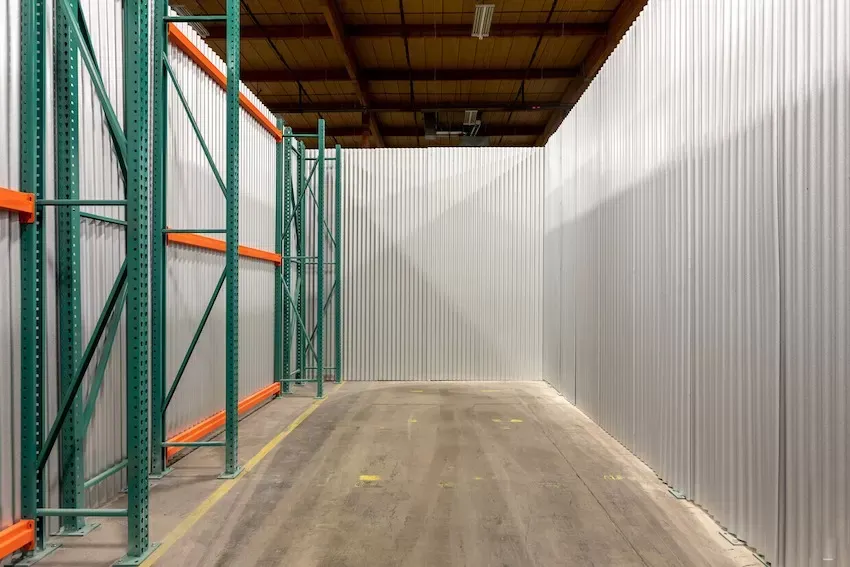
- Warehouse units span 100 to 5,000 sq. ft. and up, with shared workspace at most sites.
- Some locations add conference rooms and private offices.
- Access runs 24/7 behind secured entry, with community features on top.
- You get forklift access and loading docks, plus grade-level bays.
Pricing
ReadySpaces quotes custom rates that move with unit size, position inside the facility, and add-ons such as dock adjacency or 240V power.
Leases can start as short as 90 days.
Pros and cons
✅ Short leases, with no long-term lock-in.
✅ A lease process kept light on paperwork.
✅ Above-average coverage across the U.S. and Canada.
❌ No public pricing makes side-by-side comparison harder, which is why some members have been looking for ReadySpaces alternatives.
#6: Loloft
Best for: Solo founders and small teams that want a compact warehouse and a coworking desk at one affordable address.
Locations: 2, one in Phoenix, AZ and one in Rogers, AR.
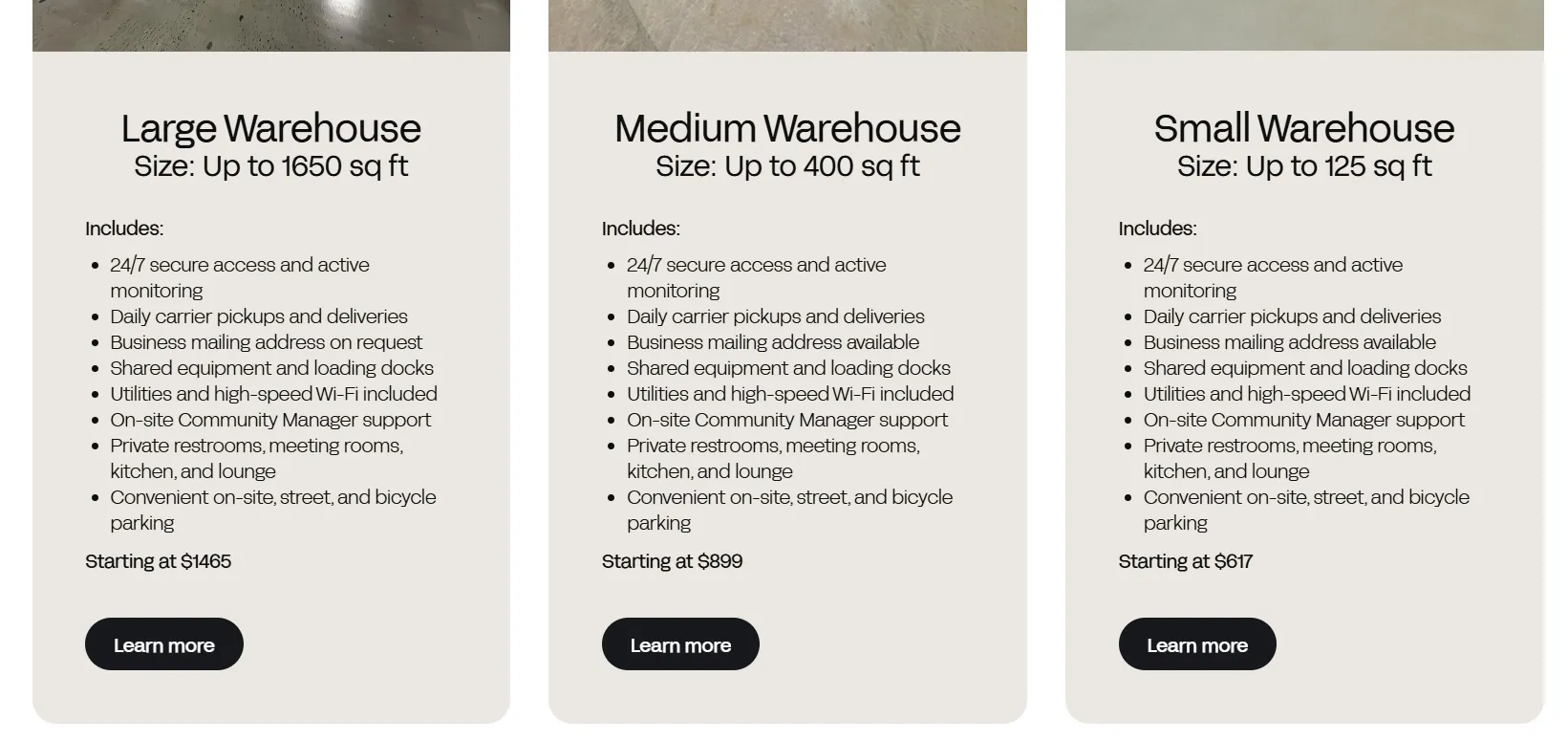
Loloft runs just two sites, one in Phoenix and one in Rogers, each putting a small warehouse next to office and coworking space.
Picture a one or two-person brand that has outgrown an outsourced provider but is not ready for a full industrial footprint, and you have the target customer.
Amenities and benefits
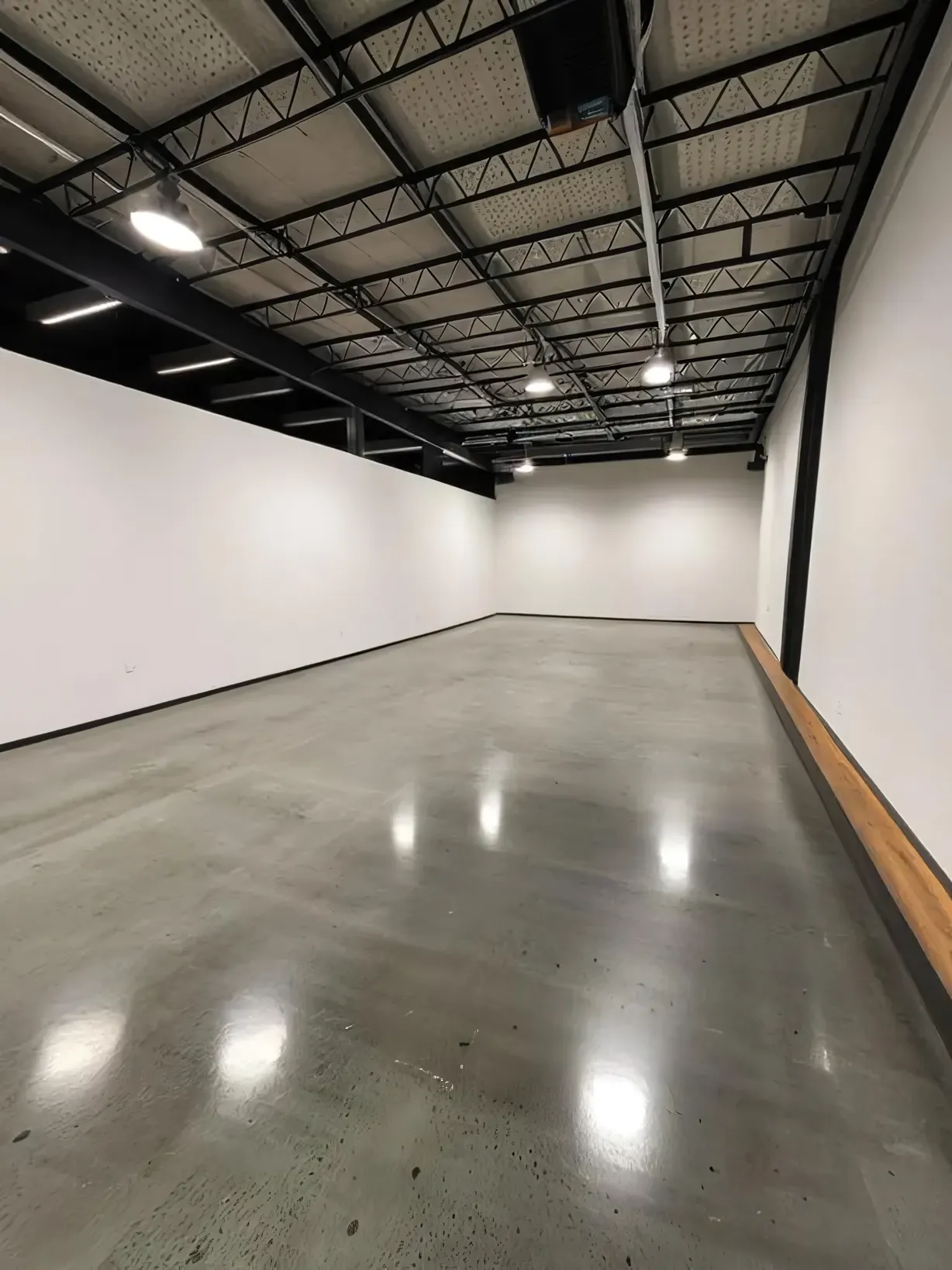
- Memberships cover coworking desks, private offices, and warehouse units at one address.
- The base tier covers Wi-Fi, a kitchen, and lounge space.
- You can book meeting rooms and classrooms as needed.
- Round-the-clock access, shared warehouse tools, free parking, and mail handling fill out the rest.
Pricing
Loloft prices month-to-month across every category.
Rogers, AR rates, for example, look like this:
- Warehouses span $617/month for a 125 sq. ft. unit up to $1,465/month for 1,650 sq. ft.
- Offices begin at $425/month for a small dedicated desk and reach $1,299/month for a 182 sq. ft. private office.
- Hot desks sit at $195/month, with $15 day passes available.
Pros and cons
✅ The lowest published entry price here for pairing a warehouse with an office.
✅ Mail handling and parking are included, not billed as add-ons.
✅ Month-to-month pricing across every space type.
❌ Two locations make it the smallest footprint on this list.
❌ Hard to see how you grow much past six or seven people across two sites.
#7: Cubework
Best for: Later-stage brands that need a large industrial footprint across many U.S. cities, with forklift labor on demand.
Locations: 77+ U.S. locations.
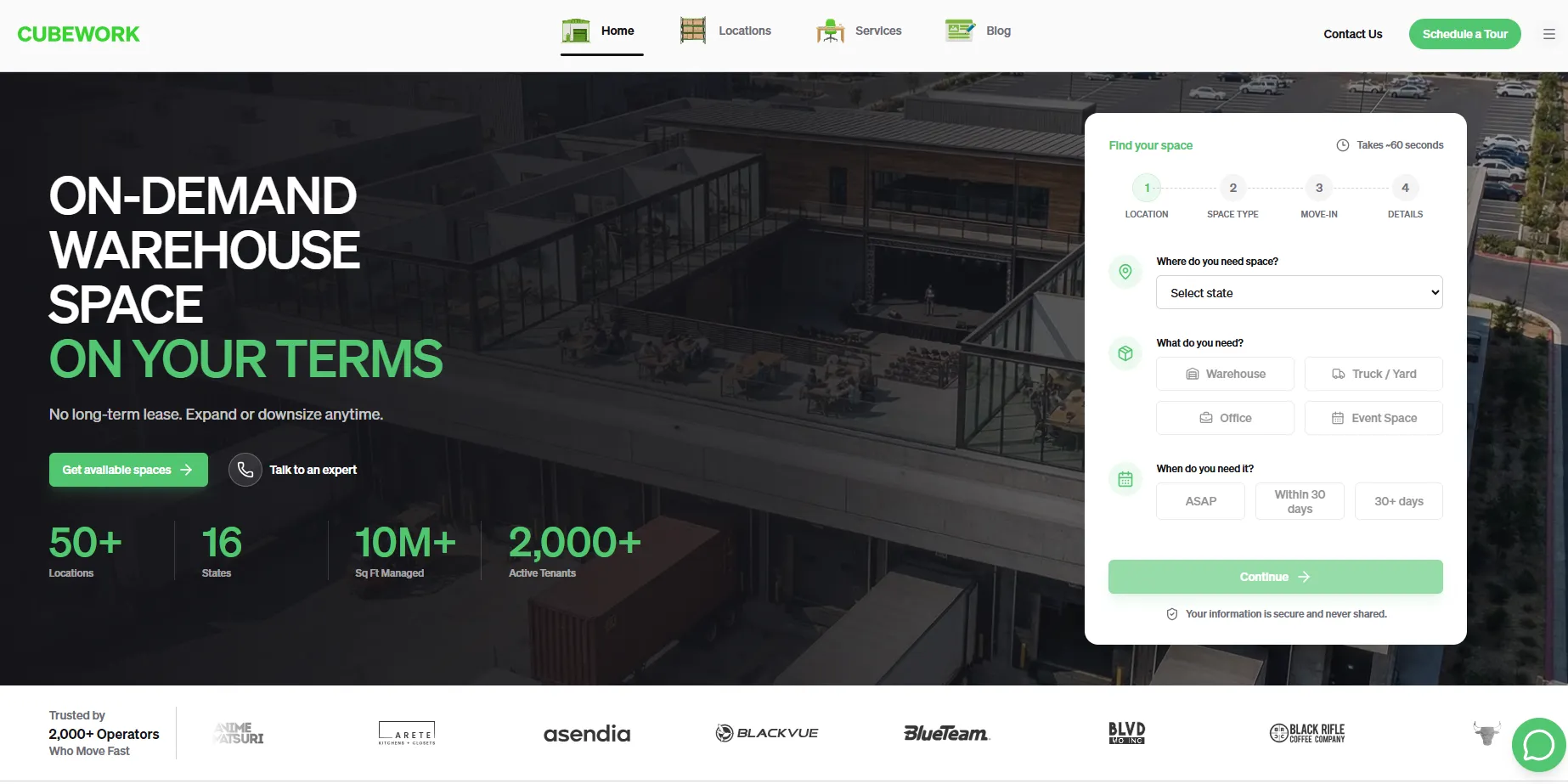
Cubework spans 77+ U.S. sites and leases flexible industrial units from 150 sq. ft. all the way to a 150,000 sq. ft. distribution floor, with forklift drivers available to hire by the shift.
Later-stage brands that need a real footprint in several cities at once are the audience, and leases open at three months.
Amenities and benefits
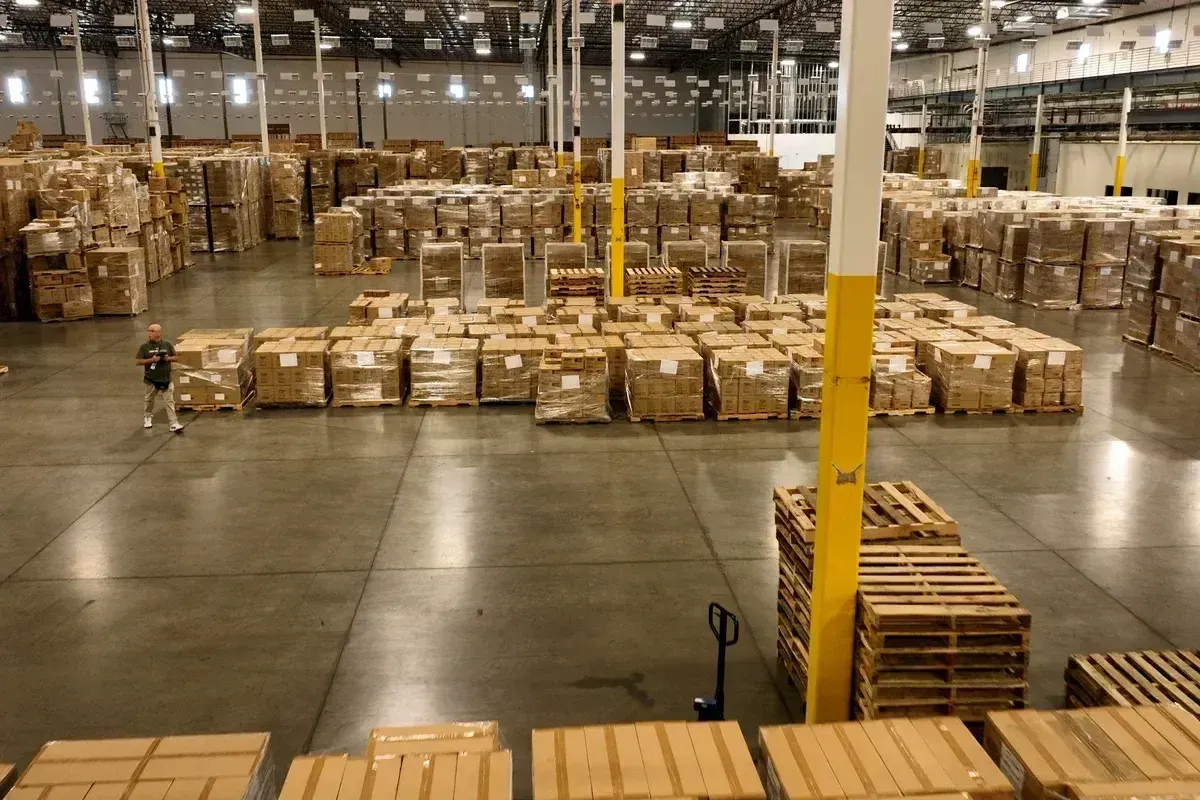
- Warehouse and industrial units cover a wide size range for operations and fulfillment, plus light manufacturing.
- Perks run to catered breakfasts, the occasional BBQ, entry to trade shows, and concierge help at a discount.
- Access stays secured and monitored around the clock.
- High ceilings and proper industrial zoning support heavier operations.
Pricing
Cubework keeps pricing off its website, and the final number depends on the city, the unit size, and the lease term.
You will need to contact the team for a quote.
Pros and cons
✅ Sites cluster near major highways and freight corridors.
✅ Three-month minimums undercut standard industrial terms.
✅ Forklifts and drivers come on demand, with no equipment to buy.
❌ No published pricing.
#8: WorkHub
Best for: Texas-based startups that want flexible coworking, offices, and warehouse space with an easy move-in.
Locations: 7, all in Texas.
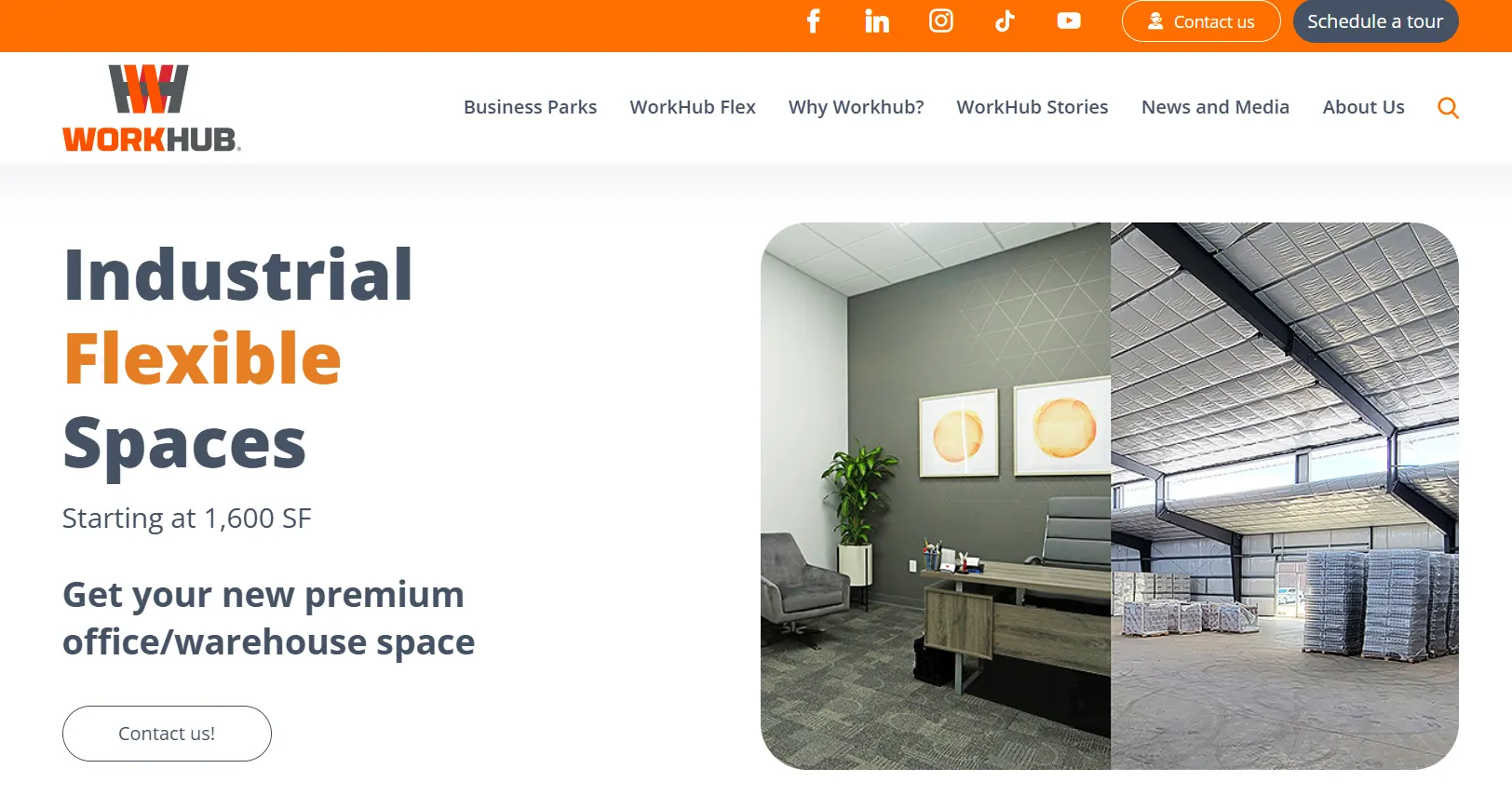
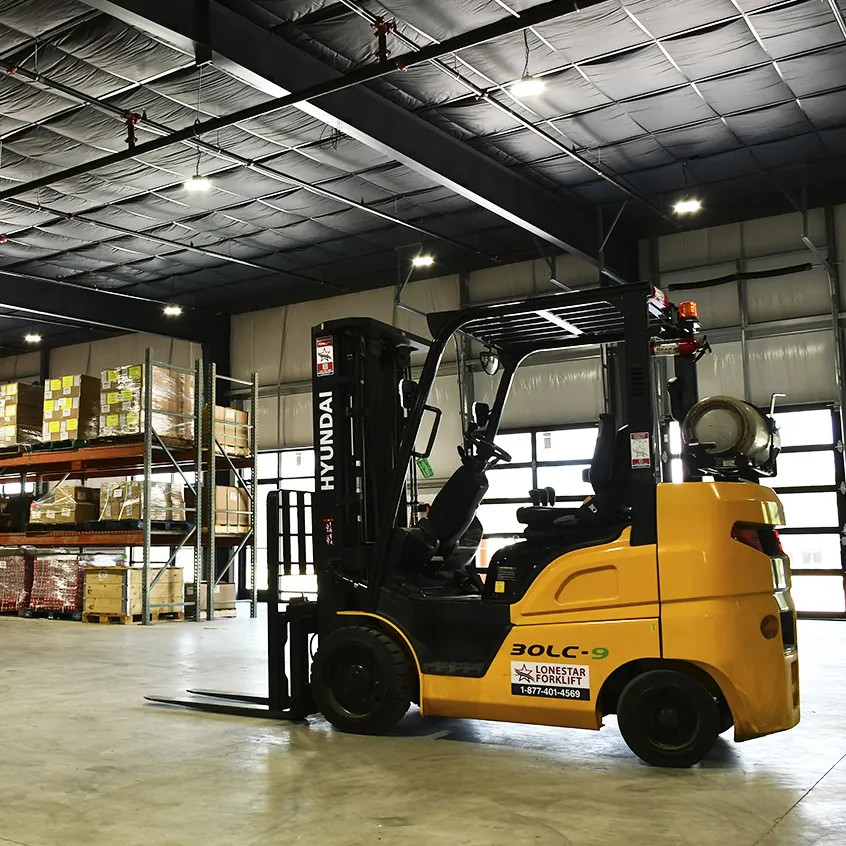
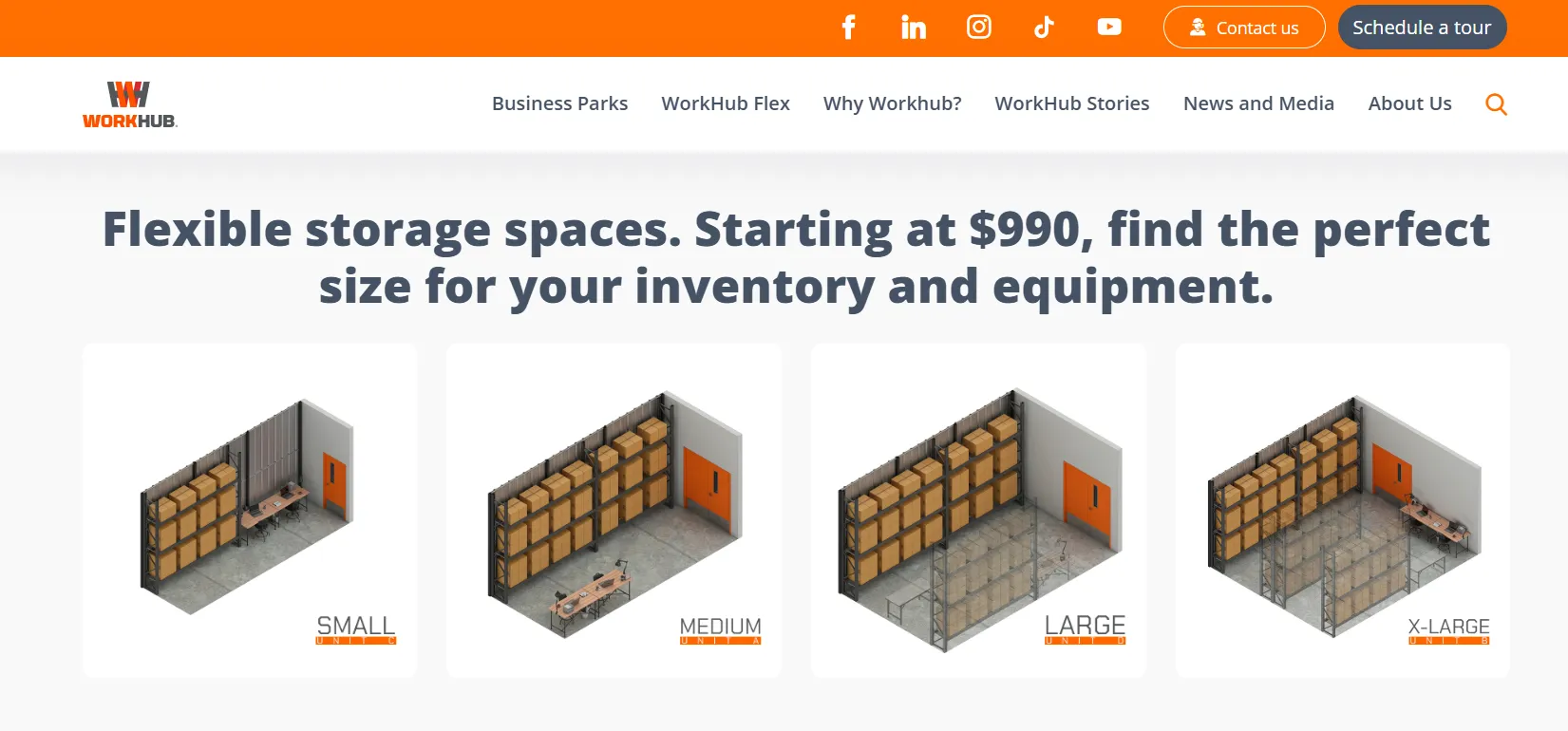
Seven Texas sites make up WorkHub, which pairs flexible workspace, from hot desks up to private offices, with climate-controlled warehouse bays.
Texas startups that want workspace and storage from one provider, with no upfront deposit, get an easy on-ramp.
Amenities and benefits
- Workspace options run from hot desks and dedicated desks to meeting rooms and private offices.
- Fast internet and business support come standard, and there is a tenant community to plug into.
- A loading dock and a forklift are included at no extra charge.
- Buildings are energy-efficient, with climate control in the warehouse bays.
Pricing
WorkHub publishes little on pricing, though it notes that flexible storage starts at $990/month.
Pros and cons
✅ Free months to move in, with no security deposit required.
✅ A wide spread of workspace options under one roof.
✅ Loading dock and forklift access included.
❌ Every location is in Texas.
What are the best 3PL alternatives to DHL Supply Chain in 2026?
If you have decided to stay outsourced, these two are the strongest picks:
#1: Flowspace
Best for: Brands that want a software-first 3PL with inventory spread across a national network.
Locations: 150+ fulfillment centers across the U.S. and select areas of Canada.
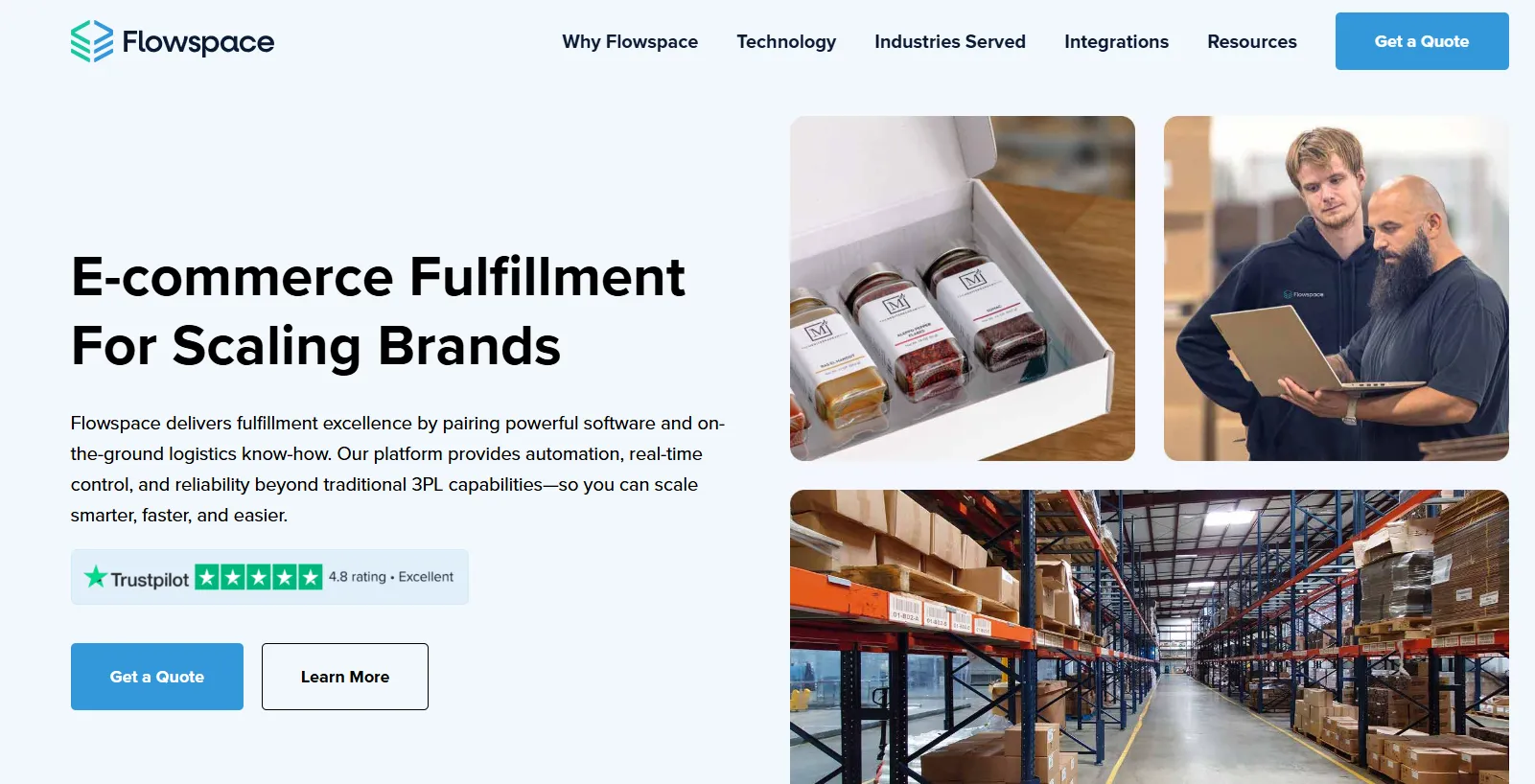
Flowspace is a distributed fulfillment platform, not a single-building operation, routing your inventory across 150+ partner centers by shipping zone.
For a brand that wants to stay outsourced but gain software-driven control over a national footprint, Flowspace is the more practical of the two 3PLs here.
Amenities and benefits
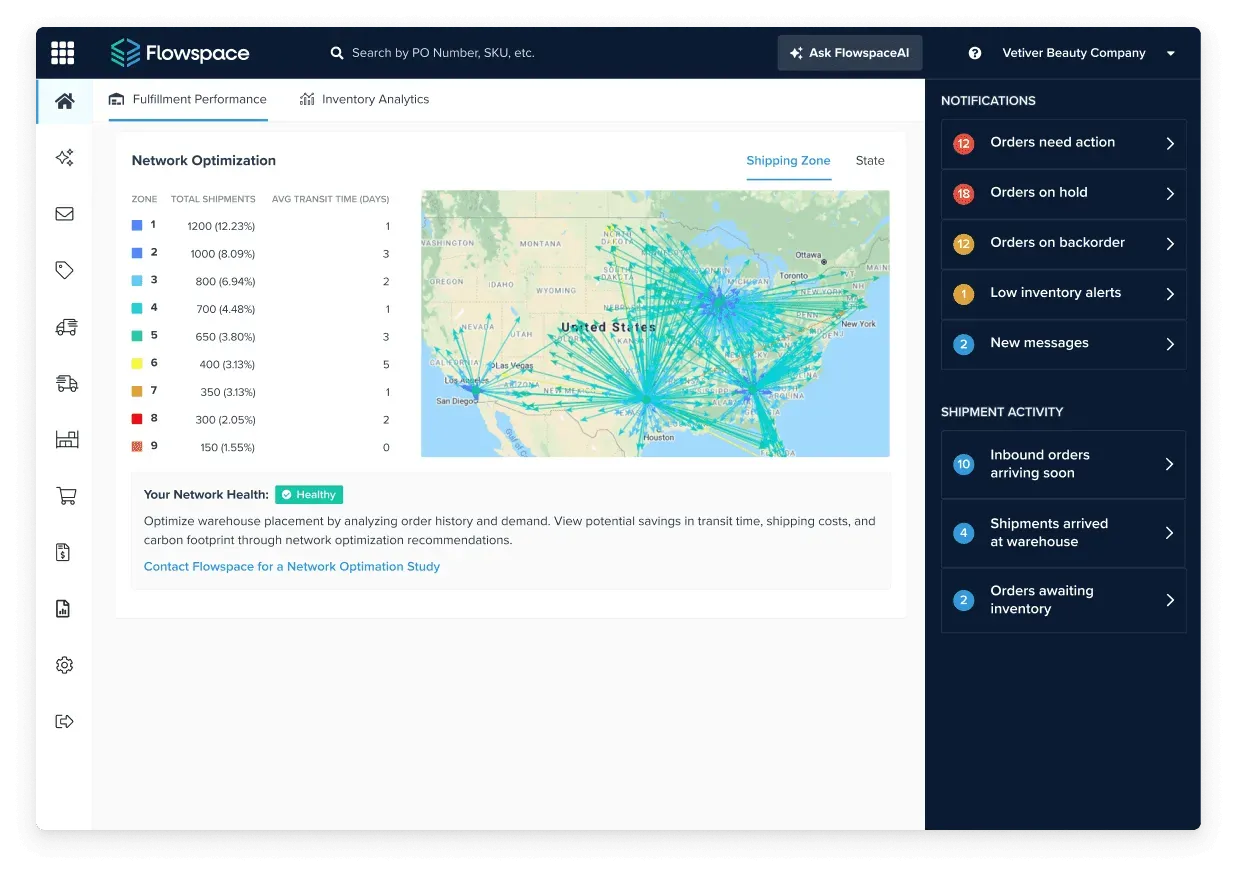
- Inventory is placed across 150+ centers to cut transit times.
- Pick, pack, ship, kitting, labeling, and returns are handled end-to-end.
- The platform gives real-time order and inventory data across connected channels.
- A distributed model lets you put stock closer to customers without signing leases.
Pricing
Flowspace pricing is custom, so you'll need to talk to their sales team for numbers.
Pros and cons
✅ A wide fulfillment network at 150+ centers.
✅ Strong Shopify integration treated as a core feature.
✅ Pick, pack, and ship handled under one provider.
❌ Custom pricing makes side-by-side comparison hard.
#2: Flexe
Best for: Mid-market and enterprise brands that need warehouse capacity in dozens of markets without signing leases.
Locations: 800+ partner warehouses across North America.

Flexe works more like warehousing infrastructure than a single facility, opening one integration onto 800+ independent operators across North America.
That reach, with no leases and pay-as-you-go capacity, is what puts Flexe closest to DHL Supply Chain's scale on this list.
Amenities and benefits
- One integration, over API, EDI, or XML, opens access to 800+ operators across Tier 1 to 3 markets.
- The platform combines warehouse, order, and inventory management in one place.
- Real-time visibility covers inventory, orders, and SLA performance.
- A dedicated logistics analyst runs point on daily operations, like a control tower.
💡 Interested in how Flowspace compares to Flexe? You can read our Flowspace vs. Flexe guide.
Pricing
Flexe’s pricing is fully custom and built per account, with the model centered on enterprise-scale agreements.
Pros and cons
✅ Reaches more markets than any other provider here.
✅ One integration covers distribution and fulfillment across 800+ partners.
✅ Network planning and consulting are part of the engagement.
❌ Less hands-on control of the physical space than a suite you rent yourself.
Keep control of your inventory with Saltbox in 2026
Saltbox lands between two extremes: a bare storage unit you run entirely on your own, and a contract-logistics provider that absorbs the whole operation.
The reason I rate Saltbox as the best DHL Supply Chain alternative for product-based brands is that it keeps control in your hands while still giving you the support a growing brand needs:
- A private suite you can step into during working hours, anywhere from 70 to 5,000+ sq. ft.
- An on-site crew that takes in your inbounds even when none of your people is on site.
- Slack member support that doesn’t take a week to respond.
- Discounted label rates through Parsel that solo brands seldom land on their own.
- A building full of other ecommerce founders facing the very same problems.
Saltbox offers month-to-month suites and access membership plans from $349/month for growth-stage DTC brands that do not want to sign a multi-year contract or hand fulfillment to a global 3PL.
You can talk to an expert to learn more about us, or book a tour at one of our locations to see a suite in person.
⚠️ Disclaimer: This article was last updated on July 6, 2026, and if there's any misinterpretation of the information, please contact us, and we will fact-check it.
Frequently asked questions
A 3PL takes your inventory and packs your orders for you, so you trade control for convenience. Fractional warehousing gives you dedicated space and shared infrastructure inside a larger facility while your team keeps doing the packing. You hold onto brand control and still offload the heavy infrastructure costs.
While there may be upfront costs, switching to a co-warehousing space can reduce long-term expenses by eliminating hidden fees and rigid contracts.
The right time is usually six months before most founders actually do it. If your error rate is consistently above 1–2%, your costs are scaling faster than your volume, or you're spending meaningful time every week managing your provider relationship, those are signals worth acting on sooner rather than later.
Prioritize pricing transparency, space flexibility, real-time inventory visibility, and on-site support. Also evaluate tech stack compatibility; your new provider should integrate cleanly with your existing sales channels and shipping tools without requiring a custom build on your end.