.webp)


Key takeaways
- Saltbox is the best Cubework alternative in 2026 for growth-stage DTC brands that want private, scalable warehouse suites, an operations staff that can receive your inventory at the dock and take it to your suite, discounted shipping rates, and flexible month-to-month pricing without large upfront deposits.
- Other co-warehousing options like ReadySpaces, WareSpace, Portal Warehousing, WorkHub, and Loloft are strong fits for teams that mainly need flexible warehouse or light industrial space without on-site operational support.
- On the office-first side, providers such as Regus, WeWork, FlexHQ, and Upflex work well for distributed or hybrid teams that need professional office access and coworking flexibility.
Are you looking for the best Cubework alternatives in 2026 to run fulfillment, storage, and ecommerce operations?
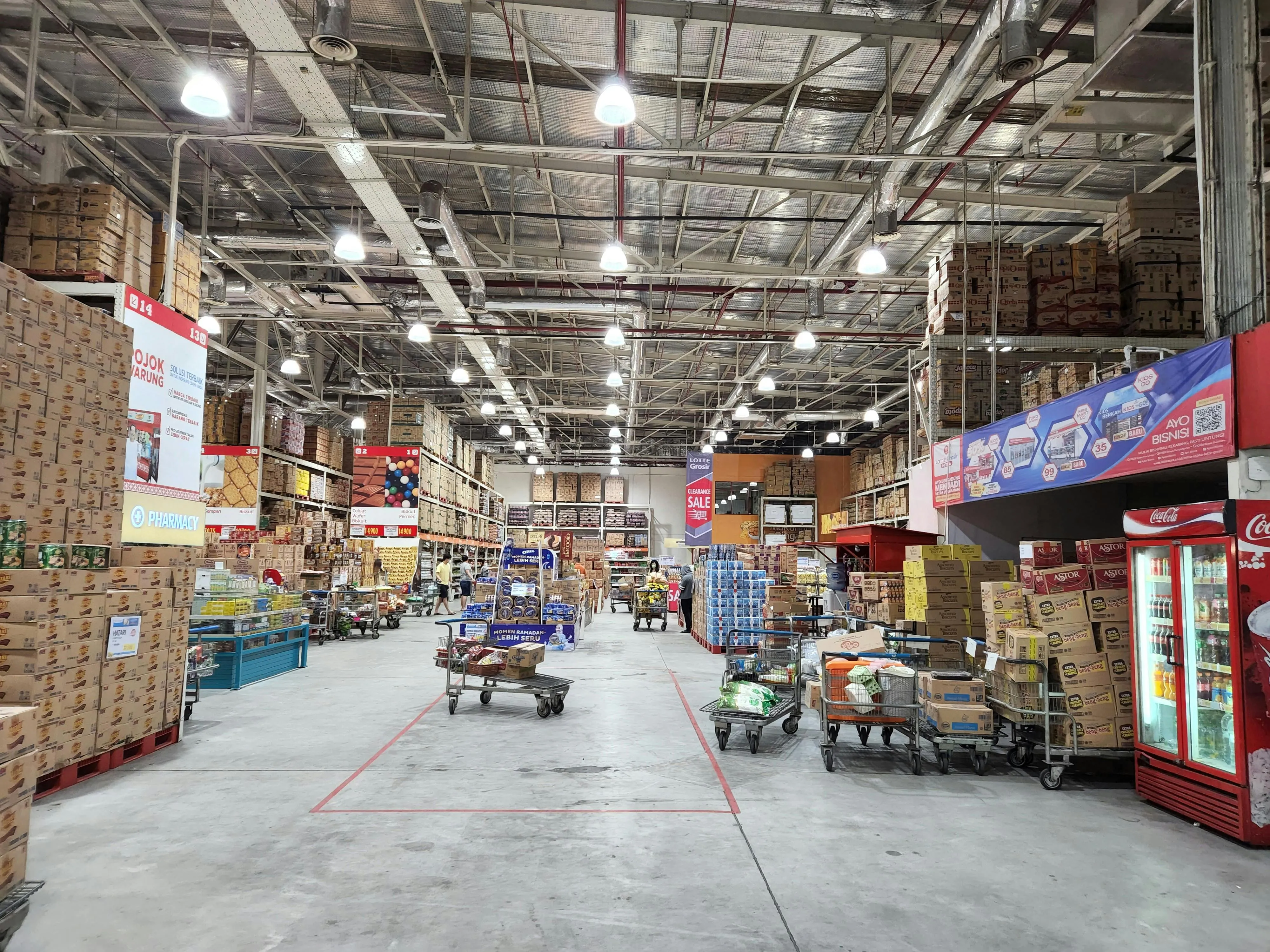
Cubework provides flexible, on-demand industrial real estate and warehousing solutions that let you scale storage, fulfillment, and logistics operations through a nationwide network of short- and long-term warehouse spaces.
However, some ecommerce founders and logistics managers have not been happy with its required deposit to move in, inconsistent on-site experiences, and how the condition of the workspaces can be worse than advertised.
In this article, I’ll go over the 10 best Cubework alternatives in 2026 that can help you ship orders, receive pallets, and stay on top of your inventory with dedicated workspaces.
Before I start, I wanted to cover the reasons why some customers have been looking to make the switch from Cubework: ⤵️
Why look for Cubework alternatives?
Most customers are generally satisfied with Cubework’s short-term lease options, facilities, and overall community, which feels like neighbors, according to one reviewer.
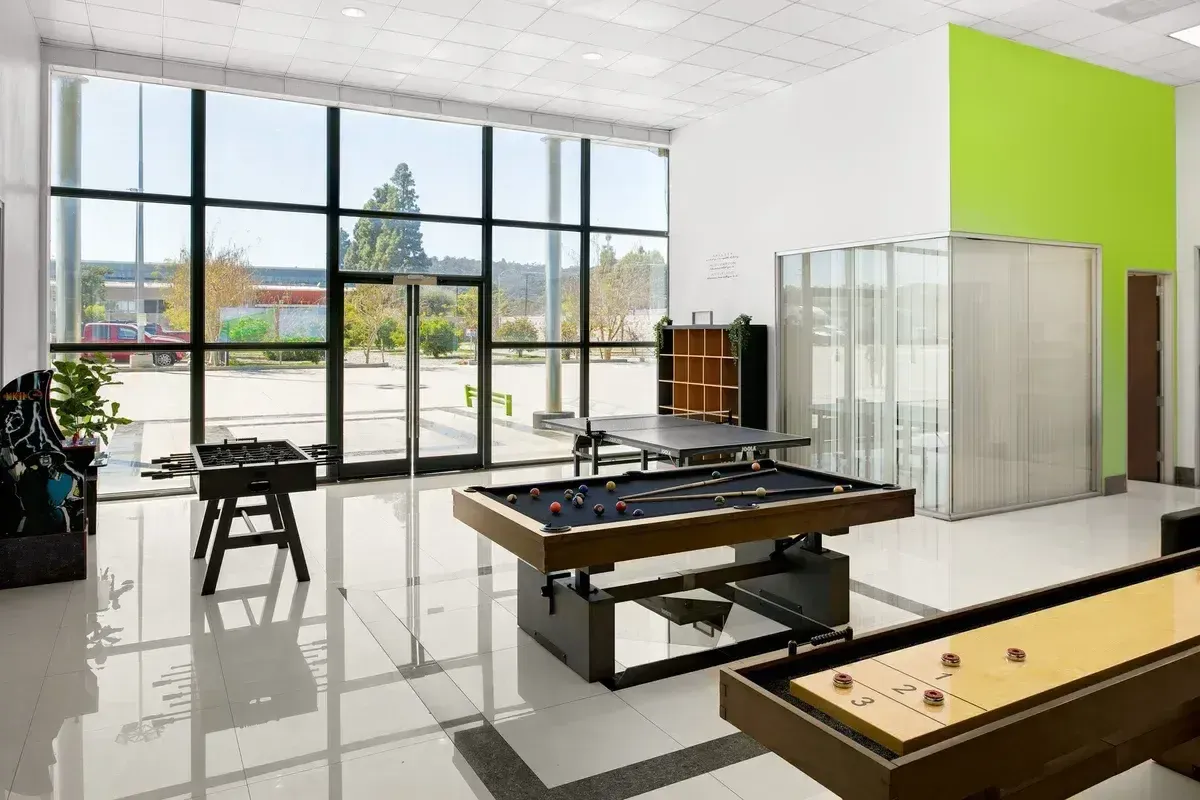
Despite this, some customers warn about a few things that you should be prepared for when working with Cubework, as well as some poor experiences that they’ve had:
#1: Cubework (allegedly) requires 4 months of deposit to move in
One start-up founder in San Francisco was quoted what appears to be a reasonable price for the workspace they wanted to move into; however, they were also told that they needed to pay 4 months of a deposit to move in.
In practice, Cubework wanted $3,200 + first month’s payment on top of insurance to get started with its 1,100 sq. ft. workplace.
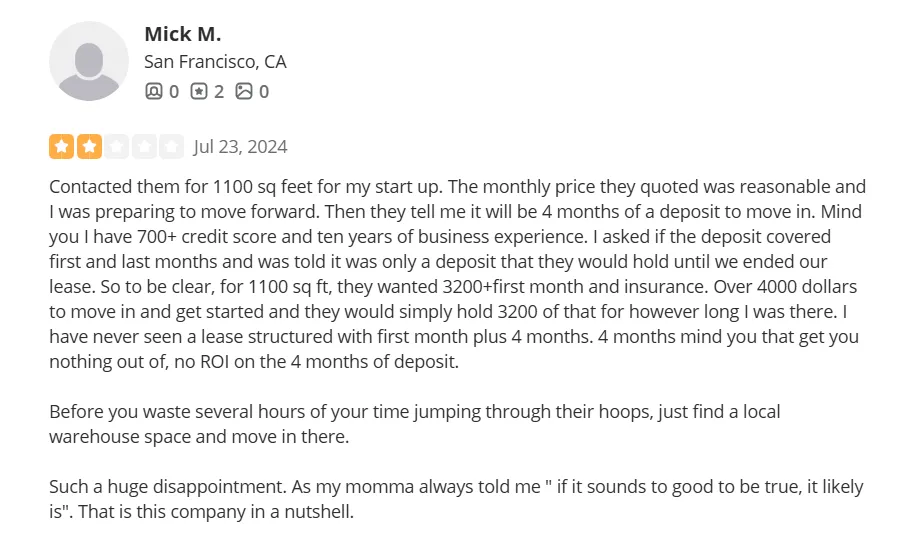
‘’Contacted them for 1100 sq feet for my start-up. The monthly price they quoted was reasonable and I was preparing to move forward. Then they tell me it will be 4 months of a deposit to move in. Mind you, I have a 700+ credit score and ten years of business experience. I asked if the deposit covered first and last months and was told it was only a deposit that they would hold until we ended our lease. So to be clear, for 1100 sq. ft., they wanted 3200+first month and insurance. Over 4000 dollars to move in and get started and they would simply hold 3200 of that for however long I was there. I have never seen a lease structured with first month plus 4 months. 4 months, mind you, that gets you nothing out of, no ROI on the 4 months of deposit.’’ – Yelp Review.
💡 I tried to verify the claim that Cubework wants 4 months of deposit to move in, and I saw that in 2021, another customer was asked for 2 months of deposit to move in.
It could mean that their rules changed, or that different cities have different deposit requirements.
#2: The team can be unprofessional and/or unresponsive
Even though I’m sure this is not the usual case with Cubework, I did find some ‘’horror stories’’ on Yelp that go over how unresponsive, unhelpful, and unprofessional Cubework’s team can be in some locations.
For example, a customer from Rosemead, CA, goes over how they found a person in their unit, and then finds out that he was working for Cubework and measuring their unit.
They were then moved out of their unit, without their consent, and found that they had other people’s stuff in their unit, and some of their racks were missing.
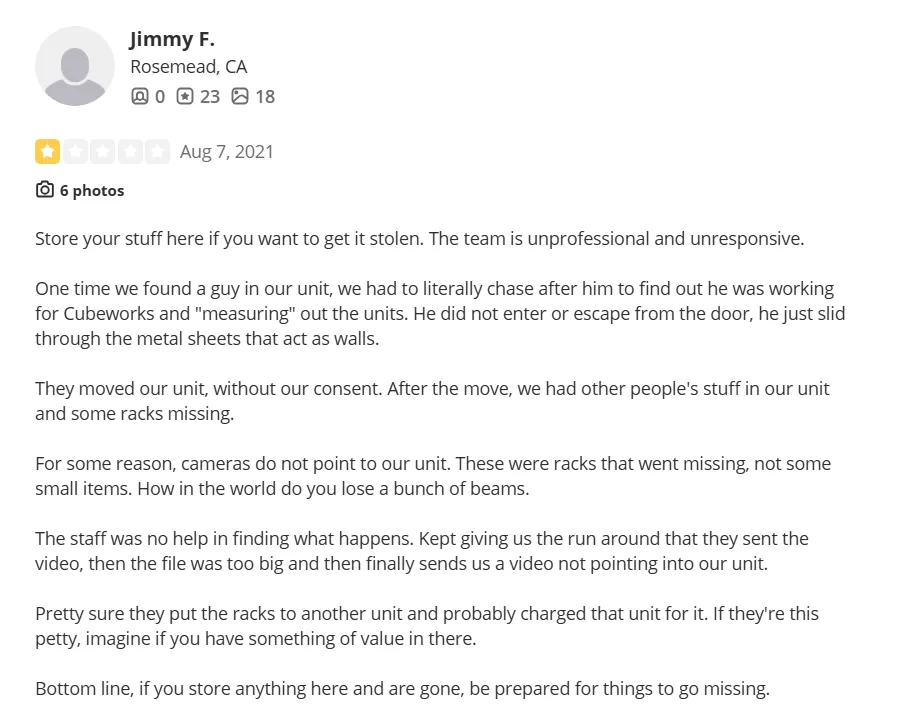
‘’One time, we found a guy in our unit, we had to literally chase after him to find out he was working for Cubeworks and ‘measuring’ out the units. He did not enter or escape from the door; he just slid through the metal sheets that act as walls. They moved our unit without our consent. After the move, we had other people's stuff in our unit, and some racks were missing. For some reason, cameras do not point to our unit. These were racks that went missing, not some small items. How in the world do you lose a bunch of beams. The staff was no help in finding what happened. Kept giving us the run around that they sent the video, then the file was too big and then finally sent us a video not pointing into our unit. Pretty sure they put the racks in another unit and probably charged that unit for it. If they're this petty, imagine if you have something of value in there.’’ – Yelp Review.
#3: The condition of the offices, bathroom, and workspace might not be what you expect
Last but not least, some prospective customers weren’t too impressed with the condition of the offices, bathroom, and workspace.
A past prospect of Cubework from Beverly Hills, CA, was not happy with the company’s facilities when it visited them in-person, and described their images online as ‘’false advertisement.’’
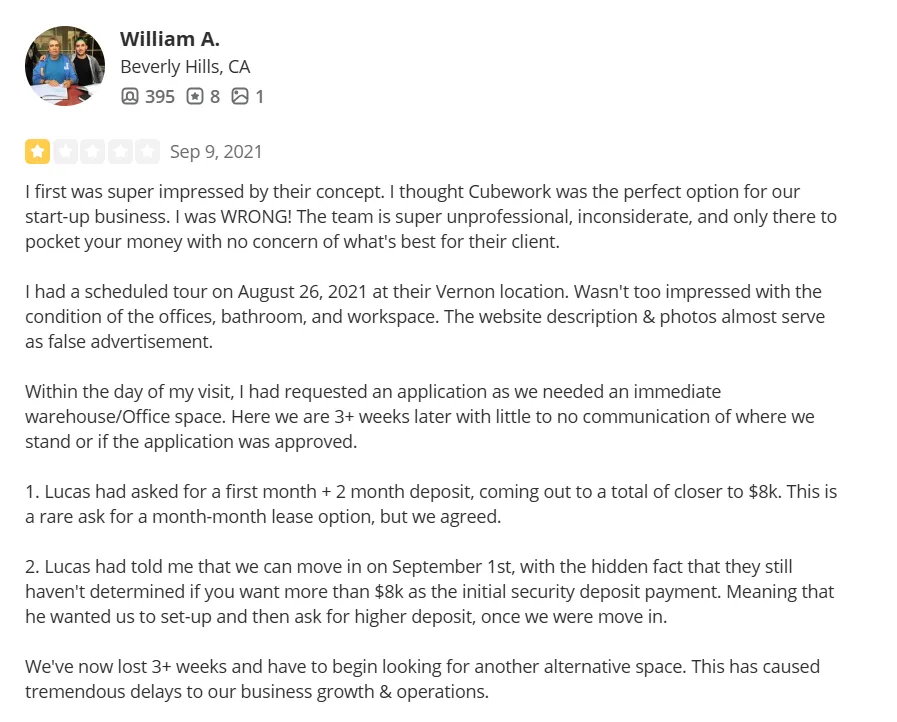
‘’I had a scheduled tour on August 26, 2021, at their Vernon location. Wasn't too impressed with the condition of the offices, bathroom, and workspace. The website description & photos almost serve as false advertisement.’’ – Yelp Review.
Note: The last 2 reviews date back to 2021 and may not reflect Cubework’s current operations.
What are the best alternatives to Cubework in 2026?
The best alternatives to Cubework in 2026 are Saltbox, WorkHub, and Loloft.
Here’s a comprehensive list of the 10 best alternatives on the market for ecommerce founders looking for a workspace:
#1: Saltbox
Saltbox offers the best alternative to Cubework for DTC brands and ecommerce founders looking to run operations themselves, with a flexible pricing structure and on-demand labor when they need it.
Our co-warehousing and logistics solution combines private warehouse suites and offices with on-site logistics services, so you can run fulfillment, storage, and business operations from one location.
And all of that without having to sign long industrial leases or outsourcing entirely to a large 3PL.
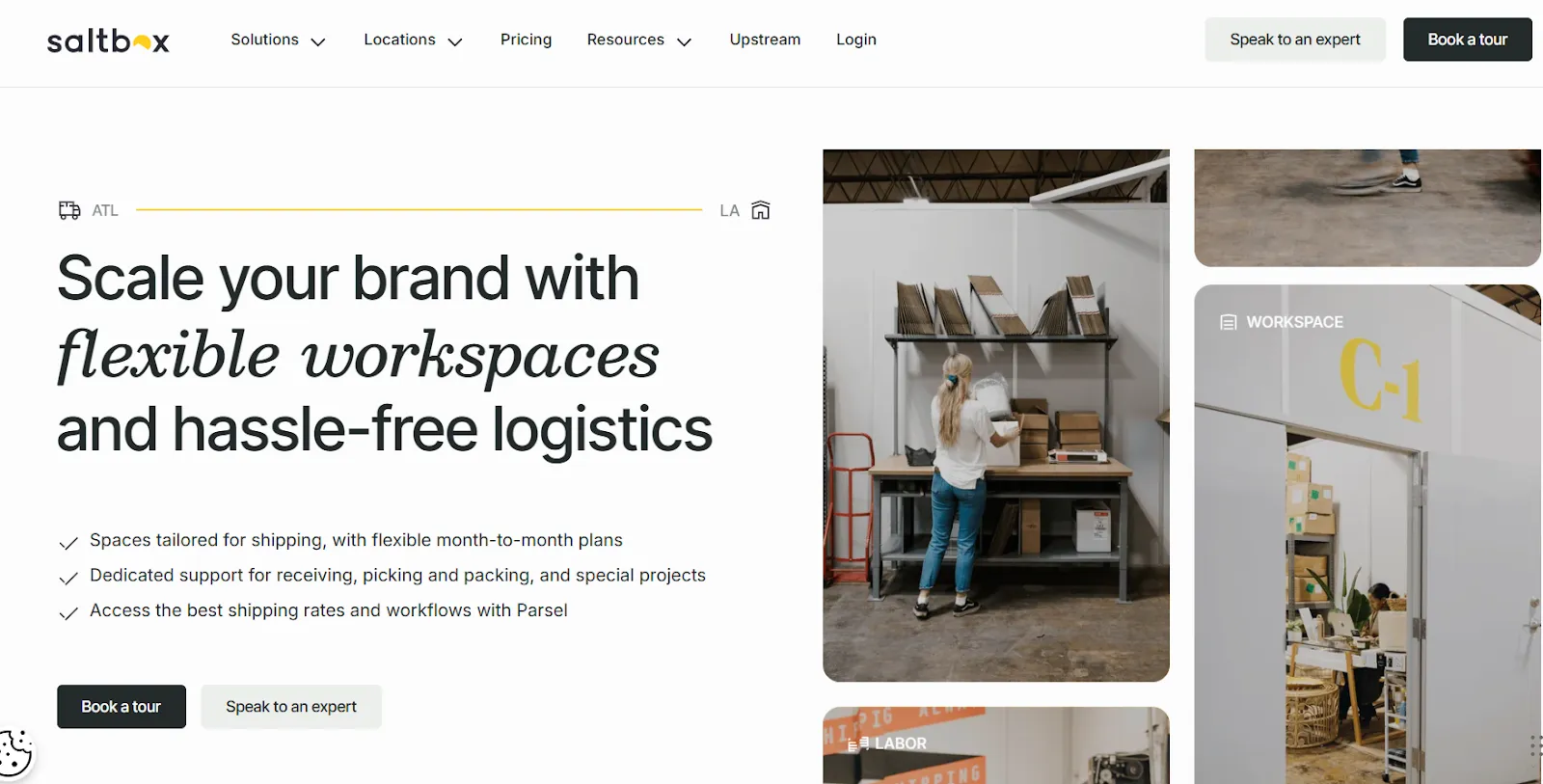
Disclosure: Even though Saltbox is our brand, I’ll provide an unbiased analysis on what makes our co-warehousing solution the best alternative to Cubework in 2026.
Let’s go over the services that have allowed DTC brands like Chunks, Shinery, and Come Alive Herbals to grow: 👇
Warehousing and workspaces that can scale with your business
We understand that some of you are going to be in different stages of your ecommerce journey.
This is why Saltbox offers flexible warehouses and office spaces that range from 70 to 5,000 sq. ft., with the option to scale up or down when you need it.
If you’re not ready to move into a warehouse space or an office yet, you can use our Access Plans, which will include a mailing address, receiving services, discounted rates with Parsel (our shipping app partner), on-site labor, and an entrepreneurial network.
And the best part? Our on-site team ships and receives packages for you while you step out to get lunch or decide to take a day off.

Here are our four core warehouse spaces, depending on your needs:
- Small: 1 to 2 employees, 70 to 250 sq. ft of space, and from 4 to 15 pallets. Ideal for solopreneurs and smaller teams needing dedicated space.
- Medium: 1 to 4 employees, 250 to 500 sq. ft of space, and from 16 to 31 pallets. Ideal for small businesses with room for growth.
- Large: 1 to 10 employees, 500 to 1,000 sq. ft of space, and from 32 to 62 pallets. Ideal for growing teams with expanding dreams and inventory needs.
- Extra Large: Up to 50 employees with 1,000 to 5,000+ sq. ft of space, and from 63 to 125 pallets. Ideal for bigger DTC teams that need extensive storage and workspace.
Logistics and shipping with support when you need it
At Saltbox, we have a flexible operations model: self-service, hybrid, or fully-managed fulfillment with hourly on-demand labor for when seasonality peaks, so that you can get help when it gets busy without having to hire more people.

Here are some of the benefits and features that you’ll get with Saltbox:
- Daily carrier pick-ups: You can skip the post office and drop your orders in our sorting area. Our team will handle the rest.
- Loading docks: You can use our on-site loading docks to receive freight and large shipments with ease.
- Complete visibility: You’ll be able to monitor your inventory and fulfillment with direct access to the team handling your shipments.
- On-demand labor: Need a hand? Use Saltbox Fulfillment or Saltbox Operations Support.
- 24/7 security with around-the-clock surveillance and security measures.
- Everything else you’ll need to win, including high-speed Wi-Fi, a 120V in-suite power, conference rooms, content studios, printing services, a fully-equipped kitchen, and enterprise-grade level equipment (e.g., shelving units and pallet jacks) to support your operations.
- Optional add-ons: 24/7 access at $299/month, additional member access at $99/month, equipment and furnishing rentals month-to-month, and reserved parking from $199/month at some locations.
Here’s how we make shipping enjoyable, instead of stressful: 👇
Shipping savings on packages through our shipping app partner, Parsel
Saltbox members can also unlock exclusive shipping rates with Parsel, which is free for all of our members.
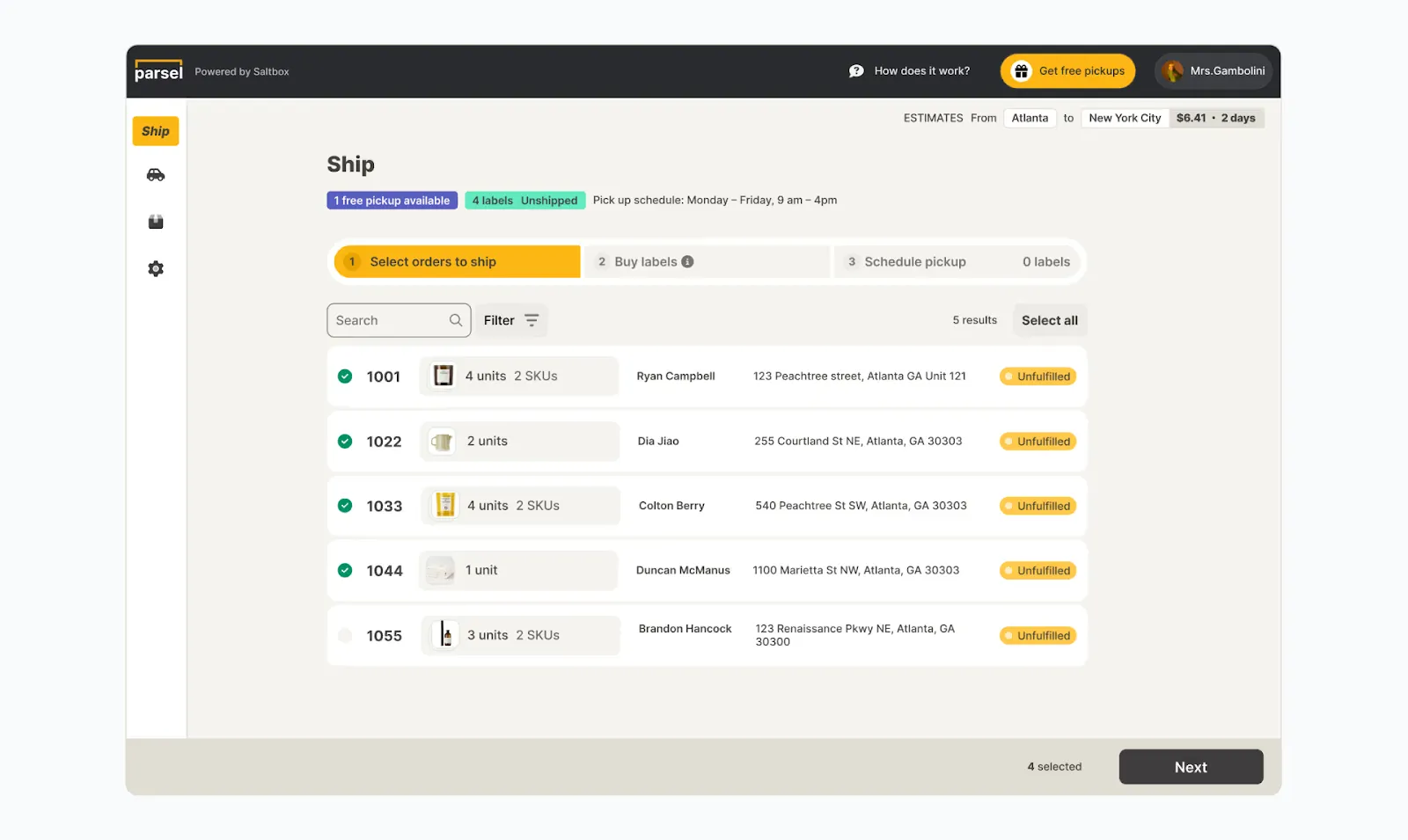
You’ll be able to get:
- Efficient packing workflows and fast delivery times.
- Seamless integration with national, regional, and emerging carriers, and the ability to ship products until 4:30 PM.
- In-app support from the Saltbox team.
- Transparent pricing on your labels, so that you can always know how much you’re paying for each of your shipments.
- The option to see the best rates across major and regional carriers, so that you can save on shipping.
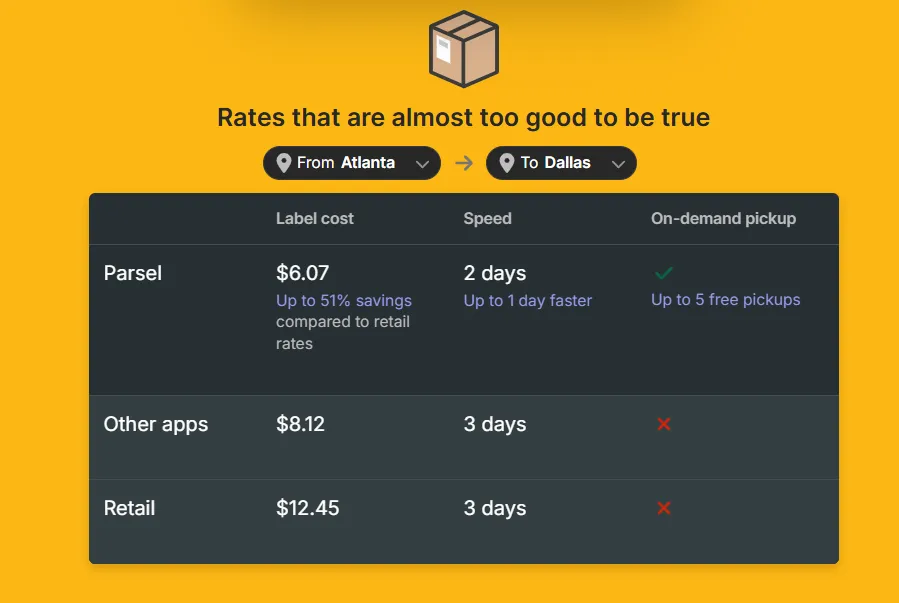
Want to try Parsel? Sign up here.
Saltbox locations across the U.S.
You can find Saltbox on the West Coast, the East Coast, and in the Central U.S.
Here’s a comprehensive list of our 13 locations:
- Los Angeles, San Gabriel Valley.
- Los Angeles, Torrance.
- Phoenix, Tempe.
- Seattle, SoDo Row.
- Denver, Park Hill.
- Dallas, Carrollton.
- Dallas, Farmers Branch.
- Chicago, Elmhurst.
- Atlanta, Upper Westside.
- Atlanta, Westside Park.
- Atlanta, Chamblee.
- Washington D.C., Alexandria.
- Miami, Doral.
Are you interested in one of the locations? You can actually book a tour to see it alongside our logistics experts: available Mon–Fri, 8:30 AM–4:30 PM Central Time.
How is Saltbox different from Cubework?
➡️ Cubework wins in, hands down, number of locations: it offers more locations than Saltbox (77+ listed locations), has a large industrial footprint, and bigger spaces for 100+ people teams.
I’d say that Cubework is a solid option for later-stage DTC brands that are looking for large-scale storage, truck parking, and have heavier industrial needs.
➡️ On the other hand, Saltbox is purpose-built for DTC entrepreneurs with our mix of affordable private suites that start from as little as 70 sq. feet, fulfillment and operations support, Parsel, access to good shipping rates, and a community of other ecommerce entrepreneurs.
💡 There was someone who was just recently in the market and was trying to compare Cubework with Saltbox: George Baker from 2 The Moon Ventures, who exited his previous company to help small businesses thrive.
We spoke to George about what he liked and disliked about Cubework and why he decided to go for Saltbox, and he shared the following insight:
Cubework felt to him more corporate and overengineered. The kind of place where you feel like you can't ask for favors or request something.
On the other hand, Saltbox, while being more expensive than Cubework, had:
- Better energy (personal, scrappy, and authentic) and was more member-centric, with a genuine vibe, which contrasted with Cubework's corporate nature, which he described to us as ''not real,'' with staff performing rather than supporting.
- Complementary inventory inbound that you don't have to schedule.
- The option to integrate his own team alongside Saltbox’s operational support as needed.
- Ability to toggle third-party logistics (3PL) services on or off, which other competitors either lacked or required by default.
- Wiggle room for flexibility with our month-to-month billings and no rigid contracts, unlike Cubework’s strict rules.
For example, he started in a 1,000 sq. ft. space plus flexible storage, and Saltbox's staff helped him set up shelving and organized backstock to maximize efficiency.
''Consolidating (and) unifying operations in a like-minded growth-oriented community has been able to save us money with 5 different brands. (You guys are) the WeWork for warehouses.'' - George Baker, Sr. Founder & Managing Partner of 2 The Moon Ventures.
George shared with us that he was able to cut his shipping costs by about 60% with Saltbox’s shipping volume discounts and saved costs by consolidating five different brands into one Saltbox location.
With Saltbox, he did not get just a storage space and a place to park his vehicle.
He got access to a community of other entrepreneurs, a warehouse that fit his operations (that he could change when he wanted to), and an extra pair of hands when he needed it.
Apart from this, Saltbox members like George get access to Parsel, a shipping app included with membership.
Parsel provides:
- Discounted shipping rates across national, regional, and emerging carriers.
- Transparent label pricing.
- In-app support from the Saltbox team.
- The ability to compare rates across carriers.
- Late-day shipping cutoffs up to 4:30 PM.

Get inventory, shipping infrastructure, and an office in one place with Saltbox
And all of that with monthly payments and no requirement for an annual contract commitment.
Speak with an expert today
Saltbox’s membership, warehouse, and office plans
At Saltbox, you have to first select your membership tier, select your warehouse size (you can skip this), and then select your office (you can also skip this).
Saltbox has 3 membership tiers that you can choose from:
- Virtual: $99/month, which is a 100% virtual membership for businesses who need a professional business mailing address (mail only, no packages), and access to our member-only Saltbox Entrepreneurs Club community.
- Access: Starting from $199/month, which adds access to our physical locations, including the loading dock and packing stations, meeting rooms, and a content creation studio, without having to commit to a full-time warehouse suite.
- Workspace: Starting from $500/month, which adds flexible warehouse and office suites designed for ecommerce entrepreneurs. Includes built-in shipping technology, onsite logistics support, and modern amenities.
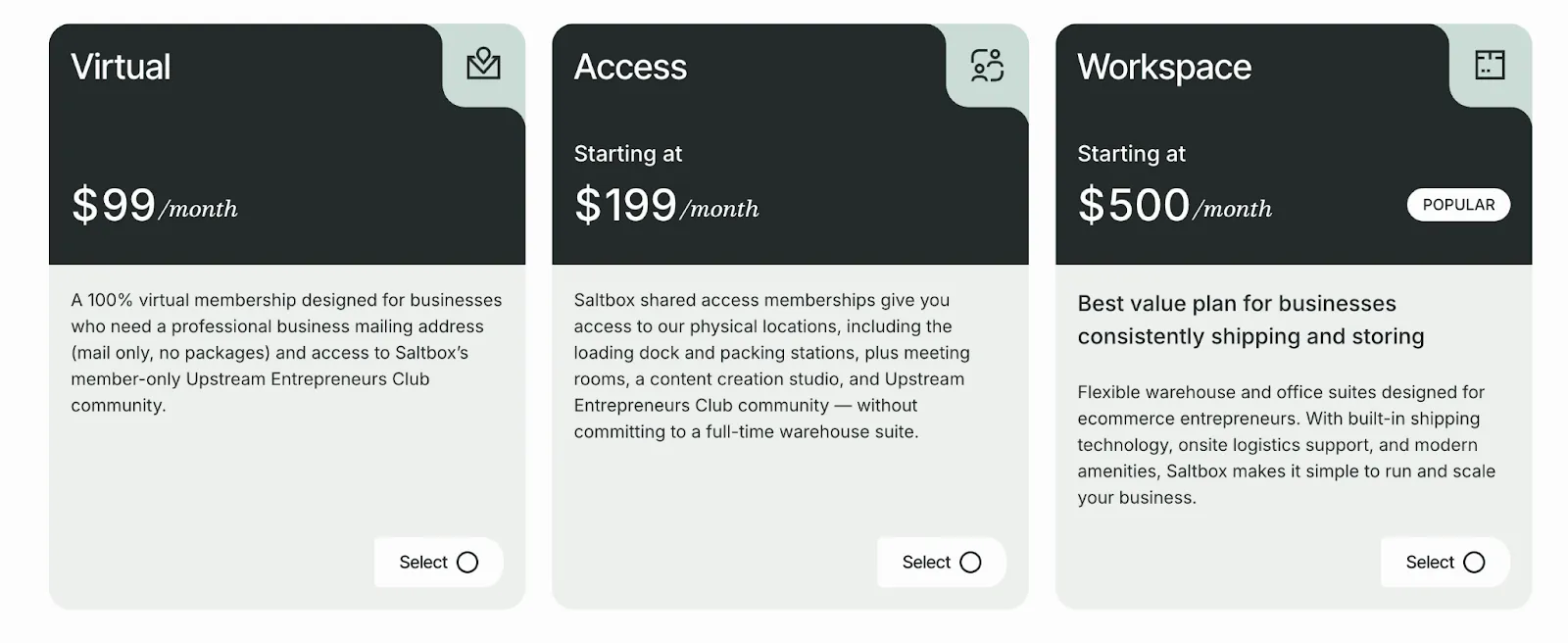
From here, you can select your warehouse size, where pricing differs with each city. Let’s take a look at Chamblee’s pricing, for example:
- Extra Small Warehouse: Starting at $810/month for 1-2 employees, from 110 to 260 sq. ft, which can take up to 15 pallets.
- Small Warehouse: Starting at $990/month for 1-3 employees, from 150 to 510 sq. ft, which can take up to 31 pallets.
- Medium Warehouse: Starting at $2,300/month for 1-4 employees, from 580 to 980 sq. ft, which can take up to 60 pallets.
- Large Warehouse: Starting at $3,200/month for 1-10 employees, from 1,000 to 1,200 sq. ft, which can take up to 75 pallets.
- Extra Large Warehouse: Starting at $4,250/month for 1-50 employees, from 1,600 to 3,200 sq. ft, which can take up to 200 pallets.
Last but not least, you’ll have to select your office size, which also has regional pricing. Here’s Chamblee’s pricing:
- 4-person office: $1,000/month for 4 chairs and 4 desks.
- 5-person office: $1,300/month for 5 chairs and 5 desks.
- 6-person office: $1,500/month for 6 chairs and 6 desks.
- 10-person office: $2,100/month for 10 chairs and 10 desks.
➡️ You will not be locked into an annual contract, as you can pay monthly, although you can save 10% by paying annually, or save 5% when paying biannually.
Saltbox pros and cons
✅ Get inventory, shipping infrastructure, and an office in one place.
✅ Keep inventory in your private suite and be able to run fulfillment yourself.
✅ Monthly payments with no requirement for an annual contract commitment.
✅ Save on shipping costs with Parsel.
✅ You’ll be able to network with other founders in the Saltbox Entrepreneurs Club.
✅ Hire an extra hand at an hourly rate when you need it.
❌ Not as many locations in the U.S. as Cubework.
❌ No availability in Canada.
#2: WorkHub
Best for: Small teams in Texas looking for flexible and modern coworking and private office options without a security deposit required.
Locations: 7, all of which are in Texas.
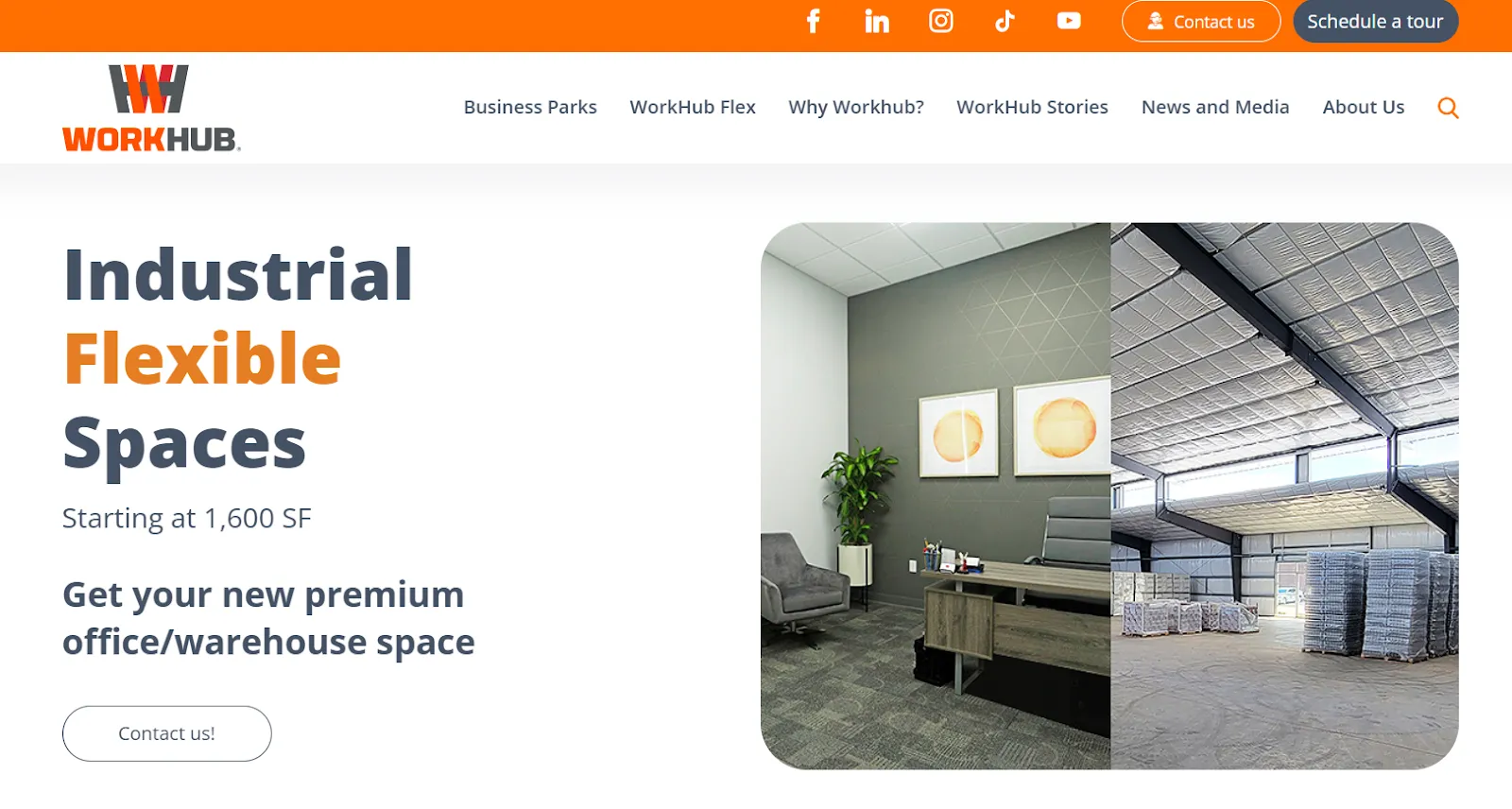
WorkHub offers flexible workspace options from hot desks to private offices designed to support productivity, collaboration, and business growth.
It’s a good alternative to Cubework because it combines coworking features with scalable space options that work for startups, remote teams, and small businesses alike.
Amenities and benefits
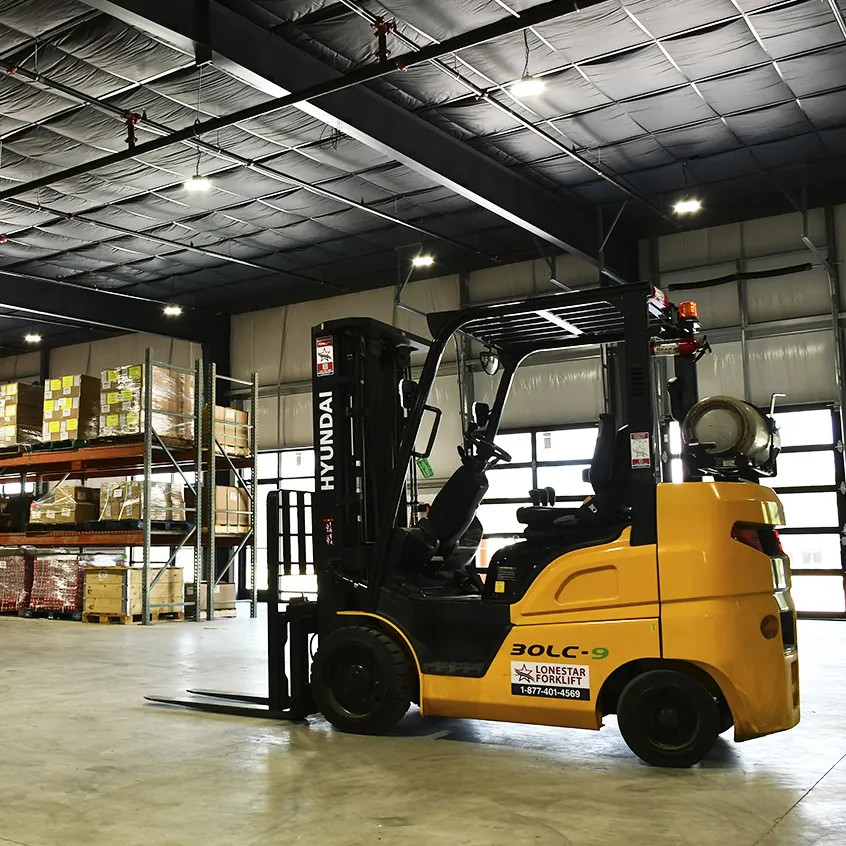
- Flexible workspace options include hot desks, dedicated desks, meeting rooms, and private offices.
- Professional environment with high-speed internet, business support services, and networking opportunities.
- Loading dock & forklift available at no additional cost.
- The buildings are energy-efficient, and the warehouses are climate-controlled.
- Three-phase electric power.
Pricing
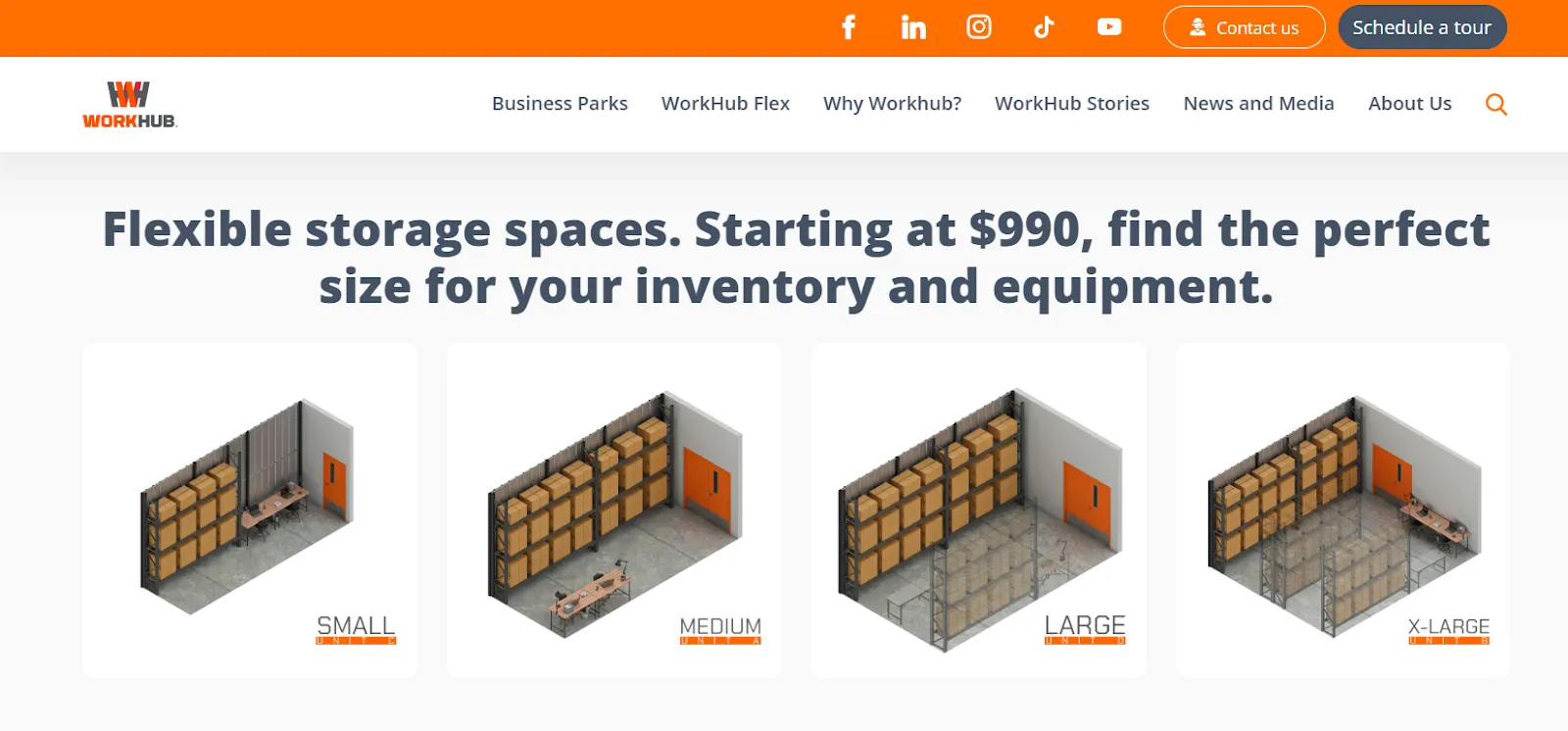
I wasn’t able to find much information about WorkHub’s pricing, apart from the fact that its flexible storage spaces start from $990/month.
Pros and cons
✅ Wide range of workspace options from casual desks to private offices.
✅ Supportive community and networking features.
✅ No security deposit required.
❌ Pricing structure is not easily available.
❌ All of the warehouses are in Texas.
#3: Loloft
Best for: Start-ups looking for a modern coworking space with a small industrial or warehouse space.
Locations: 2, one in Phoenix and one in Rogers.
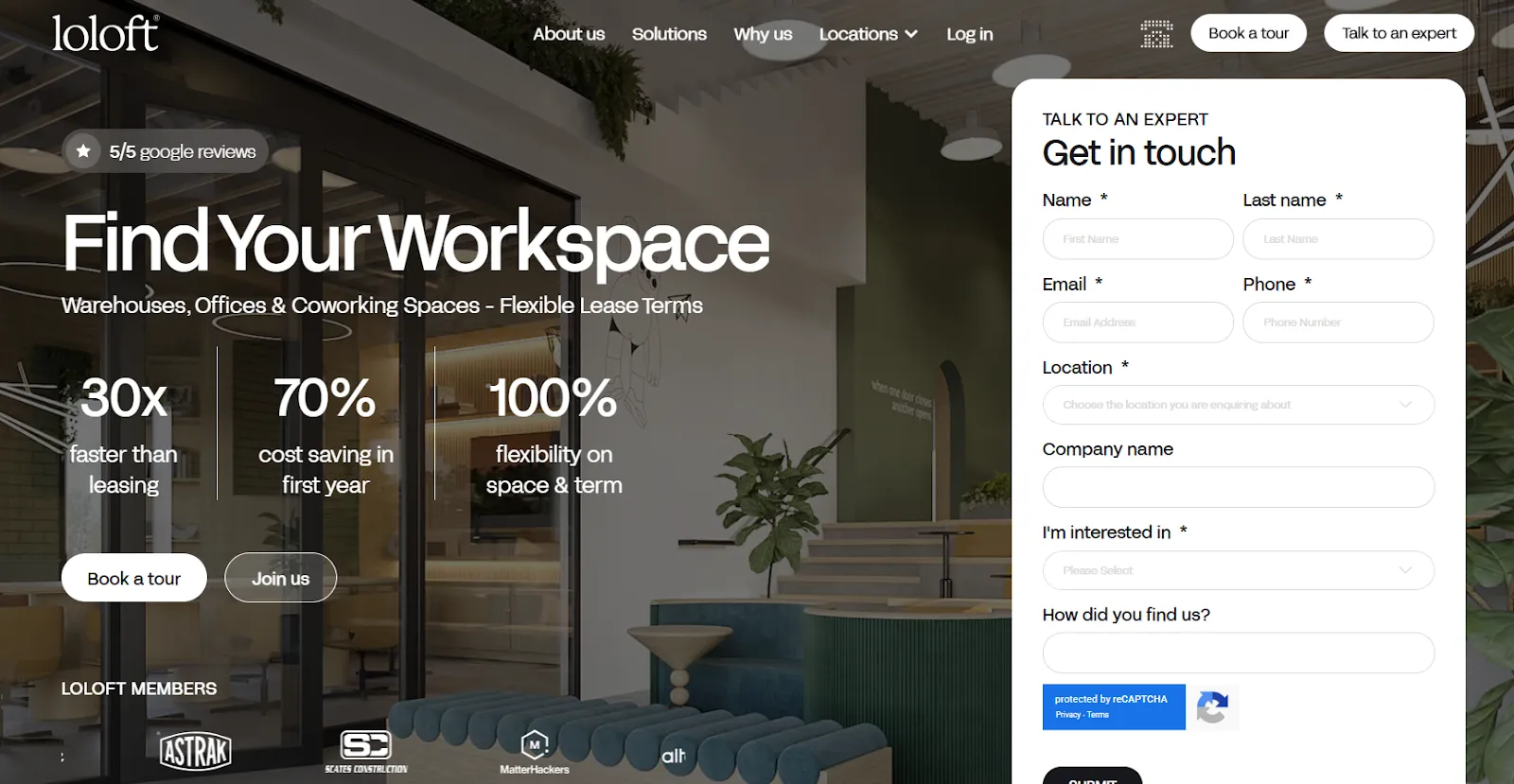
Loloft combines modern coworking, private offices, storage, and flexible warehouse space under one roof, making it a unique alternative to Cubework for businesses that need both office and operational space.
Amenities and benefits
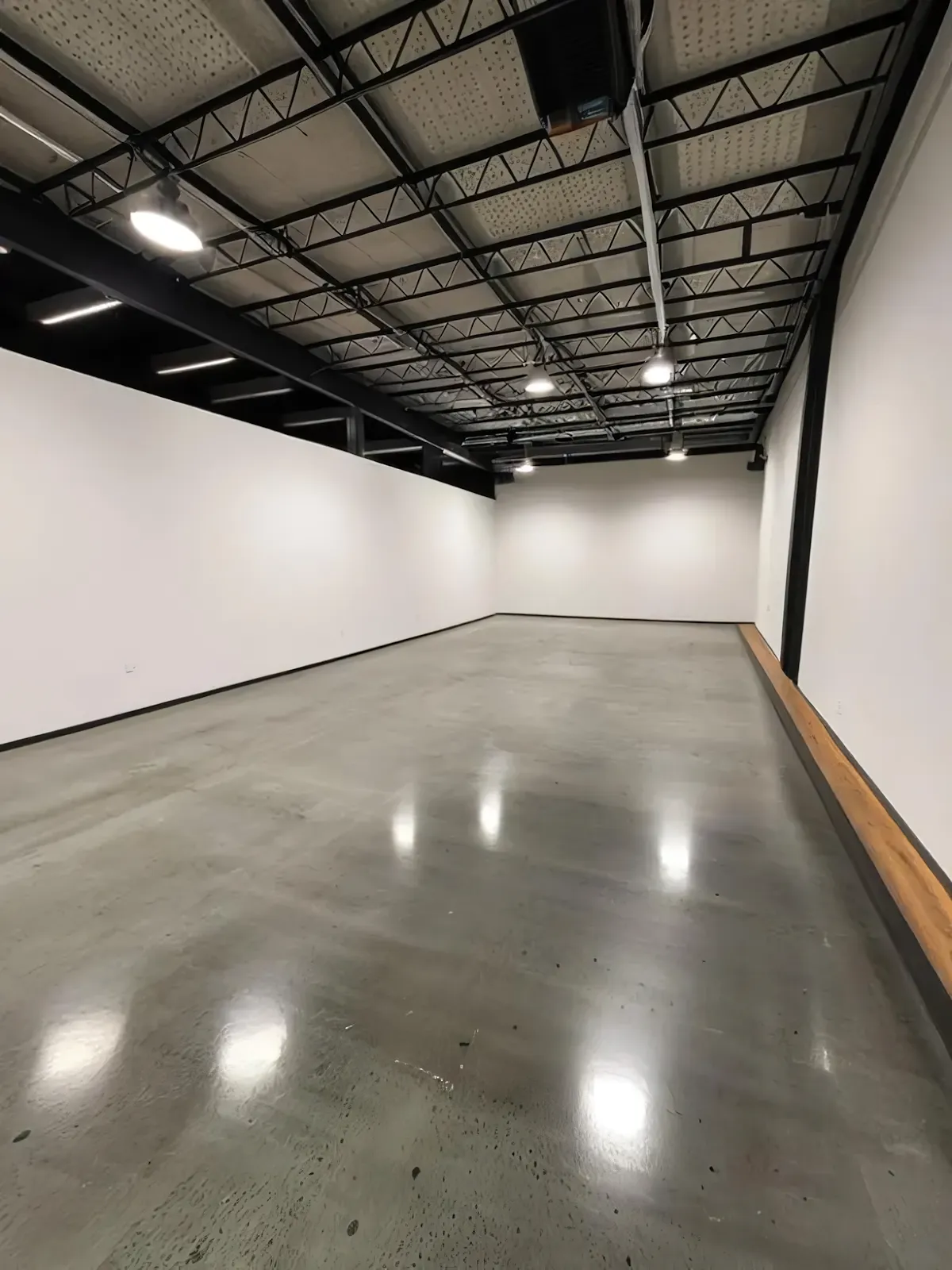
- Flexible memberships that include coworking areas, private offices, and warehouse space.
- High-speed internet, shared kitchen, and coworking lounge areas.
- You can book meeting rooms and classrooms.
- 24/7 access with access to shared warehouse tools and equipment
Pricing
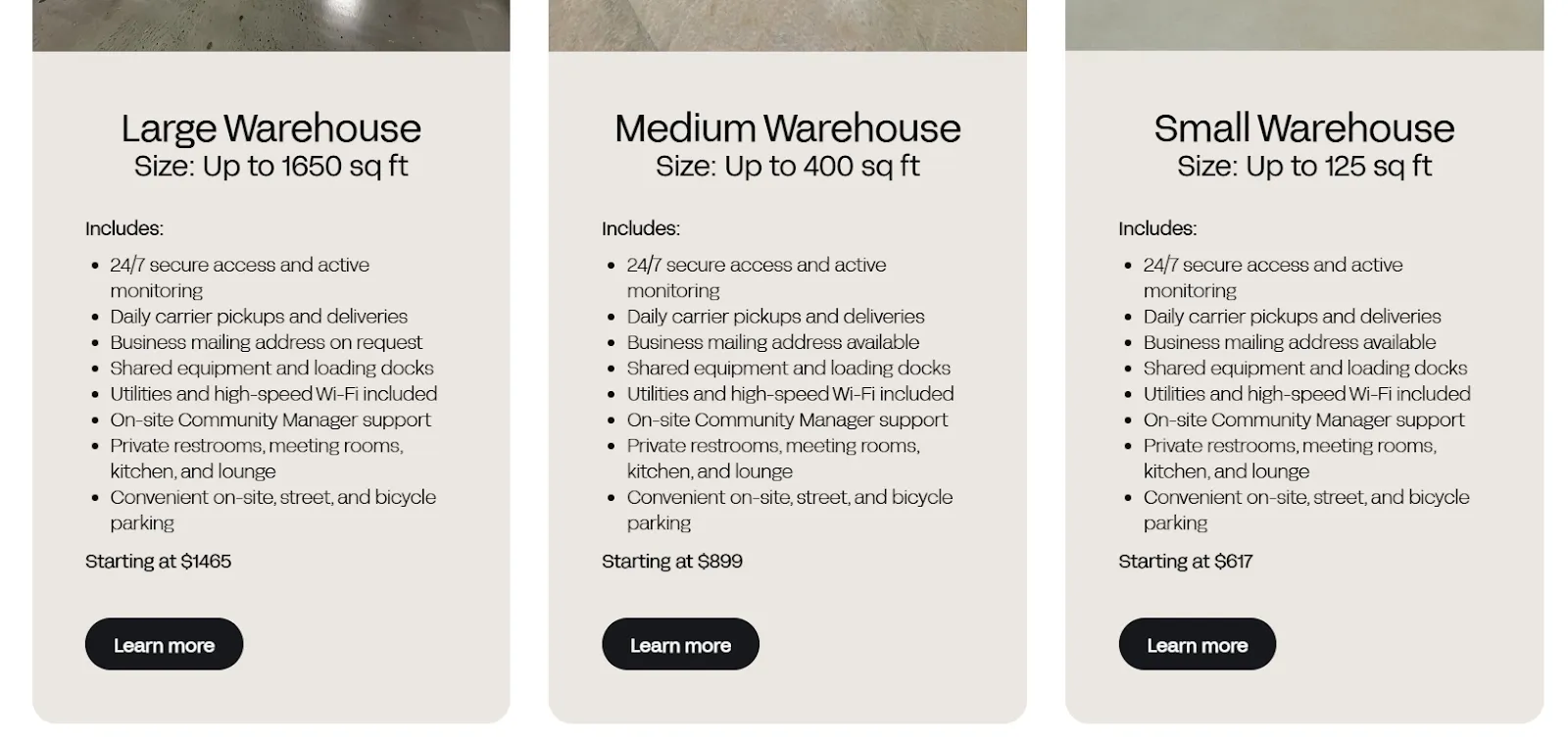
Loloft’s pricing is based on the type and size of space chosen, with month-to-month terms for office, warehouse, and coworking use.
Here are the price ranges for its services in Rogers:
- Warehouses: Starting at $617/month (125 sq. ft.) and going up to $1465/month (1,650 sq. ft.).
- Office spaces: Starting at $425/month for a dedicated small desk, and $1,299/month for a private office with a size of 182 sq. ft.
- Hot desks: Starting at $195/month with day passes at $15/person.
Pros and cons
✅ Affordable entry-level pricing when compared to other alternatives on the market.
✅ Mail handling is included in the pricing tiers.
✅ Free parking included.
❌ There are only 2 locations.
❌ I don’t see how you can scale in Loloft past 6-7 employees.
#4: ReadySpaces
Best for: Small businesses looking for a flexible warehouse and workspace with short-term leases.
Locations: 38 across the U.S.
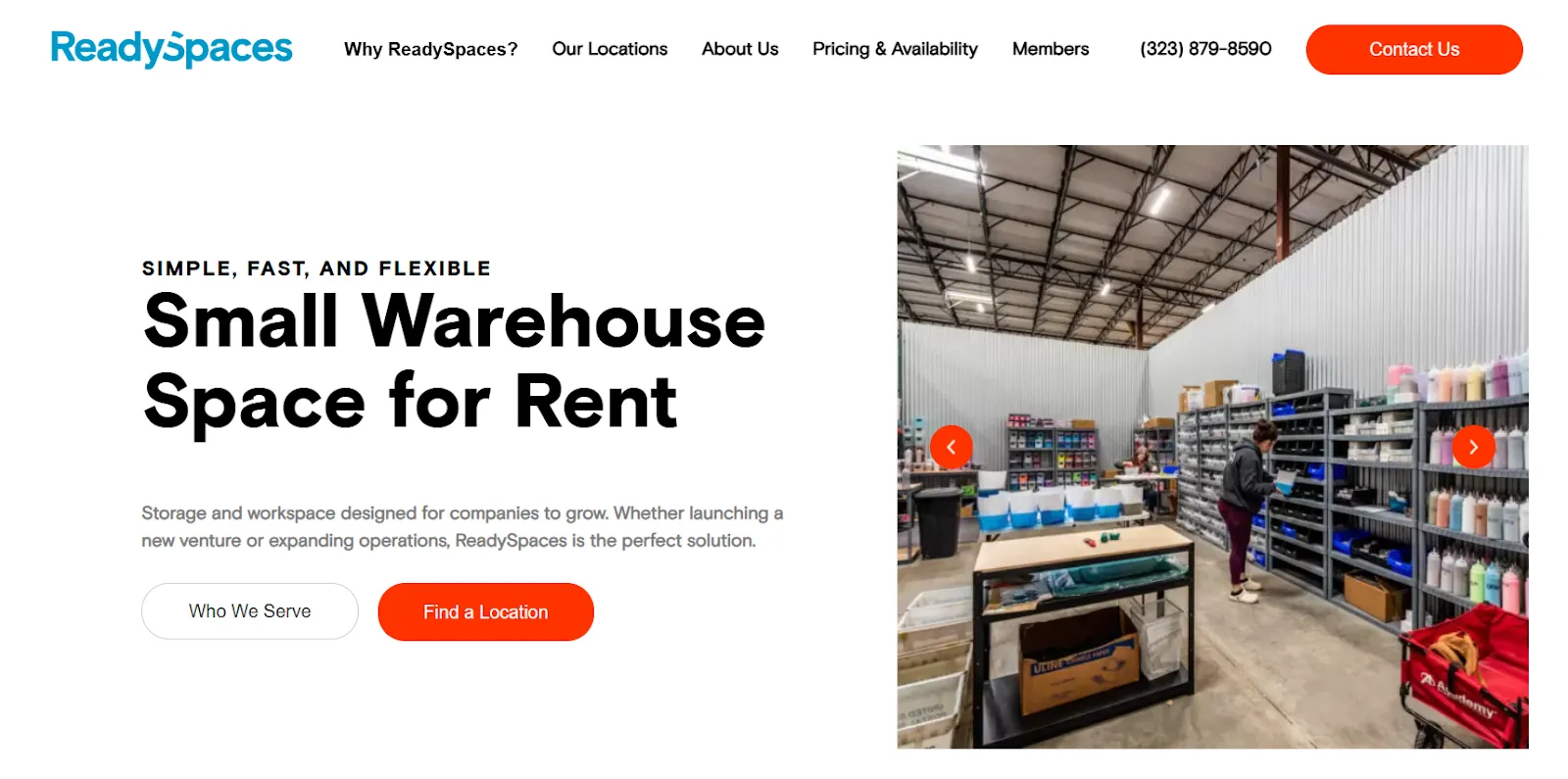
ReadySpaces provides flexible warehouse units that include coworking lounges, office spaces, and community areas alongside storage and operational space.
This makes it a practical alternative to Cubework if you want to blend office work with your logistics or distribution needs.
Amenities and benefits
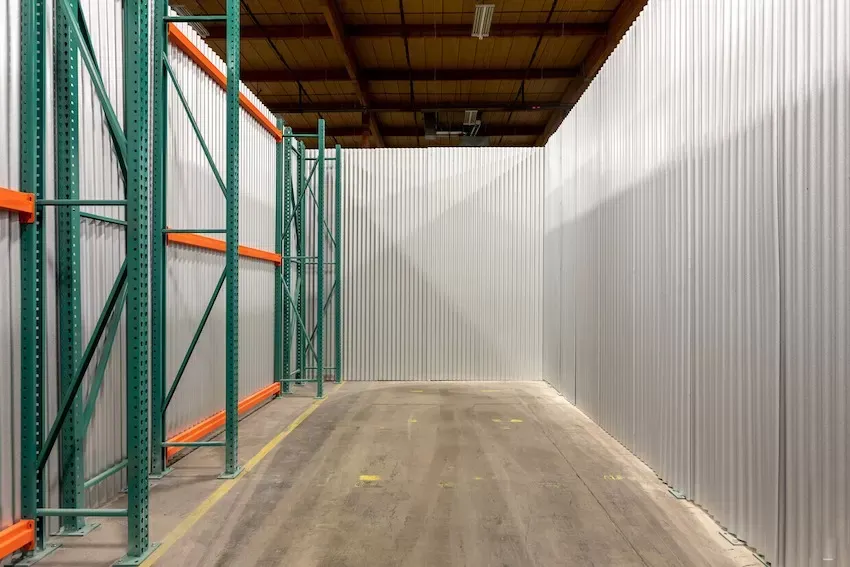
- Flexible warehouse units from 100 sq. ft. up to 5,000 sq. ft. and up with shared workspace.
- Conference rooms and private offices available at some locations.
- 24/7 access and security with community features.
- Access to forklifts, loading docks, and grade-level bays.
Pricing
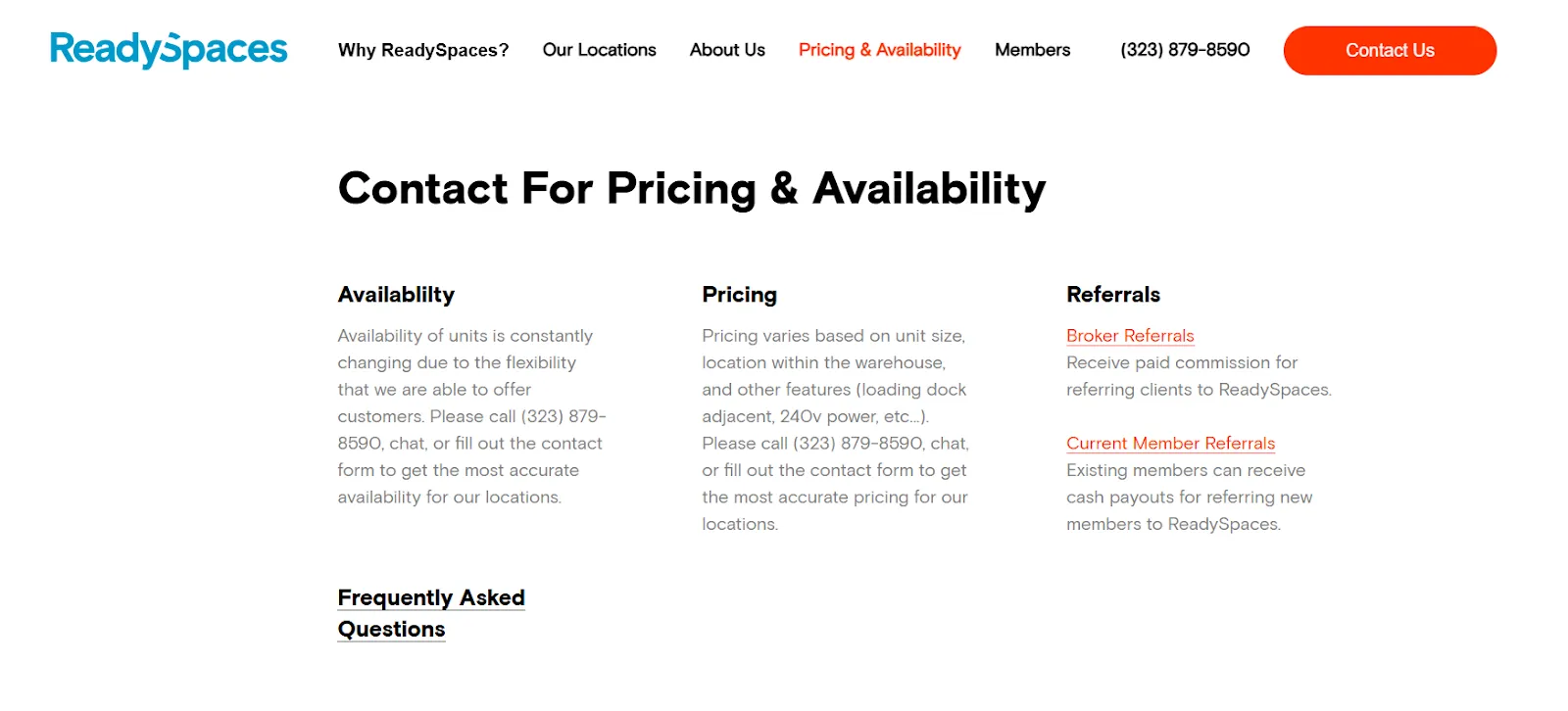
ReadySpaces’ pricing is fully custom.
According to its website, its pricing varies based on unit size, location within the warehouse, and other features (e.g., loading dock adjacent, and 240V power).
Pros and cons
✅ Flexible, short-term leases with no long-term commitment.
✅ Hassle-free lease process without unnecessary paperwork.
✅ Good national coverage.
❌ Seems to be more suited for physical logistics than traditional coworking.
❌ Office amenities can vary by location.
#5: Regus
Best for: Businesses of all sizes looking for a reliable serviced office space and coworking environment.
Locations: 1,786 in the U.S.
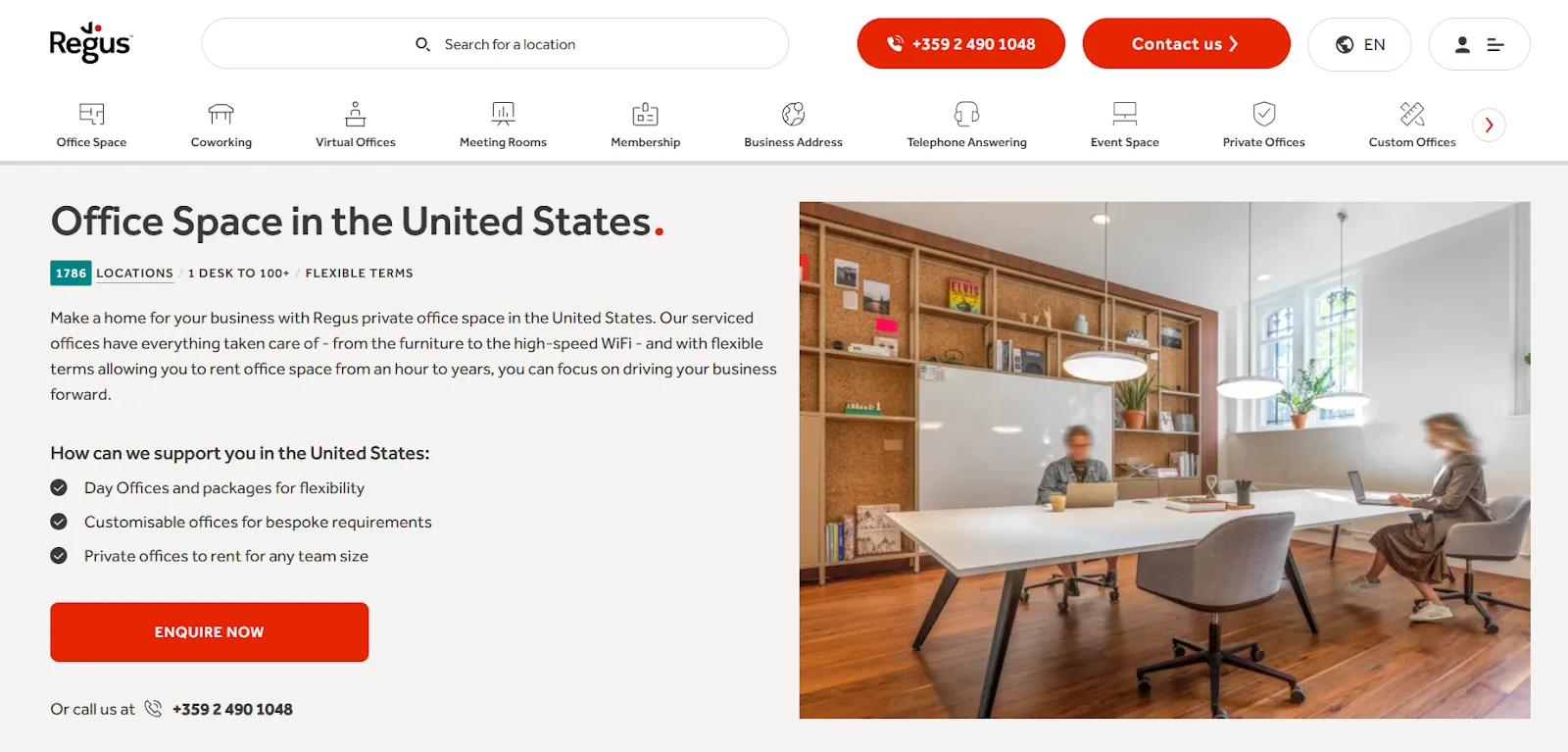
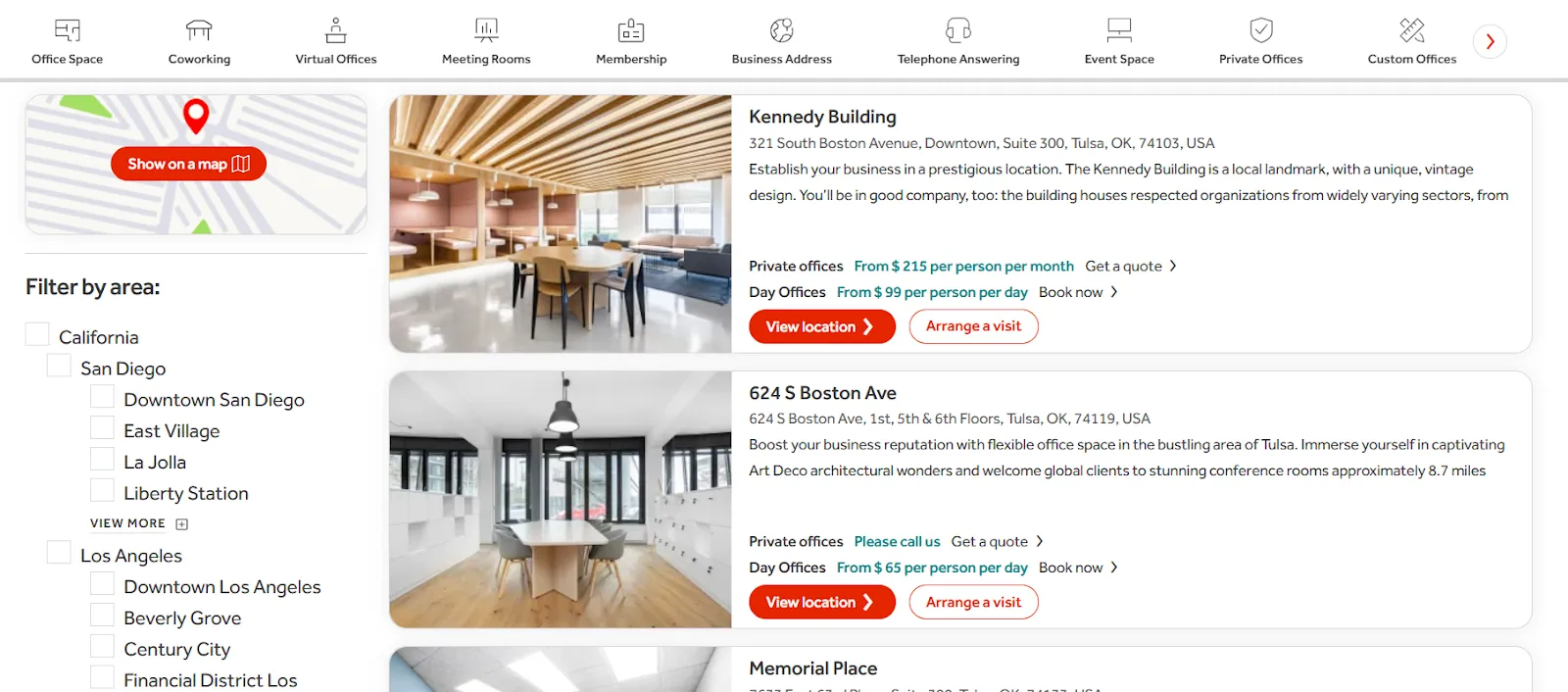
Regus is a well-established flexible workspace provider with thousands of locations, where you can get coworking spaces, dedicated desks, private offices, and meeting rooms on-demand.
It’s a strong alternative to Cubework because of its international coverage and professional services.
Amenities and benefits

- Hot desk and dedicated desk options in major cities.
- Fully serviced offices with reception, IT support, and utilities.
- An international network with easy booking and a professional environment.
Pricing
Regus’ pricing varies by city, office type, and membership option, with flexible plans available for hourly, daily, or monthly desk and office access.
Some of its offering includes:
- Private offices, starting from $75/person/month.
- Custom offices, starting from $75/person/month.
- Day offices, starting from $45/day.
- Office memberships, starting from $189/month.
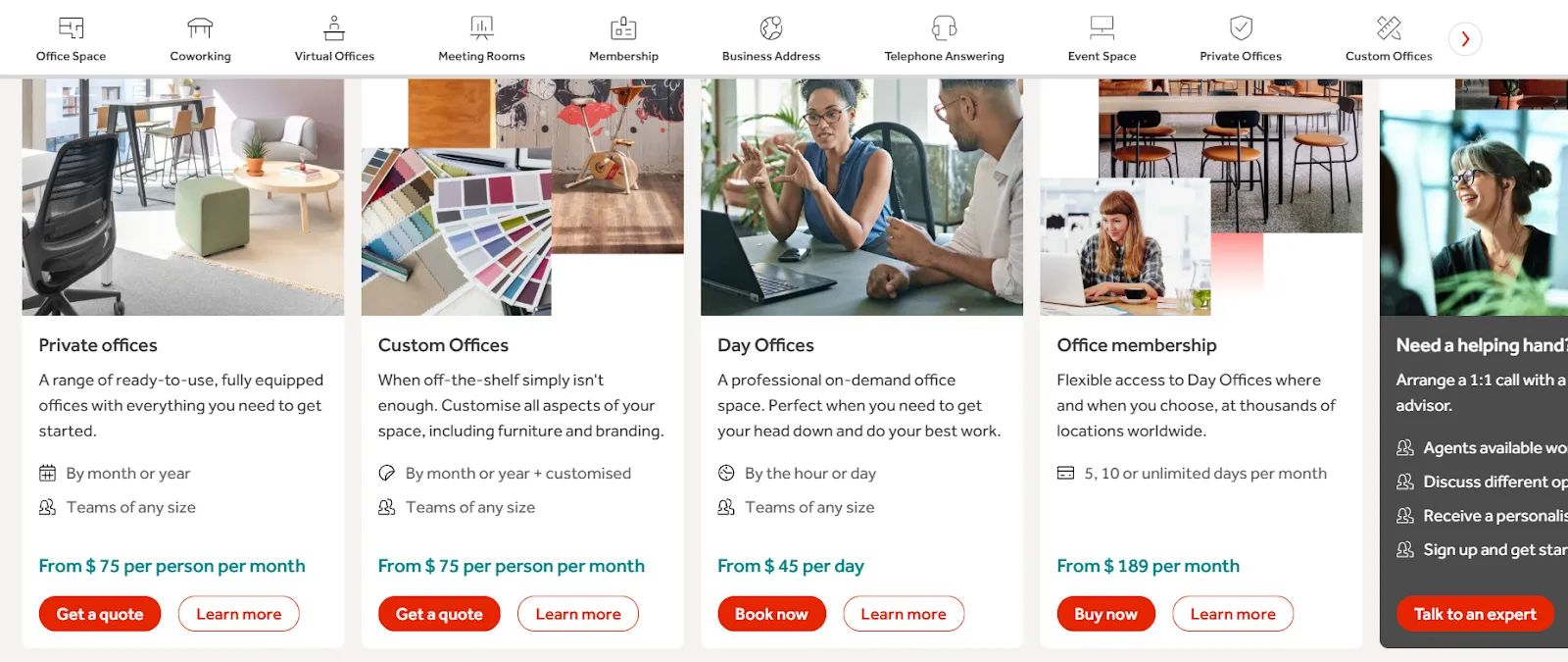
➡️ Note that every city and location will ultimately have its own pricing structure.
Pros and cons
✅ You can choose from fully equipped day offices, small offices, custom offices, or large suites.
✅ There is no minimum rental period.
✅ All offices are ready-to-use with high-speed WiFi.
❌ Can be more expensive than smaller local coworking spaces.
❌ Membership terms and pricing can be complex.
#6: WeWork
Best for: Startups and enterprises seeking vibrant coworking spaces with a community focus.
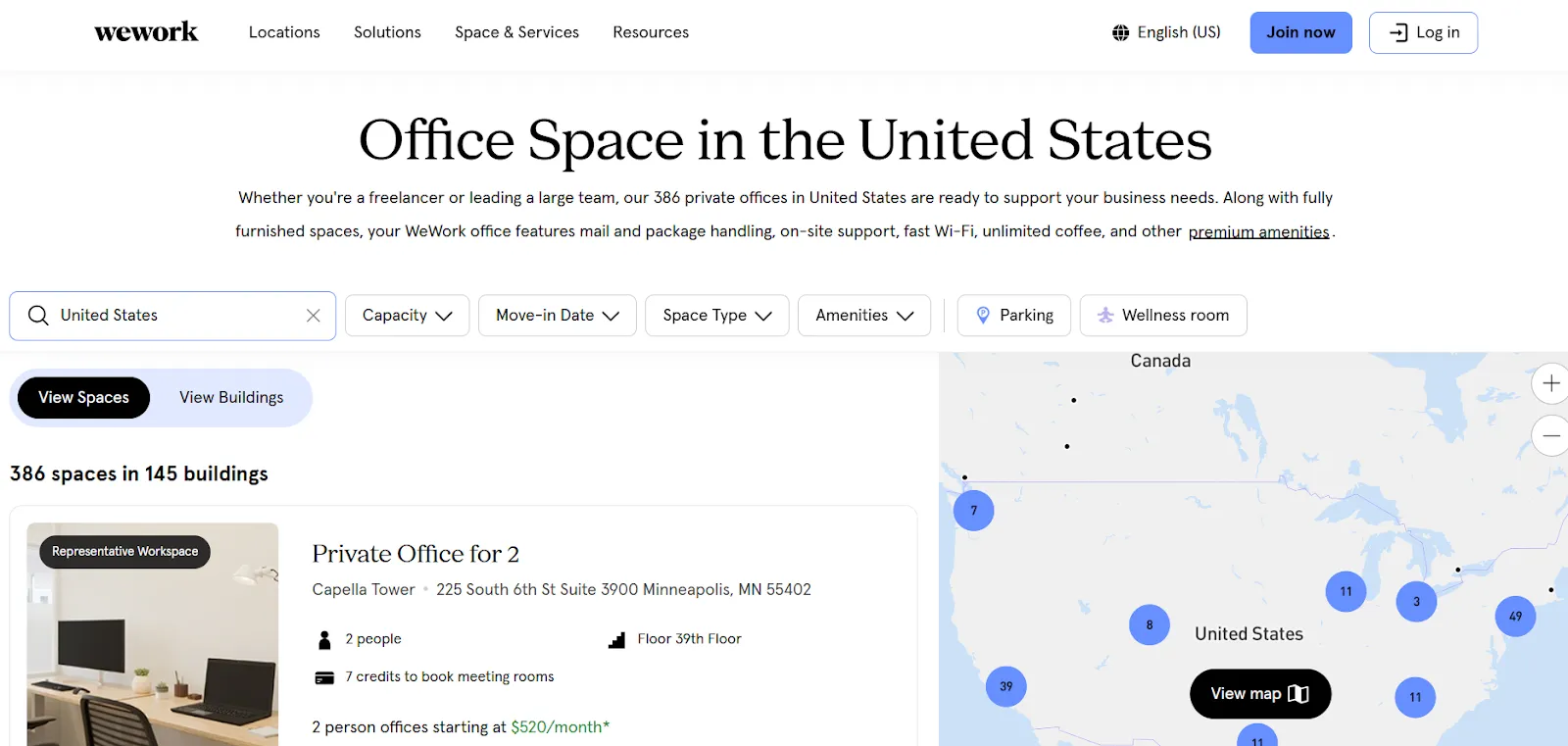
Locations: 386 private offices in the United States.
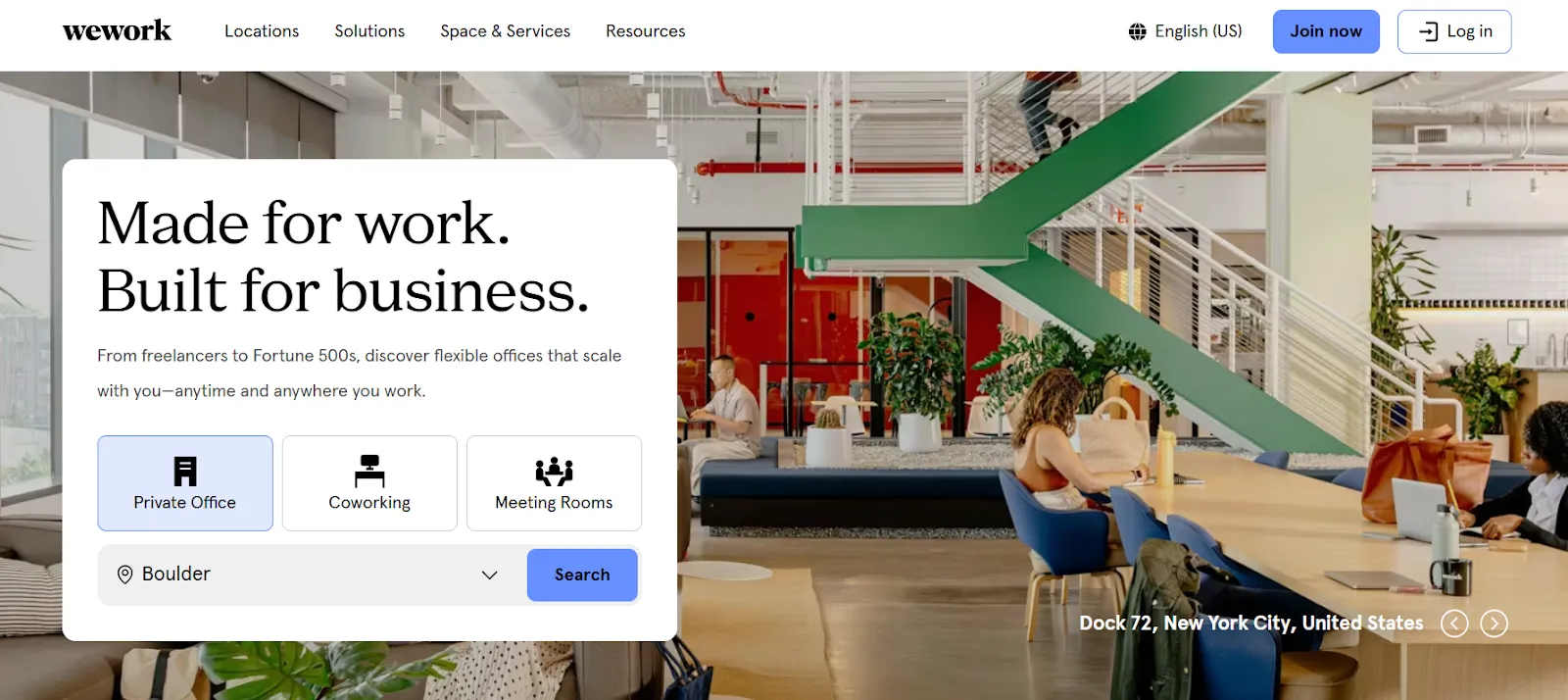
WeWork provides flexible coworking, private offices, dedicated desks, and meeting rooms across North America, making it a viable alternative to Cubework for ecommerce teams looking for an office space.
It also offers pay-as-you-go and monthly memberships for hybrid teams.
Amenities and benefits

- High-speed WiFi, coffee, beer on tap, events, and networking in modern spaces.
- International access in 100+ cities, print and scan services, and mail handling.
- On-site staff, phone booths, and wellness rooms at many of its locations.
- Showers, parking, bike storage, and an outdoor space in some locations.
Pricing
WeWork’s pricing varies by location. For example, a 2-person office in Minneapolis would start from $520/month.
Pros and cons
✅ Many U.S. locations, including in major cities like NYC, LA, and Chicago.
✅ Community events for networking purposes.
✅ Flexible payment terms: you can pay hourly, monthly, and annually.
❌ WeWork does not handle package receiving or shipping on behalf of ecommerce members, unlike some other alternatives on the market.
❌ Expensive pricing in prime markets.
#7: WareSpace
Best for: Businesses looking for flexible flex warehouse and light industrial space with workspace and operational amenities.
Locations: 20 cities across the U.S.
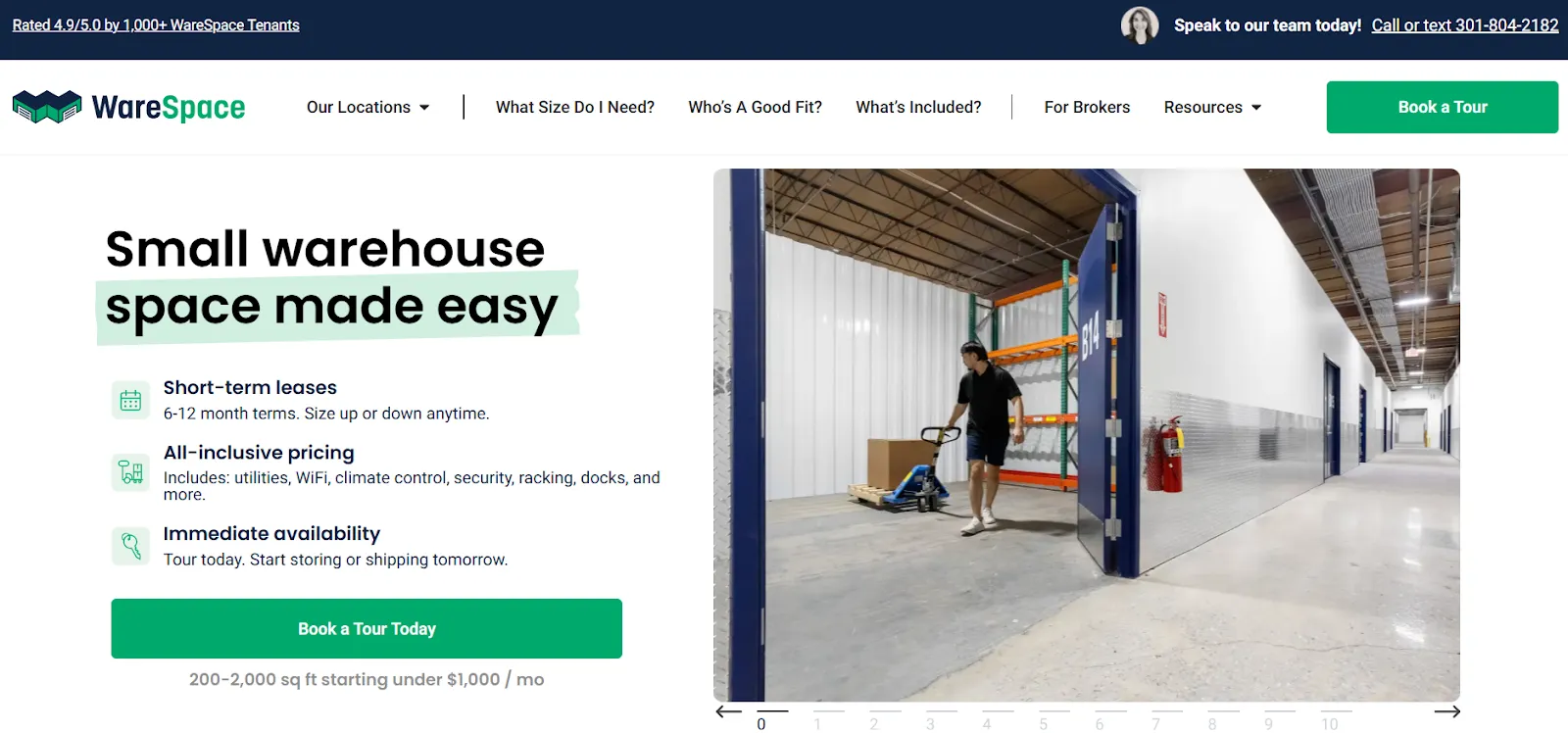
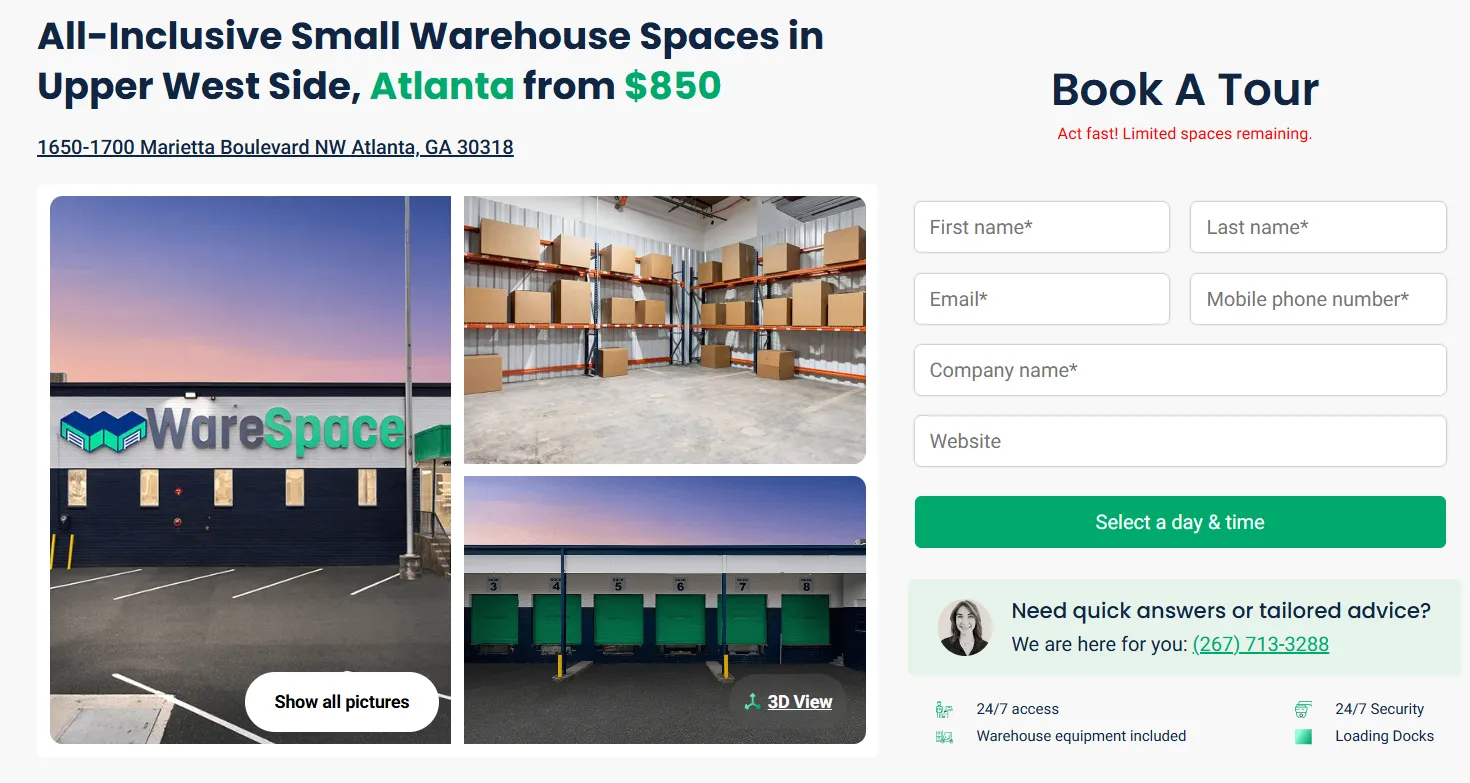
WareSpace provides all-inclusive small warehouse units from 200-2,000 sq. ft. for storage, fulfillment, and light operations, which I think is ideal for e-commerce or contractors looking to scale their ecommerce operations.
Amenities and benefits
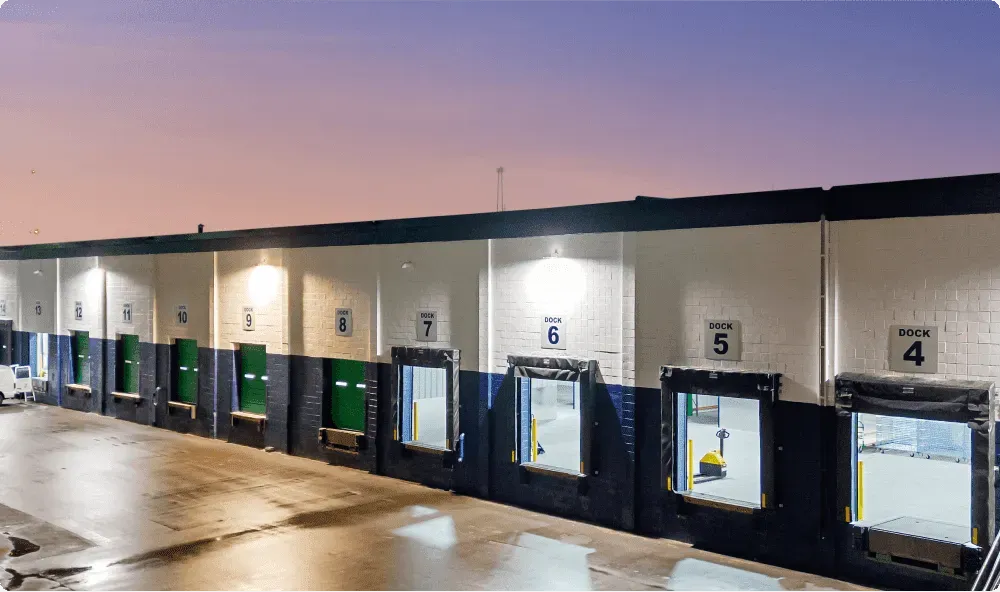
- Utilities, WiFi, pallet jacks, and loading docks included.
- Industrial racking in every unit and access to warehouse equipment.
- Shared kitchens, lounges, conference rooms, cleaning, and security.
- Climate-controlled year-round with 24/7 access.
Pricing
Starts from $1,000/month for 200-2,000 sq. ft. in some places, while it starts from $850/month in other places (e.g., Atlanta), all-inclusive with no hidden fees.
However, you’ll have to book a tour to get a final price tag, depending on what space you’d need and in which city you’d need it.
Pros and cons
✅ All-inclusive flat fee simplifies budgeting.
✅ Spaces range from 200 to 2,000 sq. ft. with shared spaces.
✅ Every location is designed to have the right amount of docks, so there will never be a traffic jam.
❌ Some members have had poor experiences in some locations.
❌ Standard agreements are for 6 or 12 months.
#8: FlexHQ
Best for: Teams and entrepreneurs looking for an immediate move into a curated, flexible office and coworking locations without long-term leases.
Locations: 6, including Los Angeles, Denver, Plano, Salt Lake City, Nashville, and Charlotte.
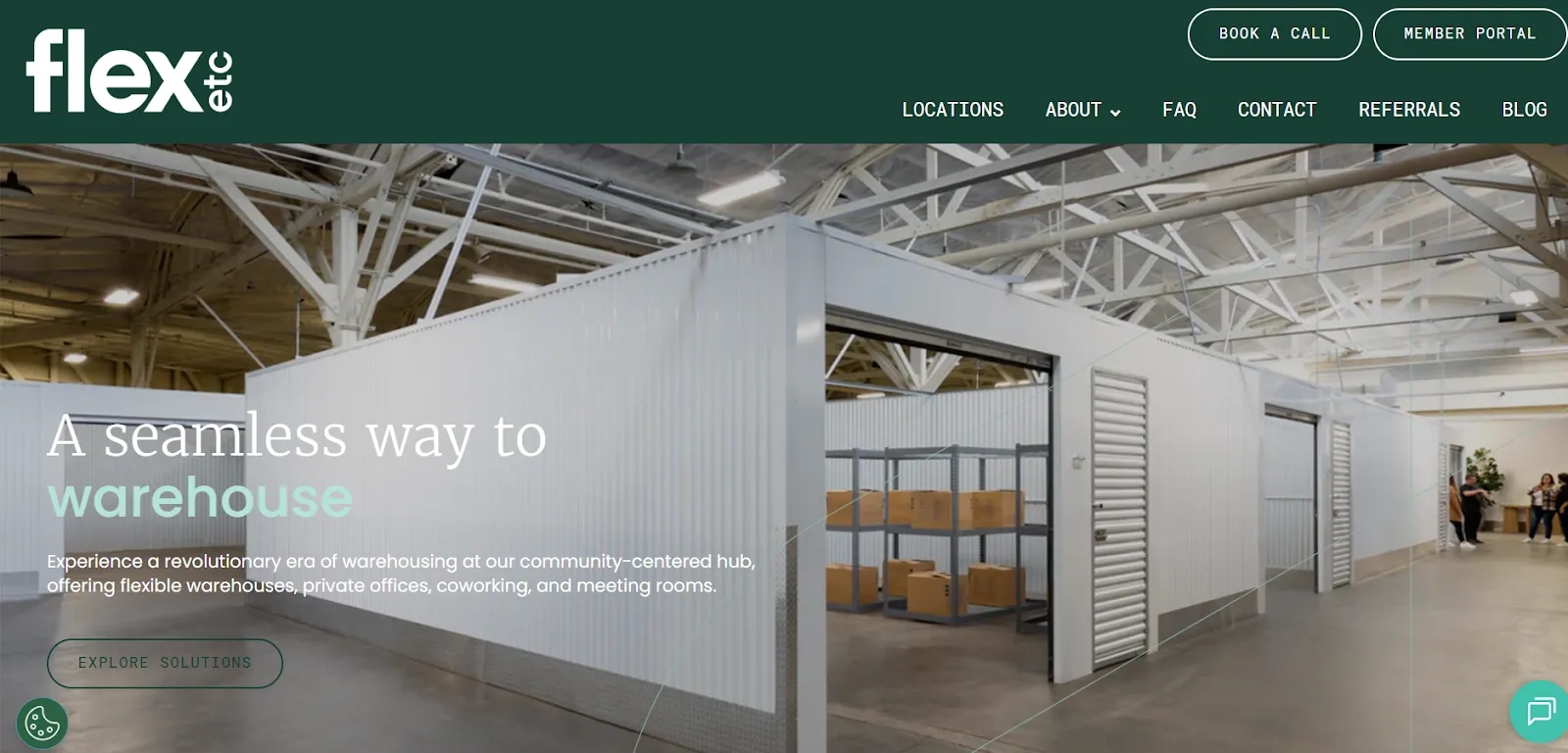
FlexHQ is a co-warehousing company that converts large industrial spaces into flexible, shared environments with smaller warehouse units, offices, and studios.
The service is a viable alternative to Cubework for ecommerce teams looking for modern shared facilities (they also partnered with Ware Malcomb, an international design firm) and private offices.
Amenities and benefits

- Flexible coworking memberships and private office options.
- Professional office environment.
- On-site staff, secure facility, and included amenities.
Pricing
I was not able to find information about FlexHQ’s pricing. You’ll have to contact them to get a quote.

Pros & Cons
✅ No long-term lease commitments and immediate move-in.
✅ Professional office and collaboration environment.
✅ Modern workspaces that were designed with the help of a designer.
❌ Warehouse spaces start at 300 sq. ft., which can be too big for startups.
❌ Fewer locations than other competitors on the market.
#9: Portal Warehousing
Best for: Ecommerce brands and startups needing flexible small warehouse spaces with coworking amenities.
Locations: 7 across U.S. cities, including Salt Lake City, Phoenix, Orlando, Minneapolis, Manhattan, Los Angeles, and Brooklyn.
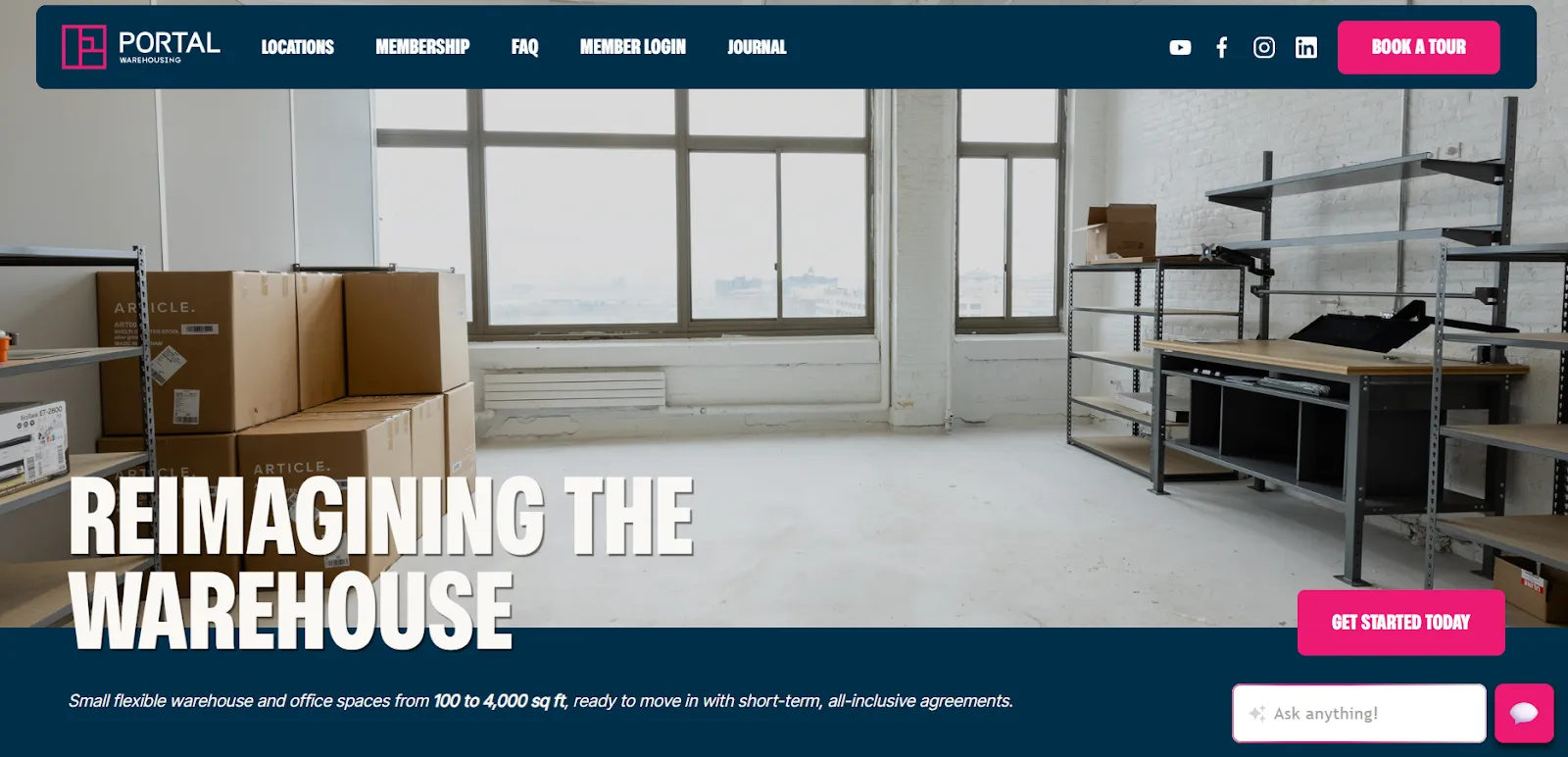
Portal Warehousing delivers turnkey warehouse units from 100-4,000 sq. ft. that blend storage, fulfillment, and office spaces for scaling ecommerce businesses.
It’s a strong alternative to Cubework due to its all-inclusive model, community events, and logistics support in high-demand urban markets.
Amenities and benefits
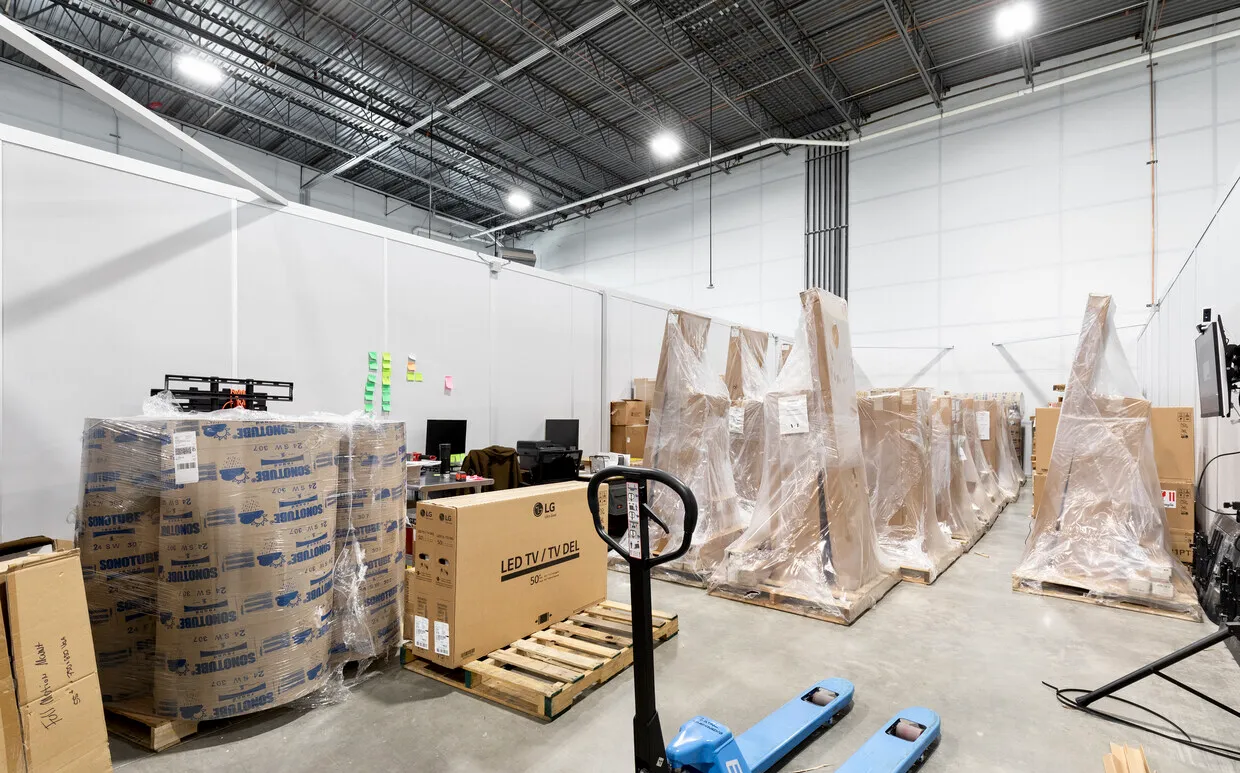
- All-inclusive utilities, high-speed WiFi, loading docks, racking, security, and daily carrier pickups.
- Private offices, shared lounges, reception, and shipping addresses.
- Move-in-ready units with flexible terms in strategic spots near highways and labor pools.
- Community events for networking purposes.
Pricing
Portal Warehousing has 3 membership tiers that you can choose from:
- Small warehouse space: From 250 to 500 sq. ft. that start from $995/month.
- Medium warehouse space: From 500 to 1,000 sq. ft. that start from $1,795/month.
- Large warehouse space: 1,000+ sq. ft. that starts from $2,995/month.
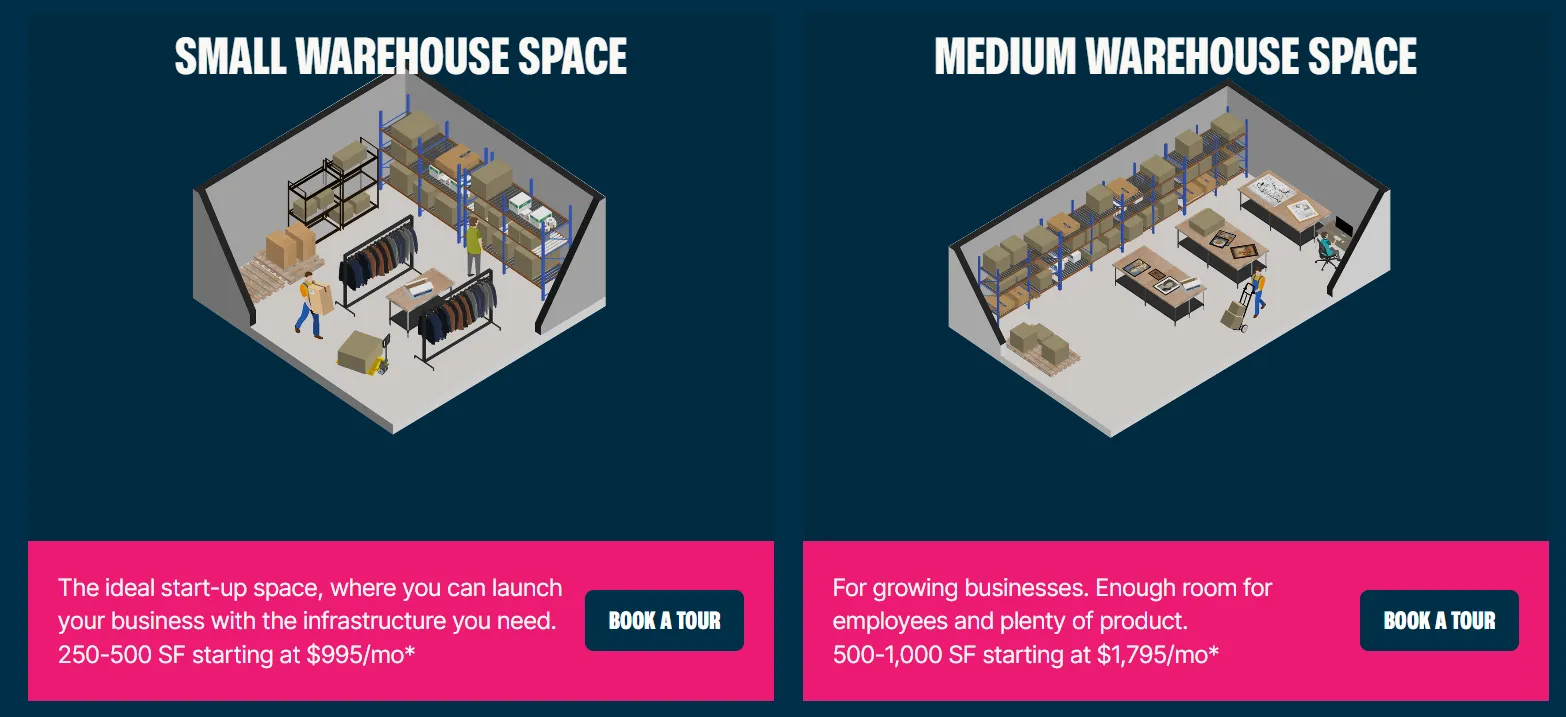
➡️ Beware that the solution’s pricing varies by location, availability, and membership options.
Pros and cons
✅ No long-term commitments, which I think is ideal for growth-stage ops.
✅ Synergistic locations near interstates and competitors for logistics efficiency vs. Cubework's model.
✅ Flexible warehouse and office spaces from 100 to 4,000 sq. ft. that are ready to move in.
❌ Fewer locations than other alternatives on the market.
❌ No option to hire an extra pair of hands when you need it.
#10: Upflex
Best for: Distributed teams needing access to flexible workspaces across the U.S. and the rest of the world.
Locations: Technically 11,000+.
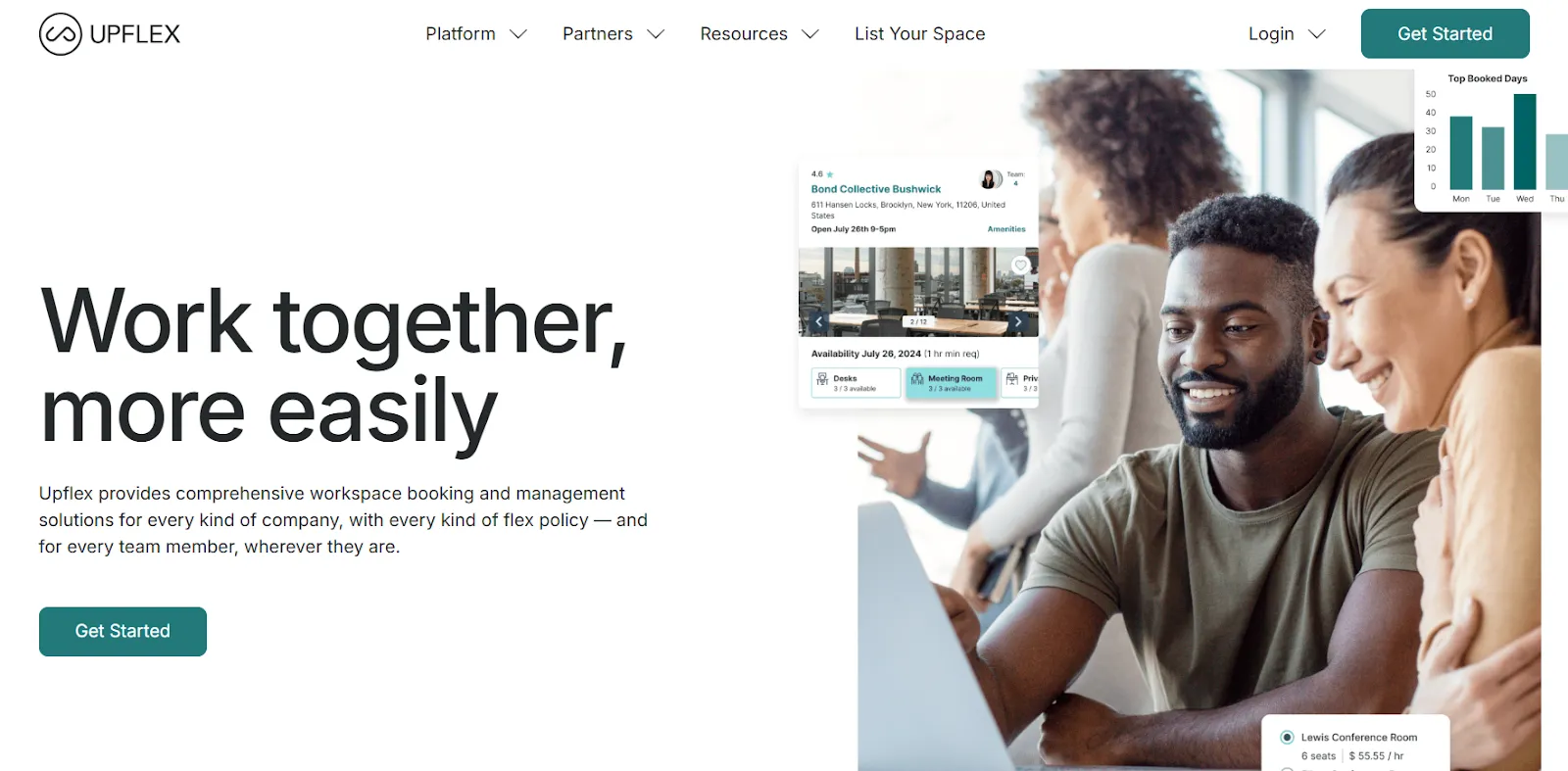
Upflex can connect you to a large network of coworking spaces, meeting rooms, and private offices that can be booked on demand or through memberships.
I think of it as a strong alternative to Cubework because it enables hybrid companies to offer flexible workspace benefits without long-term leases.
Amenities and benefits
- Access to thousands of workspace locations worldwide with desk, office, and meeting room options.
- Centralized booking and management tools for teams.
- Flexible plans that support remote workers and dynamic schedules.
- You’ll also be able to track and analyze space usage.
Pricing
I was not able to find Upflex’s pricing on its website, so I had to look up third-party sources that have reported on its pricing structure.
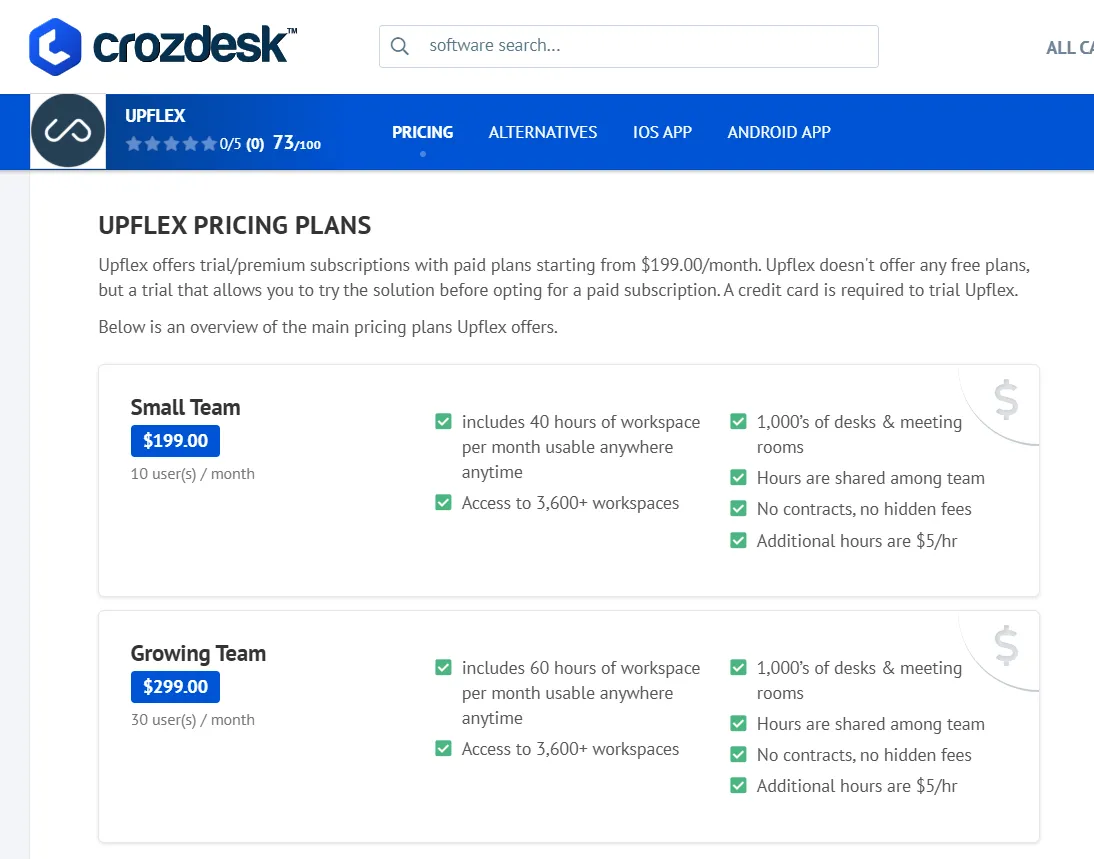
According to Crozdesk, there are 2 main pricing plans that Upflex offers:
- Small Team: $199/month for 10 users, which includes 40 hours of workspace/month usable anywhere across all of their workspaces. Additional hours being $5/hour.
- Growing Team: $299/month for 30 users, which includes 60 hours of workspace/month.
Pros and cons
✅ Easily browse and book space on the web or on mobile.
✅ Integrations for HR, collaboration, security and complicance, and flex space operations.
✅ The platform offers flexible plans that support remote workers.
❌ Does not offer warehouse spaces: only offices.
❌ The additional hours can stack up.
Choose Saltbox to be your logistics partner from your first sale to full scale
With customer expectations rising (thanks again, Amazon), we know that SMEs are being pushed to the fringes of the logistics industry.
If you aren’t happy with Cubework’s co-warehousing space offering, you’re not going to be short on alternative options.
Saltbox removes the biggest friction that we saw early-stage ecommerce founders face: not only finding a place that combines inventory, shipping infrastructure, and an office in one place, but also finding a community that you can rely on and an extra pair of hands when you need it.
As George Baker put it, the founder mindset is a paradox. It needs to let go, but fears that things won't get done right.
Saltbox’s team helps founders elevate their focus from packing boxes to building products.
Our solution offers month-to-month suites and membership plans starting at $99/month for growth-stage DTC brands that do not want to pay 4 months in advance, sign an annual warehouse lease, or manage fulfillment all by themselves.
You can talk to an expert to learn more about Saltbox and why 1,000+ businesses have chosen us, or book a tour at one of our facilities to show you around.
Related reading
- Peak Season challenges and solutions: The complete how-to guide for all things holiday.
- Unpacking the benefits of co-warehousing: Learn why more and more ecommerce founders choose co-warehousing.
- Understanding the U.S. shipping carrier market: A beginner's guide.
- What is flex space? Find out about the benefits of flexible warehousing for ecommerce operations.
- Saltbox vs 3PL: How can you choose which one is right for your company?
- How to find companies offering scalable space for logistics operations: Find out about the common types of warehousing solutions and the key elements of a scalable warehousing solution.
Frequently asked questions
Yes. The parallel-run method lets you migrate inventory and orders to a new provider while your current 3PL continues to fulfill. The key is sequencing the move by SKU, starting with slow-movers, and setting clear rules for which provider handles which orders during the overlap.
Request a fully itemized invoice and add up every fee that touches a single order: pick fee, pack fee, materials, carrier rate, and any applicable surcharges. Divide that total by your order count for the period. Don't use your quoted rate as the baseline. Use the actual invoice.
Co-warehousing differs from a traditional 3PL in that it gives small businesses direct access to their inventory, flexible terms, and on-site resources.
Traditional 3PLs give you access to shared fulfillment infrastructure on their terms. Saltbox is a co-warehousing model, which means members get private warehouse suites they control, an on-site team that's physically present, and access to Parsel, Saltbox's shipping platform partner, for discounted shipping and real-time tracking.
The model is built for founders who want the support of a fulfillment partner without giving up visibility and control. Read more here about how Saltbox compares to traditional third-party logistics providers.