.webp)


Key takeaways
- Saltbox is the strongest GoBolt alternative in 2026 for product brands that want their own warehouse suite, hands-on operations help, cheaper shipping, and month-to-month billing, all without an order minimum hanging over them.
- The co-warehousing group also covers WareSpace, Portal Warehousing, FlexHQ, ReadySpaces, Cubework, and TradeSpace, any of which fits when the main goal is four walls of your own to hold stock in.
- On the outsourced side, Flowspace, Flexe, and FlexSpace Logistics run fulfillment for you, with Flowspace mapping most closely to GoBolt's tech-led distributed network and FlexSpace Logistics carrying the kind of Canadian coverage GoBolt is known for.
If you are weighing GoBolt alternatives in 2026, the field tends to split into two camps: providers that let you keep your hands on the inventory, and providers that take the whole job off your plate the way GoBolt does.
This guide runs through 10 options drawn from both camps, with each one's footprint and the work it handles, so you can settle on the model that suits how your brand ships before committing to anyone.
What are the best alternatives to GoBolt in 2026?
The top three GoBolt alternatives for 2026 are Saltbox, WareSpace, and Flowspace, and which one wins depends on how much of the operation you would rather hold onto.
Saltbox is the pick for brands that want to stay close to their inventory, while Flowspace is the better fit when outsourcing across a national footprint is the goal.
The table below lines all 10 up together, with footprints and the services each one covers:
What are the best co-warehousing alternatives to GoBolt in 2026?
The best co-warehousing alternatives to GoBolt in 2026 are Saltbox, WareSpace, Portal Warehousing, FlexHQ, ReadySpaces, Cubework, and TradeSpace.
In this model, you take a private unit and the keys come with it.
You share the wider building and its shipping gear with neighboring brands, which gives you the occasional bit of networking, though the unit and the stock inside belong to you alone.
When orders are light, you pack them at your own pace, and when a launch overwhelms the day, you can call in a crew on-site to dig you out.
The operators below are the ones worth shortlisting.
#1: Saltbox
Saltbox pairs a private warehouse suite with an operations team on the floor, and that mix is why it tops my list of GoBolt alternatives for 2026.
You keep fulfillment under your own roof, yet you are never stranded during a peak week, since extra hands can be booked by the hour in 15-minute blocks.
A traditional 3PL ties you to volume targets and a long agreement, whereas Saltbox stays month to month from the membership up.
The level of involvement is yours to set, from packing each parcel personally to passing the whole workflow to Saltbox Fulfillment.
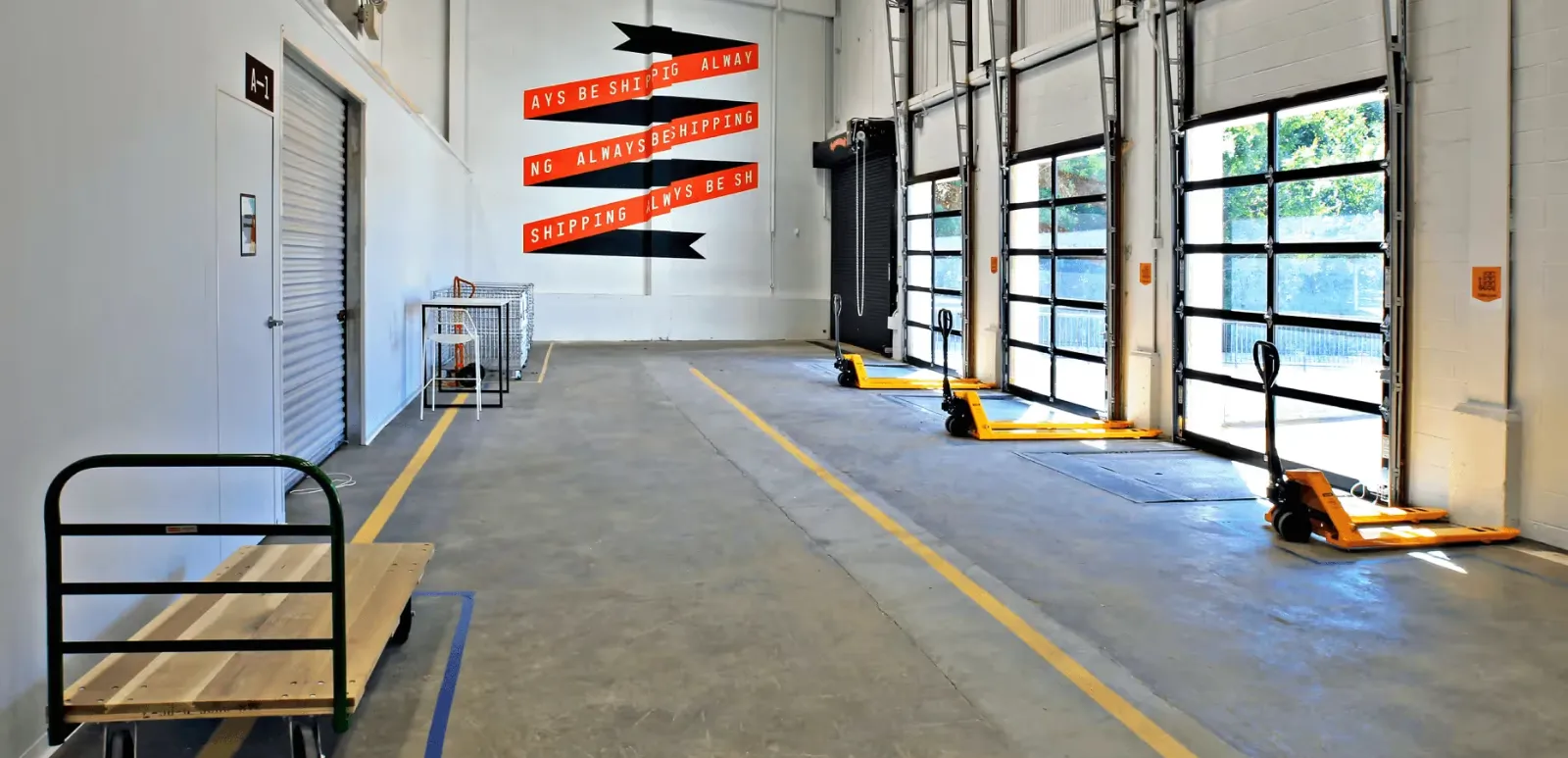
Full disclosure: Saltbox is our product. Here’s an accurate look at what makes it the strongest GoBolt alternative in 2026.
Let's go over the services and amenities that have helped brands like PURioLABS, Shinery, and GOLDN The Brand get off the ground: 👇
Warehouse suites that scale with your order count
Each Saltbox building comes in four sizes, and shifting between them is straightforward as your volume rises or eases off.
The sizes break out as follows:
- Small: 70 to 250 sq. ft., 4 to 15 pallets, fits 1 to 2 people. A sensible base for a solo founder or a tight two-person setup.
- Medium: 250 to 500 sq. ft., 16 to 31 pallets, fits 1 to 4 people. Headroom for a brand whose SKU list and order count are both growing.
- Large: 500 to 1,000 sq. ft., 32 to 62 pallets, fits up to 10 people. Plenty of floor for a wider catalog and reliable daily dispatch.
- Extra Large: 1,000 to 5,000+ sq. ft., 63 to 125 pallets, fits up to 50 people. Deep storage alongside a proper team area for a settled brand.
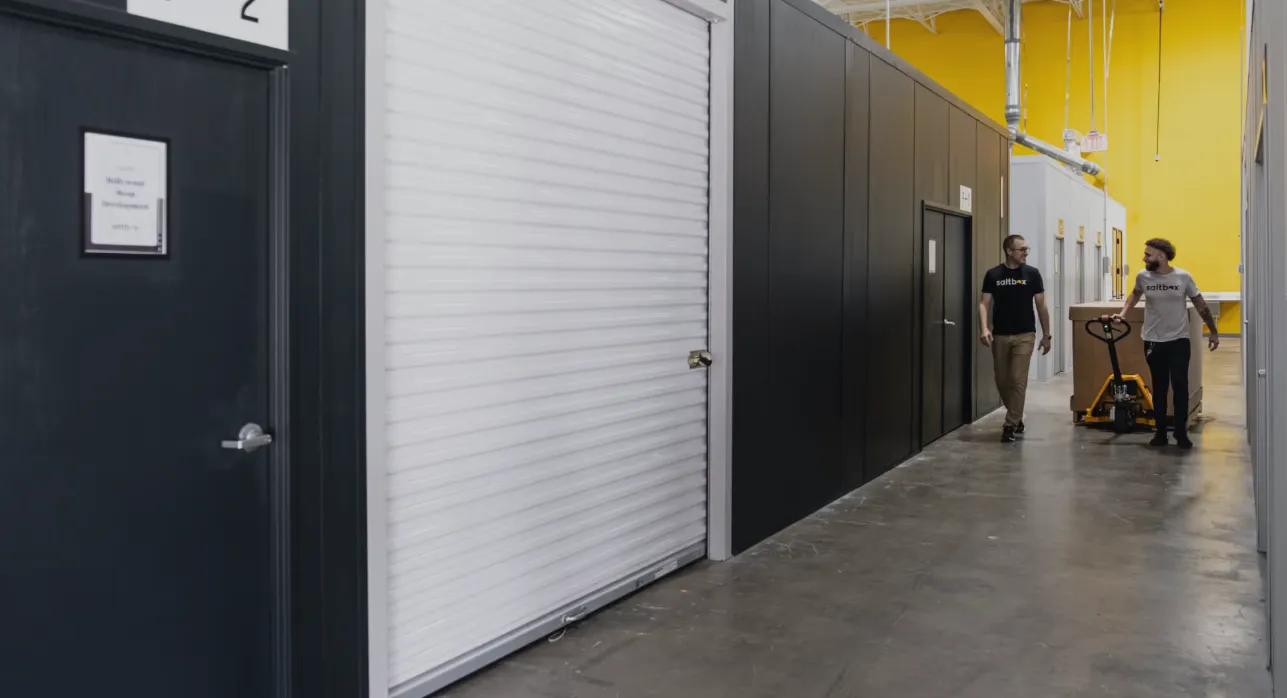
➡️ Book a tour and the team will help you pin down the size that tracks with your volume.

Get the perks before committing to a suite
A Saltbox Access Plan gives you a mailing address, receiving services, discounted rates, on-site labor, and an entrepreneur network without a warehouse lease.
Explore Access PlansHow fulfillment runs day to day at Saltbox
A suite can be set to any of three modes:
- Self-service has you handling every pick on your own.
- Assisted lets you draft in support for product launches and the holiday crunch.
- Fully managed turns pick, pack, and ship over to Saltbox Fulfillment from beginning to end.
Hourly labor opens at $45, charged in 15-minute blocks, with each pick at $3, so a spike in demand will not force a permanent hire you second-guess once the new year settles in.
Your membership also brings:
- Daily carrier collection, which means a labeled order leaves the building without a trip to the post office.
- Inbound receiving at no extra cost, so your freight gets logged and put away even when nobody from your side is on the floor.
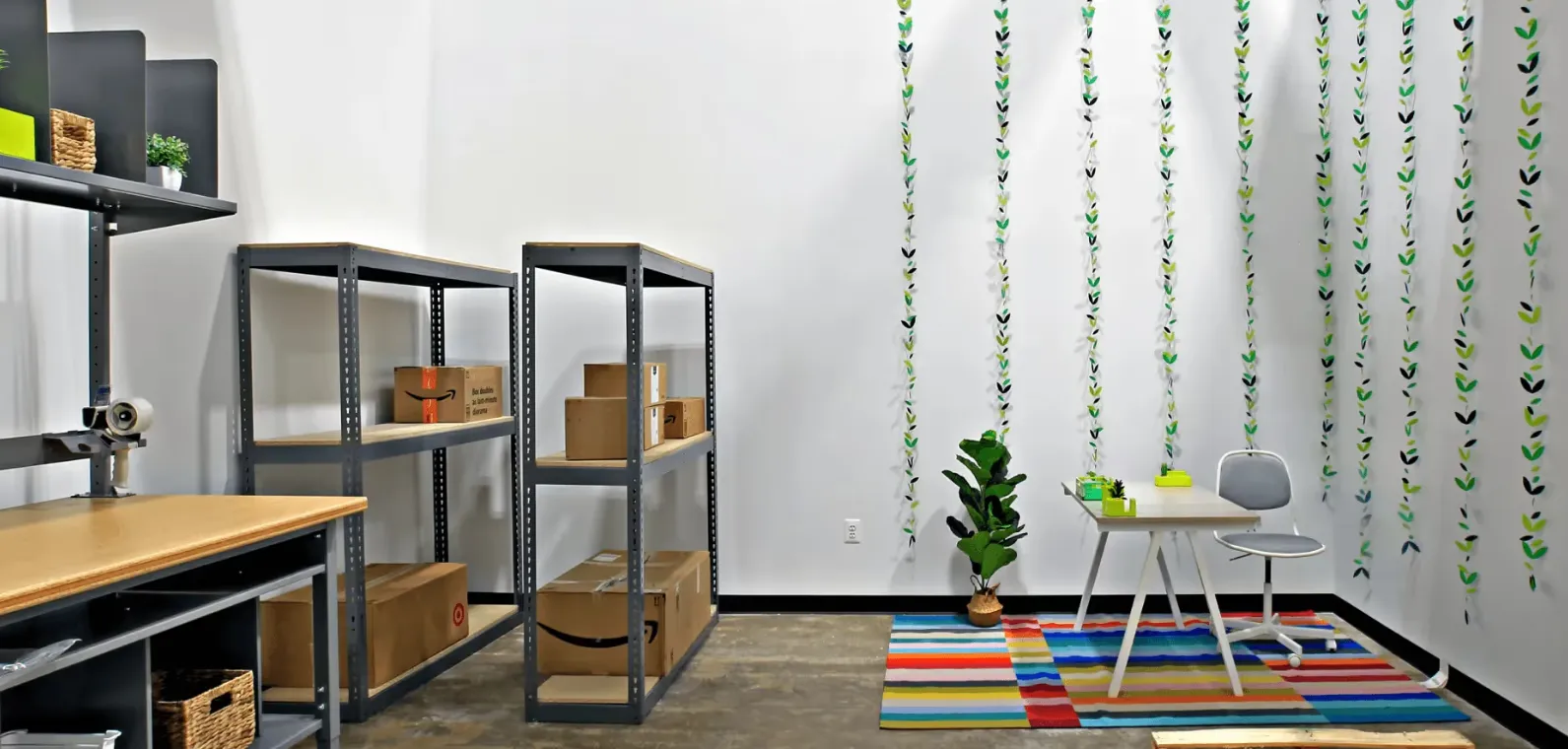
- An on-site content studio stocked with lighting and backdrops for photographing and filming product.
- In-suite 120V power, fast Wi-Fi, bookable meeting rooms, a kitchen and lounge, printing, pallet jacks, shelving, and 24/7 monitored security.
- Lower shipping costs through Parsel bundled into every membership at no charge. The shipping app lets you weigh live carrier rates, print labels right up to a 4:30 PM cutoff, and book the pickup from the same window.
Find out more about how we help make shipping easier for growth-stage ecommerce brands: 👇
Saltbox locations across the U.S.
Saltbox operates 12+ U.S. buildings, with sites on both coasts and through the country's center:
- Los Angeles, San Gabriel Valley.
- Los Angeles, Torrance.
- Phoenix.
- Seattle, SoDo Row.
- Denver, Park Hill.
- Dallas, Carrollton.
- Dallas, Farmers Branch.
- Atlanta, Upper Westside.
- Atlanta, Westside Park.
- Washington D.C., Alexandria.
- Miami, Doral.
- Atlanta, Chamblee.

Tour the location you have in mind
Book a tour and walk it with our operations team. Slots run Mon-Fri, 8:30 AM to 4:30 PM Central Time.
Book a TourHow is Saltbox different from GoBolt?
Saltbox and GoBolt both get parcels to your customers, but they part ways on who runs the operation each day and how far the service reaches.
GoBolt is a full-service 3PL that takes on warehousing, pick and pack, shipping, returns, and last-mile delivery across the U.S. and Canada, leaning on an electric-vehicle fleet and carbon-neutral delivery.
It’s best for brands already pushing thousands of orders a month, and signing on moves your stock into GoBolt-run fulfillment centers that you monitor through their tracking and warehouse software.
Saltbox flips that model by letting you keep control of your inventory in a unit only you can open.
Holding the keys means you can work the orders yourself, or use the on-site team once a week turns hectic.
The contrast plays out in a few ways:
- A stock count is a walk down your own aisles whenever you like, with no dashboard refresh to wait on.
- Packaging and inserts get put together in your suite, so your branding holds together, and no kitting charge lands on each order.
- One flat monthly figure covers the suite and membership, in place of layered volume commitments and add-on service fees.
- Booking extra labor runs $45 an hour in 15-minute blocks, and a pick is a flat $3.
- A same-day rush still ships, since whoever carries that order to the dock is either you or the floor crew.
- Nothing in the agreement sets a floor on order count.
- You also land a seat in Upstream, the Saltbox community where members trade resources and introductions.
Credit where it is due: GoBolt is the smarter choice for a brand shipping thousands of orders that wants a single provider on both fulfillment and last-mile delivery across North America.
However, a growth-stage brand that wants a hand with operations and still values walking into its own space midday is the one I would steer toward Saltbox.
Saltbox membership, warehouse, and office plans
Saltbox pricing starts with a membership tier, then adds an optional warehouse suite and an optional office.
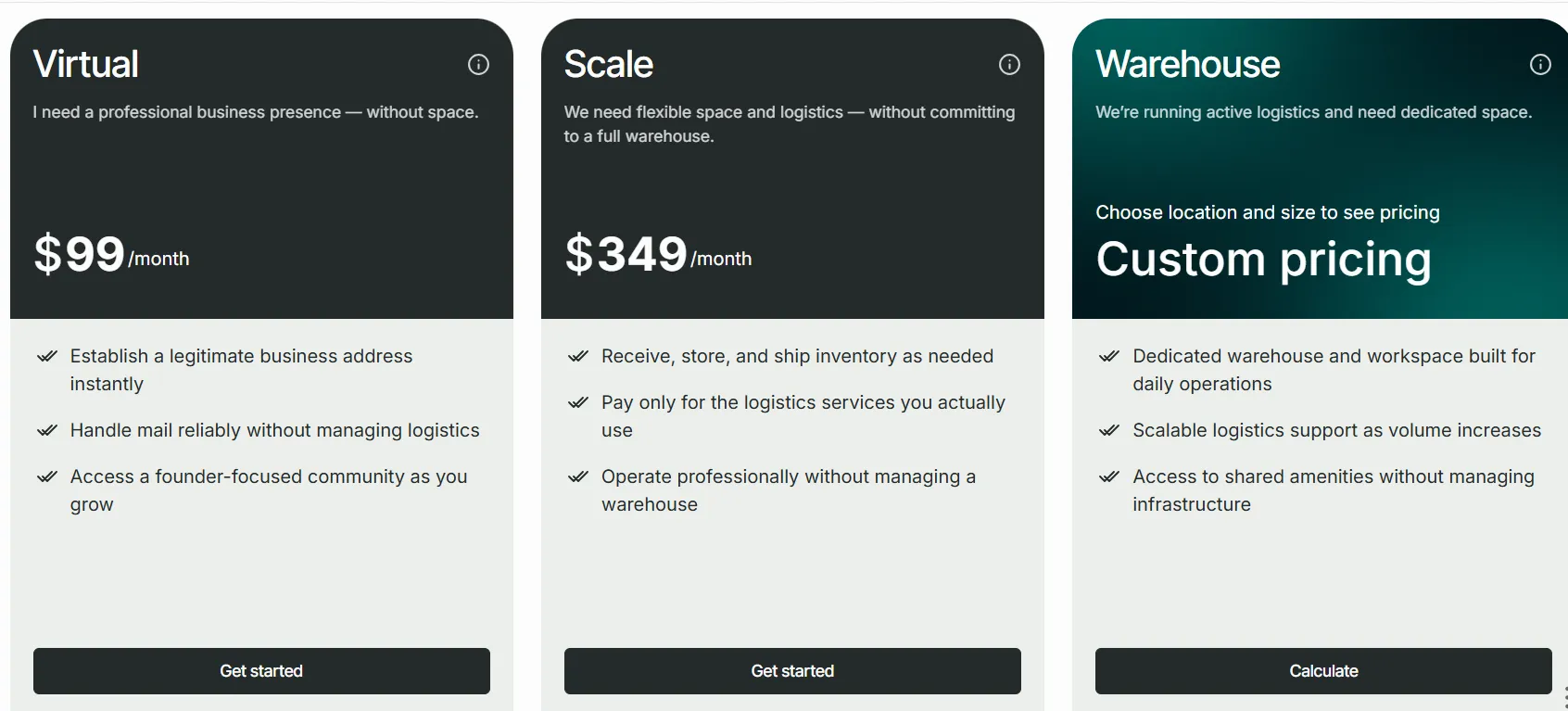
There are 3 membership tiers:
- Virtual ($99/month): a remote-only plan with a professional mailing address for letters (no packages), plus entry to the Upstream Entrepreneurs Club.
- Access (from $349/month): on-site entry to Saltbox buildings, including the loading dock, packing stations, meeting rooms, and content studio, before you take a suite.
- Warehouse (custom pricing): the full package, with a flexible suite, on-site operations help, shipping infrastructure, and the building's full amenity set.
Suite rates shift from city to city. For example, Atlanta's Upper Westside looks like this:
- Small Warehouse, from $1,157/month when billed annually: 70 to 250 sq. ft., 4 to 15 pallets, 1 to 2 employees.
- Medium Warehouse, from $1,890/month when billed annually: 250 to 500 sq. ft., 16 to 31 pallets, 1 to 4 employees.
- Large Warehouse, from $3,591/month when billed annually: 500 to 1,000 sq. ft., 32 to 62 pallets, 1 to 10 employees.
- Extra Large Warehouse, from $4,581/month when billed annually: 1,000 to 5,000+ sq. ft., 63 to 125 pallets, up to 50 employees.
All of the warehouses and locations include:
- Loading docks.
- Daily carrier pickups.
- Secure mail and package receiving.
- Professional-grade equipment.
- Multiple conference rooms.
- A content studio.
- High-speed Wi-Fi.
- A fully equipped kitchen with community dining.
- 24/7 security.
- On-site operations staff.
- In-suite 120V power.
- Printing services.
Office pricing is regional, too. Here are the prices for Atlanta Upper Westside:
- 1-person office, $468/month when billed annually: one chair, one desk.
- 2-person office, $927/month when billed annually: two chairs, two desks.
- 3-person office, $1,305/month when billed annually: three chairs, three desks.
- 4-person office, $1,674/month when billed annually: four chairs, four desks.
Saltbox pros and cons
✅ Storage, shipping gear, and office space in one building, across 12+ U.S. sites.
✅ Inventory stays in a private suite, packed by you or by the crew on-site.
✅ You can pay monthly and not be locked into an annual contract.
✅ Preferential shipping rates through Parsel.
✅ Hourly labor in 15-minute increments.
❌ We will never be the cheapest, and we don't want to be.
#2: WareSpace
Best for: DTC brands shipping steadily that want one all-inclusive invoice and a unit nobody else touches.
Locations: 20 U.S. cities, among them Atlanta, Chicago, Dallas, Denver, Philadelphia, and Phoenix.
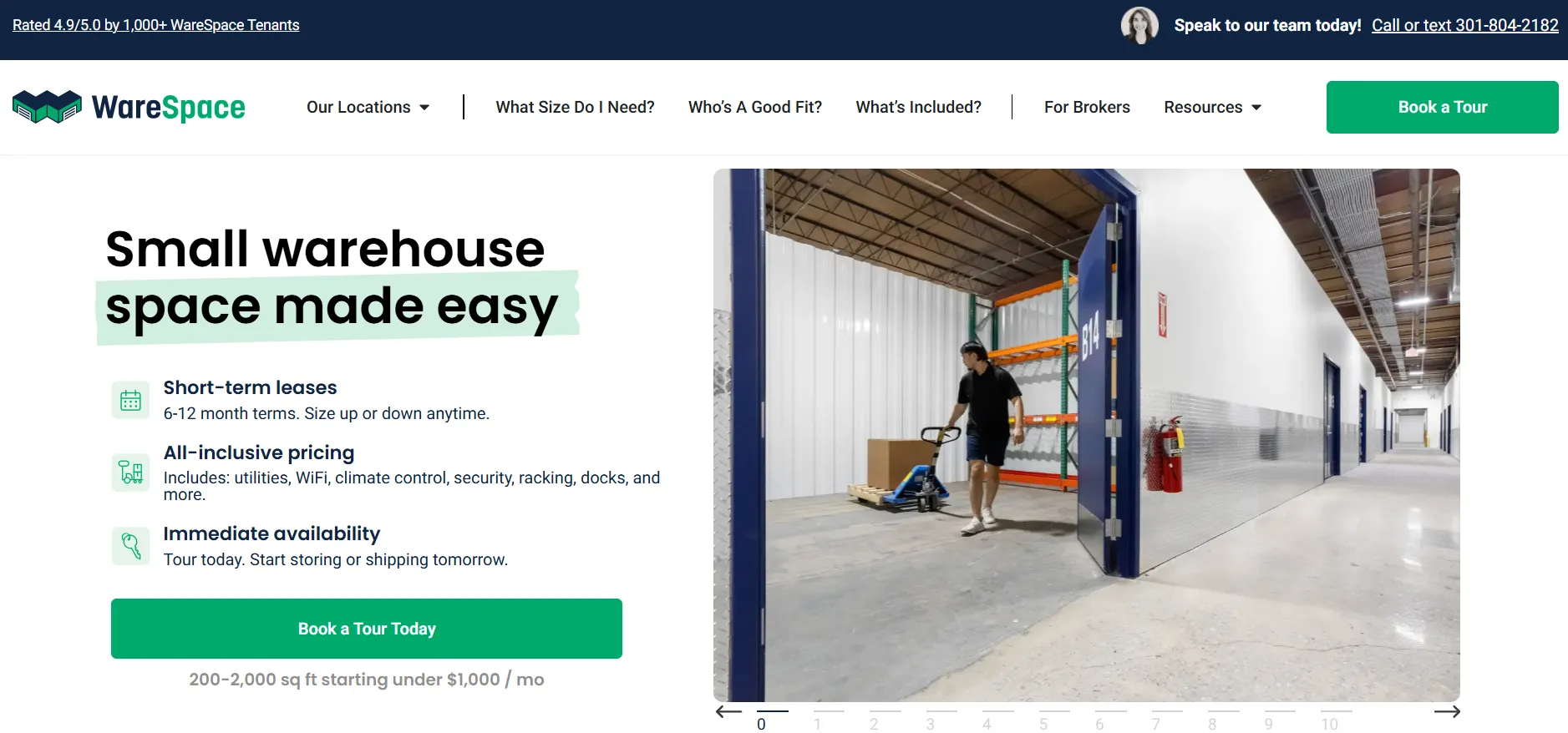
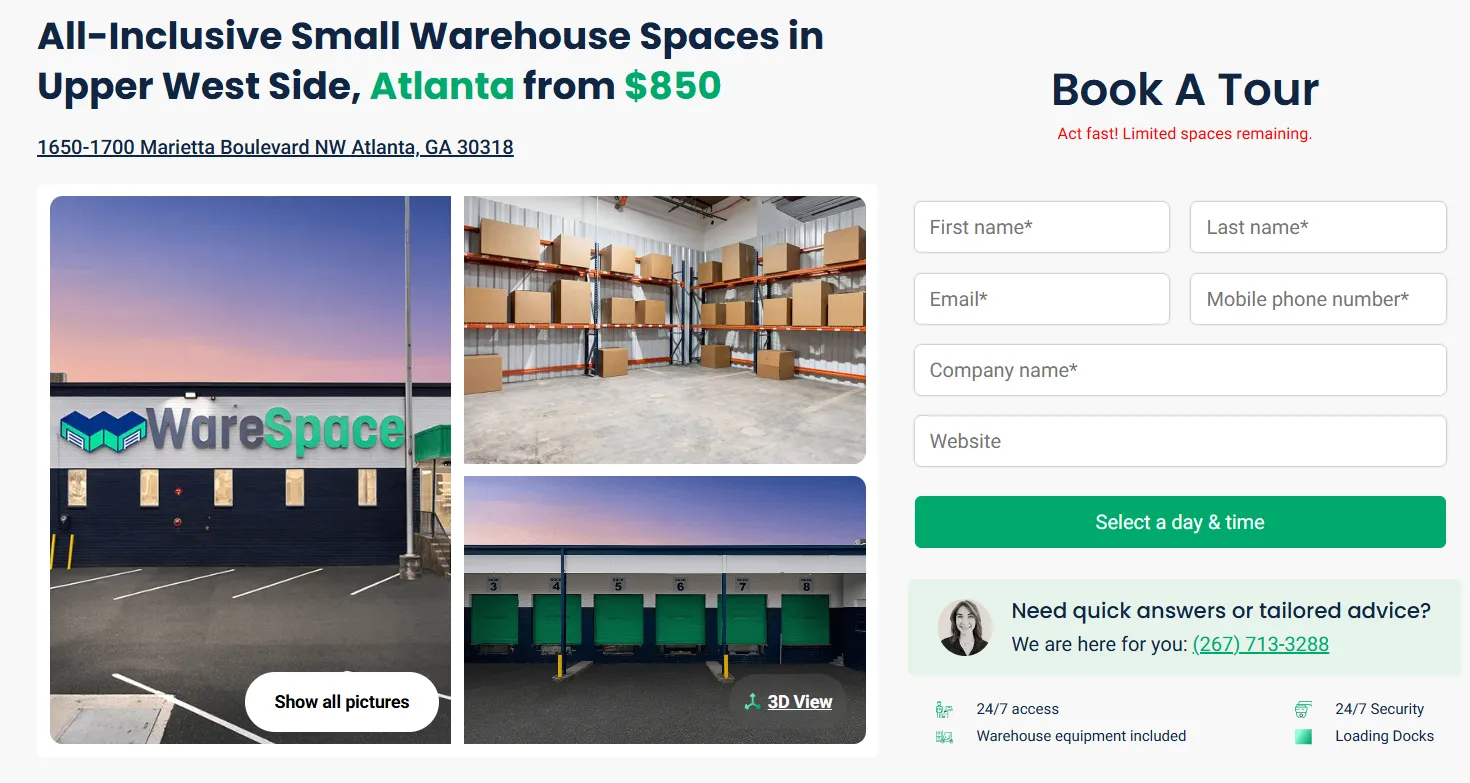
WareSpace hands you a self-contained unit between 200 and 2,000 sq. ft. that is set up for storage and light fulfillment from day one, billed as a single flat rate.
Brands stepping away from a fully outsourced setup tend to want one predictable number behind a door that is theirs, and WareSpace delivers that across 20 metros.
Amenities and benefits
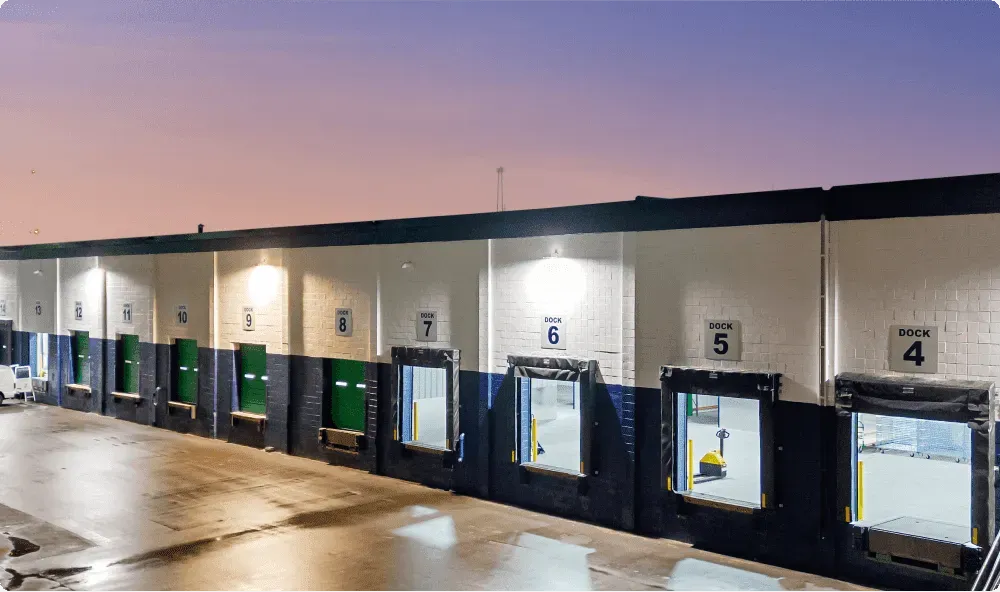
- Electricity, Wi-Fi, a pallet jack, and dock entry are folded into every unit.
- Racking is fitted from the start, and the building's shared equipment is open to you.
- Shared space includes lounges, a kitchen, and conference rooms, and cleaning and security are handled for you.
- Temperature stays regulated through every season, and entry is available any time of day.
Pricing
Pricing kicks off near $1,000/month for a 200 to 2,000 sq. ft. unit in certain markets, easing toward $850/month elsewhere such as Atlanta, all wrapped into one fee with nothing sprung later.
Book a tour to lock the exact figure, which moves with the city and the size you settle on.
Pros and cons
✅ A single flat charge makes the monthly math easy.
✅ Units run 200 to 2,000 sq. ft. with shared facilities included.
✅ Each building carries enough docks to keep loading from clogging up.
❌ Standard contracts run 6 to 12 months, unlike some WareSpace alternatives.
#3: Portal Warehousing
Best for: City-based ecommerce founders who want a ready unit inside the metro, sparing them the trek to an out-of-town industrial park.
Locations: 7 U.S. cities, covering Salt Lake City, Phoenix, Orlando, Minneapolis, Manhattan, Los Angeles, and Brooklyn.
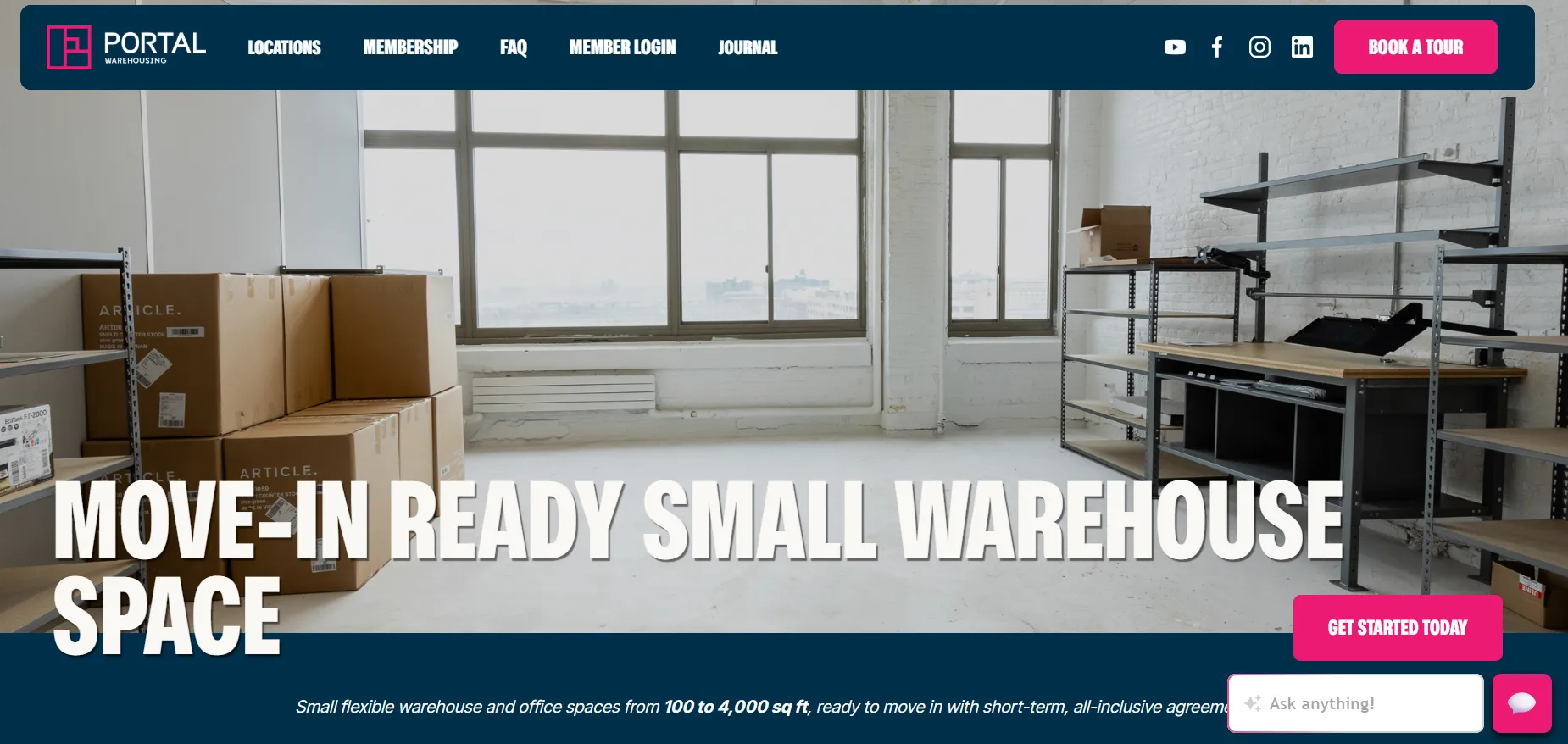
Portal Warehousing places ready-to-use units of 100 to 4,000 sq. ft. inside packed markets like Manhattan and Brooklyn, combining storage, fulfillment, and office space in one spot.
City founders like the arrangement because the unit puts them minutes from their buyers and their labor pool, which counts for more the faster they grow.
Amenities and benefits
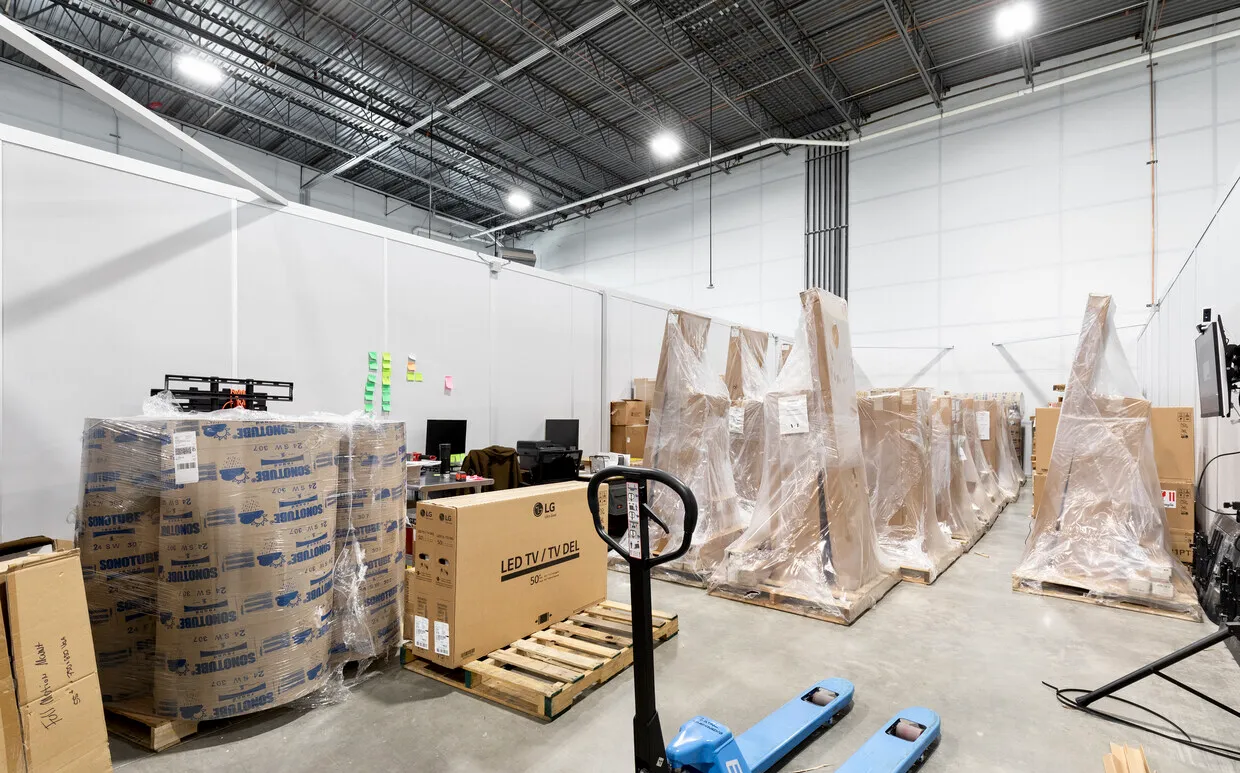
- Utilities, quick Wi-Fi, racking, and building security come built in, with docks and daily carrier pickups on hand.
- Step outside the unit and you find staffed reception, private offices, shared lounges, and a shipping address of your own.
- Units are ready on day one under flexible terms, set near highways and labor pools.
- The buildings put on networking events where members cross paths with other founders.
Pricing
Portal Warehousing splits its plans into three:
- Small, 250 to 500 sq. ft., from $995/month.
- Medium, 500 to 1,000 sq. ft., from $1,795/month.
- Large, 1,000+ sq. ft., from $2,995/month.
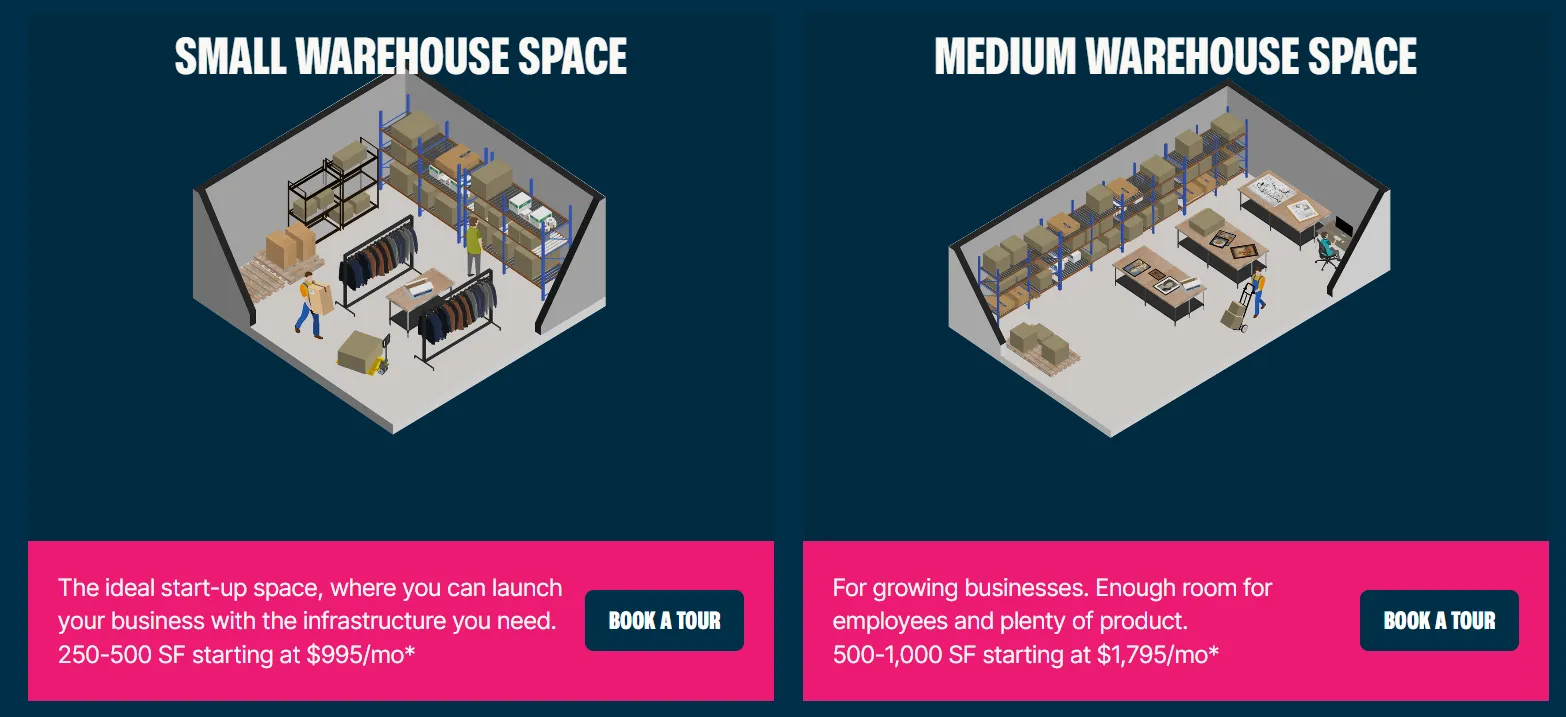
➡️ Keep in mind that the final figure moves with location, what is available, and the membership you choose.
Pros and cons
✅ Nothing binds you for the long term.
✅ A private office can sit alongside your unit.
✅ Units from 100 to 4,000 sq. ft. you can occupy right away.
❌ Seven cities cover only a slice of the country.
#4: FlexHQ (FlexEtc)
Best for: Brands that want the warehouse and a presentable office under one roof, with design-forward studios on hand.
Locations: 6 U.S. locations, namely Los Angeles, Denver, Plano, Salt Lake City, Nashville, and Charlotte.
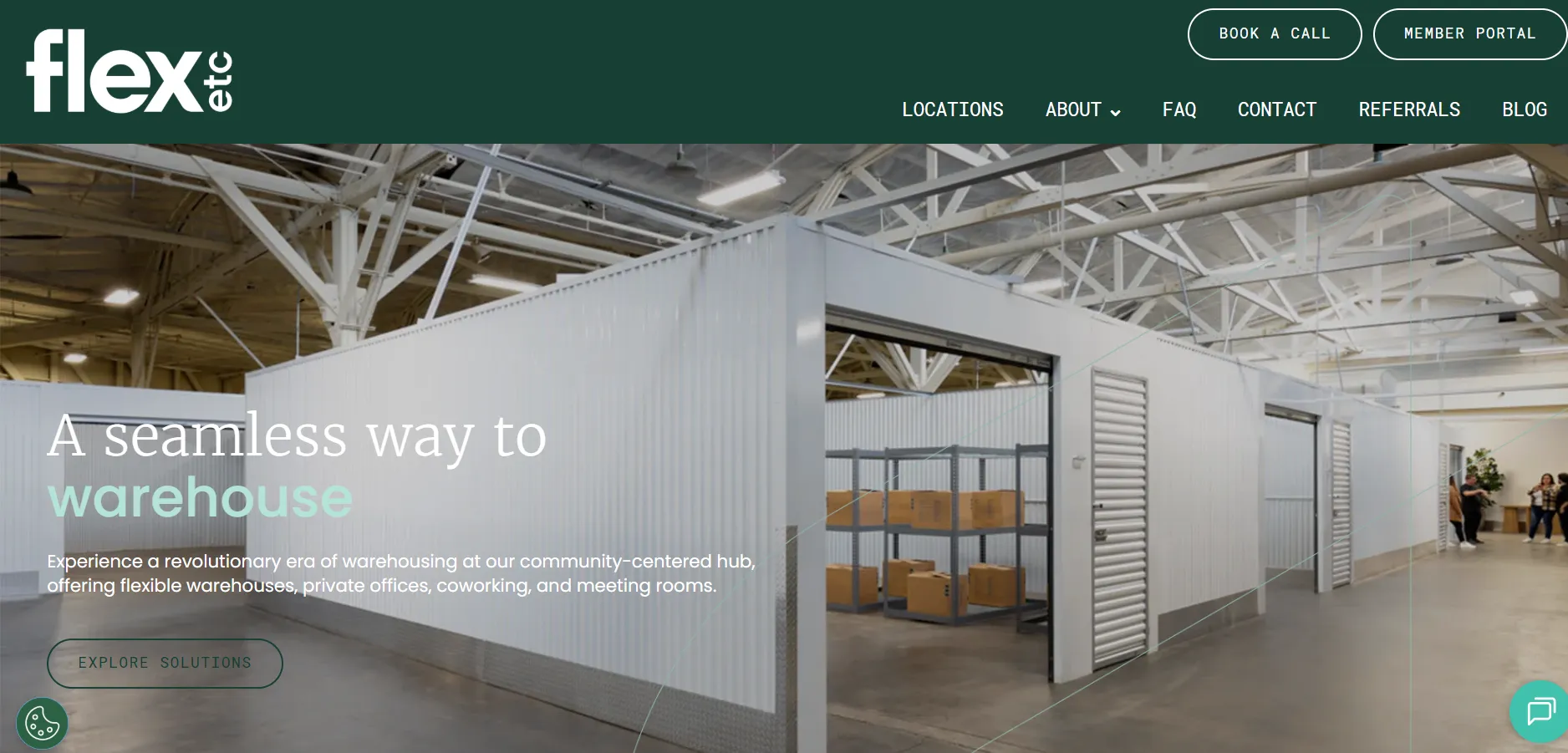
FlexHQ converts oversized industrial buildings into shared environments, slotting compact warehouse units in beside private offices and studios.
Since the offices carry a Ware Malcomb design, the brand tends to attract teams that count the space itself as part of how the company comes across.
Amenities and benefits
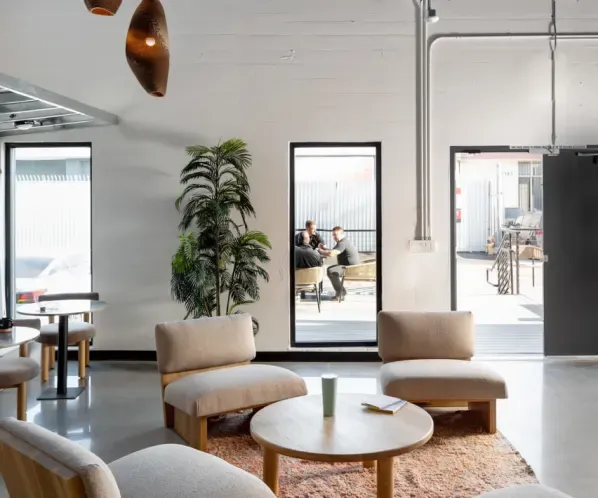
- Coworking memberships and private offices share the floor with the warehouse units.
- The office side is finished to a professional grade, which pays off for client-facing work.
- Staff on-site keep the building secured, and the amenities ride along with the membership.
- Content studios and reservable conference rooms round out the offering.
Pricing
FlexHQ keeps pricing off the public site, so a figure means contacting the team directly.
Pros and cons
✅ Month-to-month terms with a fast move-in.
✅ Offices shaped by professional design, a plus for brands that host clients.
✅ Warehouse units, private offices, and coworking all share the same building.
❌ Units begin at 300 sq. ft., which can be more room than a very small brand needs.
#5: ReadySpaces
Best for: Brands that put national reach and industrial muscle ahead of ecommerce trimmings like content studios.
Locations: 38 across the U.S. and Canada.
ReadySpaces leans on a 38-building network spanning the U.S. and Canada, with units from 100 to 5,000 sq. ft. that come fitted with forklifts and dock access.
Amenities and benefits
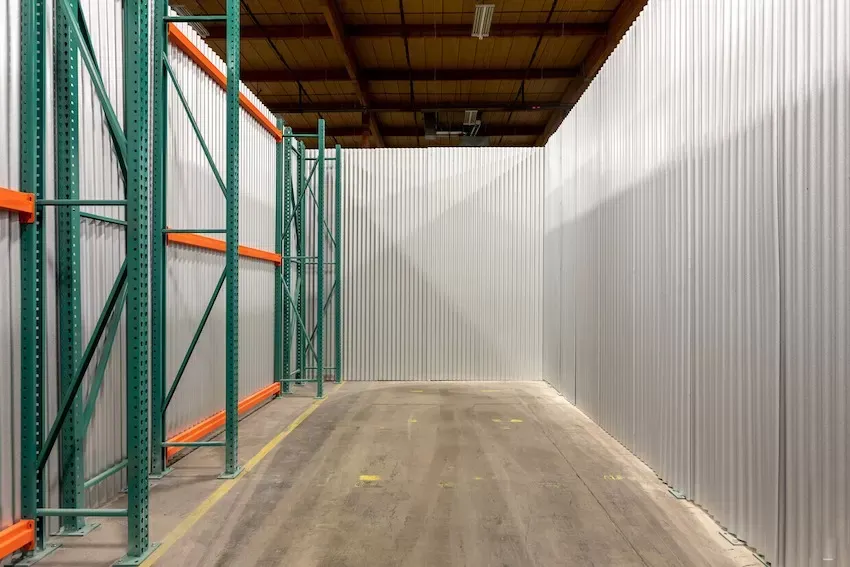
- Units span 100 to 5,000 sq. ft. and beyond, with shared workspace at most buildings.
- Conference rooms and private offices show up at a number of buildings.
- Entry stays secured and open around the clock, and the community side comes bundled in.
- Forklifts, loading docks, and grade-level bays are all on hand.
Pricing
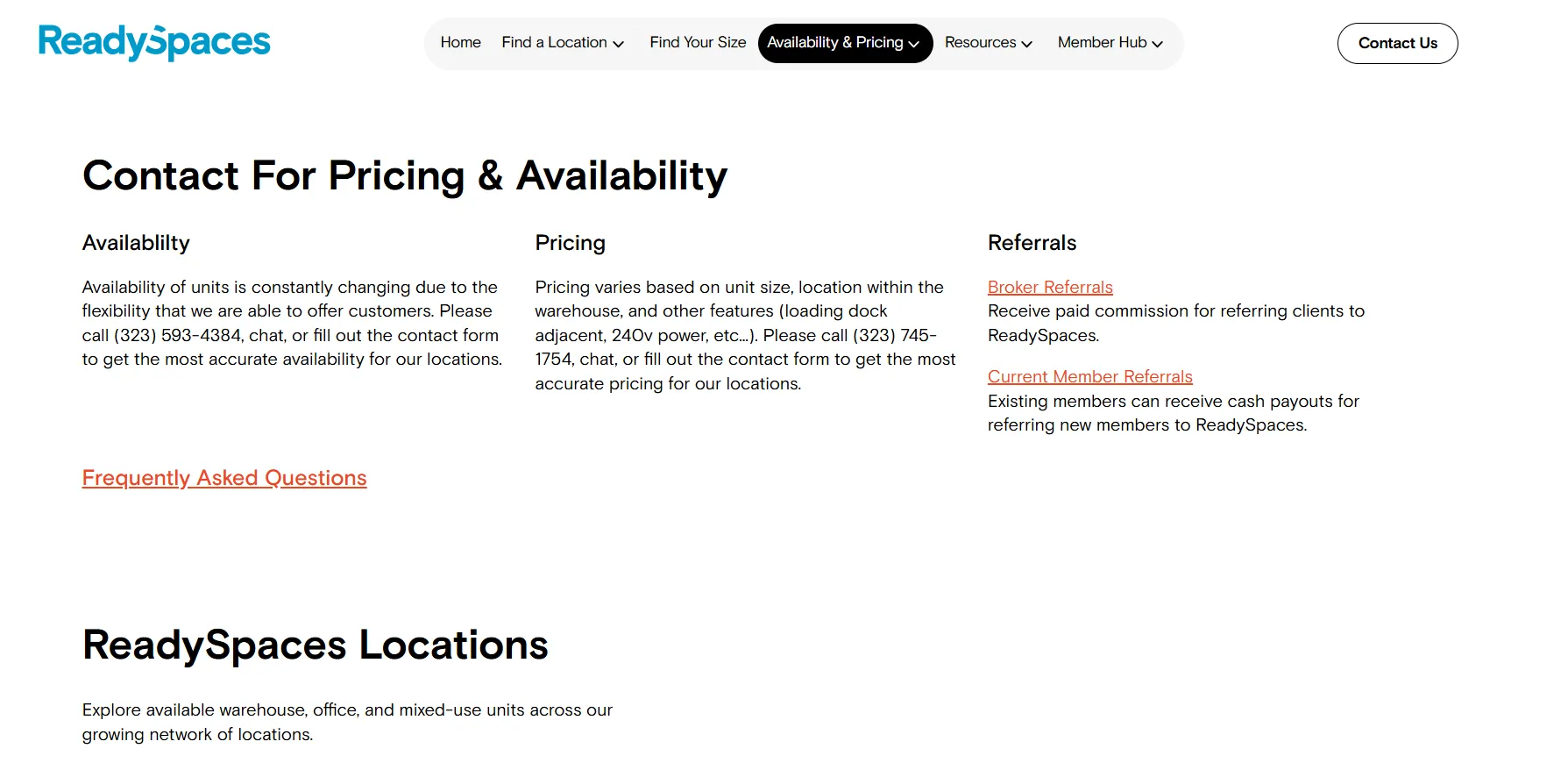
Each ReadySpaces quote is custom, shaped by the unit's size, its position in the building, and extras such as a 240V hookup or a spot next to the dock.
Leases can start on terms as brief as 90 days.
Pros and cons
✅ Short leases with nothing binding you for years.
✅ Sign-up kept free of needless paperwork.
✅ Coverage above the norm across the U.S. and Canada.
❌ No public pricing makes side-by-side comparison harder, which is why some members have been looking for ReadySpaces alternatives.
#6: Cubework
Best for: Later-stage brands after serious industrial square footage spread over a lot of U.S. metros, plus forklift crews they can book shift by shift.
Locations: 77+ U.S. locations.
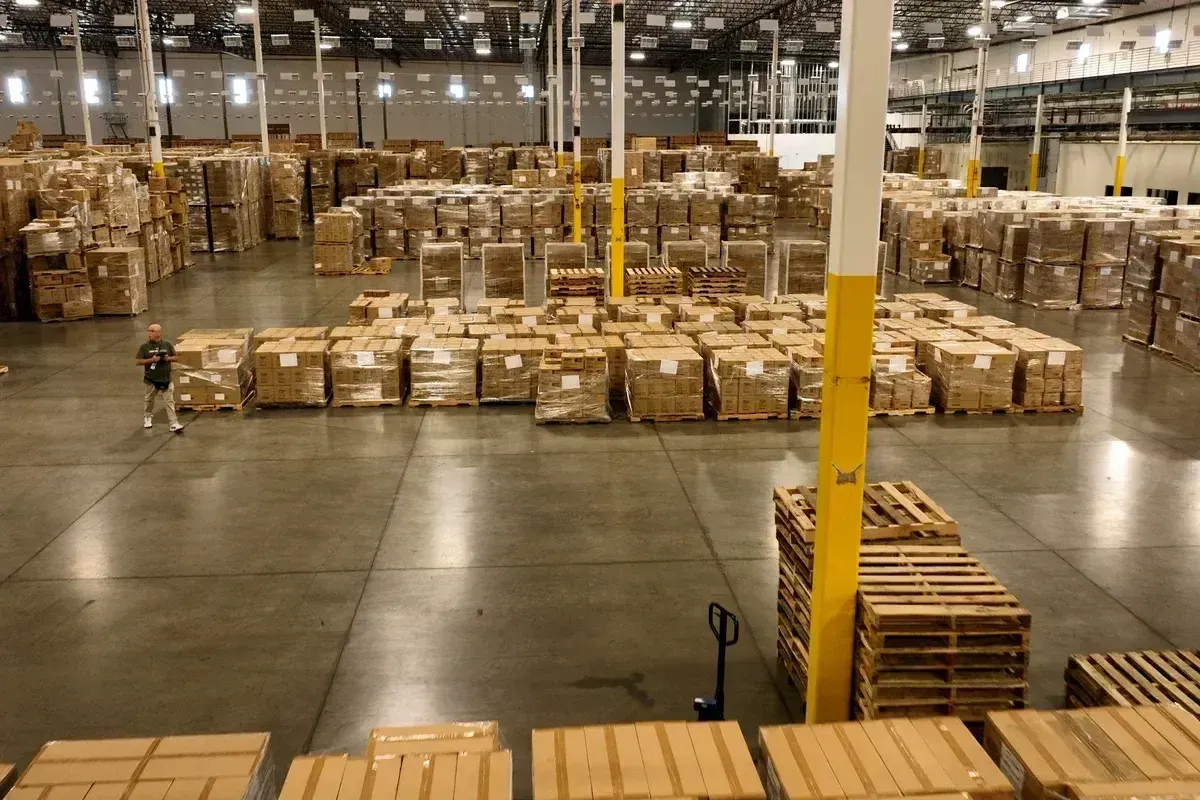
Cubework rents industrial units that run from a 150 sq. ft. corner up to a 150,000 sq. ft. distribution floor across 77+ U.S. buildings, and forklift drivers can be brought on for a single shift when a job calls for it.
Its audience is the later-stage brand needing real square footage in several cities at the same time, and leases begin at three months.
Amenities and benefits
- Warehouse and industrial units span a broad size range built for storage, fulfillment, and light manufacturing.
- Member extras stretch to catered breakfasts, the odd BBQ, trade-show passes, and discounted concierge help.
- Entry stays locked down and watched at all hours.
- Tall ceilings and proper industrial zoning carry heavier work, with cross-docking and trailer parking available.
Pricing
Cubework keeps pricing off its website, and the final number depends on the city, the unit size, and the lease term.
Pros and cons
✅ Buildings group near major highways and freight routes.
✅ Three-month minimums come in under standard industrial terms.
✅ Forklifts and operators arrive on demand, with no machines to purchase.
❌ Pricing is not published.
#7: TradeSpace
Best for: Calgary-based brands that want warehouse space, offices, and in-house fulfillment in one place, on short terms, tuned to the Canadian market.
Locations: 3 locations in Calgary, Canada.
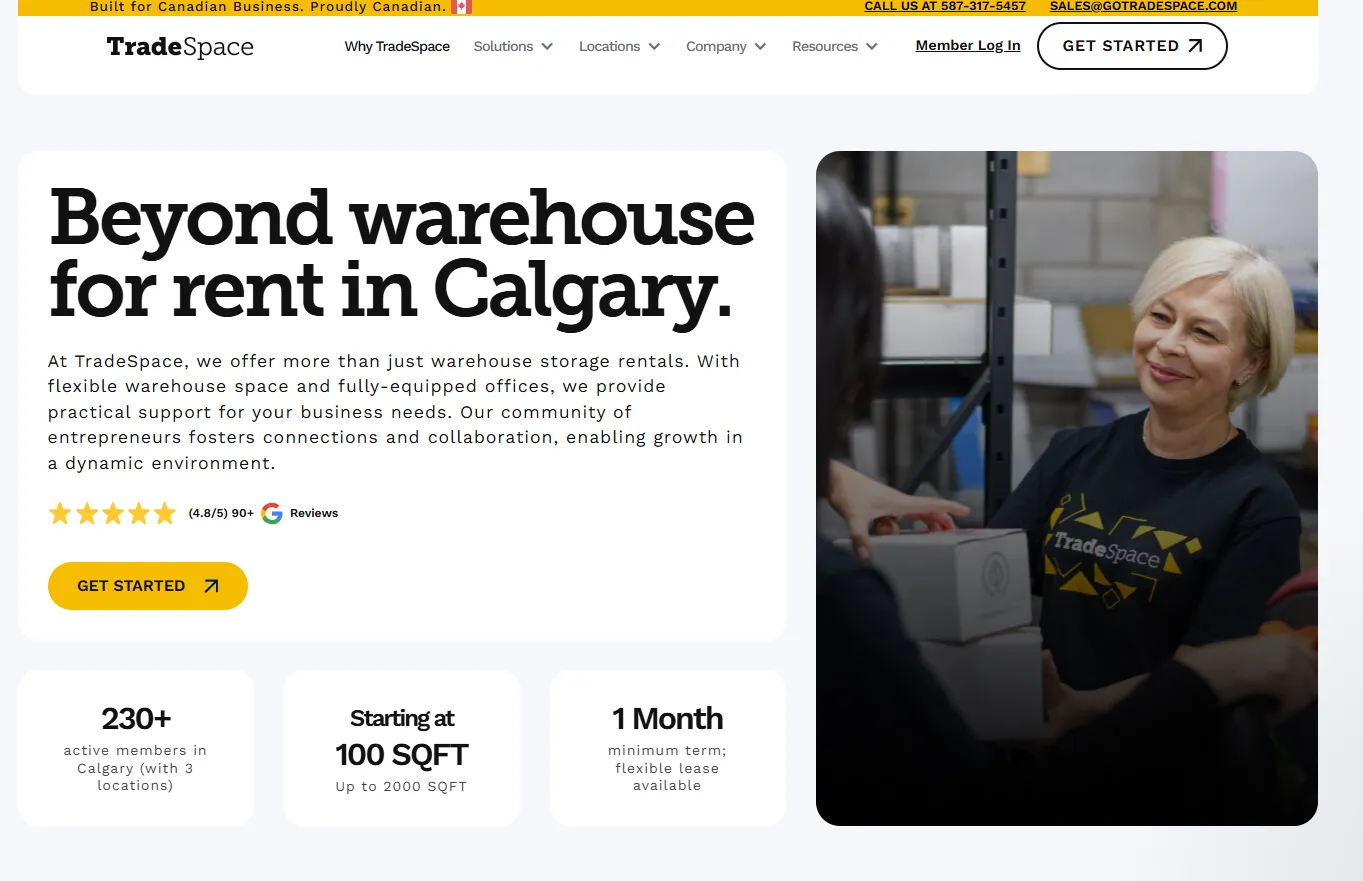
TradeSpace runs three Calgary buildings that bundle flexible warehouse units with offices, cross-docking, and in-house fulfillment under one membership, shaped around Canadian operators.
If GoBolt caught your eye partly for its Canadian footing, TradeSpace gives you a keep-the-keys route in Calgary, with pick, pack, and ship handled on-site whenever you want the help.
Amenities and benefits
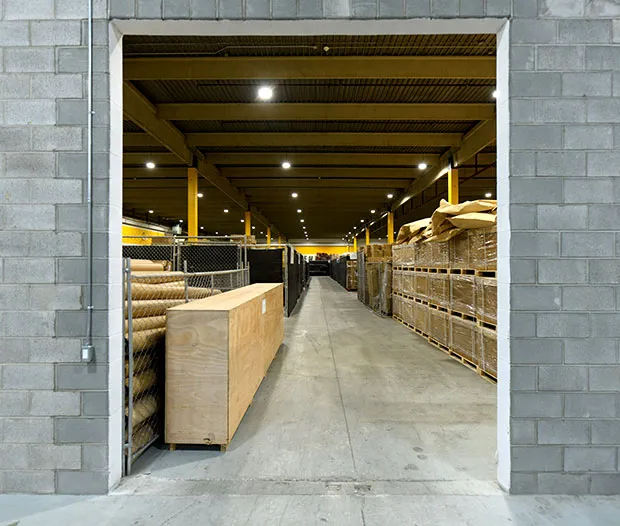
- Warehouse units run from 100 sq. ft. to 2,000 sq. ft., a fitting range for startups and brands on the way up.
- Cross-docking shaves storage time and keeps inventory in motion.
- Shipping and receiving support arrives with forklifts and on-site labor.
- Office space carries no extra overhead, amenities included.
Pricing
TradeSpace does not post rates publicly, so a quote means contacting the team directly.
Pros and cons
✅ A genuine all-in-one blend of warehouse, office, fulfillment, and operations.
✅ Month-to-month leasing, with a one-month minimum.
✅ Capable fulfillment covering pick, pack, ship, labeling, and storage.
❌ Available only in Calgary so far.
❌ Units cap out at 2,000 sq. ft.
What are the best 3PL alternatives to GoBolt in 2026?
The best 3PL alternatives to GoBolt are Flowspace, Flexe, and FlexSpace Logistics.
Let’s go over them in more detail:
#1: Flowspace
Best for: Brands set on a technology-led 3PL that spreads their stock across a coast-to-coast network.
Locations: 150+ fulfillment centers across the U.S. and parts of Canada.
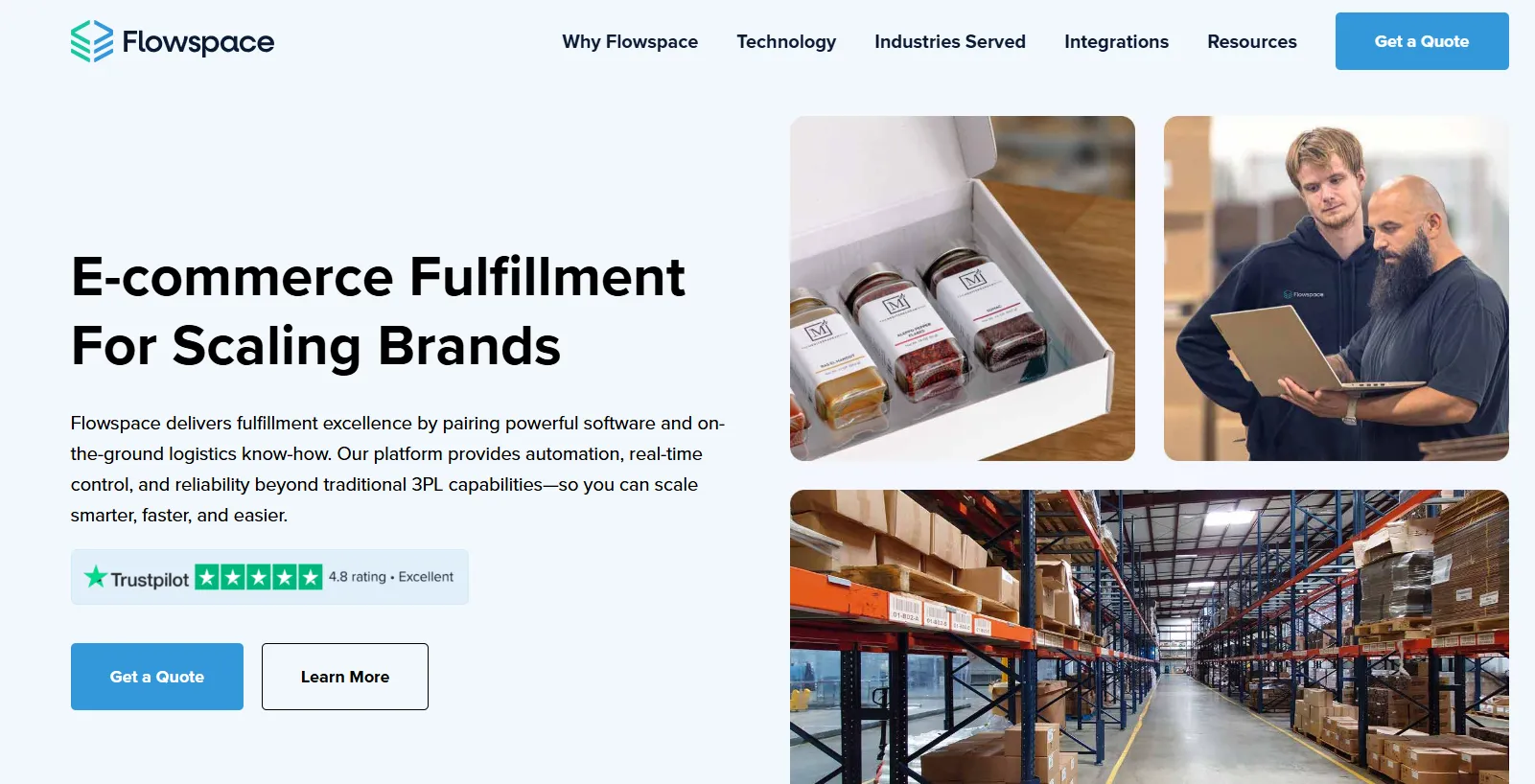
Flowspace works as a distributed fulfillment platform that parks your stock across 150+ partner centers and assigns each order to one by shipping zone, acting less like a single building and more like a software layer over a national network.
Amenities and benefits
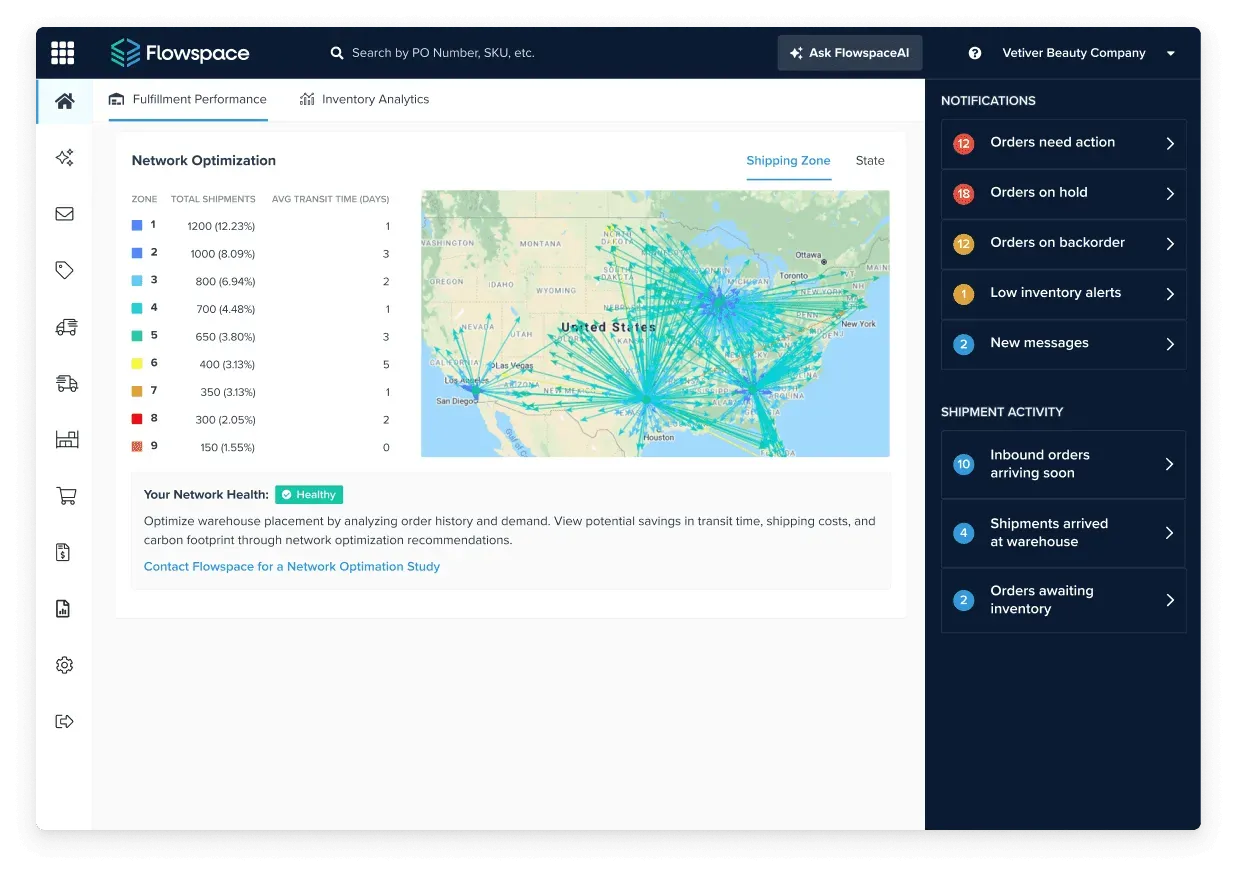
- Stock is positioned across 150+ centers to trim time in transit.
- Pick, pack, ship, kitting, labeling, and returns get covered from start to finish.
- The platform pushes out live order and inventory figures across your connected channels.
- A distributed setup keeps product close to buyers with no leases to sign.
Pricing
Flowspace prices every account to order, so real numbers call for a conversation with their sales team.
Pros and cons
✅ A broad fulfillment network at 150+ centers.
✅ Deep Shopify integration treated as central to the platform.
✅ Pick, pack, and ship run by a single provider.
❌ Custom pricing makes side-by-side comparison hard.
#2: Flexe
Best for: Mid-market and enterprise brands chasing warehouse capacity in many regions at once, with no leases to sign.
Locations: 800+ partner warehouses across North America.

With Flexe, you tap warehousing capacity on demand through one integration that connects you to 800+ independent warehouse operators throughout the U.S. and Canada.
Amenities and benefits
- A single integration over API, EDI, or XML reaches 800+ operators in Tier 1 to 3 markets.
- Warehouse, order, and inventory management are brought together on one platform.
- Live visibility takes in inventory, orders, and SLA performance.
- Every account is assigned a logistics analyst who oversees daily operations as a single command point.
💡 Interested in how Flowspace compares to Flexe? You can read our Flowspace vs. Flexe guide.
Pricing
Flexe’s pricing is fully custom and built per account, with the model centered on enterprise-scale agreements.
Pros and cons
✅ Reaches more markets than anything else on this list.
✅ One integration spans distribution and fulfillment over 800+ partners.
✅ Network planning and consulting come with the engagement.
❌ Less direct control of the physical space than a unit you rent on your own.
#3: FlexSpace Logistics
Best for: Canadian brands that want coast-to-coast storage, fulfillment, and delivery without committing to one fixed building.
Locations: 450+ locations across Canada, including Toronto.
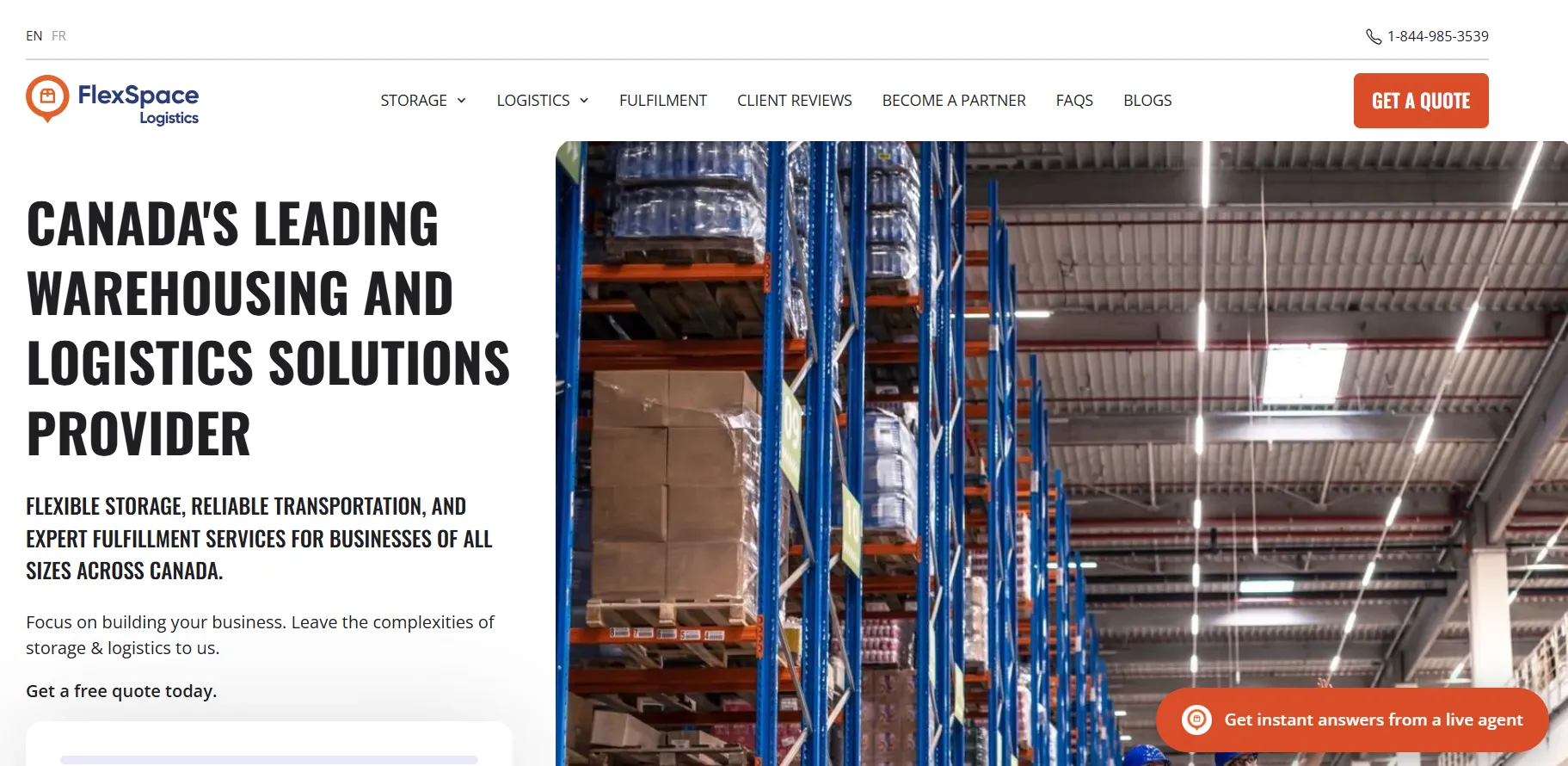
FlexSpace Logistics frames itself as a storage and operations network, not a single warehouse operator, pairing brands with suitable storage, fulfillment, and freight partners drawn from a Canada-wide footprint.
Amenities and benefits

- Storage flexes with your inventory, from as little as 25 sq. ft. to several thousand.
- Fulfillment spans DTC and B2B orders, plus inventory management.
- Operations extends to less-than-truckload and full-truckload freight, specialized trucking, and last-mile delivery.
- A roster of 90+ carrier partners stands behind the coverage.
Pricing
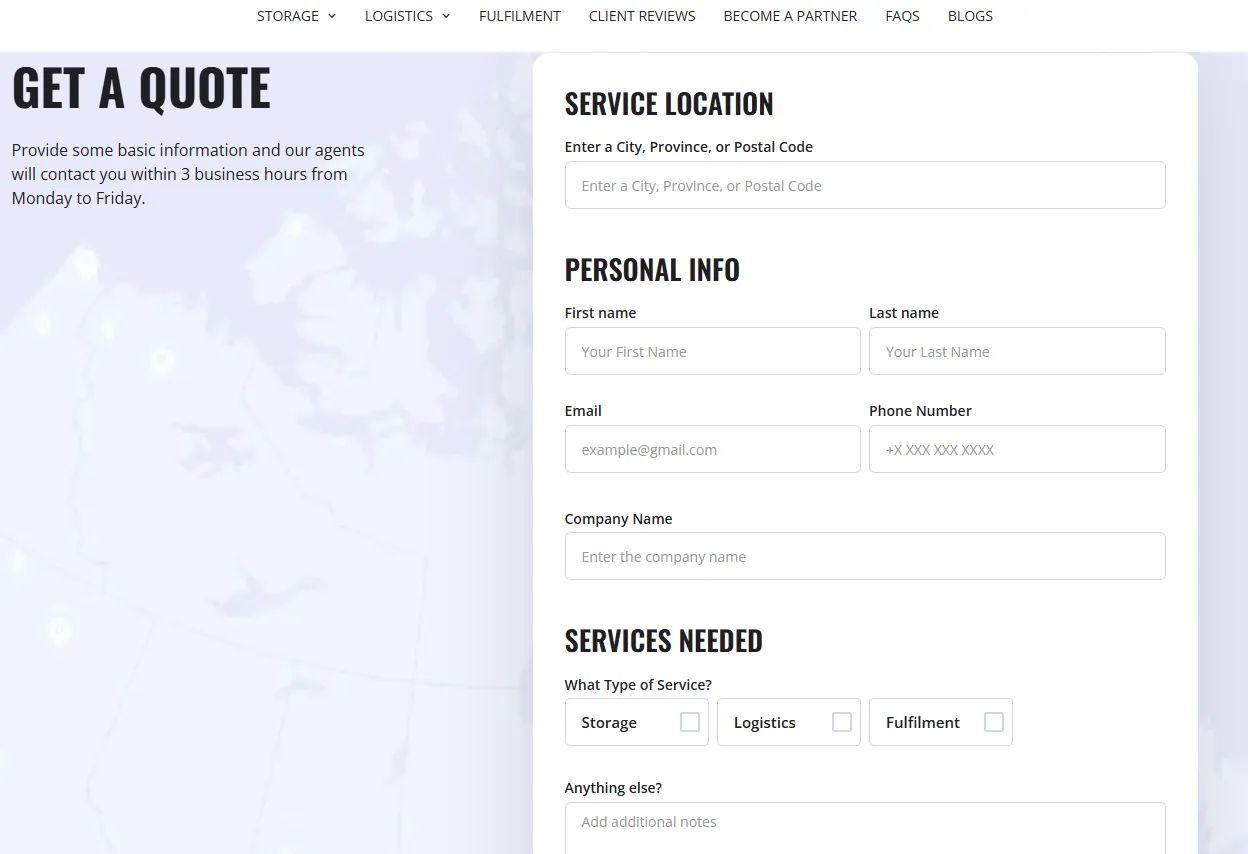
FlexSpace assembles each solution to order, so it posts no set rates. A quote means contacting the team directly.
Pros and cons
✅ Coast-to-coast Canadian coverage through 450+ partner facilities.
✅ Storage, fulfillment, and last-mile delivery inside one engagement.
✅ Deep transportation and logistics capability.
❌ Not a walk-in warehouse you physically hold.
Keep control of your inventory with Saltbox in 2026
This guide covered a wide range of GoBolt alternatives, from U.S. co-warehousing units to outsourced 3PLs reaching into Canada.
A few undercut the others on price, while some leaned on larger networks or deeper delivery reach.
What puts Saltbox at the top of my list for product brands is that it leaves the operation in your hands while still giving a scaling brand the backup it needs:
- A private unit you can step into during the workday, sized anywhere from 70 to 5,000+ sq. ft.
- An on-site team that takes delivery of your inbound freight even when nobody from your side is there.
- A shared Slack channel where the team answers your questions.
- Parsel label rates a brand would struggle to negotiate alone.
- Neighbors in the building who are other ecommerce founders working through the same headaches.
Saltbox runs month-to-month suites and access memberships from $349/month, built for growth-stage DTC brands that would sooner skip a multi-year contract and avoid handing the whole operation to a global 3PL.
Talk to an expert to learn more about us, or book a tour at one of our locations to see a suite in person.
⚠️ Disclaimer: This article was last updated on July 6, 2026, and if there's any misinterpretation of the information, please contact us, and we will fact-check it.
Frequently asked questions
While there may be upfront costs, switching to a co-warehousing space can reduce long-term expenses by eliminating hidden fees and rigid contracts.
The right time is usually six months before most founders actually do it. If your error rate is consistently above 1–2%, your costs are scaling faster than your volume, or you're spending meaningful time every week managing your provider relationship, those are signals worth acting on sooner rather than later.
Prioritize pricing transparency, space flexibility, real-time inventory visibility, and on-site support. Also evaluate tech stack compatibility; your new provider should integrate cleanly with your existing sales channels and shipping tools without requiring a custom build on your end.
Yes. The parallel-run method lets you migrate inventory and orders to a new provider while your current 3PL continues to fulfill. The key is sequencing the move by SKU, starting with slow-movers, and setting clear rules for which provider handles which orders during the overlap.
Most 3PL transitions take between 30 and 90 days, depending on your order volume, SKU complexity, and contract notice requirements. A 60-day timeline using the parallel-run method is the most common approach for mid-volume operators.
Traditional 3PLs give you access to shared fulfillment infrastructure on their terms. Saltbox is a co-warehousing model, which means members get private warehouse suites they control, an on-site team that's physically present, and access to Parsel, Saltbox's shipping platform partner, for discounted shipping and real-time tracking.
The model is built for founders who want the support of a fulfillment partner without giving up visibility and control. Read more here about how Saltbox compares to traditional third-party logistics providers.