.webp)


Key takeaways
- Saltbox offers the best GXO Logistics alternative in 2026 with its combination of a private warehouse suite with on-site operations support, shipping discounts, month-to-month billing, and an on-call crew for the busy weeks, so you can keep control of your inventory with no multi-year commitment.
- For founders who mostly want square footage they control, WareSpace, Portal Warehousing, FlexHQ, ReadySpaces, Cubework, Crate Warehouse, and Room2Work make up the co-warehousing field.
- Flowspace and Flexe cover the outsourced route for brands that want the whole operation off their hands, similar to the kind of enterprise footprint GXO runs.
In this article, I’ll compare the top 10 GXO Logistics alternatives on the market, including similar companies that operate on the same 3PL model, as well as co-warehousing options that will help you gain control back over your inventory.
What are the best alternatives to GXO Logistics in 2026?
The best alternative to GXO Logistics in 2026 is Saltbox, whose co-warehousing setup blends month-to-month membership with on-demand fulfillment help, leaving your stock and your post-purchase experience under your control.
And if you want your fulfillment operations to stay fully outsourced, the closest match to GXO’s reach and 3PL capabilities is Flexe.
Let’s go over the top alternatives to GXO Logistics on the market:
What are the best co-warehousing alternatives to GXO Logistics in 2026?
The strongest co-warehousing alternatives to GXO Logistics are Saltbox, WareSpace, Portal Warehousing, FlexHQ, ReadySpaces, Cubework, Crate Warehouse, and Room2Work.
With this model, you take a private suite and hold its keys, while the wider building and its shipping setup (e.g., loading docks) stay shared with the brands around you.
The stock and the floor space inside your suite remain entirely yours to manage.
You pack at your own pace on the quiet days, and you can normally pull in an on-site crew the moment a big drop buries you (although not every co-warehousing solution might have them).
Let’s go over each co-warehousing option:
#1: Saltbox
Saltbox is my pick for the best GXO Logistics alternative in 2026, built for product-based brands that want serious operational backup while still owning the day-to-day of their inventory.
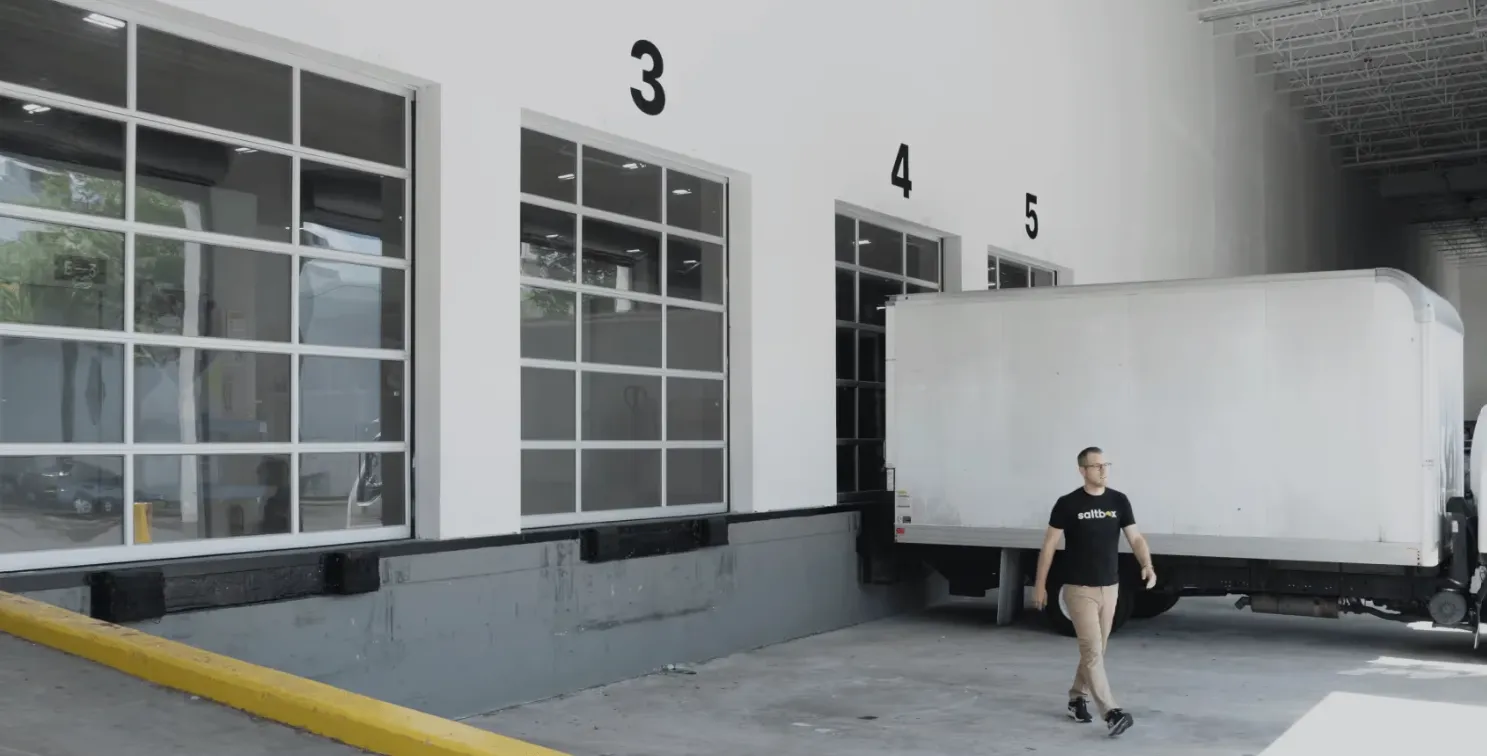
You’ll get access to a private suite with operations support layered on top, so fulfillment stays in your hands and on-demand labor (charged in 15-minute blocks) is there to lean on through a launch or a heavy stretch.
As this is co-warehousing and not a contract logistics deal, every piece of it can run month to month with nothing locking you in.
The level of involvement is yours to set, from hand-packing each parcel to passing the entire operation to Saltbox Fulfillment.
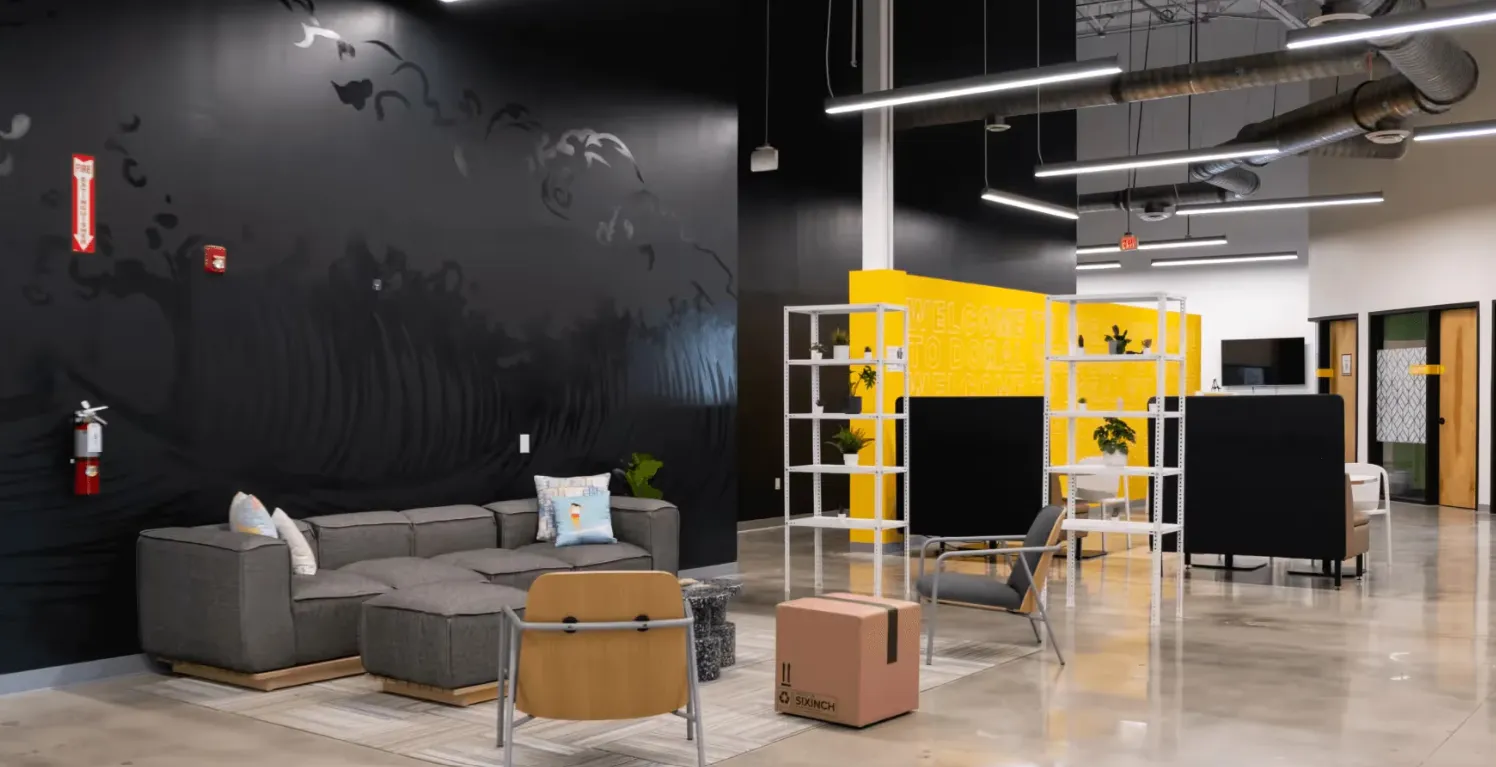
Full disclosure: Saltbox is our product. Here's an accurate look at what makes it the strongest GXO Logistics alternative in 2026.
Let’s look at the pieces that make our co-warehousing model a strong alternative to GXO Logistics:
Suites that scale with your order count
Each Saltbox location offers four suite sizes, and, since you can pay monthly, you can shift between them as orders climb or ease off.
The tiers break down like this:
- Small: 70 to 250 sq. ft., 4 to 15 pallets, 1 to 2 people. A solid first home for a founder or a two-person team that needs space of its own.
- Medium: 250 to 500 sq. ft., 16 to 31 pallets, 1 to 4 people. Headroom for a brand whose SKU list and order count are both on the rise.
- Large: 500 to 1,000 sq. ft., 32 to 62 pallets, up to 10 people. Floor for a deeper catalog and steady daily outbound.
- Extra Large: 1,000 to 5,000+ sq. ft., 63 to 125 pallets, up to 50 people. Serious storage paired with a genuine team workspace for an established brand.
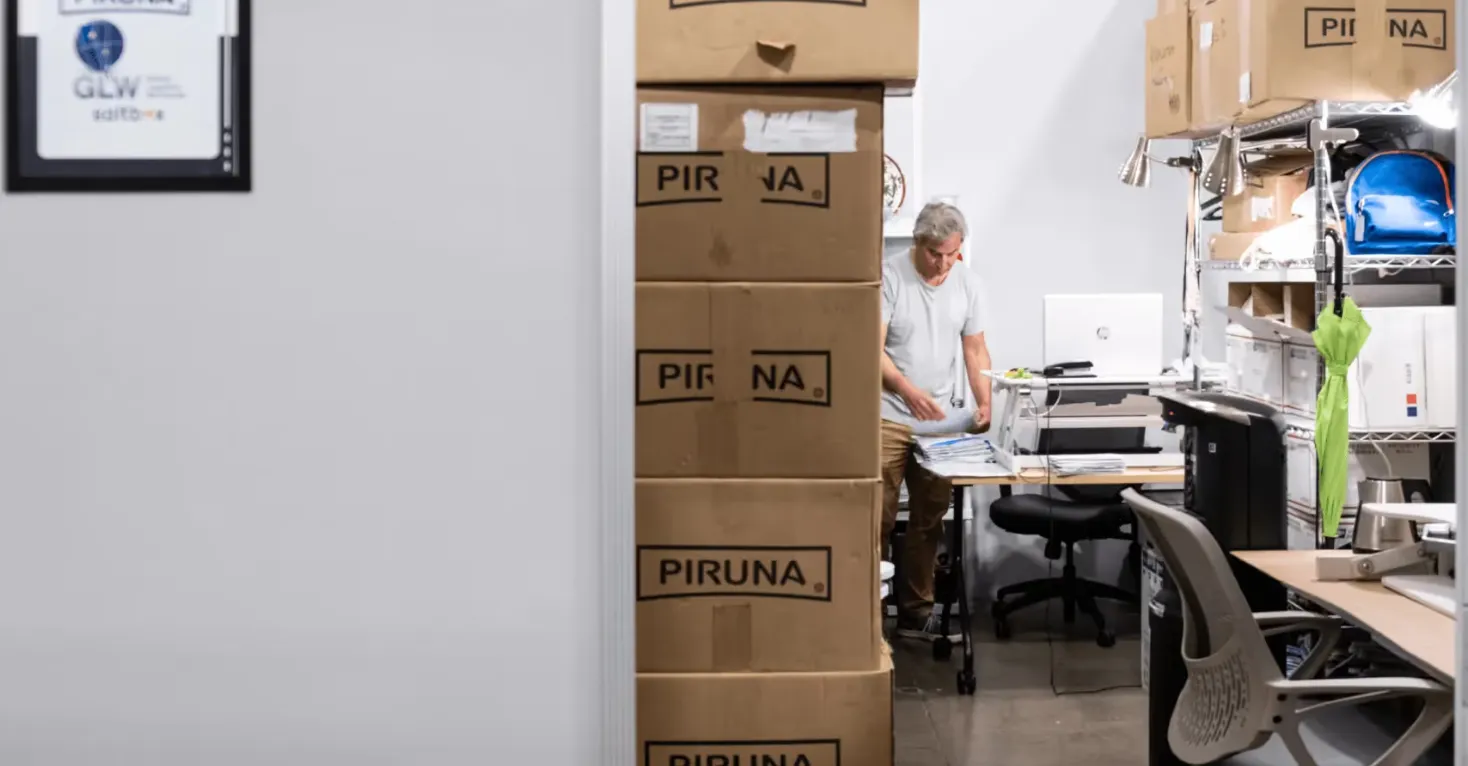
➡️ If you book a tour, our team will help you land on the right fit.

Not ready for a warehouse suite yet?
A Saltbox Access Plan gets you a mailing address, receiving, member rates, on-site labor, and an entrepreneur network, all without a warehouse lease.
Explore Access PlansThree ways to run day-to-day fulfillment
You can run your suite in one of three ways:
- Self-service: you own every pick.
- Assisted: extra hands come in for launches and the peak rush.
- Fully managed: Saltbox Fulfillment takes pick, pack, and ship from start to finish.
On-demand labor begins at $45/hour, charged in 15-minute blocks, with fulfillment at $3 per pick, so one frantic week will not talk you into a permanent hire you cannot justify two months later.
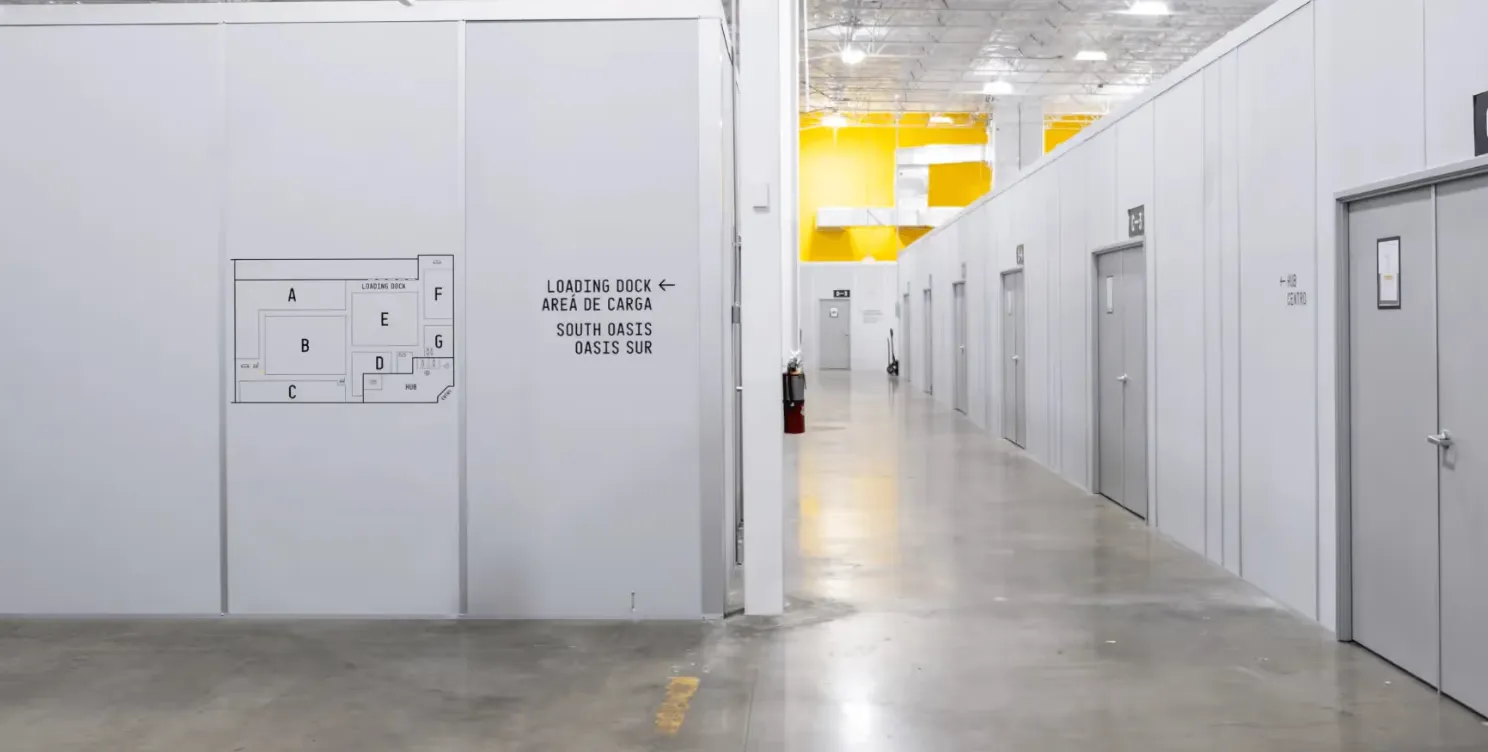
Our membership adds in a few more things:
- Daily carrier pickups, which clear labeled orders from the building with no trip to the post office.
- Free inbound receiving, so freight gets checked in and shelved even when nobody from your side is on site.
- A content studio on site, with lighting and backdrops ready for product shoots and video.
- High-speed Wi-Fi, in-suite 120V power, meeting rooms, a stocked kitchen and lounge, printing, shelving, pallet jacks, and 24/7 security.
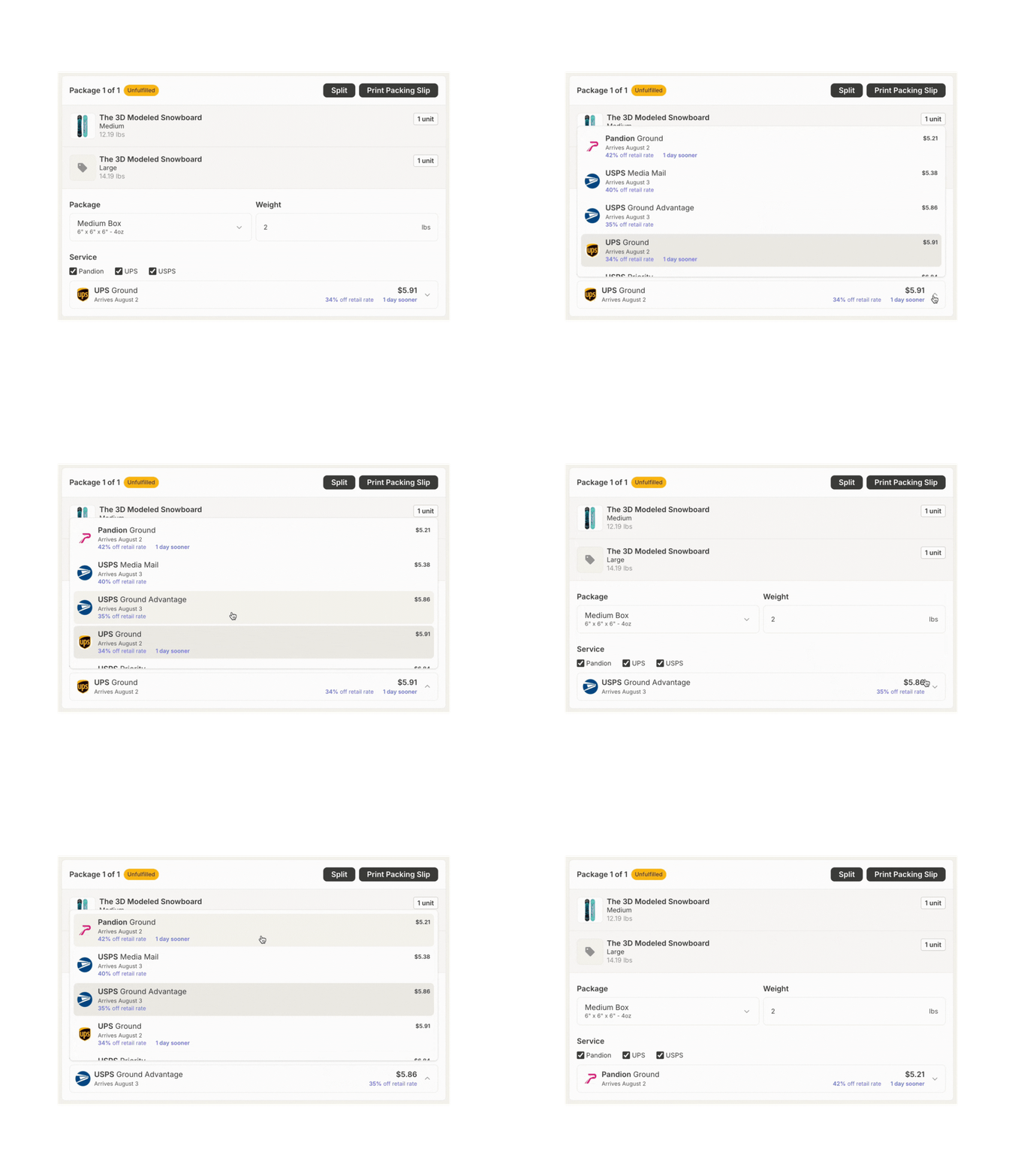
- Carrier savings through Parsel, our in-house shipping app, that surfaces live rates, lets you print labels up to a 4:30 PM cutoff, and books pickups from the same screen.
Saltbox locations across the country
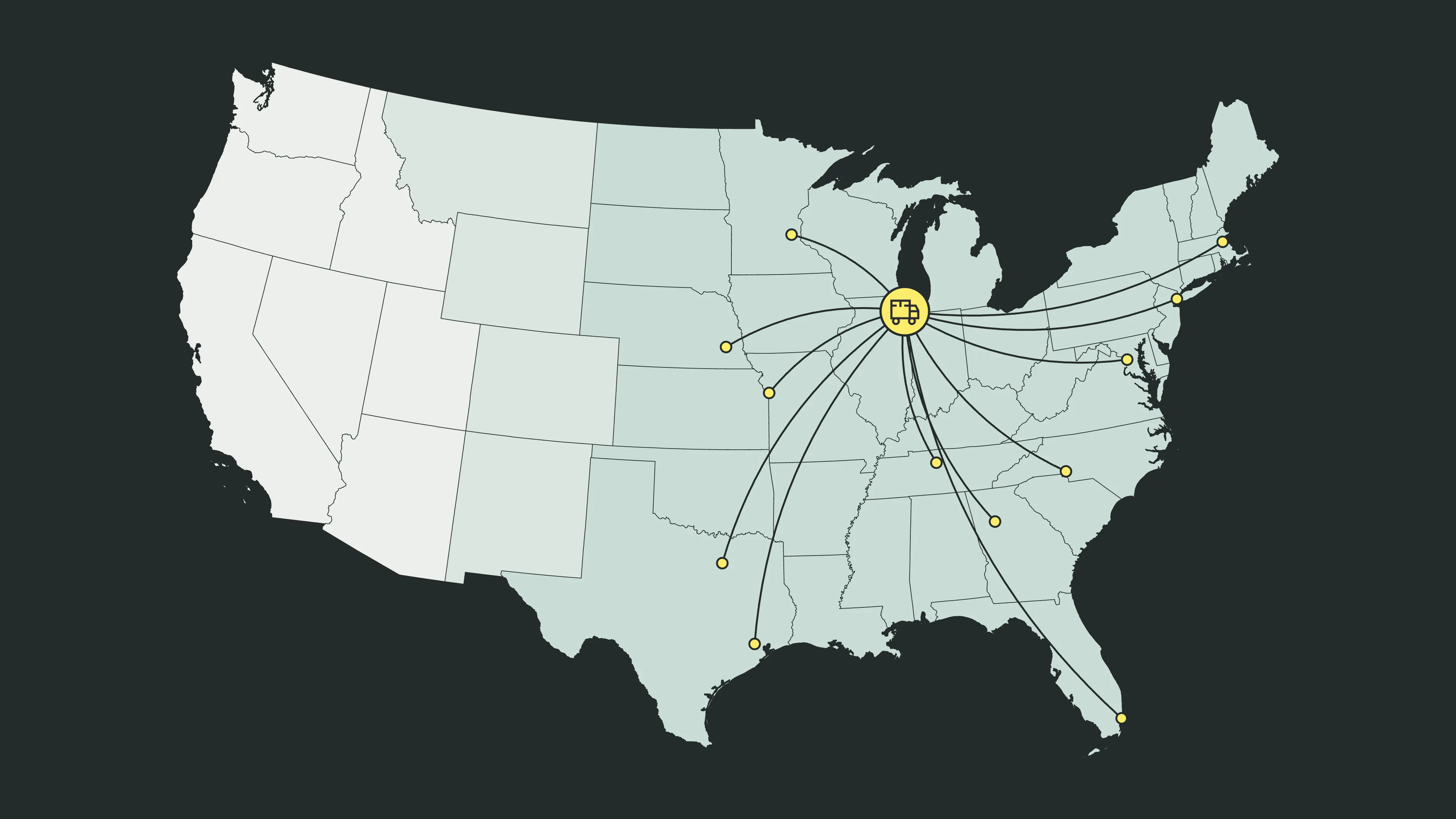
Saltbox runs 12+ U.S. locations, coast to coast and through the central states:
- Los Angeles, San Gabriel Valley.
- Los Angeles, Torrance.
- Phoenix.
- Seattle, SoDo Row.
- Denver, Park Hill.
- Dallas, Carrollton.
- Dallas, Farmers Branch.
- Atlanta, Upper Westside.
- Atlanta, Westside Park.
- Washington D.C., Alexandria.
- Miami, Doral.
- Atlanta, Chamblee.

Interested in one of our locations across the U.S?
Book a tour to walk a suite with our operations team. Available Mon-Fri, 8:30 AM-4:30 PM Central Time.
Book a TourHow is Saltbox different from GXO Logistics?
GXO and Saltbox will both get your orders shipped, but they part ways on two things: who runs the daily work, and who actually holds the keys to the building.
GXO is most likely the largest pure-play contract logistics provider in the world, operating more than 1,000 warehouse locations across 27 countries with a workforce near 150,000.
When you sign on, your inventory moves into a GXO-run facility where a team backed by warehouse robotics and the GXO IQ platform handles the work.
This model typically operates on a long-term contract, with your window into the operation arriving through reporting and a dedicated account team.
Saltbox flips that model completely.
Your stock stays in a private suite you hold the keys to, which means you can work orders yourself or call in the on-site crew when a week gets heavy.
The practical differences land in a few places:
- A stock count is a walk down your own aisles, with no dashboard sync to wait on.
- Your packaging and inserts come together inside your own suite, so the branding stays yours with no per-order kitting fee.
- Billing is a single flat monthly rate for the suite and membership, with none of the volume commitments or value-added line items a contract tends to carry.
- Extra hands run $45/hour in 15-minute increments, and picks are a flat $3 each.
- Even a same-day rush goes out, since the box only has to travel from your suite to the dock, carried by you or whoever is on the crew that day.
- There are no order minimums written into the agreement.
- Membership also brings you into Upstream, the Saltbox entrepreneur community built on shared resources and peer connections.
To give GXO credit where it's due, it can be the right answer for large enterprises moving enormous volume across many countries that want warehousing and transport bundled with heavy automation under one global provider.
For a growth-stage brand that wants real operations support and still likes the idea of walking into its own suite each day, I would point you to Saltbox.
Saltbox membership, warehouse, and office plans
Saltbox pricing starts with a membership tier, then adds an optional warehouse suite and an optional office.
There are 3 membership tiers:
- Virtual ($99/month): a remote-only plan with a professional mailing address for letters (no packages), plus entry to the Upstream Entrepreneurs Club.
- Access (from $349/month): on-site entry to Saltbox buildings, including the loading dock, packing stations, meeting rooms, and content studio, before you take a suite.
- Warehouse (custom pricing): the full package, with a flexible suite, on-site operations help, shipping infrastructure, and the building's full amenity set.
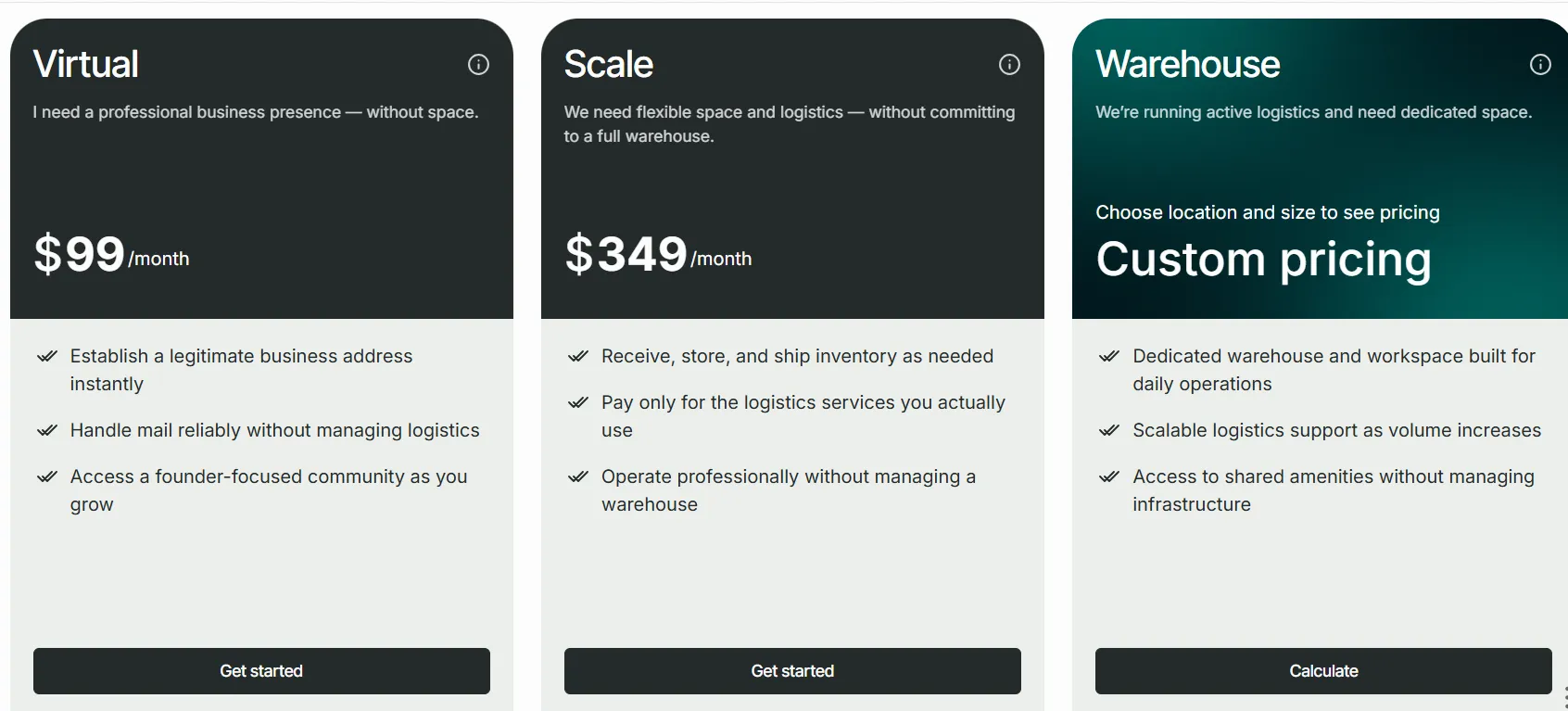
Suite rates shift city to city. For example, Atlanta's Upper Westside looks like this:
- Small Warehouse, from $1,157/month when billed annually: 70 to 250 sq. ft., 4 to 15 pallets, 1 to 2 employees.
- Medium Warehouse, from $1,890/month when billed annually: 250 to 500 sq. ft., 16 to 31 pallets, 1 to 4 employees.
- Large Warehouse, from $3,591/month when billed annually: 500 to 1,000 sq. ft., 32 to 62 pallets, 1 to 10 employees.
- Extra Large Warehouse, from $4,581/month when billed annually: 1,000 to 5,000+ sq. ft., 63 to 125 pallets, up to 50 employees.
All of the warehouses and locations include:
- Loading docks.
- Daily carrier pickups.
- Secure mail and package receiving.
- Professional-grade equipment.
- Multiple conference rooms.
- A content studio.
- High-speed Wi-Fi.
- A fully equipped kitchen with community dining.
- 24/7 security.
- On-site operations staff.
- In-suite 120V power.
- Printing services.
Office pricing is regional, too. Here are the prices for Atlanta Upper Westside:
- 1-person office, $468/month when billed annually: one chair, one desk.
- 2-person office, $927/month when billed annually: two chairs, two desks.
- 3-person office, $1,305/month when billed annually: three chairs, three desks.
- 4-person office, $1,674/month when billed annually: four chairs, four desks.
Saltbox pros and cons
✅ Storage, shipping gear, and office space in one building, across 12+ U.S. sites.
✅ Inventory stays in a private suite, packed by you or by the crew on-site.
✅ You can pay monthly and not be locked into an annual contract.
✅ Preferential shipping rates through Parsel.
✅ Hourly labor in 15-minute increments.
❌ We will never be the cheapest, and we don't want to be.
#2: WareSpace
Best for: DTC brands with steady volume that want one all-inclusive bill and a unit nobody else operates.
Locations: 20 U.S. cities, including Atlanta, Chicago, Dallas, Denver, Philadelphia, and Phoenix.
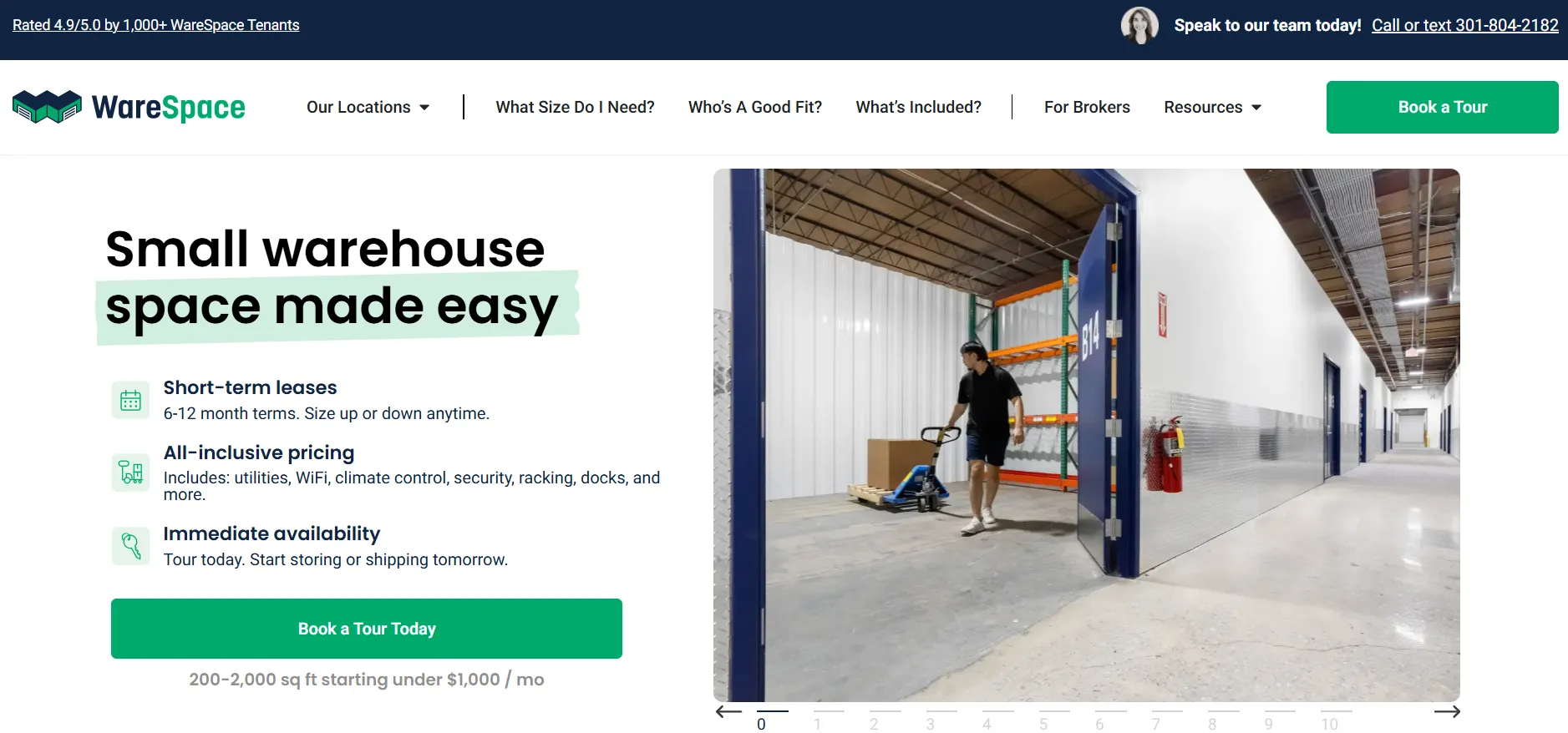
With WareSpace, you get a ready-to-use warehouse unit from 200 to 2,000 sq. ft. for storage and light fulfillment, and a single all-inclusive invoice covers all of it.
For a brand stepping away from a GXO-style outsourced setup, that one predictable bill across its 20 cities is an easy way to bring inventory back under its own roof.
Amenities and benefits
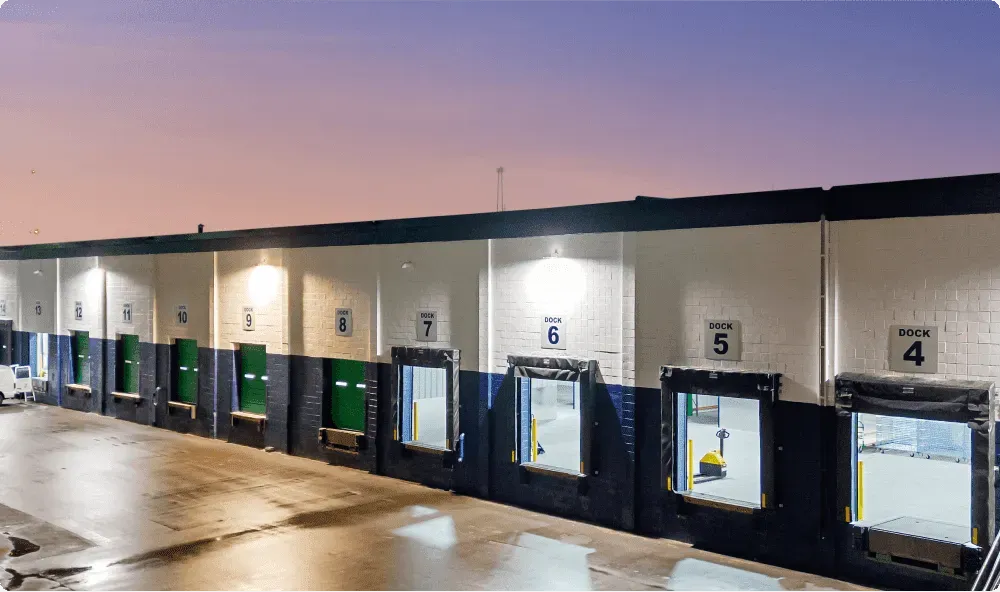
- Each unit lands with power, internet, a pallet jack, dock access, and pre-fitted industrial racking, with shared warehouse equipment on top.
- The shared side covers a kitchen, lounges, conference rooms, cleaning, and security, none of which you have to manage.
- Climate control runs year-round, and the building opens 24/7.
Pricing
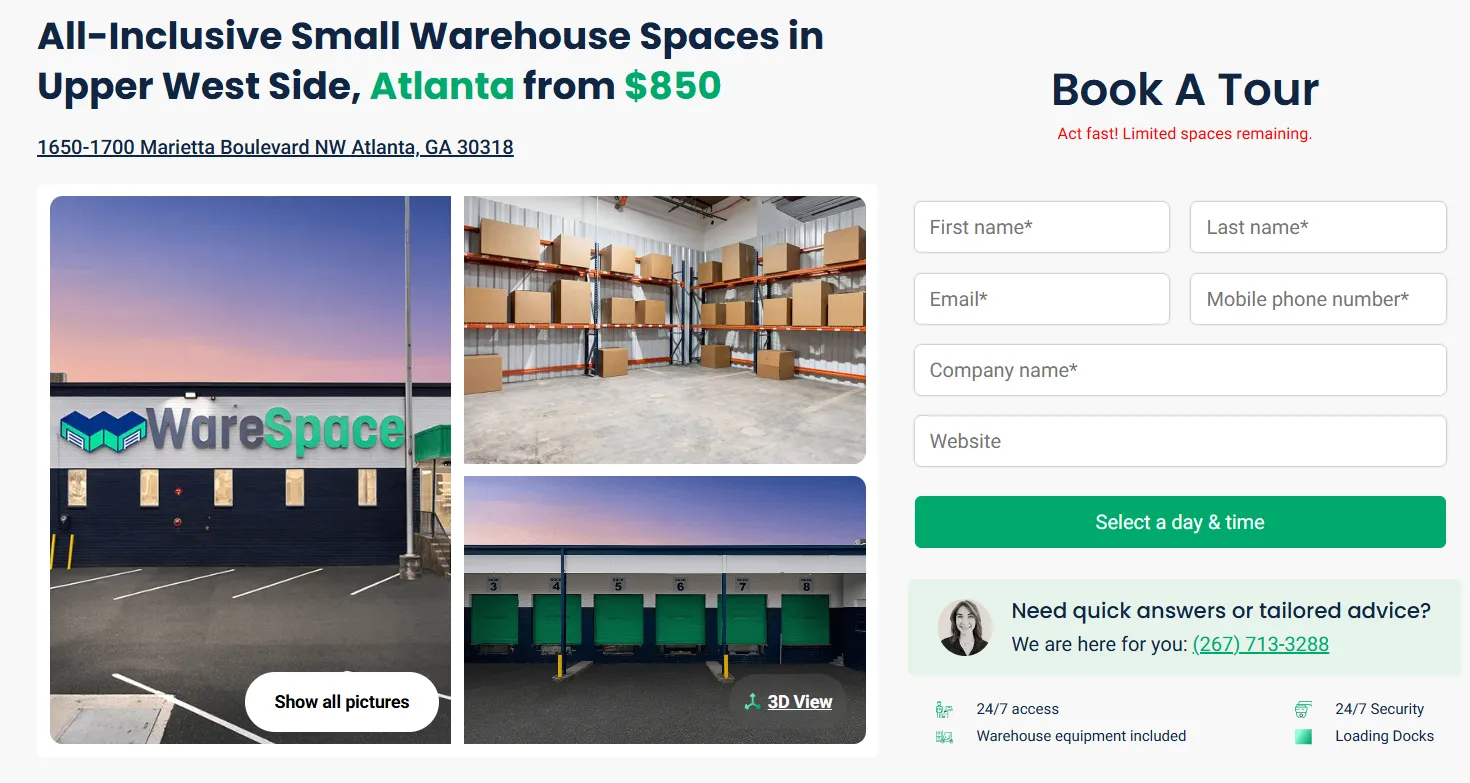
Pricing opens around $1,000/month for a 200 to 2,000 sq. ft. unit in many markets, and falls to roughly $850/month in others, Atlanta among them, with everything included and no add-ons.
A tour will pin down the final number based on the city and the space you need.
Pros and cons
✅ One flat monthly fee makes the budget easy to read.
✅ Sizes from 200 to 2,000 sq. ft. come with shared amenities included.
✅ Docks are distributed across each site to keep loading moving.
❌ Standard contracts run 6 to 12 months, unlike some WareSpace alternatives.
#3: Portal Warehousing
Best for: Urban ecommerce founders who want a turnkey unit inside the city, not a drive out to an industrial park.
Locations: 7 U.S. cities, including Salt Lake City, Phoenix, Orlando, Minneapolis, Manhattan, Los Angeles, and Brooklyn.
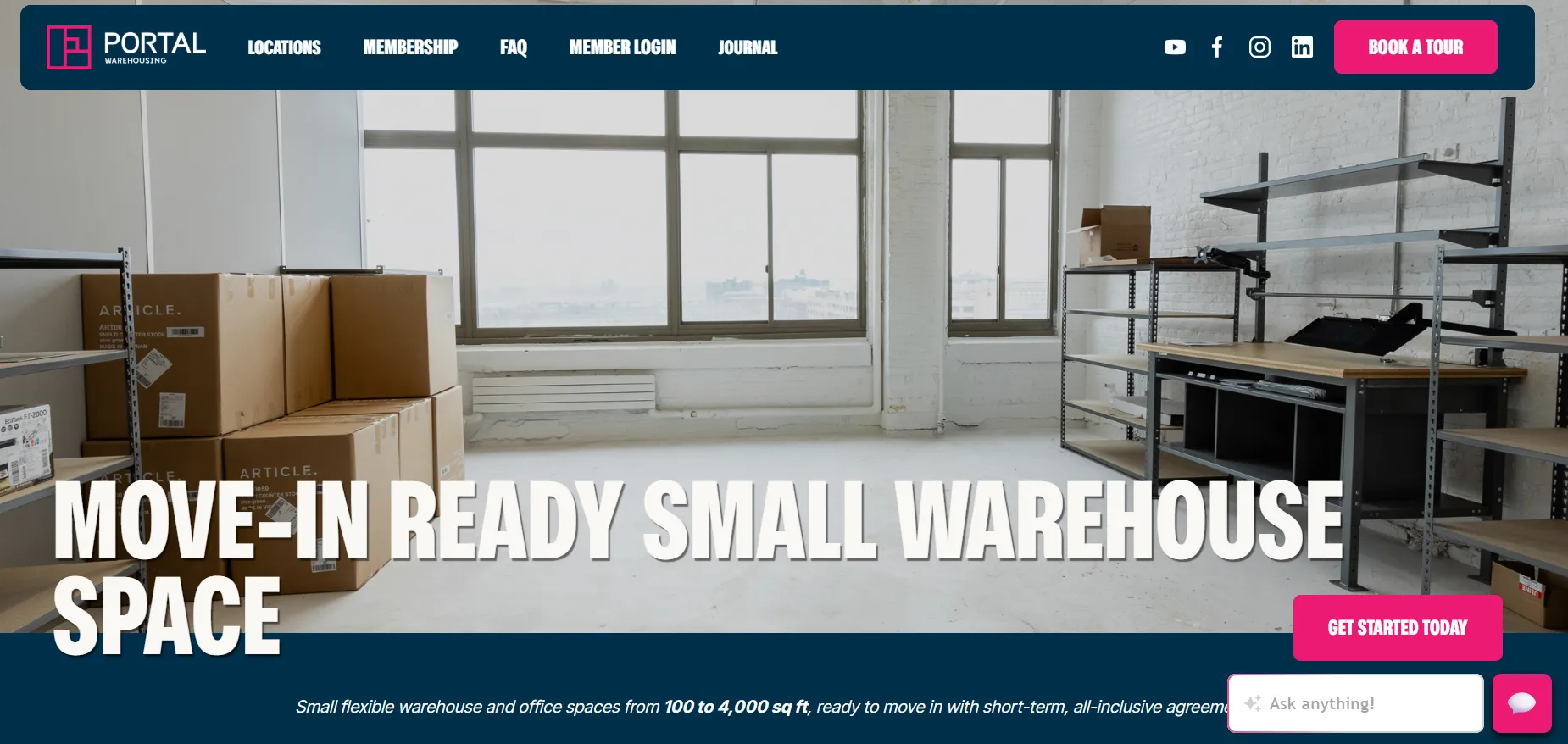
Picture a turnkey unit a few blocks from your customers in Manhattan or Brooklyn, not an hour out of town, and you have Portal Warehousing, which combines storage and fulfillment with office space inside units from 100 to 4,000 sq. ft.
Proximity is what city-based founders are paying for here, keeping them near both their buyers and their labor pool as they grow.
Amenities and benefits
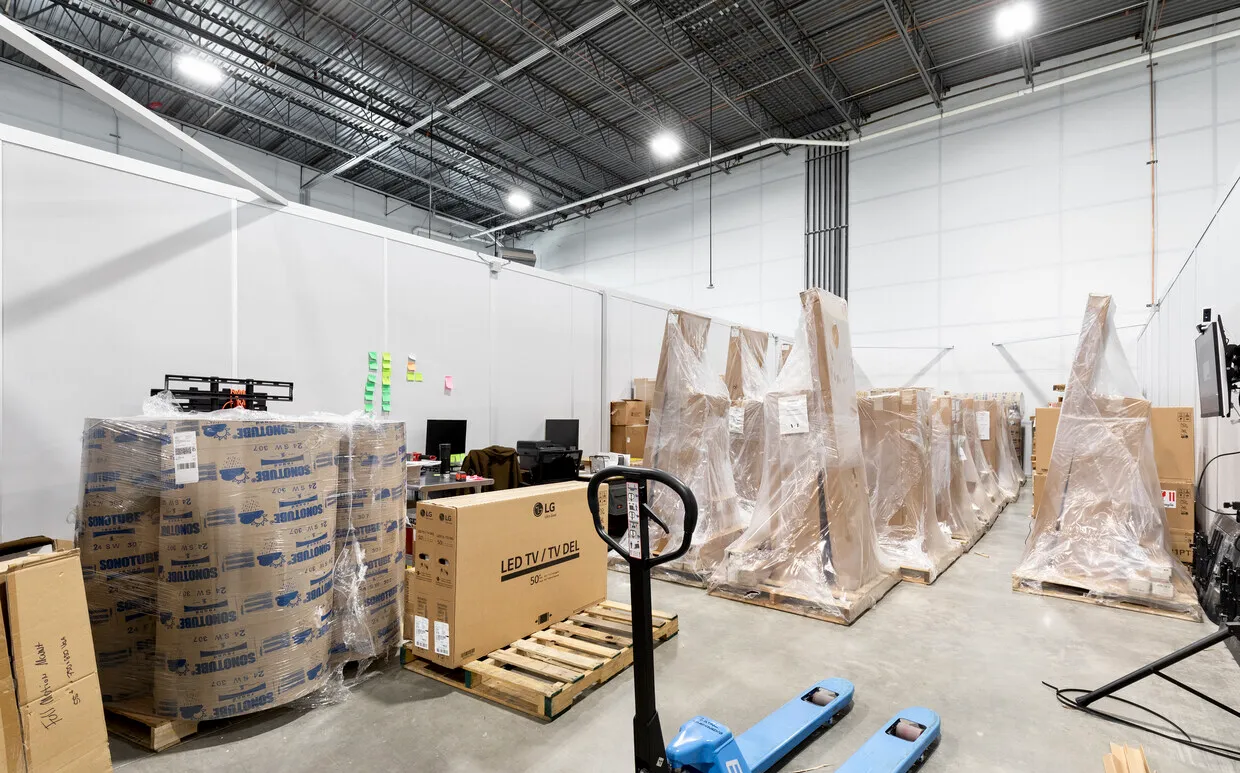
- The all-in unit covers utilities, fast Wi-Fi, racking, security, loading docks, and daily carrier pickups, so nothing gets billed on the side.
- On top of the unit, members get private offices, a staffed reception desk, shared lounges, and a dedicated shipping address.
- Move-in is quick and the terms stay flexible, helped by buildings placed near major highways and local labor.
- Networking is part of the package too, with regular events that put founders in the same room.
Pricing
Portal Warehousing runs three tiers:
- Small, 250 to 500 sq. ft., from $995/month.
- Medium, 500 to 1,000 sq. ft., from $1,795/month.
- Large, 1,000+ sq. ft., from $2,995/month.
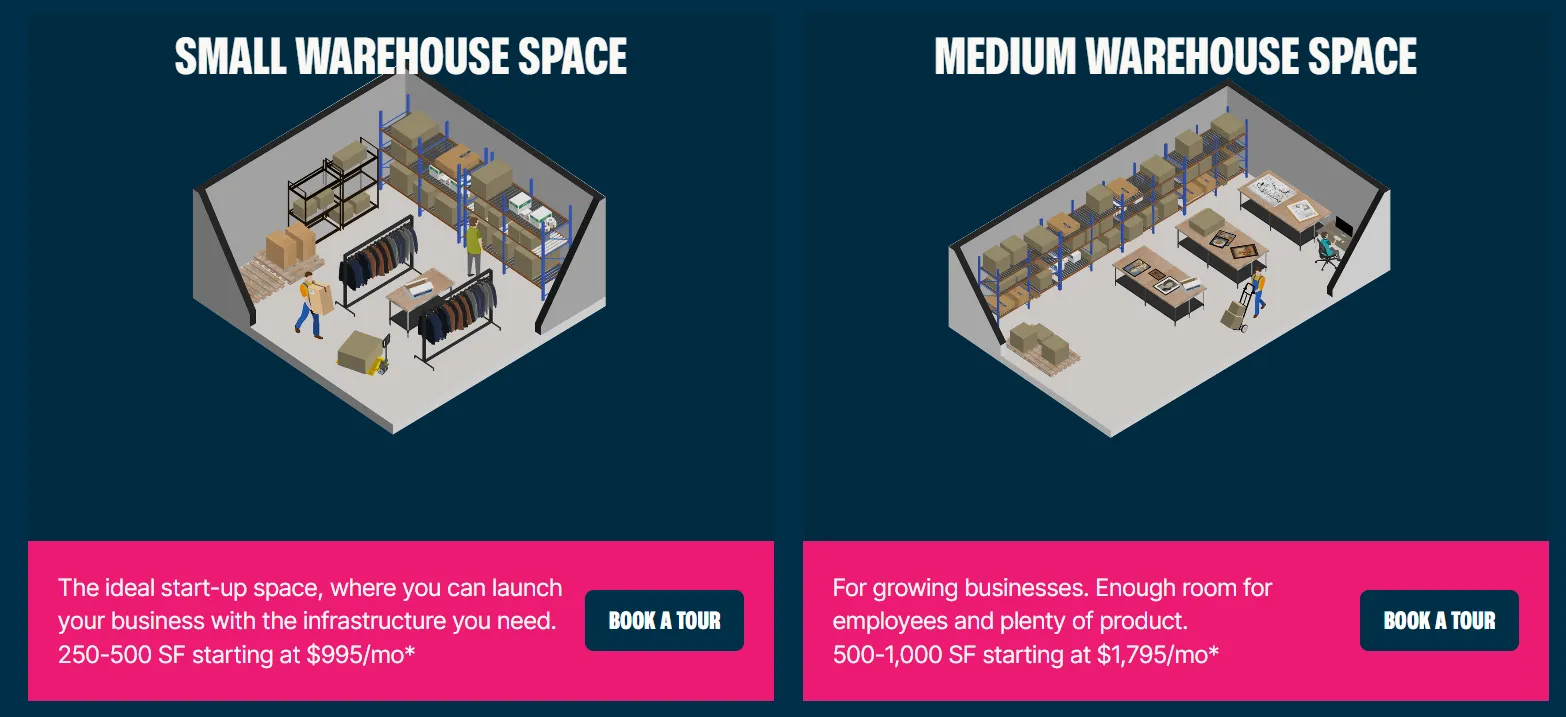
➡️ Final pricing shifts with the city, the availability on hand, and which membership tier you pick.
Pros and cons
✅ No long-term signature required.
✅ A private office can attach right next to your unit.
✅ Move-in-ready units from 100 to 4,000 sq. ft.
❌ Seven cities leave much of the map uncovered.
#4: FlexHQ (FlexEtc)
Best for: Teams that want the warehouse to double as a polished brand HQ, with designed offices and studios attached.
Locations: 6 U.S. locations, including Los Angeles, Denver, Plano, Salt Lake City, Nashville, and Charlotte.
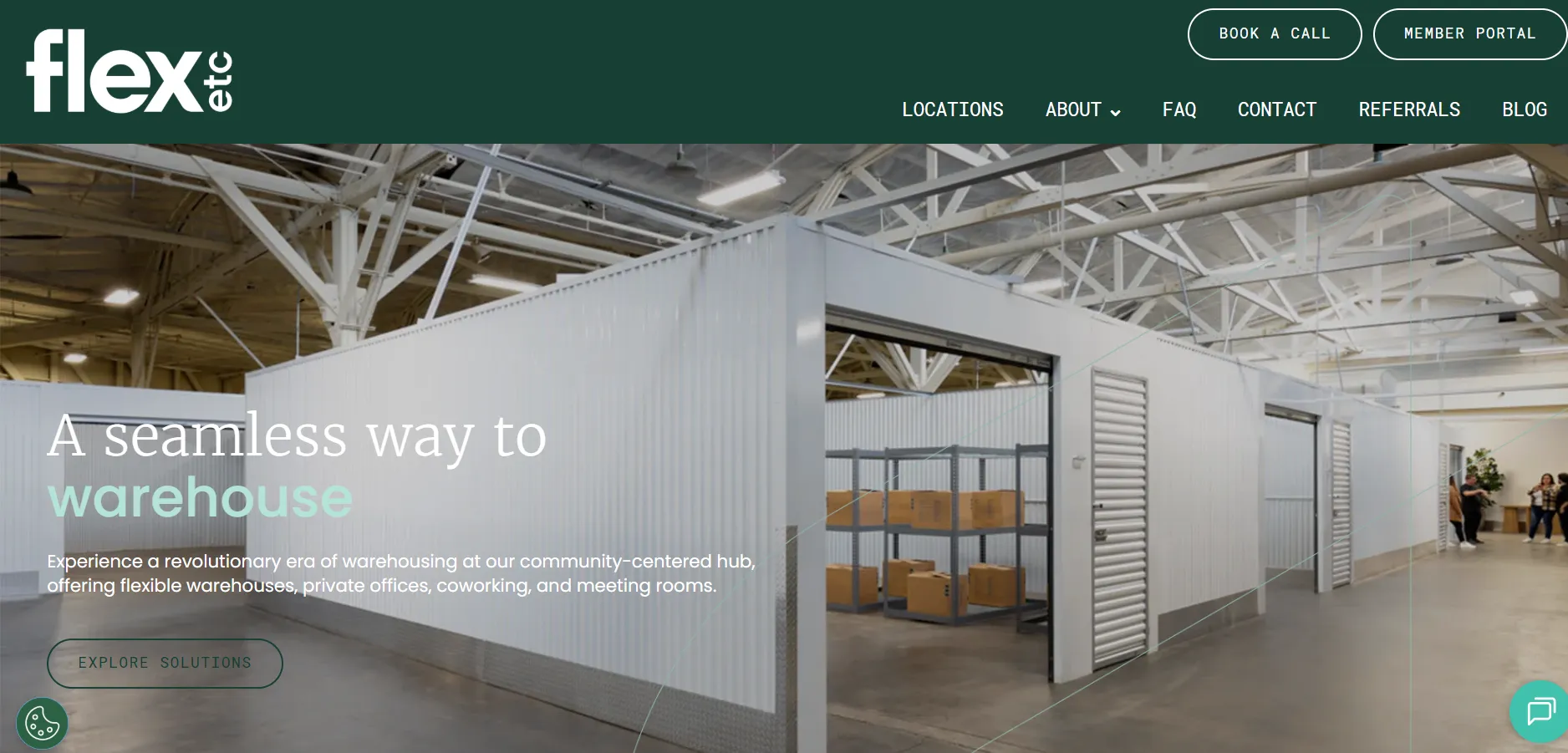
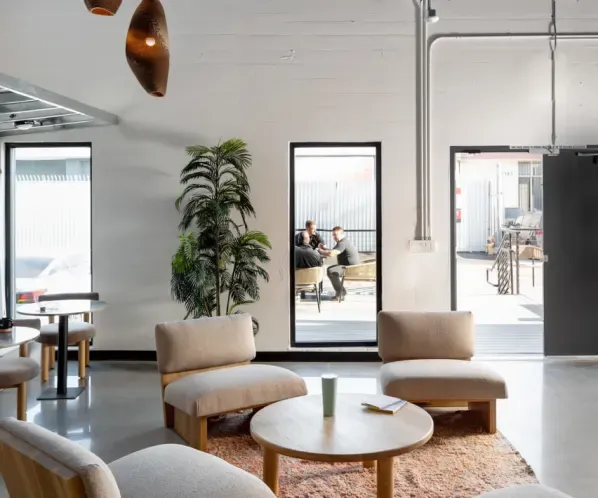
FlexHQ is for the brand that wants its warehouse to read like a headquarters, dividing big industrial shells into warehouse units sized from 300 to 3,000 sq. ft. alongside offices and studios.
The offices come laid out by Ware Malcomb, the detail that pulls in teams who see the room as an extension of the brand.
Amenities and benefits
- The mix runs from flexible coworking memberships to private offices, all sharing the building with the warehouse units.
- The office finish is held to a professional standard, which reads well for client meetings.
- On-site staff handle security, and amenities are part of the membership, not extras.
- A content studio and conference rooms you can reserve round things out.
Pricing
FlexHQ keeps its rates off the website, so you will need to contact the team for a quote.
Pros and cons
✅ Month-to-month terms with quick move-in.
✅ Professionally designed offices that work for client-facing brands.
✅ Coworking, offices, and warehouse units in one building.
❌ Warehouse units open at 300 sq. ft., which can overshoot a very small operation.
#5: ReadySpaces
Best for: Brands that value national reach and industrial infrastructure over ecommerce extras like content studios.
Locations: 38 across the U.S. and Canada.
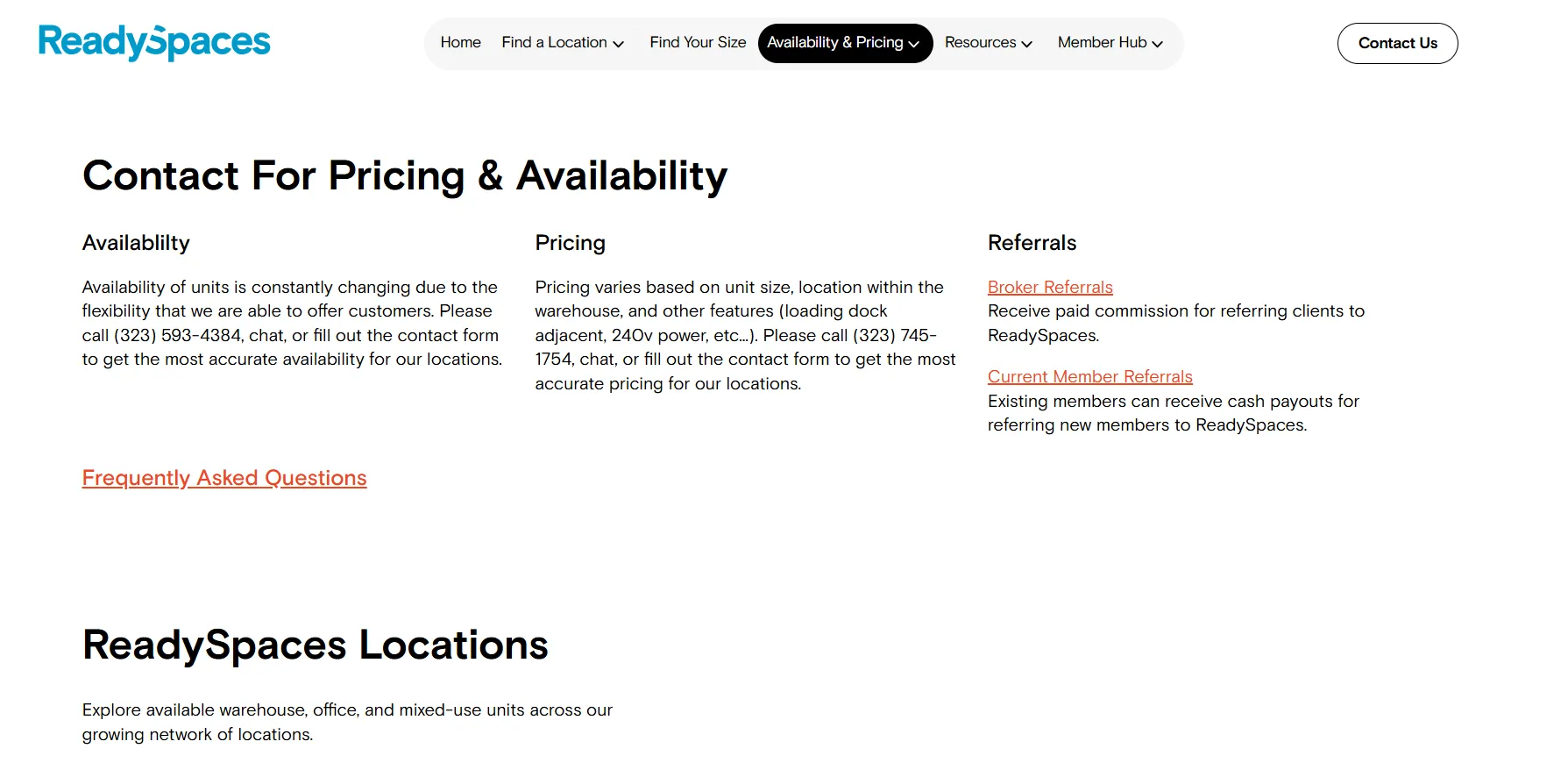
ReadySpaces is the pick when reach counts for more than ecommerce frills, running 38 facilities across the U.S. and Canada with warehouse units from 100 to 5,000+ sq. ft.
Forklifts and dock access come with the space, a good fit if your operation needs industrial room in a few different regions and you do not want an enterprise contract to get it.
Amenities and benefits
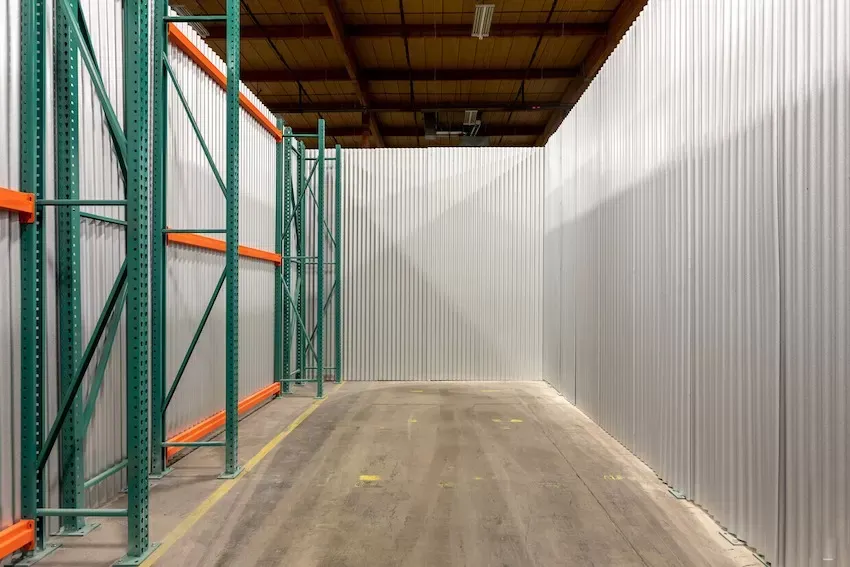
- Units run anywhere from 100 to 5,000+ sq. ft., with the forklifts and dock access an industrial operation needs.
- Most sites add shared workspace, and a few extend to private offices and conference rooms.
- Security is built in, with secured 24/7 entry and a light community layer around the warehouse space.
Pricing
ReadySpaces quotes custom rates that move with unit size, position inside the facility, and extras such as dock adjacency or 240V power.
Leases can begin as short as 90 days.
Pros and cons
✅ Short, flexible leases that never tie you down long term.
✅ A move-in process kept light on paperwork.
✅ Strong coverage spanning the U.S. and Canada.
❌ No public pricing makes side-by-side comparison harder, which is why some members have been looking for ReadySpaces alternatives.
#6: Cubework
Best for: Later-stage brands that need a large industrial footprint across many U.S. cities, with forklift labor on call.
Locations: 77+ U.S. locations.
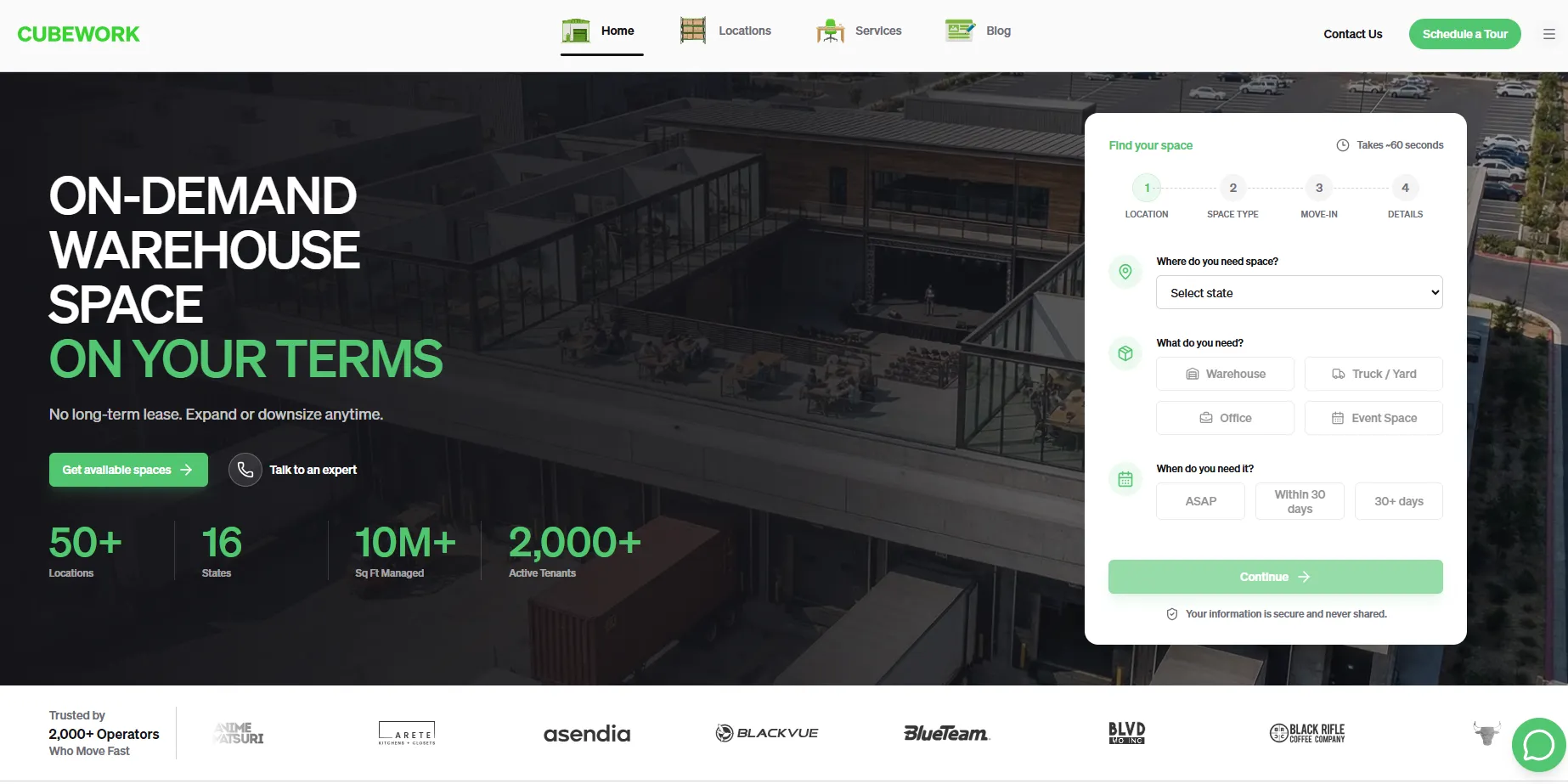
Cubework plays at a different scale from most names here, running 77+ U.S. sites and units that stretch from 150 sq. ft. up to a 150,000 sq. ft. distribution floor, and you can bring in forklift drivers by the shift.
It is built for later-stage brands after a real presence in multiple cities, with lease terms starting at three months.
Amenities and benefits
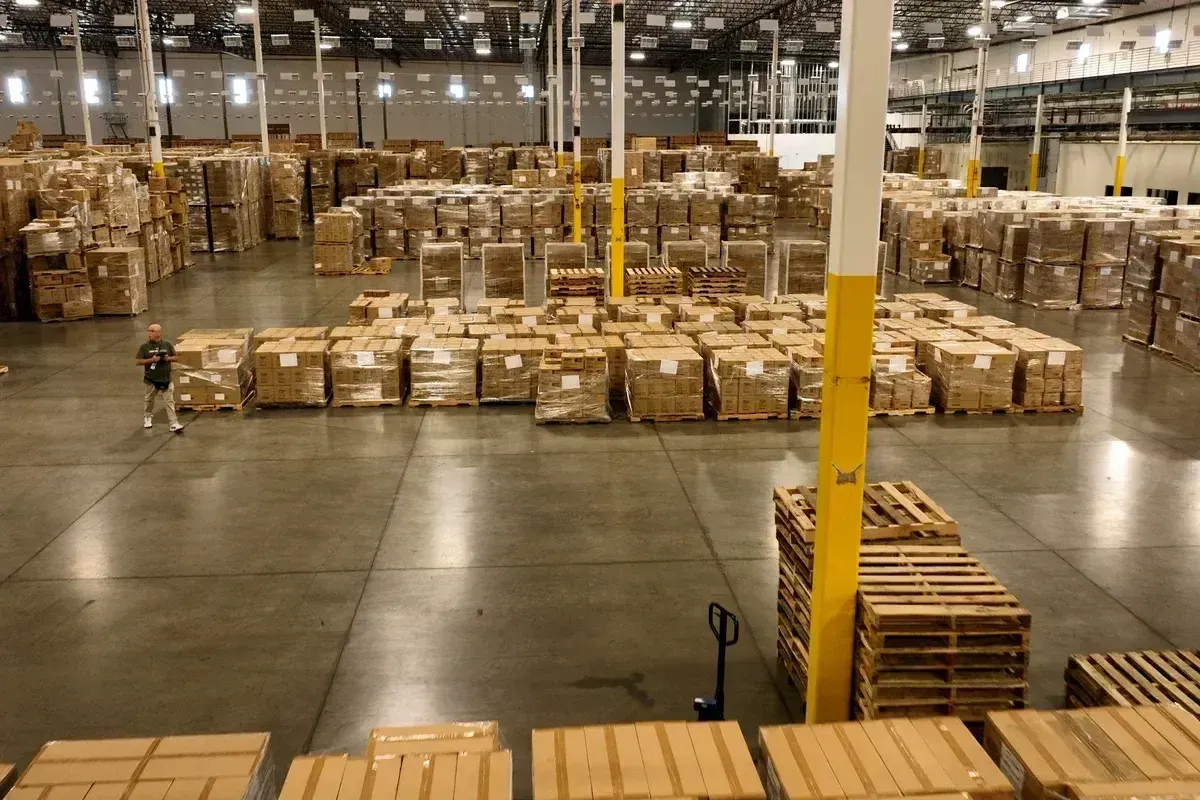
- Unit sizes cover everything from small bays to large industrial floors built to handle fulfillment and light manufacturing.
- Membership throws in some social extras, from catered breakfasts and the odd BBQ to trade show access and discounted concierge service.
- The facilities stay secured and monitored 24/7.
- Headroom is generous, and the zoning is properly industrial, so heavier operations are no problem.
Pricing
Cubework keeps pricing off its website, and the final number depends on the city, the unit size, and the lease term.
Pros and cons
✅ Sites cluster along major highways and freight corridors.
✅ Three-month minimums come in under standard industrial terms.
✅ Forklifts and drivers arrive on demand, with no equipment to buy.
❌ Pricing is not published.
#7: Crate Warehouse
Best for: Houston founders who want dependable infrastructure and tight security without paying for extras they will not use.
Locations: 1 location in Houston, Texas.
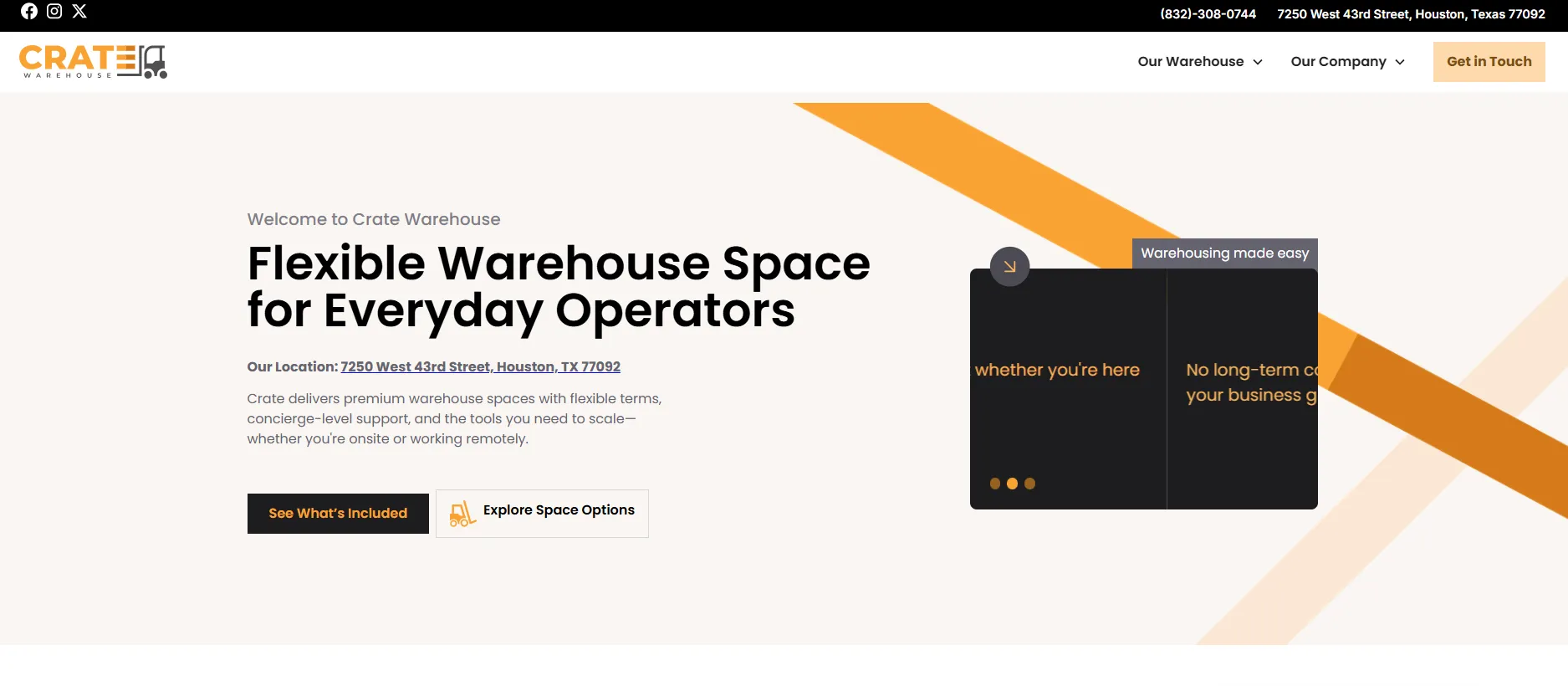
Crate Warehouse keeps things deliberately practical, running a single Houston facility on all-inclusive memberships and full operations support, with security treated as a core part of the offer.
That focus is exactly the point for anyone who values solid bones and predictable monthly costs over a long list of perks, and it makes Crate a grounded GXO alternative in the Houston market.
Amenities and benefits
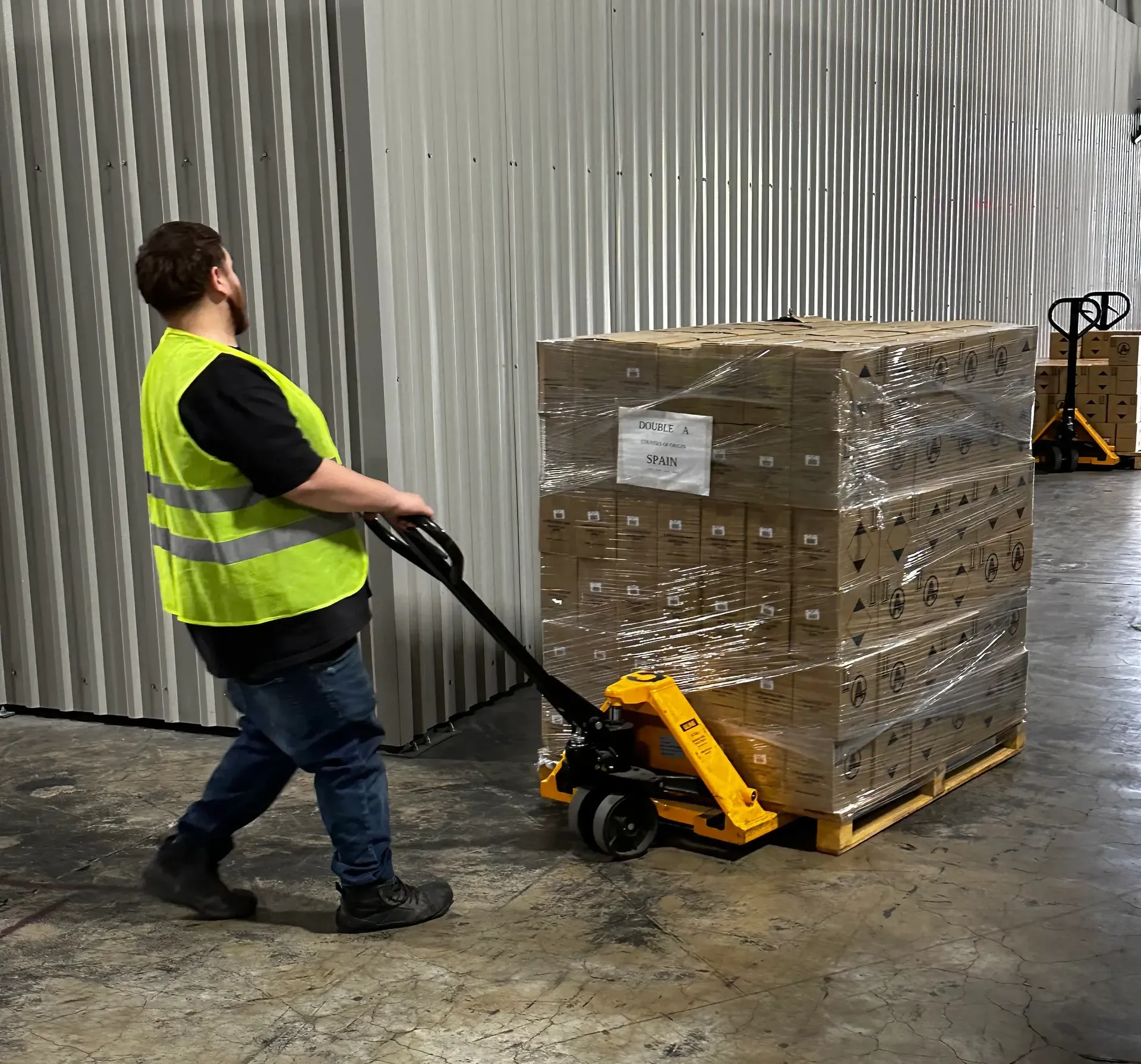
- Memberships fold in forklift access along with on-site logistics and fulfillment support.
- Receiving for both packages and freight is included.
- Secure entry pairs with 24/7 video monitoring across the building.
- Loading docks are unlimited.
Pricing
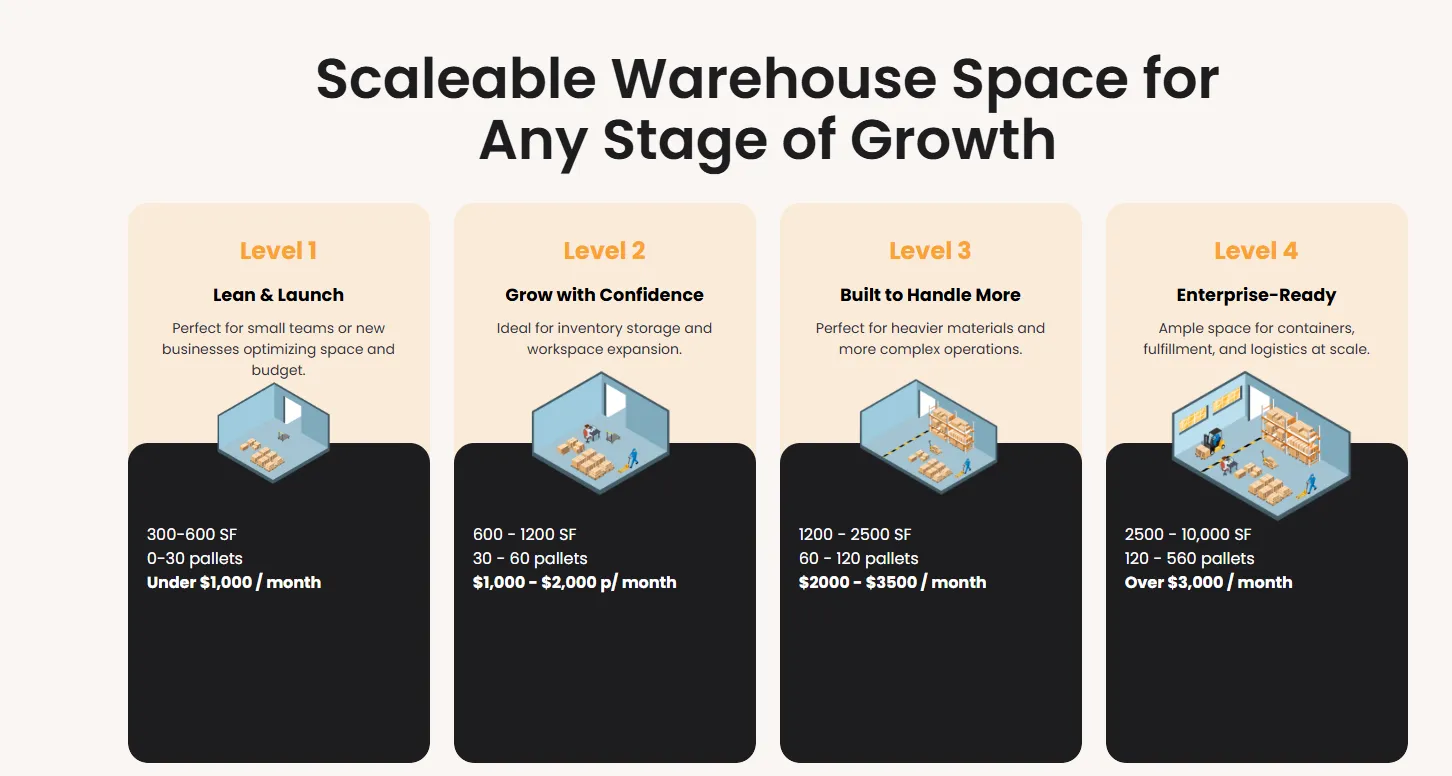
Crate Warehouse runs four membership levels:
- Level 1: under $1,000/month for 300 to 600 sq. ft., up to 30 pallets.
- Level 2: $1,000 to $2,000/month for 600 to 1,200 sq. ft., up to 60 pallets.
- Level 3: $2,000 to $3,500/month for 1,200 to 2,500 sq. ft., up to 120 pallets.
- Level 4: over $3,000/month for 2,500 to 10,000 sq. ft., up to 560 pallets.
Pros and cons
✅ Memberships are bundled, which keeps monthly costs easy to forecast.
✅ Room to grow into 10,000 sq. ft. of warehouse space.
✅ Forklifts and equipment are included, not billed separately.
❌ Just one location, in Houston.
❌ Units start at 300 sq. ft., which can run large for a brand at the very beginning.
#8: Room2Work
Best for: Atlanta-area founders outgrowing a home office who want light warehouse space alongside coworking and meeting rooms.
Locations: 1 location in Roswell, GA, inside the greater Atlanta metro.
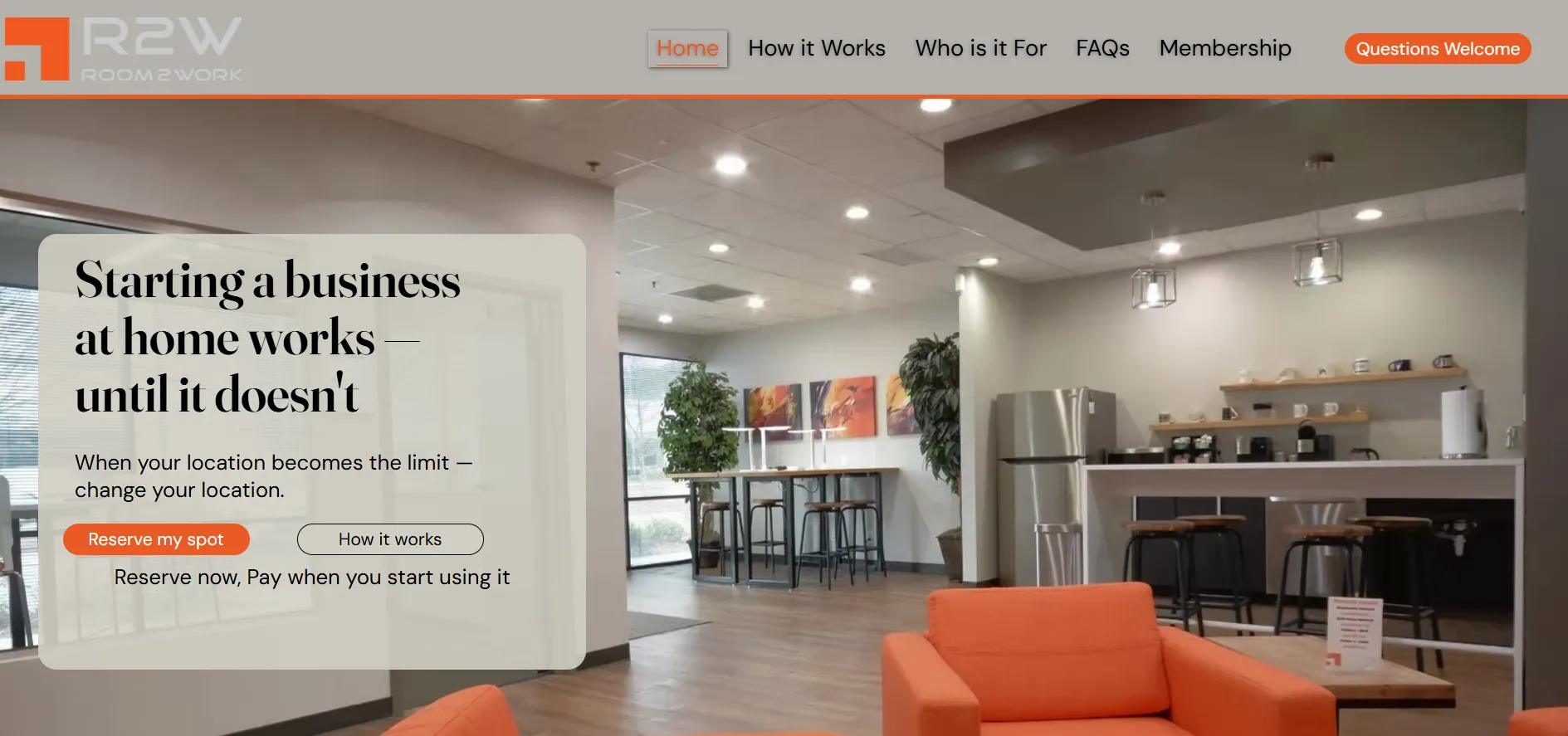
Room2Work targets the awkward middle, where a business has outgrown the kitchen table but is not ready for a long industrial lease, by putting coworking and private offices alongside light warehouse storage at one Roswell address.
Month-to-month memberships and a low first-month trial keep the commitment light, a good setup for a one- or two-person brand testing its first dedicated space.
Amenities and benefits
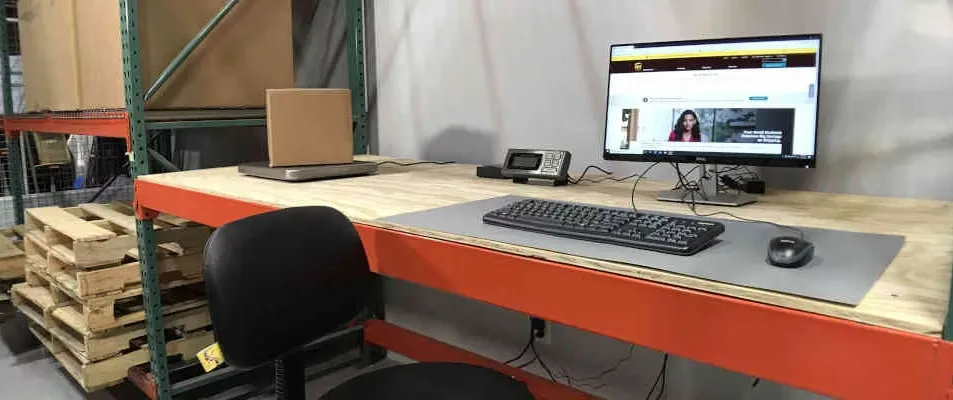
- Co-warehousing pods handle inventory and outbound shipments.
- Light production space works for prepping ecommerce orders, setting up gear, or laying out new designs.
- A community of local entrepreneurs supports networking and peer help.
- Gigabit internet, 24/7 secured access, and an on-demand loading dock fill out the rest.
Pricing
Room2Work keeps two month-to-month memberships, both all-access with no lease:
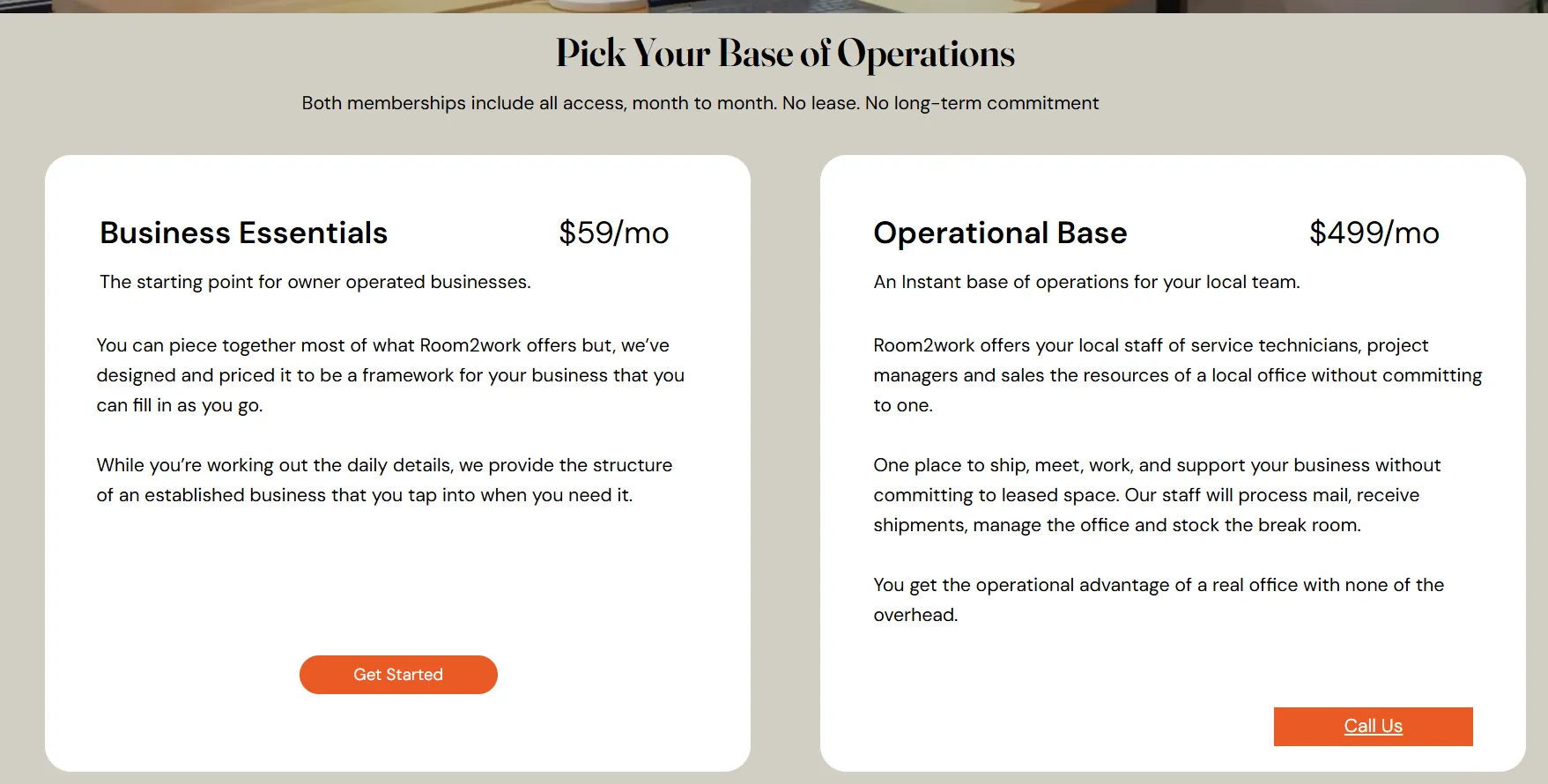
- Business Essentials ($59/month): a lean base for an owner-run business, with the structure of an established office to draw on as you go.
- Operational Base ($499/month): a ready-made base for a small local team, with on-site staff covering mail, deliveries, office management, and the break room.
Everything else, from meeting rooms to workspace and logistics, is pay-as-you-go, so you are charged only for what you actually use.
Pros and cons
✅ A $59/month entry point, all-access and month-to-month with no lease.
✅ A ready-made community of local entrepreneurs.
❌ A single location in Roswell, GA.
What are the best 3PL alternatives to GXO Logistics in 2026?
The best 3PL alternatives to GXO Logistics are Flowspace and Flexe.
Let’s go over them in more detail:
#1: Flowspace
Best for: Brands that want a software-first 3PL with inventory spread across a national network.
Locations: 150+ fulfillment centers across the U.S. and select areas of Canada.
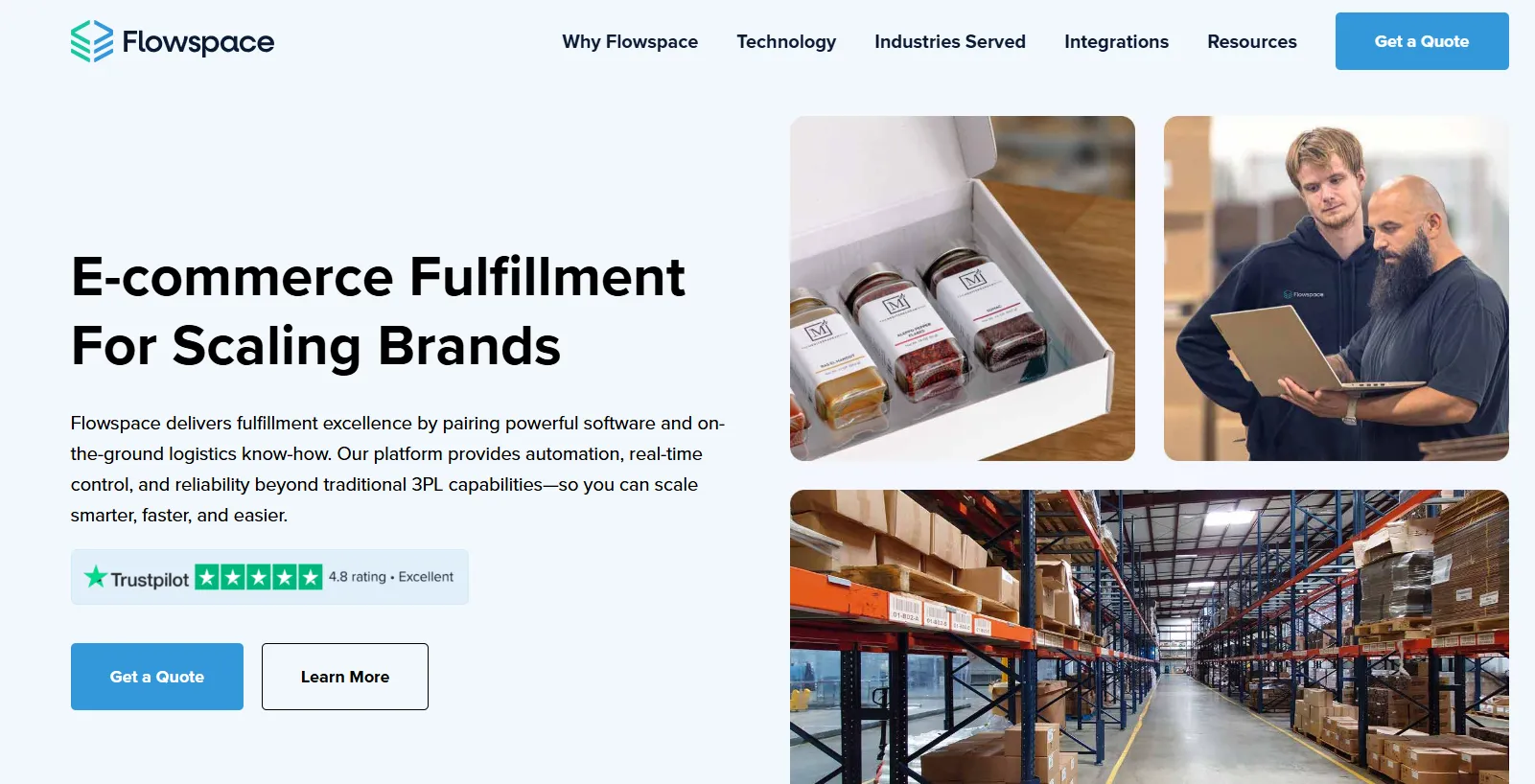
Flowspace runs on software more than real estate, spreading your inventory across 150+ partner fulfillment centers and assigning each order to whichever one matches the delivery zone.
If you want the outsourced route but still expect to watch and steer a national network from a dashboard, Flowspace is the more hands-on of the two 3PLs here.
Amenities and benefits
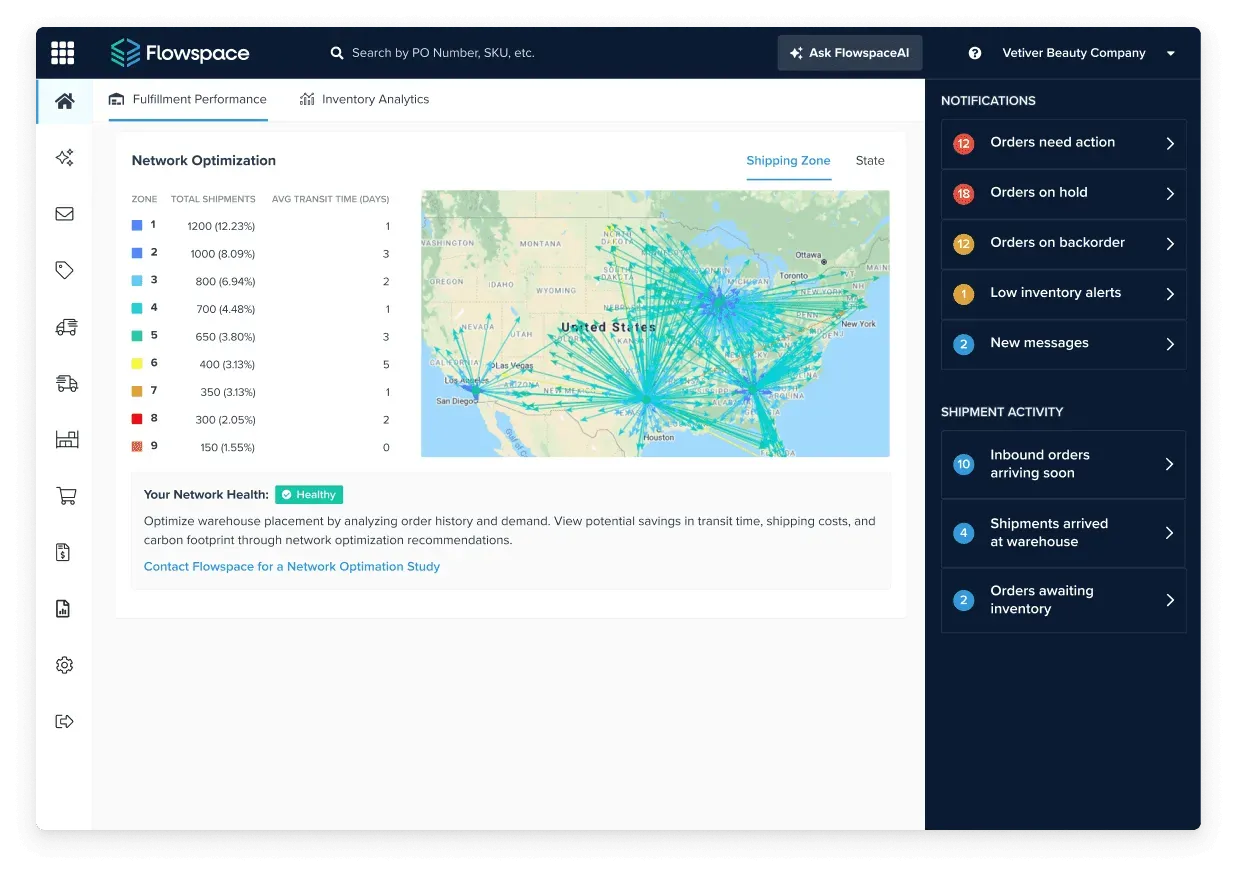
- Pick and pack, kitting, labeling, returns: the platform runs the full fulfillment cycle end to end.
- Spreading stock across 150+ centers shortens the trip to each buyer.
- Live order and inventory figures show up in one dashboard across your connected channels.
- Because the footprint is a network, you keep stock close to customers with no leases to sign.
Pricing
Flowspace pricing is custom, so you will need to talk to their sales team for numbers.
Pros and cons
✅ A broad fulfillment network at 150+ centers.
✅ Shopify integration treated as a core part of the product.
✅ Pick, pack, and ship handled under one provider.
❌ Custom pricing makes side-by-side comparison hard.
#2: Flexe
Best for: Mid-market and enterprise brands that need warehouse capacity in dozens of markets without signing leases.
Locations: 800+ partner warehouses across North America.

Flexe reads less like a warehouse and more like a layer of infrastructure, since a single integration plugs you into 800+ independent operators across North America.
Such breadth, with no leases and capacity you pay for only as you use it, is what makes Flexe the closest stand-in for GXO's enterprise scale on this list.
Amenities and benefits
- A single API, EDI, or XML integration is all it takes to reach 800+ operators across Tier 1 to Tier 3 markets.
- The platform combines warehouse and order management with inventory tracking, all in one system.
- You get live visibility into inventory and order status, plus SLA results.
- The day-to-day is steered by a dedicated logistics analyst who works like a control tower.
💡 Interested in how Flowspace compares to Flexe? You can read our Flowspace vs. Flexe guide.
Pricing
Flexe’s pricing is fully custom and built per account, with the model centered on enterprise-scale agreements.
Pros and cons
✅ Reaches more markets than anything else on this list.
✅ One integration spans distribution and fulfillment across 800+ partners.
✅ Network planning and consulting come with the engagement.
❌ Less hands-on control of the physical space than a suite you rent yourself.
Stay in control of your operation with Saltbox in 2026
This list ran the full range of GXO Logistics alternatives, from co-warehousing suites where the keys stay with you to a pair of 3PLs that take the operation off your plate completely.
A few come in cheaper, and a couple stretch further on raw reach or industrial muscle.
What keeps Saltbox at the top for product brands is that you give up none of the control, even as the operation picks up the kind of backup a scaling brand leans on:
- A private suite you can walk into during the day, sized anywhere from 70 to 5,000+ sq. ft.
- An on-site crew that takes in your inbounds even when none of your people is on site.
- Slack member support that doesn’t take a week to respond.
- Parsel label rates a brand would struggle to negotiate alone.
- A room full of other ecommerce founders facing the very same problems.
Saltbox offers month-to-month suites and access membership plans from $349/month for growth-stage DTC brands that do not want to sign a multi-year contract or hand fulfillment to an international 3PL.
Talk to an expert to learn more about us, or book a tour at one of our locations to see a suite in person.
⚠️ Disclaimer: This article was last updated on July 6, 2026, and if there's any misinterpretation of the information, please contact us, and we will fact-check it.
Frequently asked questions
While there may be upfront costs, switching to a co-warehousing space can reduce long-term expenses by eliminating hidden fees and rigid contracts.
The right time is usually six months before most founders actually do it. If your error rate is consistently above 1–2%, your costs are scaling faster than your volume, or you're spending meaningful time every week managing your provider relationship, those are signals worth acting on sooner rather than later.
Prioritize pricing transparency, space flexibility, real-time inventory visibility, and on-site support. Also evaluate tech stack compatibility; your new provider should integrate cleanly with your existing sales channels and shipping tools without requiring a custom build on your end.
Yes. The parallel-run method lets you migrate inventory and orders to a new provider while your current 3PL continues to fulfill. The key is sequencing the move by SKU, starting with slow-movers, and setting clear rules for which provider handles which orders during the overlap.
Most 3PL transitions take between 30 and 90 days, depending on your order volume, SKU complexity, and contract notice requirements. A 60-day timeline using the parallel-run method is the most common approach for mid-volume operators.