.webp)


Key takeaways
- Saltbox is the best ShipBob alternative in 2026 for DTC brands that want their own warehouse space with built-in operations support, discounted shipping through Parsel, and access plans starting at $349/month.
- WareSpace, Portal Warehousing, and FlexHQ are strong co-warehousing options for brands that want flexible warehouse units with basic shared amenities.
- Flowspace, FedEx Fulfillment, and Flexe are 3PL alternatives worth considering if you still want to outsource fulfillment but need a different provider than ShipBob.
- Cubework, ReadySpaces, and Loloft work well for brands that primarily need storage and light operational space without the full 3PL layer.
You handed ShipBob your inventory, your customer experience, and your trust, and somewhere along the way, the wrong items started showing up at your customers' doors.
That story keeps coming up in reviews, Reddit threads, and founder group chats: hidden shipping markups, SKU mix-ups, support tickets that go nowhere for 48 hours, and billing surprises that eat into margins you worked months to build.
The thing is, ShipBob isn't a bad company, but the traditional 3PL model itself might not be the right fit for every ecommerce brand, especially if you're still growing and want to stay close to your products.
If you're rethinking how your fulfillment works and looking for the best ShipBob alternatives in 2026, this article covers 10 options across co-warehousing spaces, 3PL providers, and flexible warehouse solutions.
What are the best alternatives to ShipBob in 2026?
The best alternative to ShipBob in 2026 is Saltbox with its co-warehousing solution. If you’re looking for a 3PL solution like ShipBob, then Flowspace is the best alternative, with Cubework also offering a flexible warehouse and storage solution.
Here's a breakdown of all 10 alternatives for ecommerce brands looking for a better way to store, pack, and ship:
What are the best co-warehousing alternatives to ShipBob?
If you're tired of handing your inventory to a 3PL and hoping for the best, co-warehousing flips the model.
You get your own space, your own workflow, and the operations infrastructure to support it.
Here are the best co-warehousing alternatives to ShipBob in 2026:
#1: Saltbox
Saltbox is a co-warehousing solution designed for growth-stage ecommerce brands that want a warehouse infrastructure without the overhead of a traditional lease or the hidden costs of a 3PL.
You can get started with an access plan membership at $349/month, and every plan runs month-to-month with free inventory inbounding included.

What makes this model work for DTC founders is the combination of private warehouse suites, on-demand labor, and discounted shipping, all under one roof, with on-site staff keeping operations moving even when you step away.
You also get access to a community of fellow ecommerce founders through the Upstream Entrepreneurs Club, which is something no 3PL is going to offer you.
Disclosure: Yes, Saltbox is our solution. Despite this, I'll provide an honest breakdown of what makes us the top ShipBob alternative for growth-stage brands in 2026.
Let's go over the services and amenities that have helped ecommerce businesses like PURioLABS, Shinery, and GOLDN The Brand get off the ground: 👇
Warehouse and office space for every stage of growth
If you're packing orders from your living room or running a small crew that's bursting out of a storage unit, Saltbox has warehouse suites and offices from 70 to 5,000+ sq. ft. spread across 12 U.S. locations.
And, unlike 3PLs, there's no annual commitment required to get started. Not even a quarterly commitment is required.
You can pay monthly and have the freedom to switch to a bigger or smaller suite as your needs change or downsize without renegotiating.

Not ready to move into a warehouse space, yet?
Saltbox Access Plans will provide you with a mailing address, receiving services, discounted rates, on-site labor, and an entrepreneurial network.
Explore Access PlansHere are the four warehouse sizes you can choose from:
- Small: For 1 to 2 employees. You get 70 to 250 sq. ft. with room for 4 to 15 pallets, which works well for solopreneurs who want a dedicated space.
- Medium: For 1 to 4 employees. This gives you 250 to 500 sq. ft. and capacity for 16 to 31 pallets, a good match for brands that are actively scaling.
- Large: For 1 to 10 employees. You'll have 500 to 1,000 sq. ft. and space for 32 to 62 pallets, built for teams managing a growing catalog.
- Extra Large: For teams up to 50 employees. This tier offers 1,000 to 5,000+ sq. ft. with capacity for 63 to 125 pallets, designed for established DTC brands with bigger operations.
➡️ You can take a quiz after selecting your location to figure out the right fit, or book a tour and have our team figure out the right amount of space for your use case.
Supported (or unsupported) shipping and operations
One of the biggest differences between Saltbox and ShipBob is control.
You decide how much help you need: handle everything yourself, bring in support when it gets busy, or hand off fulfillment entirely.

Here's what's included:
- Daily carrier pickups: Leave your packages in the sorting area, and FedEx, USPS, and UPS collect them every weekday.
- Discounted shipping rates: Through Parsel, our shipping app partner, you get access to carrier rates that most early-stage brands can't negotiate on their own.
- On-demand labor: When things spike, bring in our on-site team by the hour for packing, inbounding, and inventory tasks, billed in 15-minute increments starting from $45/hour.
- Free inventory inbounding: Our team receives and organizes your shipments even when you're away, so operations don't stop when you leave the building.
- 24/7 security: Surveillance and security systems protect your inventory around the clock.
- Content studio: A professional studio inside the facility for product photography and video, so you don't need to rent one elsewhere.
Find out more about how we help make shipping easier for growth-stage ecommerce brands: 👇
Cut shipping costs with Parsel
Every Saltbox member gets access to Parsel, a shipping app that unlocks carrier rates and label pricing that most growing brands can't access independently.
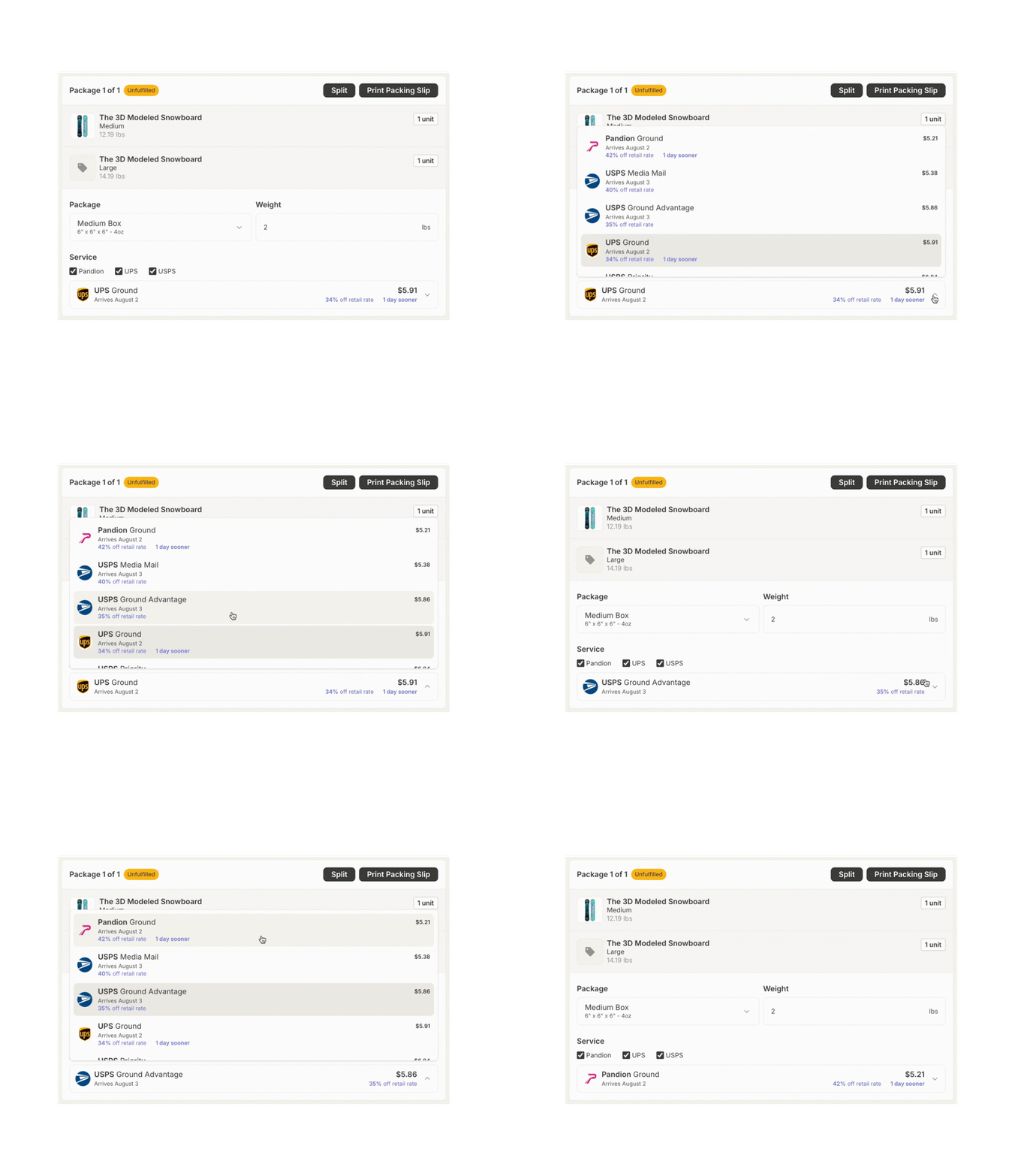
You can compare rates across USPS, UPS, FedEx, and a mix of regional and emerging carriers directly in the app, then choose the best option per shipment.
Orders can go out as late as 4:30 PM, and every label comes with transparent pricing so there are no surprises on your invoice.
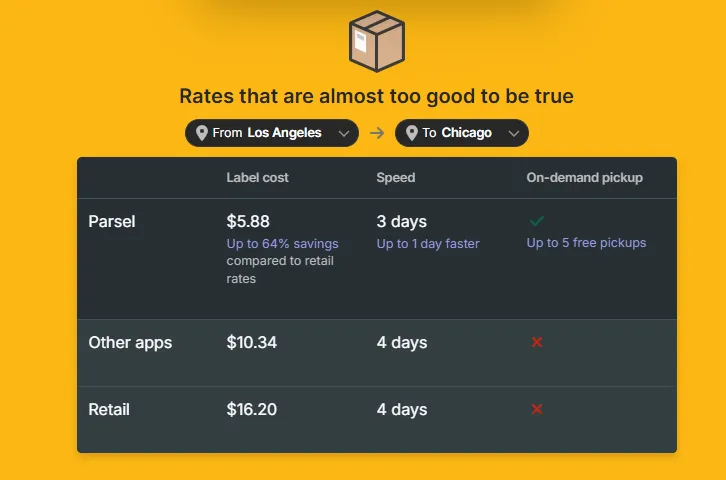
Want to try Parsel? You can sign up to Parsel here.
Saltbox locations across the U.S.
You can find Saltbox on the West Coast, the East Coast, and in the Central U.S.
Here's the full list of our locations:
- Los Angeles, San Gabriel Valley.
- Los Angeles, Torrance.
- Phoenix.
- Seattle, SoDo Row.
- Denver, Park Hill.
- Dallas, Carrollton.
- Dallas, Farmers Branch.
- Atlanta, Upper Westside.
- Atlanta, Westside Park.
- Washington D.C., Alexandria.
- Miami, Doral.

Interested in one of our locations across the U.S?
You can book a tour to see it alongside our operations experts. Available Mon-Fri, 8:30 AM-4:30 PM Central Time.
Book a TourHow is Saltbox different from ShipBob?
The core difference between Saltbox and ShipBob is that ShipBob is a traditional 3PL where you hand over your inventory, and they handle fulfillment on your behalf, while Saltbox is a co-warehousing solution where you keep full control of your products inside your own private suite.
With ShipBob, your inventory sits in shared fulfillment centers managed by their team.
You don't visit the warehouse, you don't choose how things get packed, and when something goes wrong (e.g., SKU mix-up or a shipping delay), you're relying on their support team to fix it.
Saltbox takes a different approach.
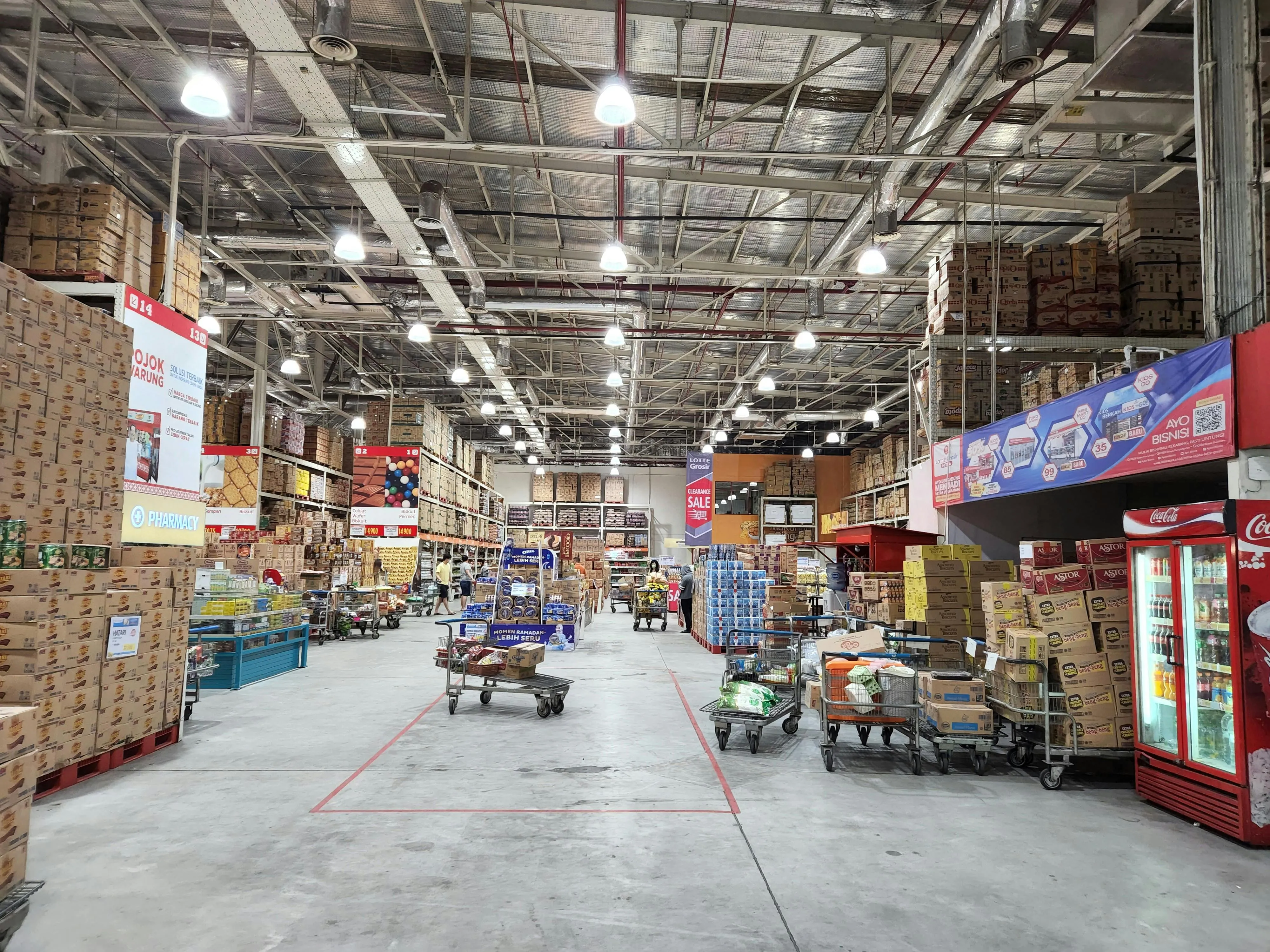
You get your own dedicated space with the operations infrastructure built in: loading docks, daily carrier pickups, discounted shipping through Parsel, and on-demand labor you can hire by the hour when things get busy.
Unlike with 3PLs, you're not locked into opaque per-order fees that scale unpredictably. You pay a monthly membership and suite rate that you can see upfront.
And unlike ShipBob's model, where you need volume to justify the partnership, Saltbox works for start-up ecommerce brands that may not be shipping thousands of orders a month yet.
Here's what it comes down to:
- ShipBob is built for brands that want someone else to handle everything. The trade-off is less visibility, variable costs, and limited control over your customer experience.
- Saltbox is built for brands that want to stay close to their operations but need real infrastructure to do it properly, without signing a multi-year warehouse lease or paying 3PL markups on every order.
Saltbox's membership, warehouse, and office plans
Pricing at Saltbox works in layers. You pick a membership tier first, and from there, you can add a warehouse suite and an office if you need them.
Here are the 3 membership tiers:
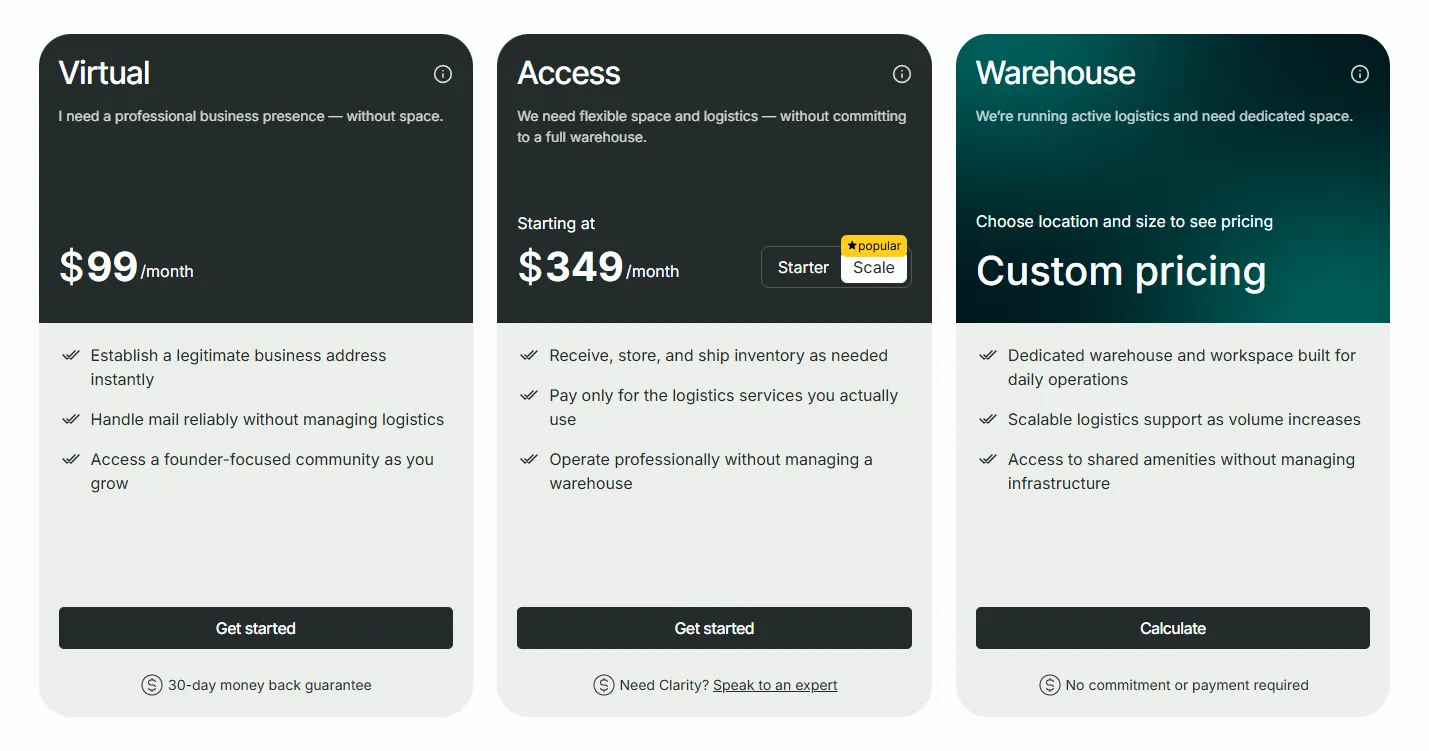
- Virtual: $99/month, a fully virtual membership for businesses that need a professional mailing address (mail only, no packages) and access to the Upstream Entrepreneurs Club community.
- Access: Starting from $349/month, which includes physical access to our locations, loading dock, packing stations, meeting rooms, and a content creation studio, without requiring a warehouse suite.
- Warehouse: Custom pricing, which includes flexible warehouse and office suites built for ecommerce entrepreneurs, with shipping technology, onsite operations support, and modern amenities.
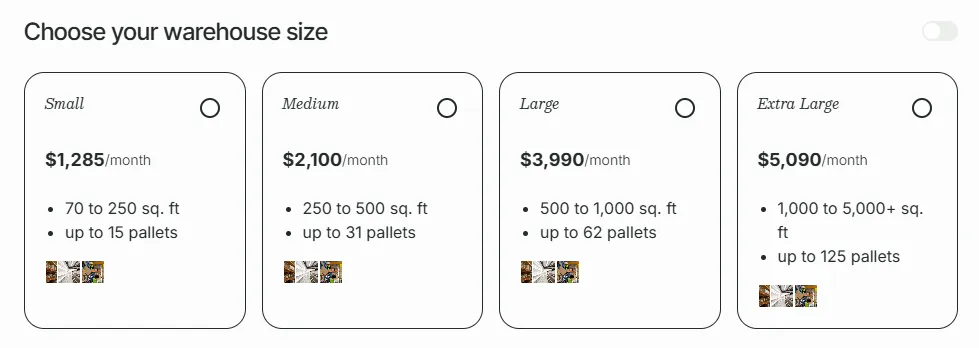
Warehouse rates depend on your city and suite size. To give you a sense of what it looks like, here's the pricing for Atlanta's Upper West location:
- Small Warehouse: Starting at $1,285/month for 1 to 2 employees, 70 to 250 sq. ft., and can accommodate 4 to 15 pallets.
- Medium Warehouse: Starting at $2,100/month for 1 to 4 employees, 250 to 500 sq. ft., and can accommodate 16 to 31 pallets.
- Large Warehouse: Starting at $3,990/month for 1 to 10 employees, 500 to 1,000 sq. ft., and can accommodate 32 to 62 pallets.
- Extra Large Warehouse: Starting at $5,090/month for 1 to 50 employees, 1,000 to 5,000+ sq. ft., and can accommodate 63 to 125 pallets.
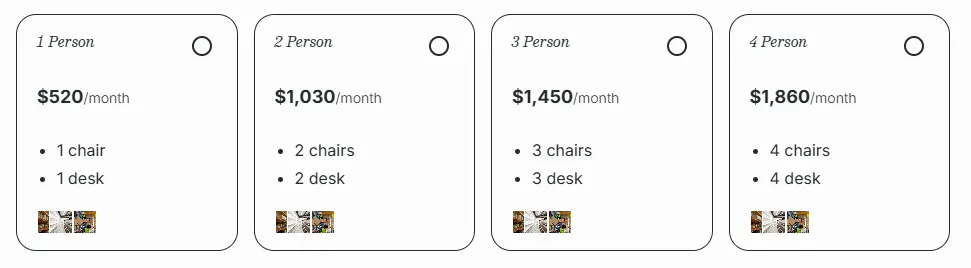
Lastly, you can select your office size, which is optional. Here’s the pricing of our Atlanta's Upper West location:
- 1-person office: $520/month for 1 chair and 1 desk.
- 2-person office: $1,030/month for 2 chairs and 2 desks.
- 3-person office: $1,450/month for 3 chairs and 3 desks.
- 4-person office: $1,860/month for 4 chairs and 4 desks.
➡️ You can pay monthly, which means that you won't be locked into an annual contract. However, you can save 10% by paying annually, or save 5% when paying biannually.
Saltbox pros and cons
✅ Get warehousing, shipping infrastructure, and an office in one place across 11+ U.S. locations.
✅ Access Plan memberships start at $349/month, which are ideal for startups that aren't ready for a full warehouse commitment.
✅ The option for monthly payments with no long-term lease requirement.
✅ Save on shipping costs with Parsel's carrier partnerships.
❌ Not available in Canada, although you can handle cross-border operations from our Phoenix location.
❌ Not a 3PL, so if you want fully hands-off fulfillment, it's a different model than ShipBob.
#2: WareSpace
Best for: Ecommerce brands and small businesses that want one flat monthly bill covering their entire warehouse setup.
Locations: 20 cities across the U.S.
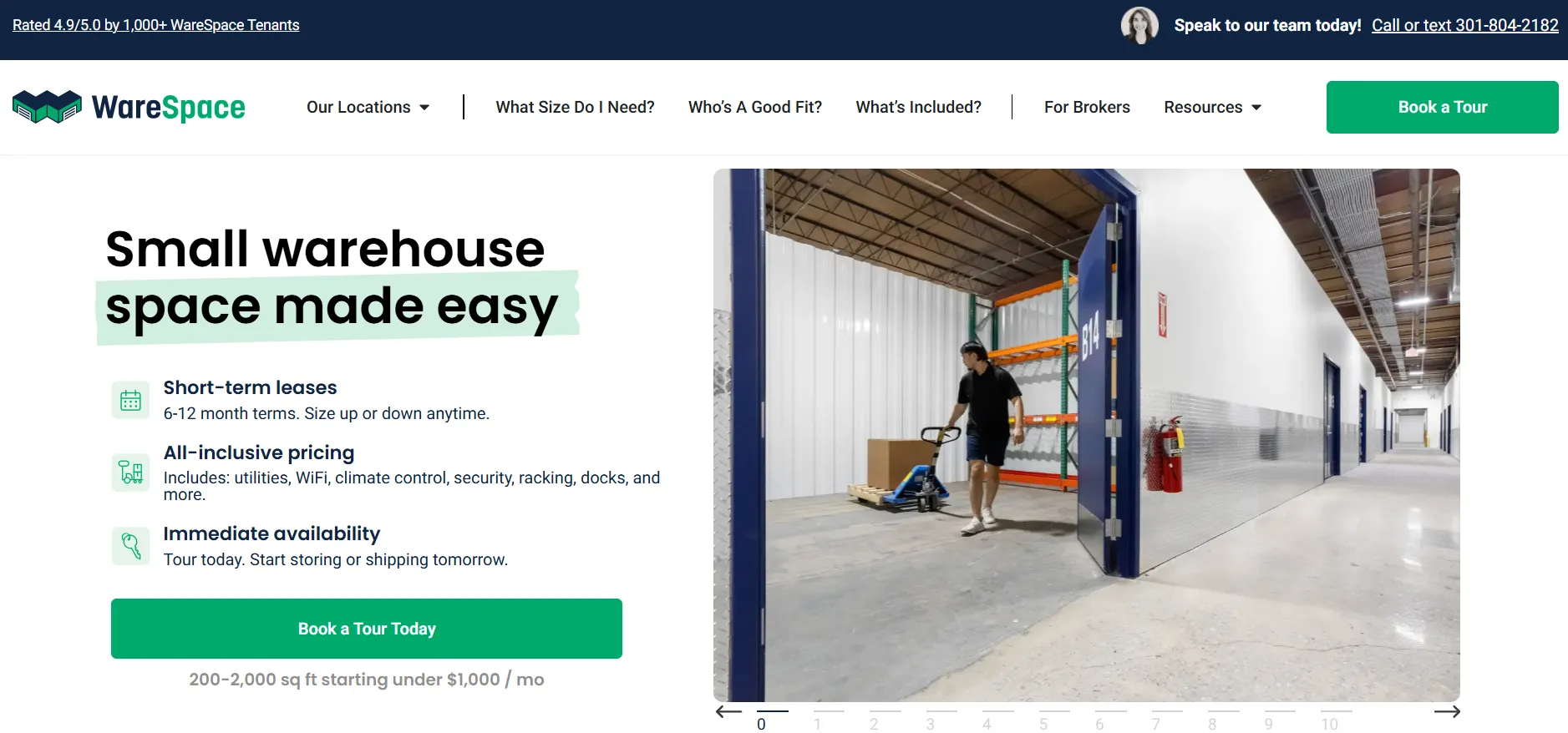
Think of WareSpace as the "utilities included" apartment of co-warehousing.
You get a self-contained unit from 200 to 2,000 sq. ft. with industrial racking already bolted in, docks you can actually use, and Wi-Fi that works.
Climate control, cleaning, security, kitchen, conference rooms, all bundled into that single monthly number.
For founders who are done letting a 3PL like ShipBob make decisions about their packaging and shipping, WareSpace hands you the space and the gear to do it yourself.
Amenities and benefits
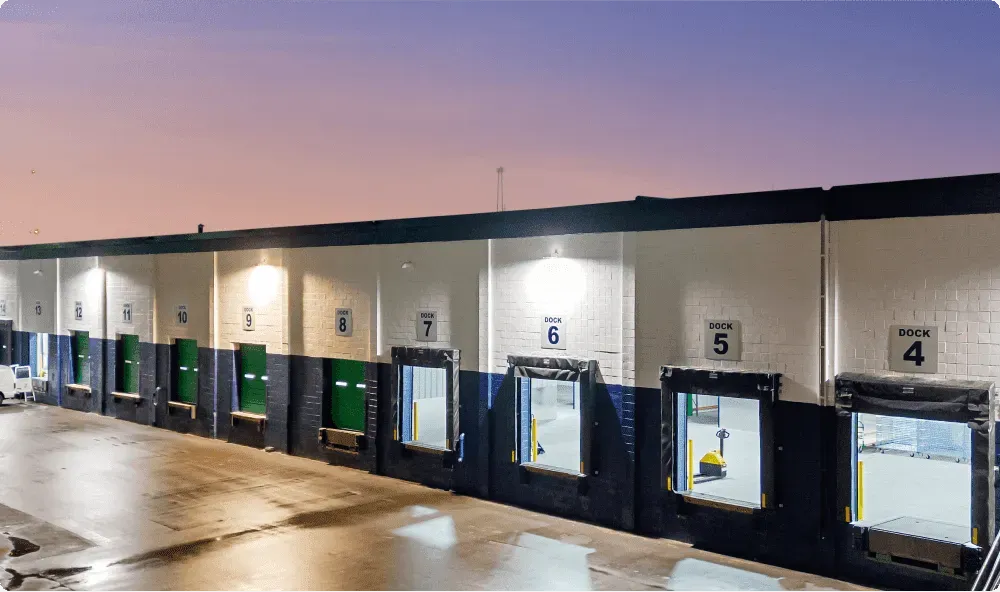
- Every unit comes with racking, pallet jacks, and dock access as standard.
- Wi-Fi, utilities, and climate control are baked into the monthly rate.
- Shared spaces like kitchens, lounges, and conference rooms are part of the deal.
- You get 24/7 access to your unit, every day of the year.
Pricing
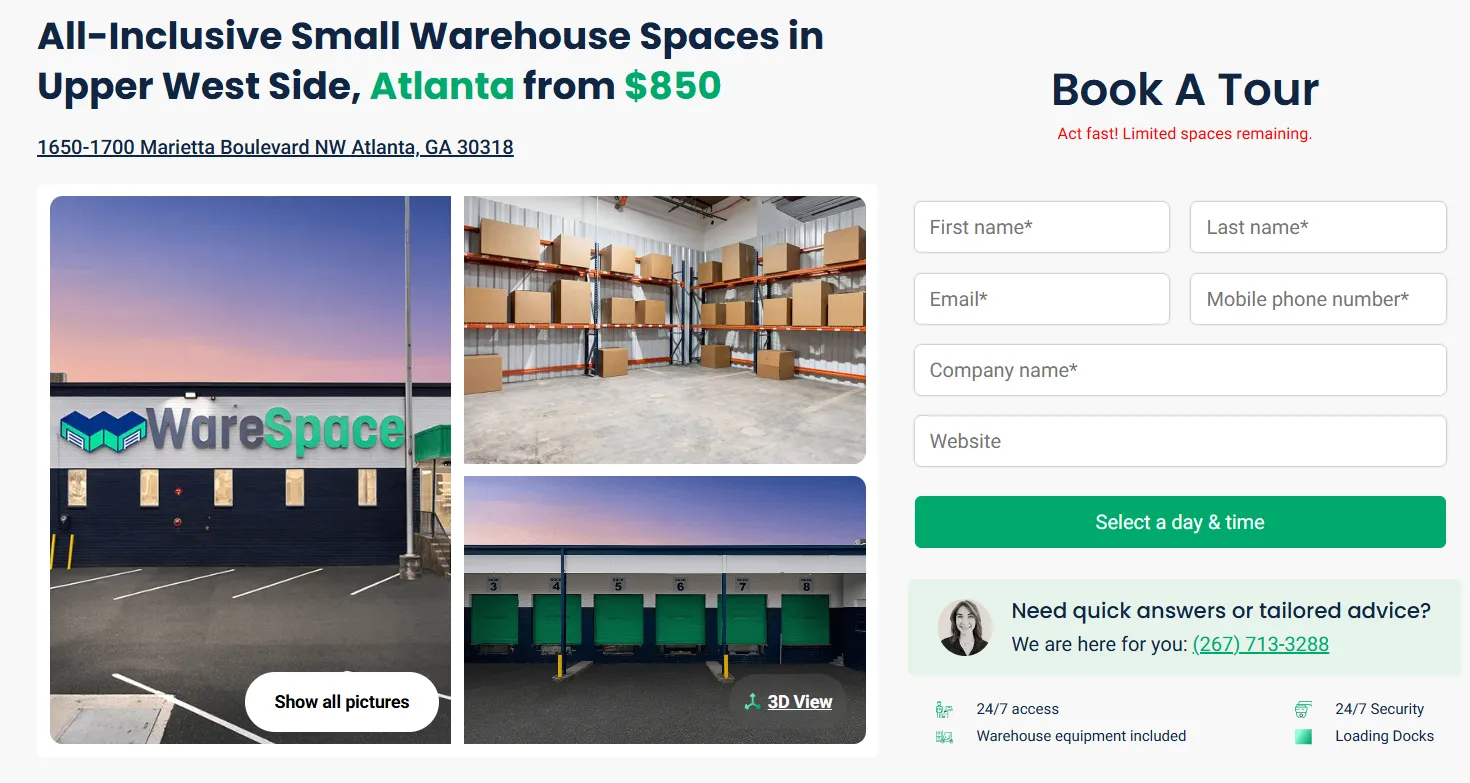
Rates land between $850 and $1,000/month in most markets, with Atlanta on the lower end.
No hidden line items. What you see is what you pay.
That said, you'll want to take a tour to pin down the exact rate for your preferred city and unit size.
Pros and cons
✅ One flat monthly payment covers everything.
✅ Units from 200 to 2,000 sq. ft. with shared operational spaces.
✅ Dock access is engineered to avoid bottlenecks at every location.
❌ Some members have flagged inconsistent experiences depending on the location.
❌ Lease agreements typically run 6 or 12 months, unlike some WareSpace alternatives.
#3: Portal Warehousing
Best for: Ecommerce startups that want to walk into a warehouse on Monday and start shipping by Tuesday.
Locations: 7 U.S. cities, including Salt Lake City, Phoenix, Orlando, Minneapolis, Manhattan, Los Angeles, and Brooklyn.
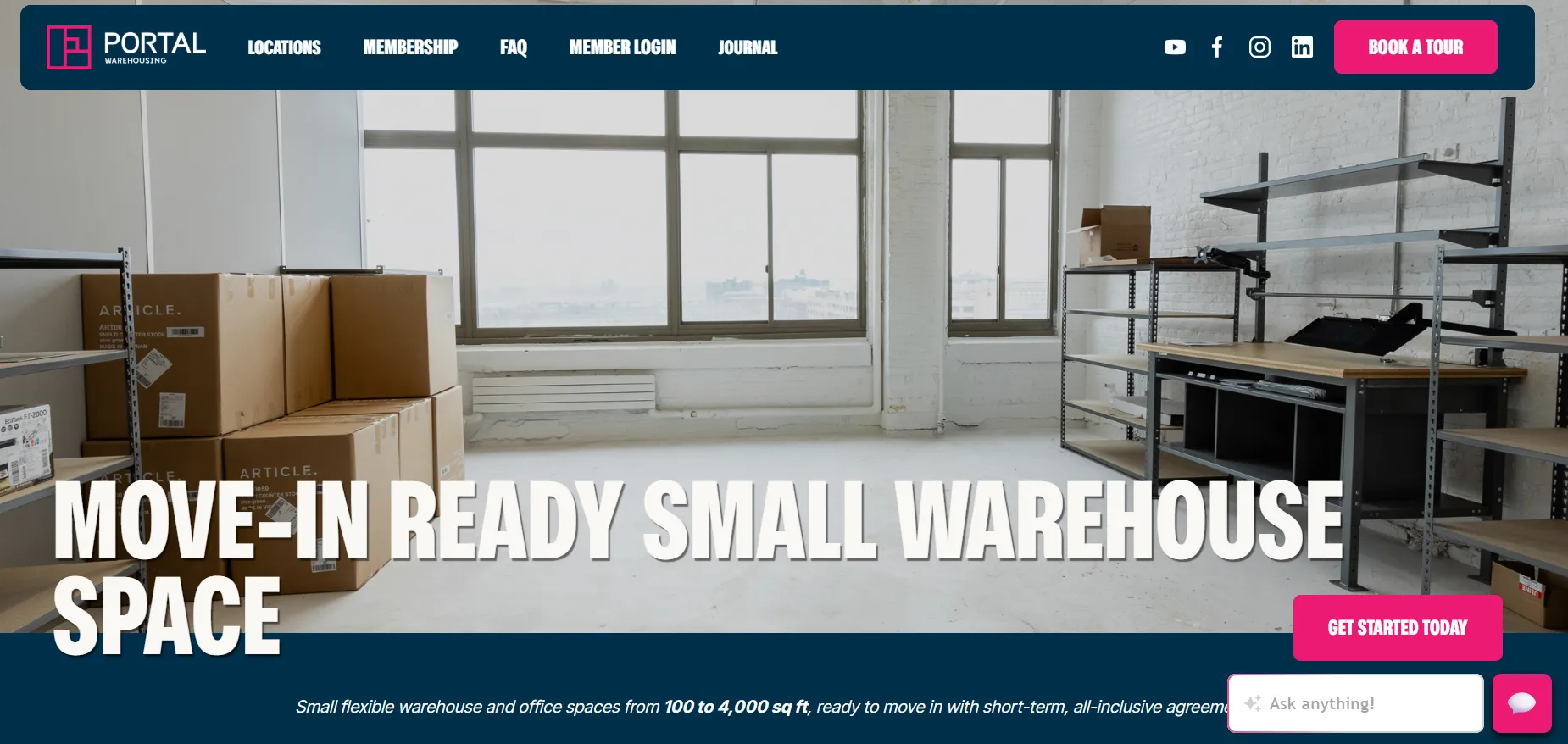
Portal's pitch is simple: move-in-ready warehouse spaces with the boring stuff already handled.
Units range from 100 to 4,000 sq. ft., and everything from Wi-Fi to racking to daily carrier pickups is included from day one.
They also run community events, so you're not just renting space, you're joining a network of founders in the same building.
Amenities and benefits
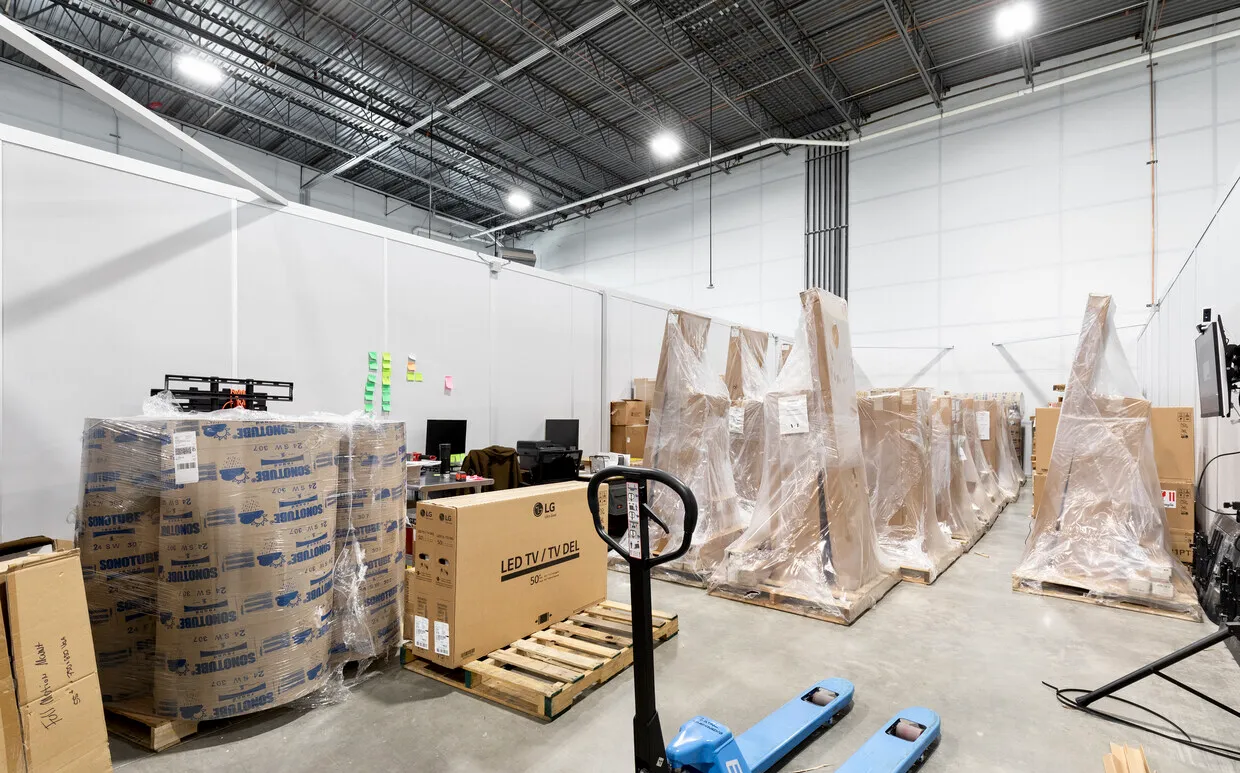
- Daily carrier pickups, loading docks, racking, high-speed Wi-Fi, and security come standard.
- Private offices, shared lounges, a reception desk, and a dedicated shipping address round out the setup.
- Sites are picked for operations access, near major interstates and labor markets.
- Networking events designed specifically for ecommerce founders.
Pricing
Three tiers based on space:
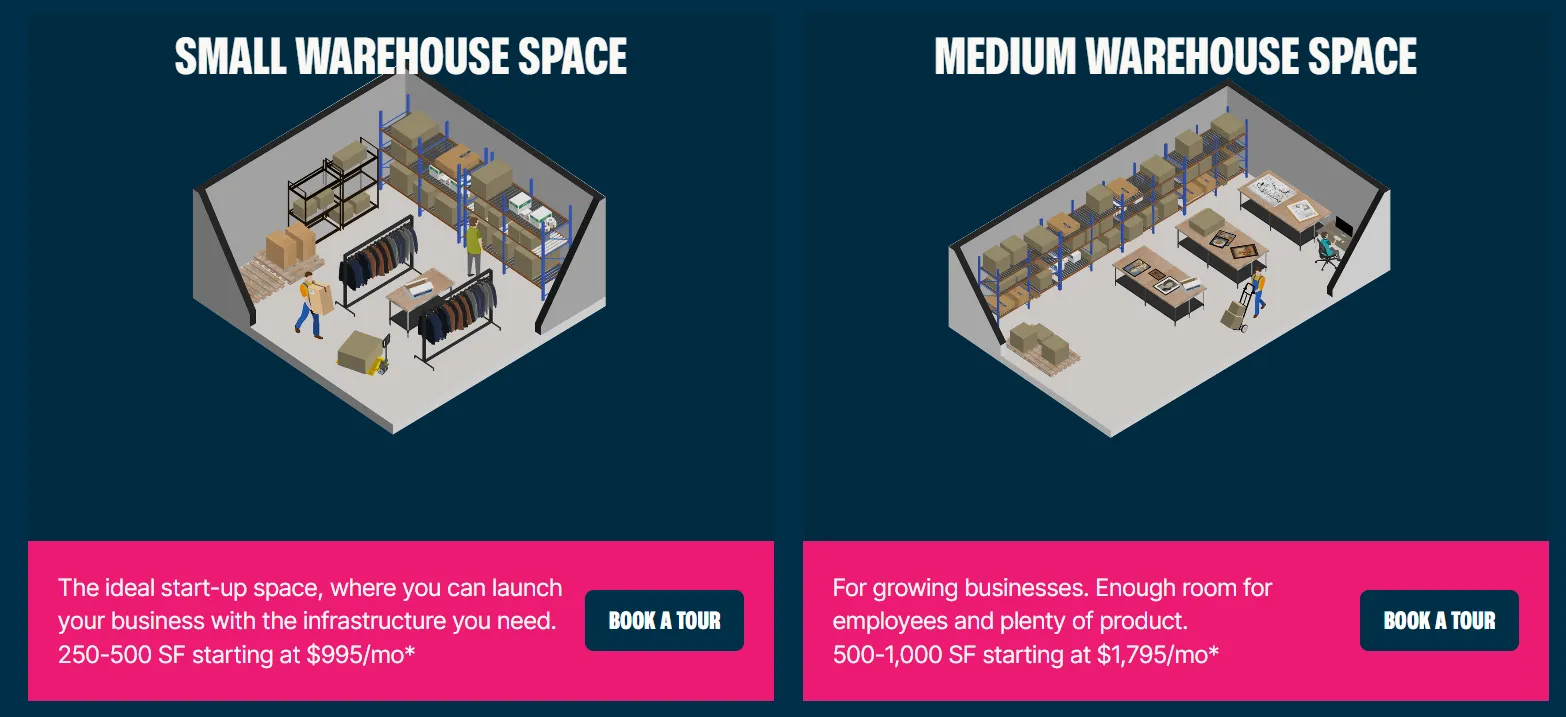
- Small: 250 to 500 sq. ft., starting at $995/month.
- Medium: 500 to 1,000 sq. ft., starting at $1,795/month.
- Large: 1,000+ sq. ft., starting at $2,995/month.
➡️ Your actual rate will depend on city, availability, and any extras you add.
Pros and cons
✅ No long-term lease required.
✅ Sites are positioned near major interstates for fast shipping.
✅ Flexible unit sizes that are ready the day you sign.
❌ Only 7 cities, so your options are limited if your target metro isn't on the list.
❌ There's no on-demand labor model, which means you handle staffing yourself when volume jumps.
#4: FlexHQ
Best for: Teams that care about working in a space that doesn't look like it was built in 1987.
Locations: 6 across the U.S., including Los Angeles, Denver, Plano, Salt Lake City, Nashville, and Charlotte.
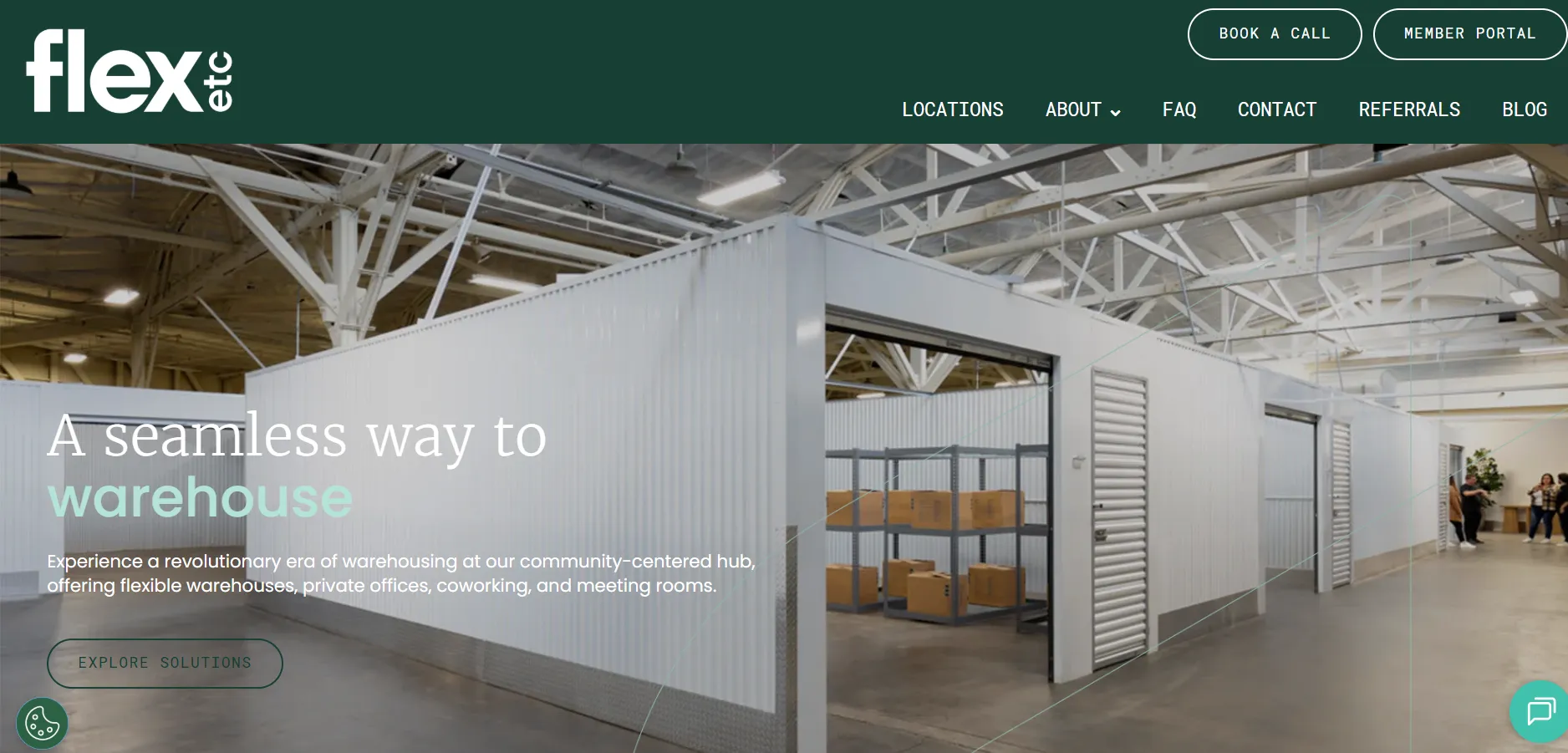
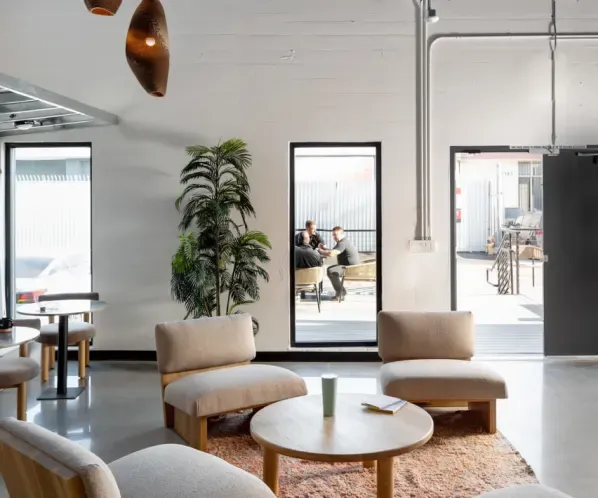
FlexHQ takes large industrial buildings and converts them into shared warehouse and office environments that actually feel designed, because they are.
Units start at 300 sq. ft. and go up to 3,000+ sq. ft., and the whole thing runs month-to-month.
Amenities and benefits
- Private offices, coworking memberships, and warehouse units all under one roof.
- Conference rooms and content creation studios are included in the package.
- On-site staff and a secure facility with professional-grade amenities.
- You can move in almost immediately, no drawn-out setup process.
Pricing
They don't list pricing on their site.
You'll have to talk to their team to figure out what a unit costs for your preferred location and size.
Pros and cons
✅ Month-to-month terms with no long-term leases.
✅ Spaces are well-designed, which matters if you're hosting clients or shooting content.
✅ Quick move-in with minimal friction.
❌ The smallest warehouse unit is 300 sq. ft., which could be more space than an early-stage brand needs.
❌ Six locations means you're working with a shorter list of cities, which is why some brands have been looking for FlexHQ alternatives.
What are the best 3PL alternatives to ShipBob?
Maybe you still want someone else to handle pick, pack, and ship for you.
That's fine. Not every brand is ready to run their own warehouse.
Here are 3PL alternatives to ShipBob that offer a similar outsourced model but with different strengths and trade-offs:
#1: Flowspace
Best for: DTC brands that want someone else to handle fulfillment, but with better tech visibility than what ShipBob offers.
Locations: Over 150 fulfillment centers across the U.S. and parts of Canada.
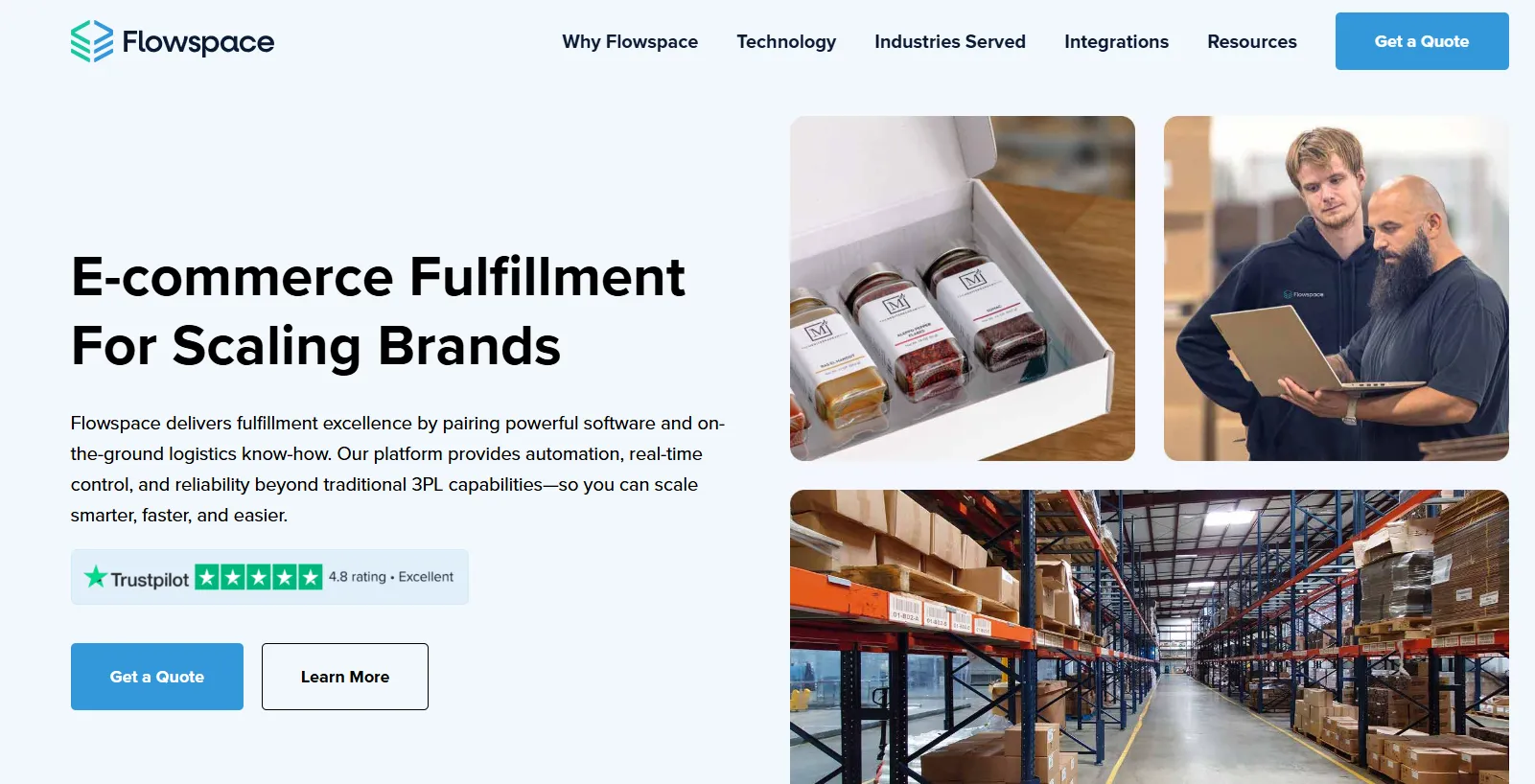
Flowspace is still a 3PL. You're still handing over your inventory. But the difference is the technology layer sitting on top.
Their platform routes inventory across warehouse partners based on where your customers are, with demand forecasting and automated carrier selection built in.
Amenities and benefits
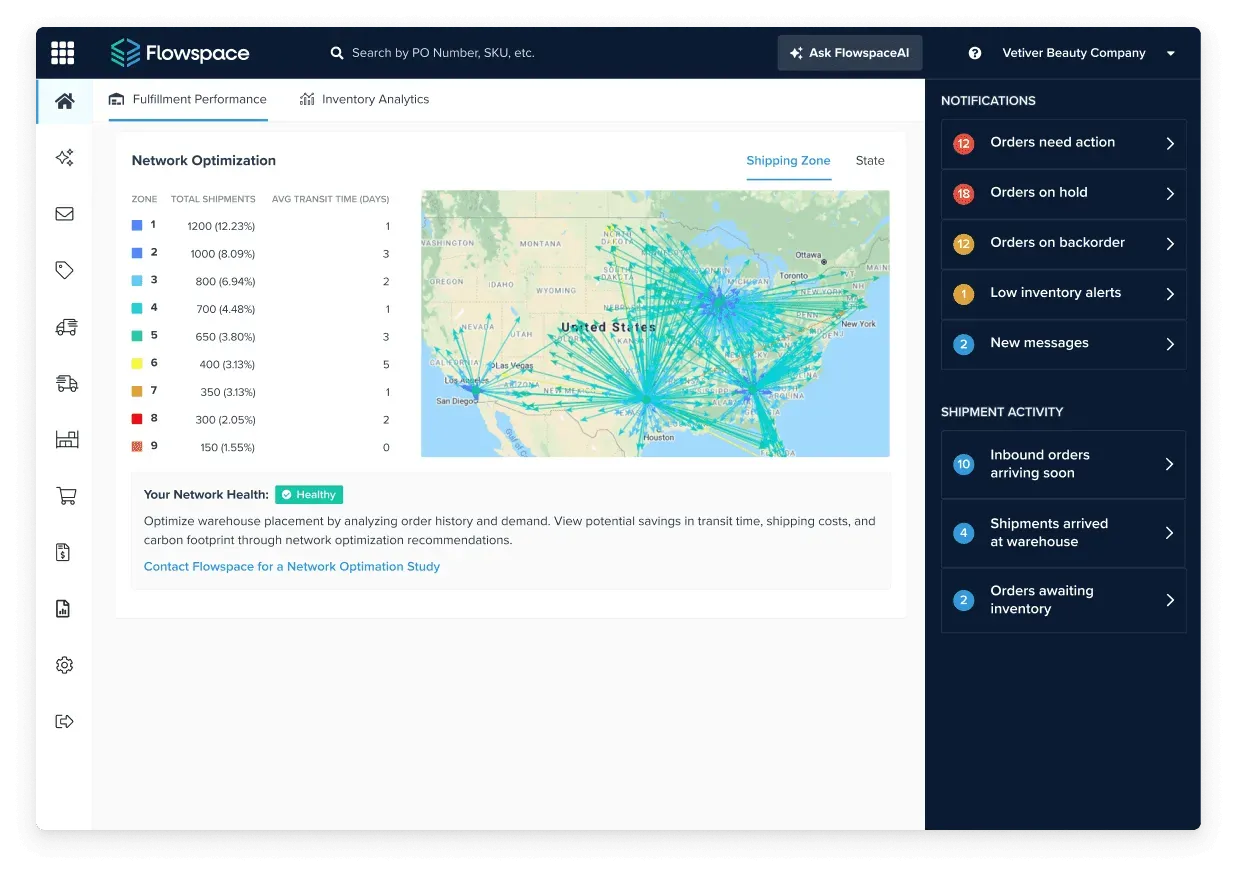
- Inventory gets placed across fulfillment nodes to shorten delivery times, and you can see where everything is in real time.
- Pick, pack, ship, kitting, labeling, and returns are all handled through the network.
- The platform connects with Shopify, Amazon, TikTok, and other major sales channels.
- Carrier selection is automated to balance speed and cost per order.
Pricing
No public pricing. Everything is custom.
You'll pay across a few categories: storage (per pallet or cubic foot), pick and pack (per order), and shipping (at Flowspace's negotiated rates).
Worth flagging: several Trustpilot reviewers have called out surprise price increases, some over 100%, without any advance notice, which is why some members have been looking for Flowspace alternatives.
Pros and cons
✅ Distributed network that gets your products closer to buyers.
✅ A technology layer that gives you actual visibility into what's happening.
✅ No warehouse lease or real estate commitment on your end.
❌ Pricing is a black box until you talk to sales.
❌ Since Flowspace uses partner warehouses, quality can vary from one location to the next.
#2: FedEx Fulfillment
Best for: Higher-volume brands already shipping through FedEx that want warehousing and fulfillment under one roof with that same carrier.
Locations: Multiple facilities within FedEx's U.S. infrastructure.
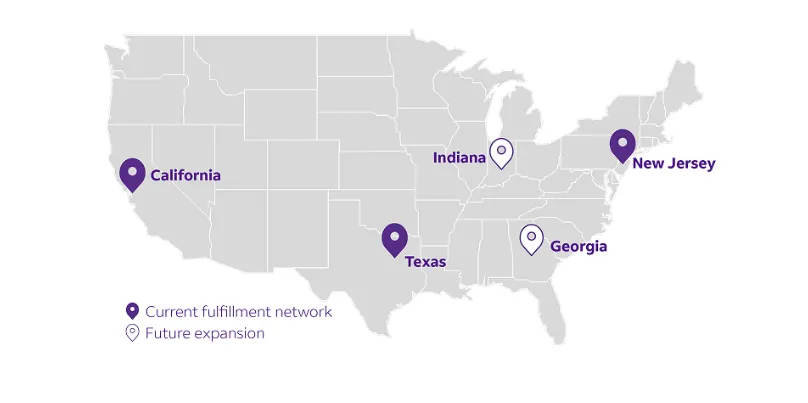
If you're already running most of your shipments through FedEx, it might make sense to keep the whole operation in one place.
FedEx Fulfillment connects you to their warehousing and order fulfillment services, plus the 2-day delivery network, freight management, and customs brokerage that come with the FedEx ecosystem.
It's a "stay in the family" play for brands that don't want to stitch together separate 3PL and carrier relationships.
Amenities and benefits

- Warehousing and fulfillment tied directly to FedEx's shipping infrastructure.
- 2-day delivery coverage across the continental U.S. without needing a separate carrier partnership.
- SKU-level inventory tracking and order management tools.
- International shipping through freight forwarding and customs brokerage for cross-border sellers.
💡 Interested in how Flowpsace compares to FedEx Fulfillment? Check out our comprehensive Flowspace vs. FedEx Fulfillment guide.
Pricing
Custom quotes only. Your rate depends on order volume, product type, and how much storage you need.
Industry benchmarks suggest storage starts around $5 per bin per month, but your actual numbers will vary.
Pros and cons
✅ You get the full FedEx delivery and operations backbone behind your fulfillment.
✅ Makes the most sense if FedEx is already your primary carrier.
✅ International operations capabilities that smaller 3PLs can't match.
❌ Not built for startups with smaller order volumes. This is more of a mid-to-large brand solution.
❌ You won't have physical access to your inventory the way you would in a co-warehousing setup.
#3: Flexe
Best for: Mid-size to enterprise brands that need to plug into warehousing capacity across North America without committing to leases.
Locations: Access to 800+ warehouse operators across North America.

Flexe isn't really a 3PL in the traditional sense. It's more of an infrastructure layer.
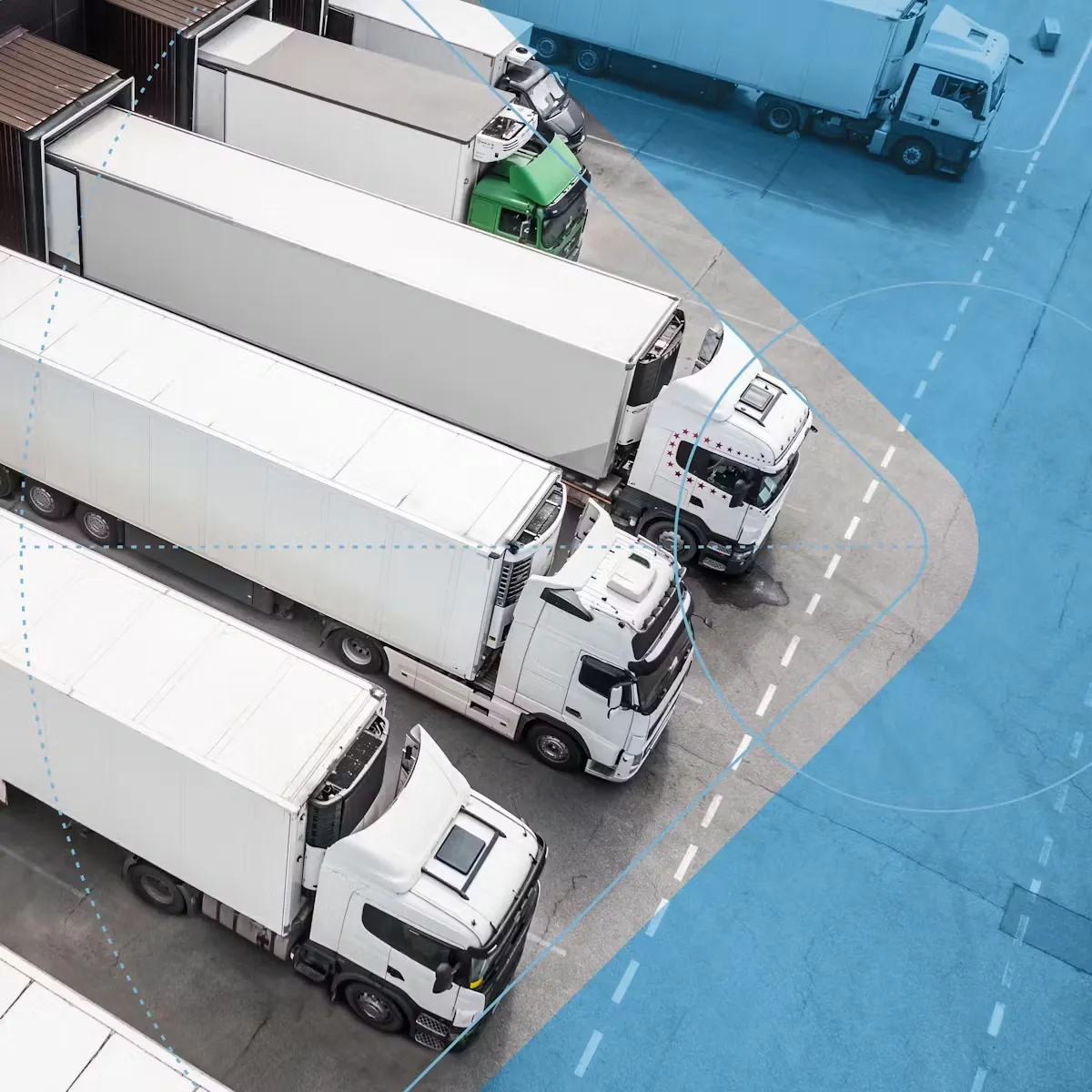
You connect to their network of 800+ warehouse operators through a single integration, and then you use space as you need it: overflow during peak season, testing a new market, or expanding your distribution footprint without signing a lease.
Amenities and benefits
- A single integration that connects you to warehouse operators across Tier 1 through Tier 3 markets in North America.
- Built-in warehouse management, order management, and cross-network inventory visibility.
- Pay-as-you-go model where you only use (and pay for) what you actually need.
- Designed around use cases like seasonal surges, inventory overflow, and network testing.
💡 Interested in how Flowpsace compares to Flexe? You can read our Flowspace vs. Flexe guide.
Pricing
Everything is pay-as-you-go, but the actual rates are custom based on your volume, locations, and what services you need. You'll have to reach out for a quote.
Pros and cons
✅ 800+ warehouse operators gives you unmatched geographic reach in North America.
✅ No upfront capital or long-term warehouse commitments.
✅ The go-to option for seasonal demand management and inventory overflow.
❌ This is built for bigger brands.
❌ You're renting capacity in someone else's warehouse. There's no "your space" to walk into.
What are the best flexible warehouse and storage alternatives to ShipBob?
We know that some brands don't need a 3PL or a full co-warehousing setup.
They need a warehouse. A good one, with a reasonable lease, real equipment, and the space to run operations their way.
Here are storage and flexible warehouse options that give you that:
#1: Cubework
Best for: Brands that need serious industrial space with geographic flexibility.
Locations: 77+ listed locations across the U.S.
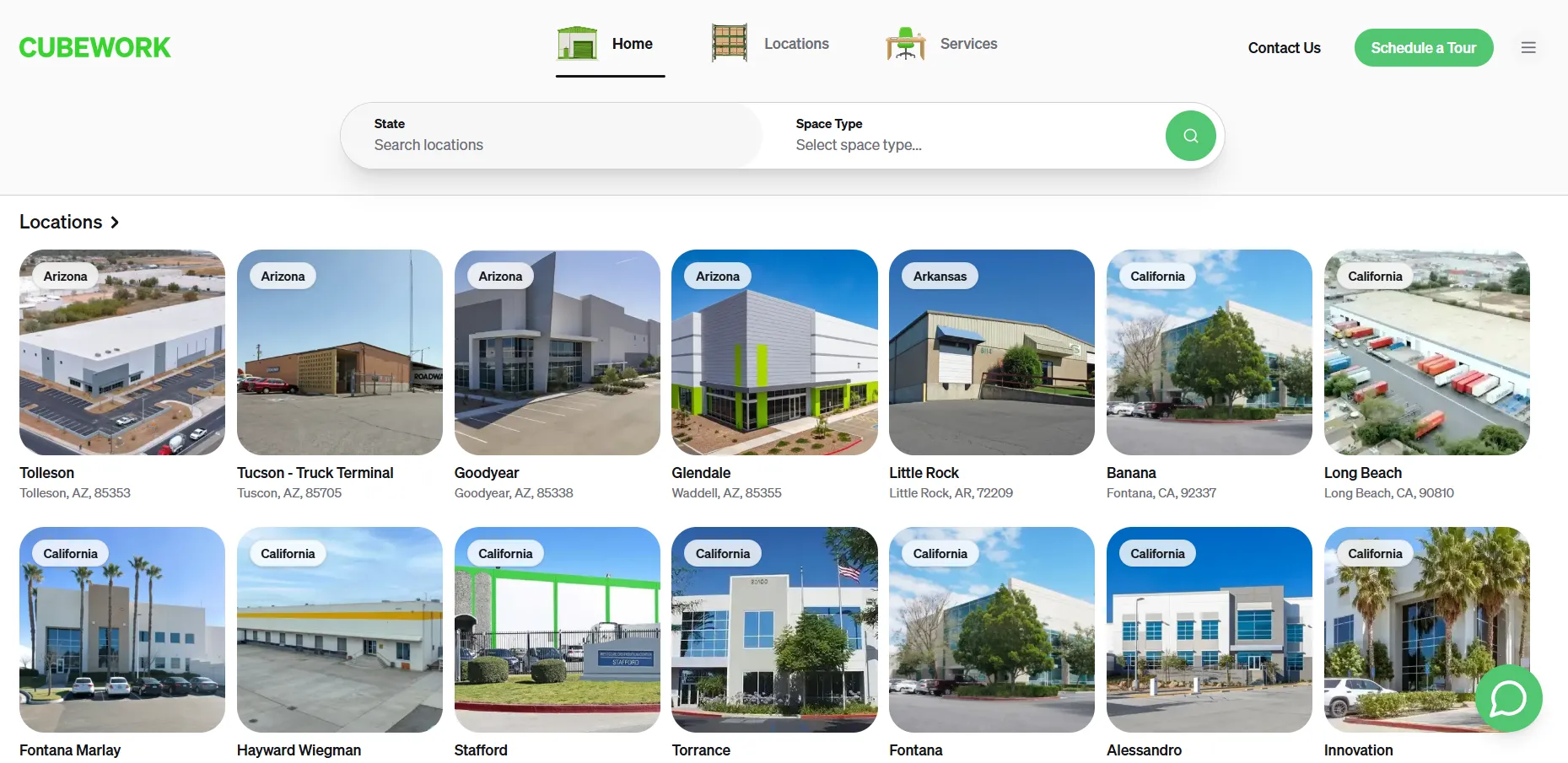
If you need more than 2,000 sq. ft. and want options in dozens of cities, Cubework is where you start looking.
They focus on industrial-grade warehouse and operations space, everything from smaller units to large-scale facilities with high ceilings, industrial zoning, and advanced dock systems.
Amenities and benefits
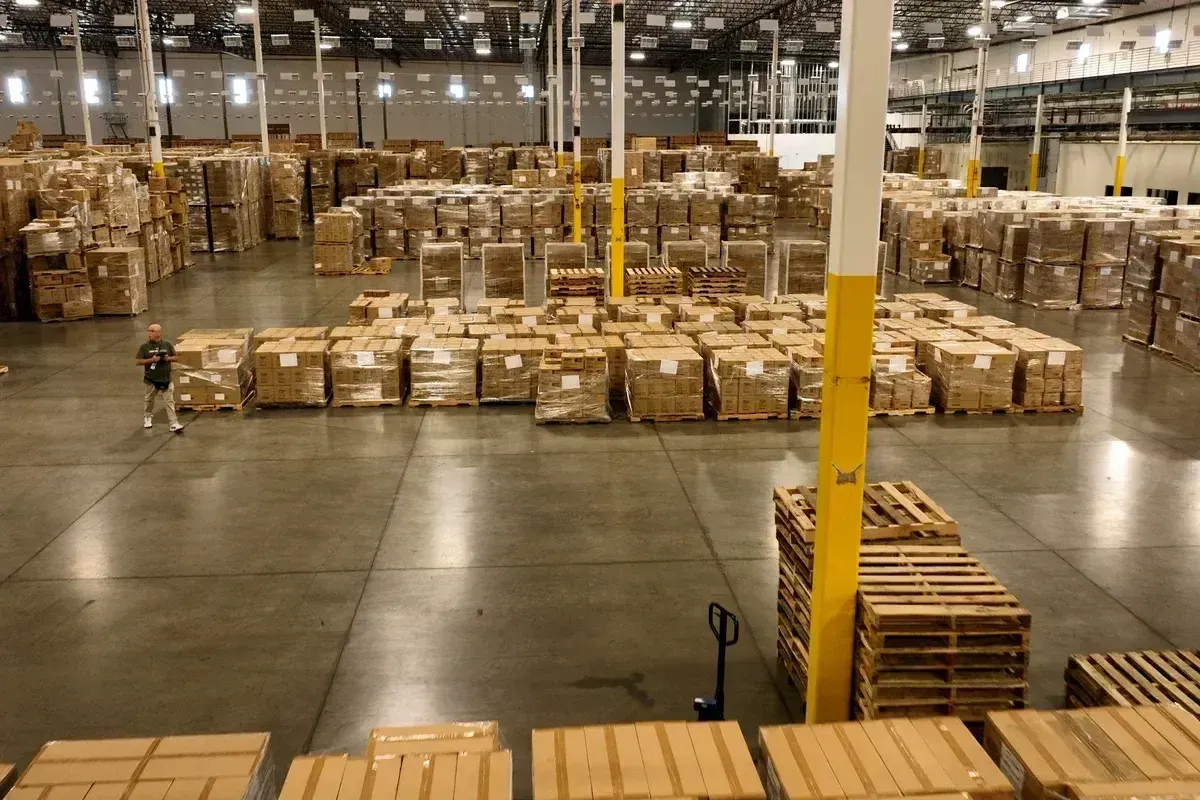
- Units scale from modest warehouse spaces to full industrial facilities, all with 24/7 secure and monitored access.
- On-demand forklift drivers and outsourced labor available directly through their facilities.
- High ceilings and industrial zoning make them suitable for fulfillment, distribution, and light manufacturing.
- Community perks like catered meals, BBQs, and exclusive trade show access.
Pricing
No published rates. Costs can change based on which city you're in, how big your unit is, and how long your lease runs. You'll have to get on a call with them.
Pros and cons
✅ 77+ locations means you can probably find one near a major highway or transport hub.
✅ Lease terms as short as 3 months.
✅ Industrial-grade facilities with dock infrastructure and on-demand forklift drivers.
❌ Pricing isn't transparent, so comparing costs upfront takes extra effort.
❌ The vibe is more industrial park than founder community.
#2: ReadySpaces
Best for: Small businesses that want a warehouse without the headache of negotiating lease terms, tracking down equipment, or dealing with surprise charges.
Locations: 38 across the U.S. and Canada.
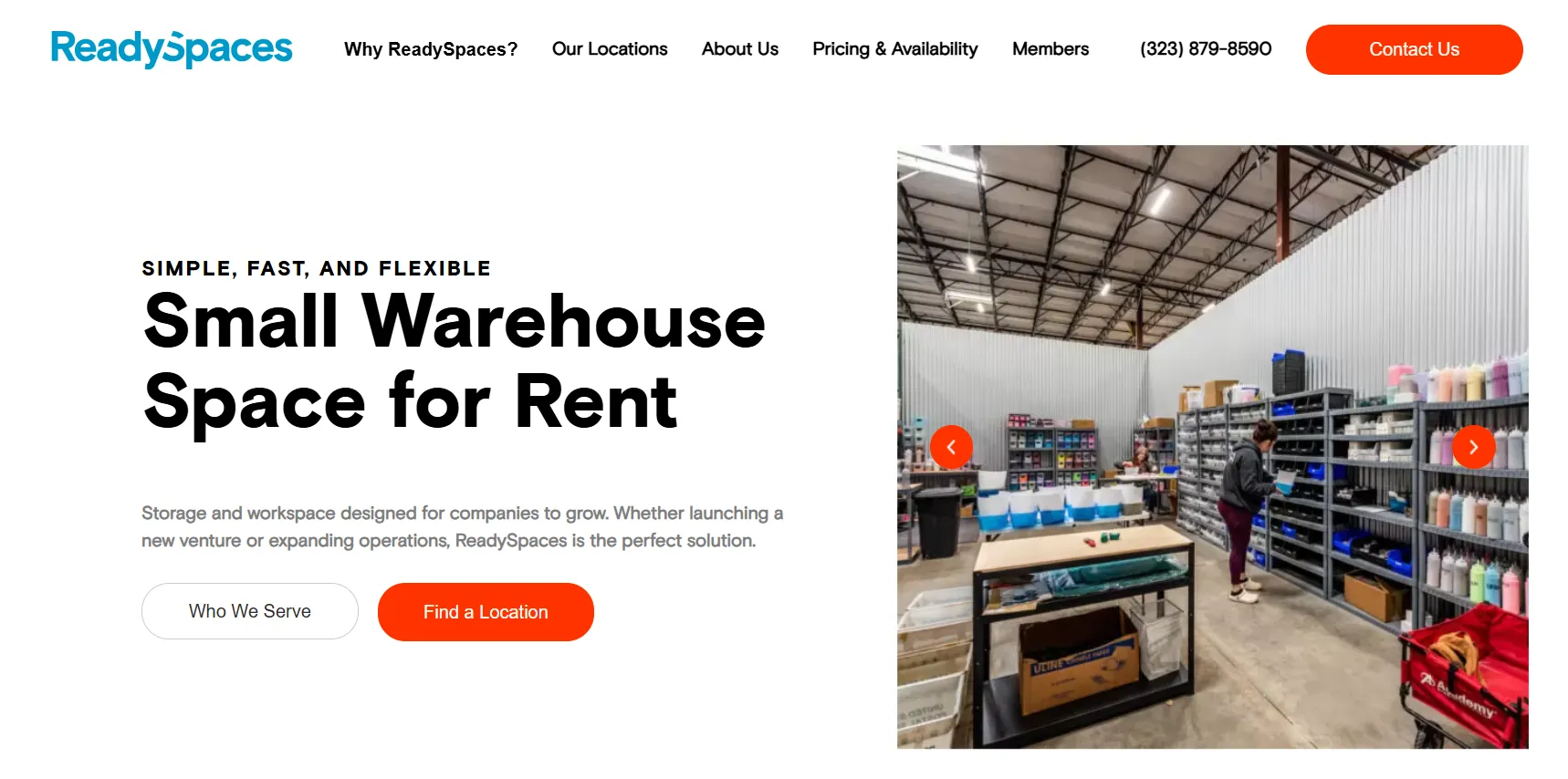
ReadySpaces keeps things simple. You pick a unit (250 to 5,000 sq. ft.), sign a straightforward lease, and walk in to a space that already has forklifts, loading docks, and pallet jacks waiting.
With 38 locations spanning the U.S. and Canada, it's one of the wider co-warehousing networks out there, even if it's more of a "storage and operations" play than a fulfillment-focused solution.
Amenities and benefits
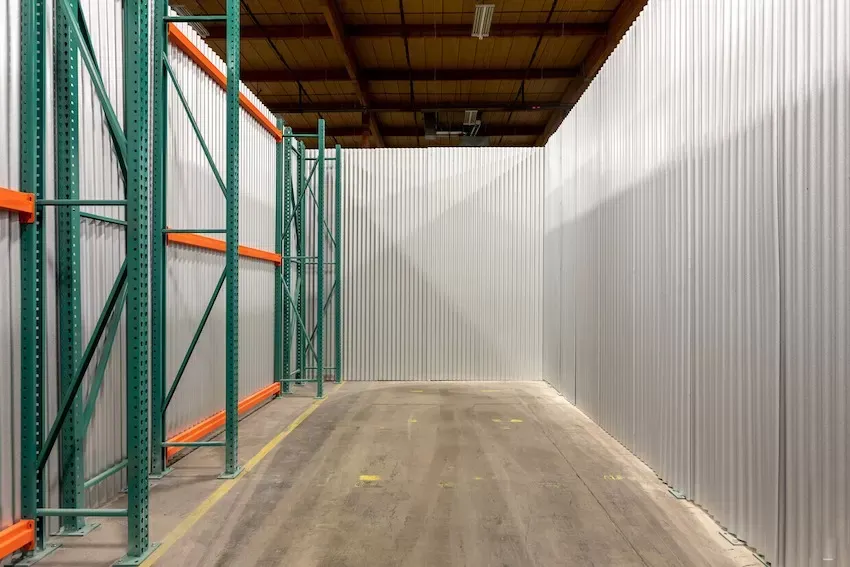
- Forklifts, loading docks, and grade-level bays are included with every unit from move-in day.
- 24/7 building access and on-site security at all locations.
- Some locations include coworking lounges, conference rooms, and private offices.
- Flat monthly billing with no hidden line items.
Pricing
Rates are set per location and depend on unit size, building position, and features like loading dock proximity.
Pricing isn't listed publicly, so you'll need to request a quote through their site.
Pros and cons
✅ Minimal paperwork. Fast move-in.
✅ 38 locations gives you decent coverage in the U.S. and Canada.
✅ One flat rate with no surprise fees.
❌ It's more of a storage-first operation. Don't expect built-in fulfillment tools or shipping partnerships.
❌ Quality can swing depending on the local manager at your specific location, which is why some members have been looking for ReadySpaces alternatives.
#3: Loloft
Best for: Early-stage brands that need a small, polished space where they can work and store inventory without spending thousands.
Locations: 2, one in Phoenix, AZ and one in Rogers, AR.
Loloft is the smallest operation on this list, and that's actually part of the appeal. It's a hybrid: coworking space, office, and warehouse rolled into one facility.
For a founder who just left their apartment to set up shop somewhere real but doesn't need 1,000 sq. ft., Loloft gives you an entry point that many providers can't match on price.
Amenities and benefits
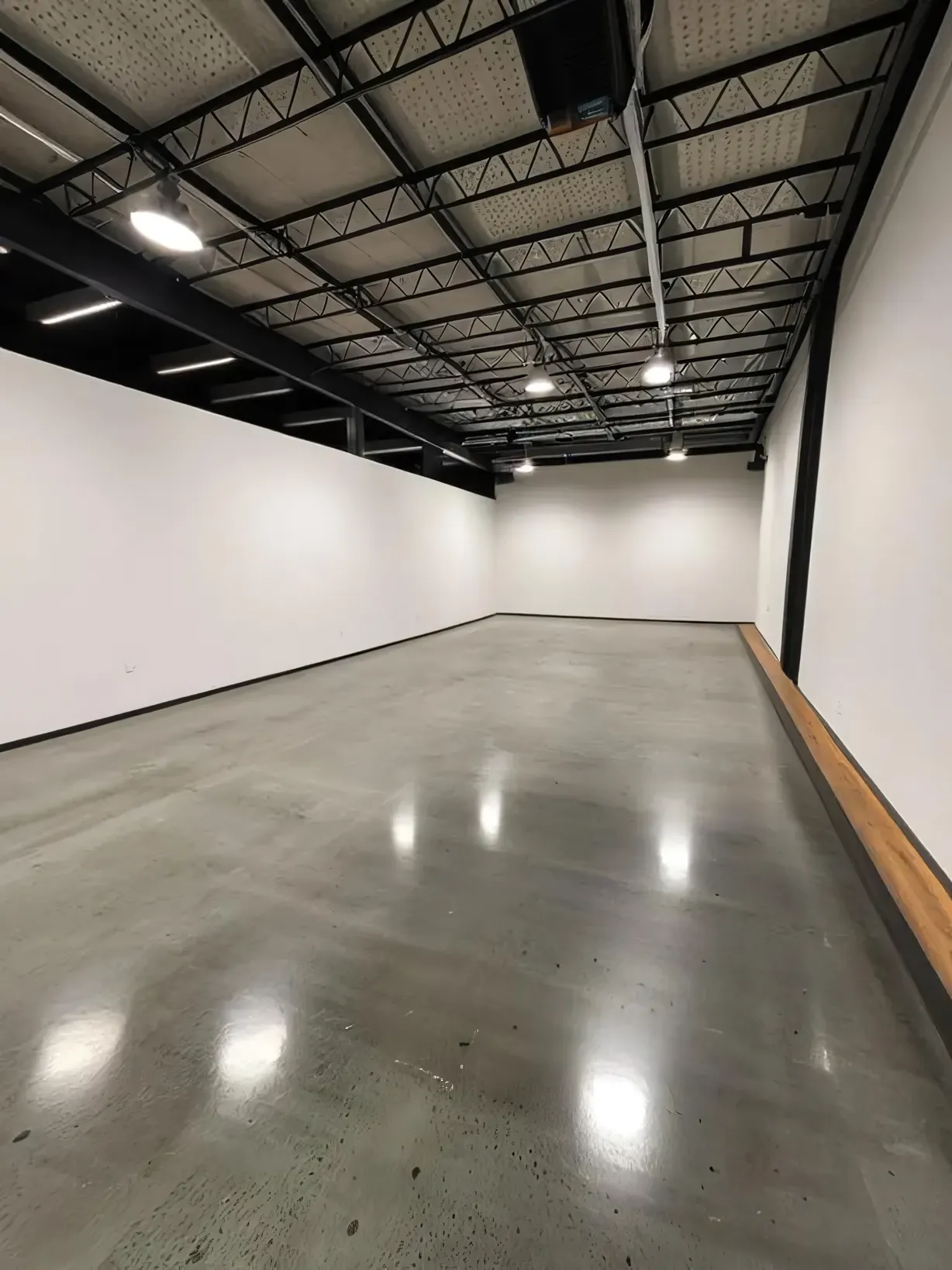
- Warehouse space, private offices, and coworking desks all available at a single location.
- High-speed internet, a shared kitchen, and lounge areas for working outside your unit.
- Meeting rooms and classrooms you can reserve.
- 24/7 access with shared warehouse tools and equipment.
Pricing
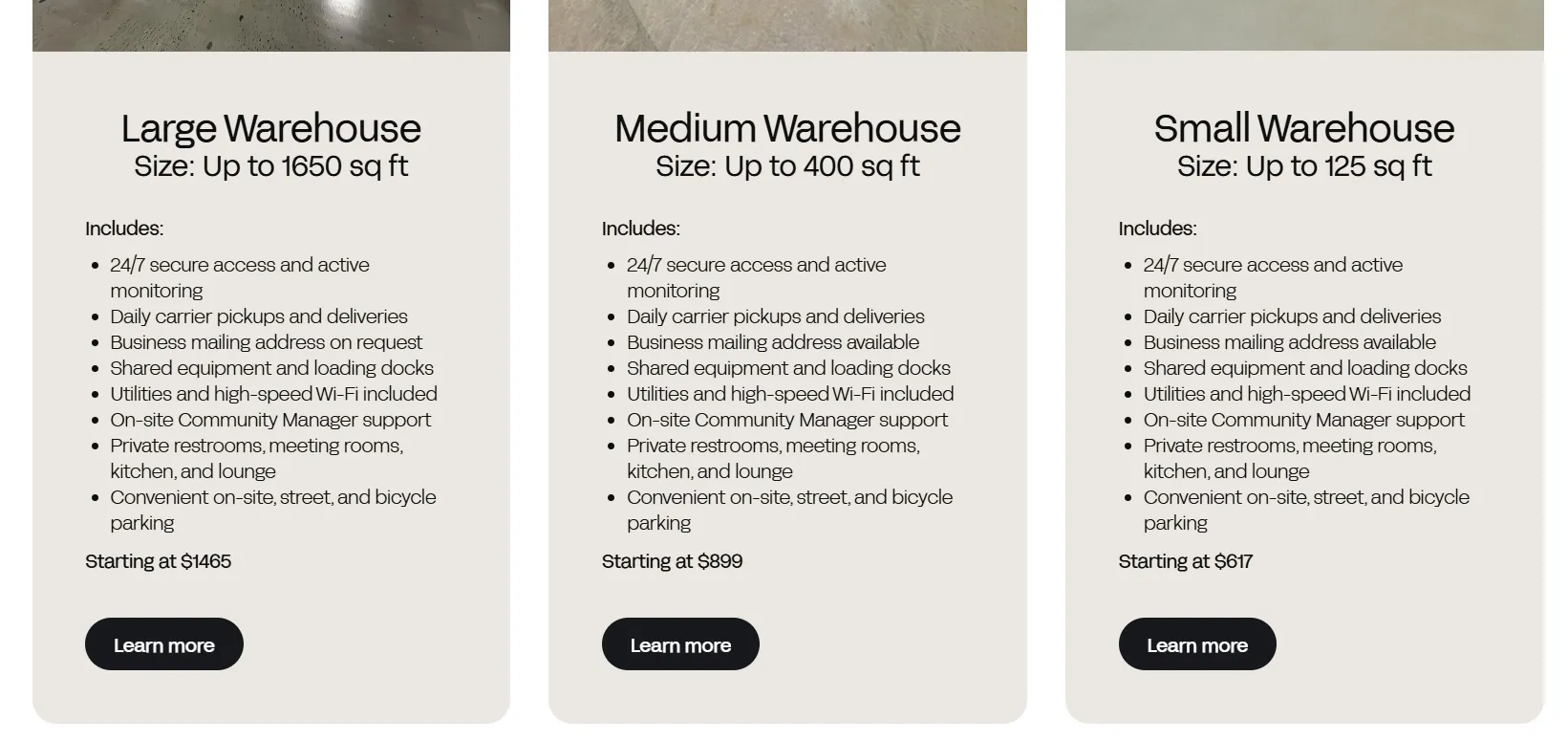
Everything runs month-to-month. Here's what the Rogers location looks like:
- Warehouses: $617/month for 125 sq. ft. up to $1,465/month for 1,650 sq. ft.
- Office spaces: $425/month for a dedicated desk, or $1,299/month for a 182 sq. ft. private office.
- Hot desks: $195/month, with day passes at $15/person.
Pros and cons
✅ Some of the most affordable entry-level pricing in co-warehousing.
✅ Mail handling comes included with membership.
✅ Free parking at both locations.
❌ Only has two locations.
❌ Once your team grows past 6 or 7 people, you'll likely need to move on to something bigger.
Take control of your fulfillment with Saltbox
I covered 10 ShipBob alternatives across three categories: co-warehousing solutions, 3PL providers, and flexible warehouse spaces.
Some of these options still follow the outsourced fulfillment model, while others hand the keys back to you.
The reason I believe Saltbox stands out from this list is that it addresses the specific frustrations that push ecommerce founders away from 3PLs like ShipBob:
- Unpredictable costs that grow faster than your revenue.
- Zero physical access to your own inventory.
- SKU errors and shipping mistakes that your customers blame on you, not your 3PL.
- Rigid contracts that are hard to exit when things go wrong.
With Saltbox, you get your own warehouse suite with month-to-month billing, on-demand labor when volume spikes, discounted shipping through Parsel, free inventory inbounding, and a community of founders who are building alongside you.
Our access plan membership starts at $349/month for brands that aren't ready for a full warehouse commitment, and warehouse suites scale from 70 sq. ft. all the way to 5,000+ sq. ft.
You can talk to an expert to learn more about Saltbox, or book a tour at one of our locations to see the space for yourself.
Frequently asked questions
You’ll meet with a Saltbox team member, review your needs, and confirm next steps to join.
Parsel is an independent shipping management platform and Saltbox partner that helps ecommerce brands manage multiple carriers, compare rates, and streamline fulfillment workflows from one place. It is not proprietary Saltbox software but rather a standalone platform accessible to Saltbox members.
Warehouse staff are direct employees you hire, train, and manage in-house. Fulfillment support refers to on-demand or outsourced labor that provides operational capacity without the overhead of full-time hiring.
Traditional 3PLs struggle during peak season for SMBs because they are built for large enterprises and often lack the flexibility, transparency, and control small business owners need during demand spikes.