
.webp)


Key takeaways
- If you fulfill any of your own orders from inventory stored in Illinois, you have physical presence nexus there, and Illinois no longer treats you as a "remote retailer."
- There's one exception: inventory used only to fill marketplace orders, where the marketplace collects the tax, doesn't create physical presence nexus for you.
- Orders shipped from your Illinois inventory are taxed at the rate where your inventory sits (origin rate). Orders shipped into Illinois from inventory elsewhere use the customer's rate (destination rate).
- Since January 1, 2026, the only economic nexus test for remote sellers is $100,000 in Illinois sales over the lookback period. The 200-transaction test is gone.
When brands look at a Chicago-area hub to reach Midwest customers faster, one question comes up almost every time: if I move inventory to Illinois, do I owe Illinois sales tax? The short answer is yes. The longer answer is that it's more manageable than it sounds, and for orders shipped from your Illinois space, it can actually be simpler than what you're doing now.
Sales tax nexus is the connection between your business and a state that requires you to register, collect, and remit that state's sales tax. In Illinois, inventory is one of the clearest ways to create it. Here's exactly what triggers nexus in Illinois, what changes once you have it, and how to decide whether a Chicago-area hub is worth it for your business.
This post is for general information, not tax advice. Tax rules change, so confirm your situation with a CPA or the Illinois Department of Revenue (IDOR).
What is sales tax nexus in Illinois?
Illinois sales tax nexus is the level of connection to Illinois that makes your business responsible for Illinois sales tax. You can get there two ways:
- Physical presence nexus. You have a physical footprint in Illinois, such as an office, a warehouse, employees, or inventory you fulfill orders from.
- Economic nexus. You have no physical presence, but your sales into Illinois cross the state's threshold. Since January 1, 2026, that threshold is $100,000 in gross receipts from sales to Illinois customers.
One quick vocabulary note: Illinois calls its sales tax the Retailers' Occupation Tax (ROT). Technically, it's a tax on the retailer for the privilege of selling, but in practice it works like sales tax, and you'll see the term all over IDOR's guidance.
Does storing inventory in Illinois create nexus?
Yes, if you use that inventory to fulfill your own orders. IDOR's guidance is direct on this point: a retailer that fulfills any orders from its inventory in Illinois is not a remote retailer. That means you have physical presence nexus, and the $100,000 economic threshold no longer matters. You owe Illinois sales tax on your taxable Illinois sales from your first order.
What's the marketplace-only exception?
IDOR carves out one situation. If your Illinois inventory is used strictly to fulfill orders made through a marketplace that collects and remits the tax for you (Amazon, for example), that inventory doesn't create physical presence nexus for you.
The exception disappears the moment you mix channels. If the same Illinois inventory also fills orders from your own website, wholesale accounts, or any channel where you're the one responsible for the tax, IDOR treats that inventory as creating physical presence nexus.
Which situation are you in?
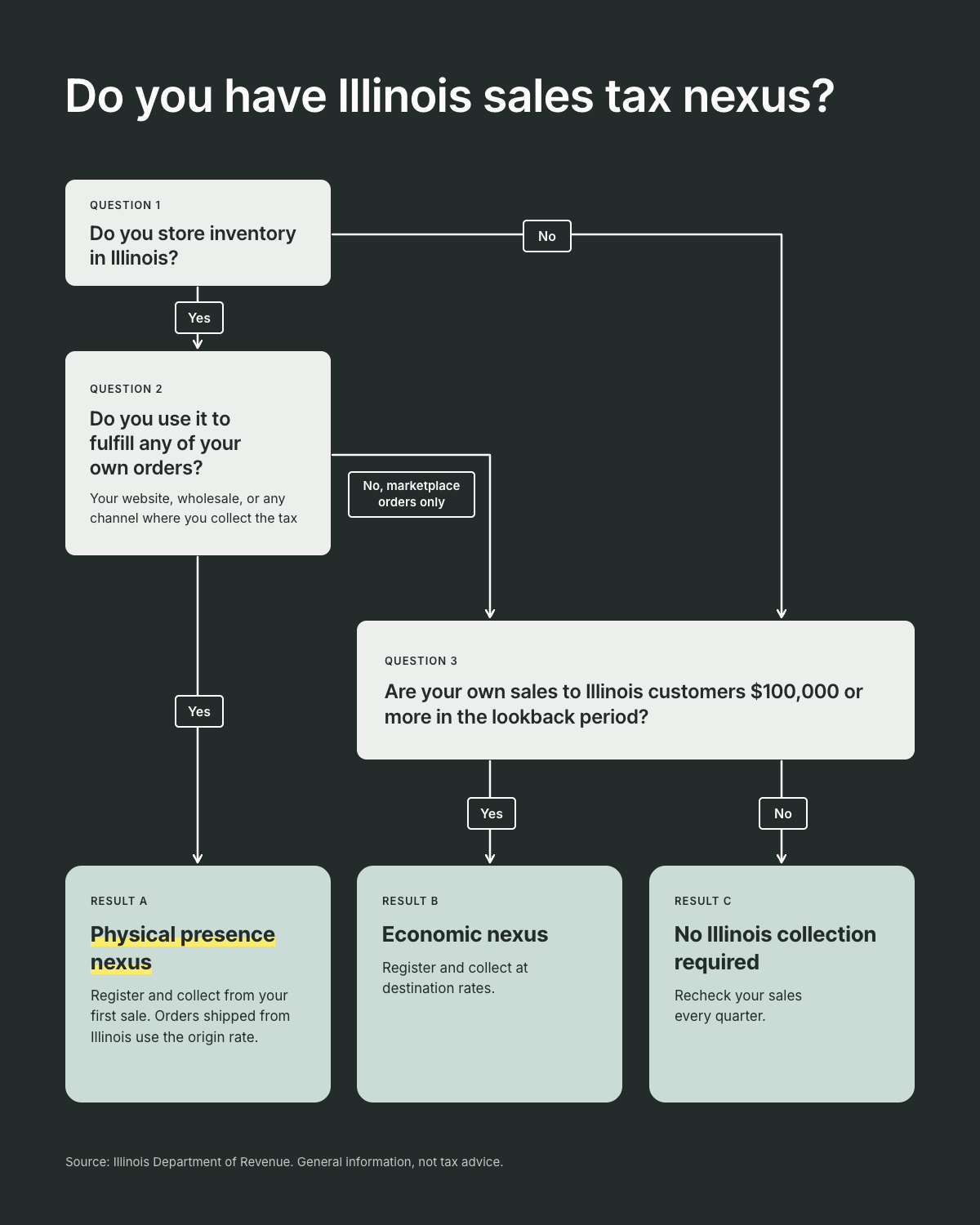
- You're an out-of-state brand shipping your own Shopify orders from an Illinois space. You have physical presence nexus in Illinois. Register and collect.
- You only sell on Amazon, and some of your FBA inventory sits in Illinois. That inventory doesn't create physical presence nexus for you, because Amazon remits the tax on those sales. But if you also sell into Illinois through your own channels and pass $100,000, economic nexus still applies.
- You ship both your own orders and marketplace orders from one Illinois space. You have physical presence nexus.
- You're already based in Illinois. You already have nexus. What changes when you move from a garage to a warehouse space is your inventory's location, which can change the rate you charge on orders you ship from it.
What changes once you have nexus in Illinois?
Three things: you register, you charge the right rate on each order, and you keep the records that prove it.
1. Register with the Illinois Department of Revenue
You'll register for a sales tax account through MyTax Illinois, IDOR's online portal, before you start selling from your Illinois inventory. IDOR says electronic registration usually takes one to two business days. If you're already registered as a remote retailer, contact IDOR's Central Registration Division to update your status once you start fulfilling from Illinois. [Link to upcoming post: How to register a product business in Illinois]
2. Charge origin rates on orders shipped from Illinois
This is the part most guides skip, and it's good news. Illinois uses two sourcing rules:
- Origin rate: When you fulfill an Illinois order from your Illinois inventory, the sale is taxed at the state and local rate in effect where your inventory is located.
- Destination rate: When an Illinois customer's order ships from inventory outside Illinois, the sale is taxed at the rate in effect where the customer receives it. Since January 1, 2025, this applies to retailers with an Illinois presence too, not only remote sellers.
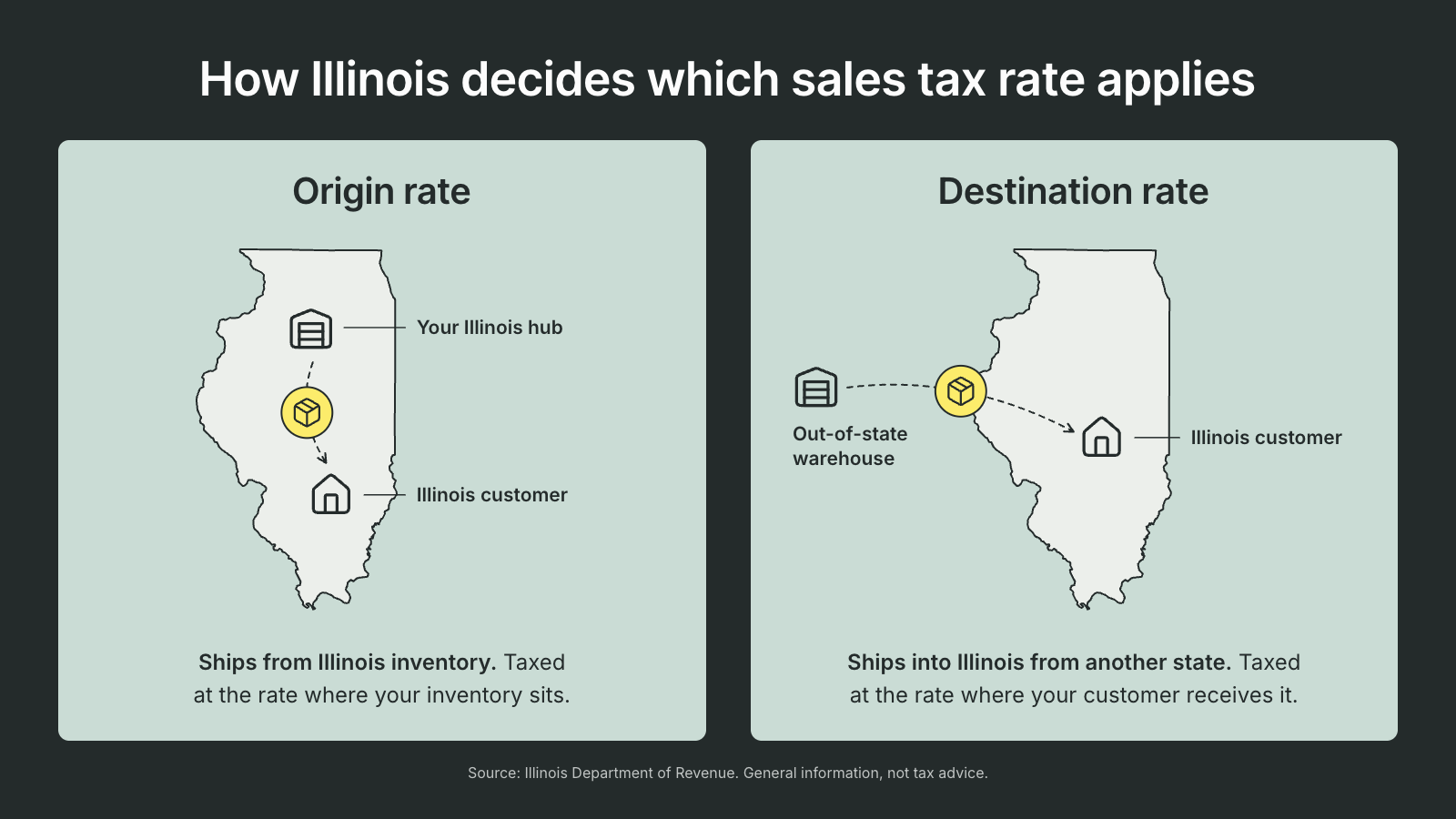
Illinois has a long list of local taxing jurisdictions, and calculating a destination rate for every delivery address takes real work. When your Illinois orders ship from one Illinois location, those orders use one origin rate. Look up the exact rate for your inventory's address with IDOR's tax rate database, since rates can differ even within a single city.
If you ship Illinois orders from more than one place (for example, your Illinois hub plus a warehouse in another state), you'll use both rules: origin rates for orders shipped from Illinois, and destination rates for Illinois orders shipped from elsewhere.
3. Keep records that show where each order shipped from and to
For destination-based sales, IDOR expects you to keep the customer's name and billing address, the exact ship-to address, and documentation of where the product shipped from. This matters more than it used to. Since January 1, 2026, if you can't show the delivery location for a destination-based sale, IDOR can tax it at 15%, and it can apply that rate in audits of earlier periods too.
Most ecommerce platforms and sales tax tools capture this data automatically. Check that yours does before you start shipping from Illinois.
Does nexus affect other Illinois taxes?
It can. A physical presence in a state can also affect state income and franchise tax obligations, and those rules are different from sales tax. If you're moving inventory into Illinois for the first time, ask your CPA to look at the full picture, not just sales tax.
What if you don't store inventory in Illinois?
Then you're a remote retailer, and only economic nexus applies. Starting January 1, 2026, you have Illinois nexus if your gross receipts from sales to Illinois customers reach $100,000 during the lookback period. The old 200-transaction test no longer applies. IDOR now has remote retailers check the threshold on a rolling quarterly basis.
If you crossed the threshold in past years and didn't collect, there's a limited window to fix it. The 2026 Illinois Remote Retailer Tax Amnesty Program runs through October 31, 2026. It covers remote-seller sales tax for sales made January 1, 2021 through June 30, 2026, lets participants report at a simplified 9% rate for general merchandise, and waives penalties and interest. You must be registered and have a MyTax Illinois login to apply, so don't wait until the last week. [Note for publishing: cut or rewrite this paragraph if the post goes live after October 31, 2026.]
Is a Chicago-area hub still worth it?

For most growing brands, yes. Nexus is a compliance task, not a reason to give up faster shipping. A single node in the Chicago area covers about 68% of the U.S. in two days of ground transit. That's a big reach upgrade if you're shipping from one coast today.
The real question is whether the shipping speed and lower zones are worth one more state registration and a few records to keep. If a meaningful share of your customers are in the Midwest, the math usually works in your favor.
That's why we built Saltbox Chicago, Elmhurst. It gives you flexible warehouse space, a loading dock, and an on-site operations team in the Chicago area, with month-to-month flexibility instead of a multi-year lease. If you're weighing a Midwest hub, book a tour of Saltbox Chicago, Elmhurst, and see the space for yourself.
__________
Sources: IDOR FAQs for marketplace sellers and remote retailers; IDOR Bulletin FY 2026-12; IDOR Bulletin FY 2026-28.
Frequently asked questions
Not on its own. IDOR says inventory used strictly to fulfill marketplace orders, where the marketplace remits the tax, doesn't create physical presence nexus for the seller. If the same inventory also fulfills your own orders, it does.
$100,000 in gross receipts from sales to Illinois customers during the lookback period. Illinois removed its 200-transaction threshold effective January 1, 2026.
Both, depending on where the order ships from. Orders fulfilled from inventory in Illinois use the rate where the inventory is located. Orders shipped to Illinois customers from outside the state use the rate where the customer receives the order.
You should be registered before you start fulfilling your own orders from Illinois inventory, since nexus applies from your first sale from that location. Registration through MyTax Illinois usually takes one to two business days.
It's a limited-time program, running August 1 through October 31, 2026, for remote retailers with unpaid Illinois sales tax on sales made between January 1, 2021 and June 30, 2026. Participants pay the tax at a simplified rate and have penalties and interest waived.