
.png)


Key takeaways
- Roughly 230 million people, about 68% of the U.S. population, sit inside two days of ground transit from Chicago. Twenty-nine states plus D.C. fall entirely inside that band.
- Of the 50 largest U.S. metros, 33 are reachable in two days or less. Fifteen of those are next-day.
- Chicago cannot reach the West Coast, most of Florida, or Central Texas in two days. Los Angeles and Seattle are four to five days out.
- Adding one West Coast node takes the same 50 metros from 33 covered to 44, and from 66% of that population to 88%.
- The right question isn't which single city covers the most ground. It's how many nodes your order map actually needs.
Our location teams get a version of this question on nearly every tour they run. A founder shows up with last quarter's order data pulled up on their phone, and what they want to know isn't what the space costs. It's whether one building can get their product to their customers fast enough to stop losing carts at checkout.
It's a good question, and most of the answers online are vague. So I ran the numbers on 2-day shipping from Chicago: which states, which metros, how many people, and just as importantly, who's still out of reach. Here's what the map actually looks like.
What can you reach in two days of ground shipping from Chicago?
You can reach roughly 68% of the country in two days of ground shipping from Chicago. Roughly 230 million people live inside the two-day ground band from Chicago, across 29 states plus the District of Columbia that fall entirely inside it, and another 12 that fall partly inside.
That's the number to hold onto. Two days of ground transit, no air premium, no expedited surcharge, from a single building.
A quick note on where that comes from, because the methodology matters more than the headline. Carrier transit maps are gated behind shipper accounts, so I modeled the bands instead of borrowing someone else's graphic. Ground linehaul covers roughly 500 to 550 road miles per transit day, and road distance runs about 1.18 times straight-line distance. Population figures are Census Bureau Vintage 2024 estimates. Treat these as close estimates rather than a carrier guarantee, and confirm against your own carrier's map before you commit to a delivery promise on your product pages.
Which metros are inside the two-day band?
Thirty-three of the 50 largest U.S. metros are inside the two-day band. Fifteen of them are next-day.
Three of those are worth pausing on. New York, the largest metro in the country at nearly 20 million people, is a two-day ground shipment from Chicago. So is Dallas. So is Denver, which surprises people who assume the Rockies are a hard wall. Houston sits at roughly 1,100 road miles, which puts it right at the outer edge of day two. If Houston is a top-five market for you, test it before you promise it.
Stack up the population and the picture is clear: the entire Northeast corridor, the Southeast down to Jacksonville, the industrial Midwest, and a meaningful piece of the Southwest are all two days or better from one Midwest node.
What can't you reach in two days from Chicago?
The West Coast, the Mountain West, most of Florida, and Central Texas can’t be reached in two days from Chicago. This is the half that most location pages skip, and it's the half that should drive your decision.
Los Angeles alone is nearly 13 million people sitting four to five days from a Chicago shipment. Add the rest of the West Coast metros, and you're looking at more than 40 million people that a single Midwest node simply cannot serve quickly on the ground.
So if a quarter of your revenue comes from California, Chicago doesn't fix your delivery speed problem. It fixes two-thirds of it and leaves the rest exactly where it was.
Why one node is usually the wrong question
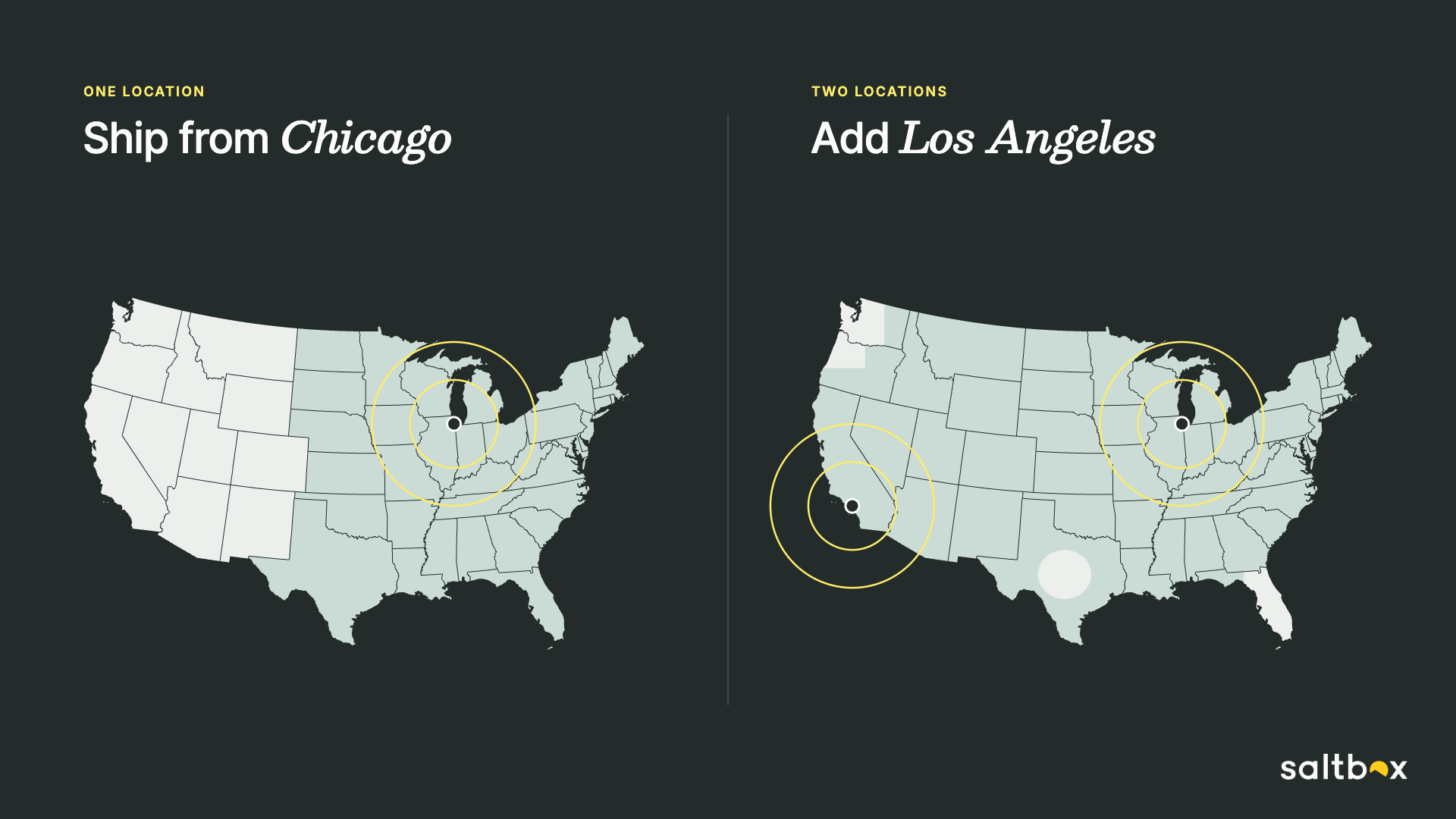
Here's where the math gets interesting. Add a single West Coast node to Chicago and run the same 50 metros again.
Coverage goes from 33 metros to 44. Population inside the two-day band goes from 66% of that top-50 group to 88%. One additional location, one extra receiving process, and you've closed most of the gap that a Midwest-only setup leaves open.
And the six metros still outside two days after that? Miami, Tampa, Orlando, Seattle, Austin, and San Antonio. Saltbox has locations in Miami, Seattle, and Dallas, which means the remaining gaps are addressable too, without you signing a second industrial lease or onboarding a second fulfillment partner to do it.
That's the part founders tend to discover late. Once you're operating in more than one city, your locations stop being storage and start being a distribution network. You cross-dock inbound containers to the node closest to the demand. You split a purchase order two ways instead of trucking pallets across the country twice. Your delivery promise gets shorter in two regions at once, and you didn't have to buy your way into an air rate to do it.
You can go get space anywhere. You can't get an operational partner everywhere, and a second node only works if someone is receiving, scanning, and staging your product in both places the same way.
How to run this math on your own order data
Don't take my bands and apply them blindly. Take 20 minutes and check your own map.
- Export your last 90 days of orders. Ninety days smooths out a single viral week without burying a real seasonal pattern.
- Group destination ZIPs by state, then sort by order volume. Most brands find that 10 to 12 states carry the majority of shipments.
- Lay your top states against the bands above. Anything east of the Rockies is likely one or two days from Chicago. Anything on the Pacific side is four or five.
- Calculate the share of volume sitting outside two days. Under 15%, one node is fine and you should stop overthinking it. Over 30%, you're a two-node business and you're paying for it every day you wait.
- Weigh it against your expedited spend. If you're buying air to cover the West Coast, that line item is the real cost of a single-node setup, and it's usually bigger than founders expect.
That last step is the one people skip. Expedited shipping is how a distribution problem hides inside a shipping budget.
Start with the order map, not the floor plan
Chicago is one of the strongest single nodes in the country. About 68% of Americans, 33 of the 50 largest metros, and the entire Northeast corridor all sit within two days of ground transit from one building.
But picking a location is a distribution decision, not a square-footage decision, and you can't make it from a floor plan. So do this before you tour anything: export your last 90 days of orders, group the destination ZIPs by state, and calculate the single number that decides this for you, which is the share of your volume sitting outside the two-day band.
Bring that number with you. Walk into the conversation knowing whether you're a one-node business or a two-node business, and you'll get a straight answer about what to do next instead of a tour of a room.

Not sure how many nodes your order map needs?
Bring us your last 90 days of orders and we'll walk the map with you.
Speak to an expertFrequently asked questions
One to two business days to most of the eastern half of the U.S., three days to Florida and Central Texas, and four to five days to the West Coast. Fifteen of the 50 largest metros are next-day from Chicago.
Roughly 68% of the population, or about 230 million people, across 29 states and the District of Columbia fall entirely inside the two-day ground band, plus parts of 12 more.
It's one of the best single locations in the country for reaching the eastern two-thirds of the U.S. quickly. It's a poor choice if most of your customers are on the West Coast, where transit runs four to five days.
Yes. New York is roughly 860 road miles from Chicago, which puts it inside the two-day ground band, along with Boston, Philadelphia, and the rest of the Northeast corridor.
It depends on where your orders land. If more than 30% of your volume ships outside the two-day band from your current node, a second location will usually shorten delivery times and cut expedited spend enough to justify itself.
Saltbox is home to 1,000+ members nationwide across markets including Chicago, Denver, Dallas, Atlanta, Miami, Washington D.C., Phoenix, Seattle, and Los Angeles. See our post, Saltbox locations: Your guide to our 13 flexible workspaces across the U.S., for the complete list.
For Her
For Him
For Pets
For Anyone


Related posts
Learn from businesses improving their operational efficiency. Explore how Saltbox’s expert support and flexible spaces drive their growth.


How much of the U.S. can you reach in two days from Chicago?
One Midwest node covers about 68% of the country in two days of ground transit. Here's exactly which two-thirds, and which third it misses.
2026 peak season shipping surcharges: what FedEx, UPS, USPS, and Amazon are charging
Additional handling went up about 6%. The fee on every single order went up 25%. Here’s the full 2026 surcharge picture, and what it costs you per order.
10 best 3PL companies in Atlanta, GA (2026)
Ten Atlanta 3PL providers compared on buildings and certifications, plus the case for keeping fulfillment in a suite you control.
Related terms
Learn from businesses improving their operational efficiency. Explore how Saltbox’s expert support and flexible spaces drive their growth.