
.webp)


Key takeaways
- Packaging isn't one decision. It's a series of handoffs, and each one is triggered by volume or SKU count rather than ambition.
- Early on, the win is looking intentional for almost nothing. Later, the win is fewer box sizes covering more SKUs.
- The most expensive mistake is buying custom dimensions before your SKU mix has settled.
- Every box size you add costs more than the boxes: another reorder point, another pick face, another decision per order.
I've watched a brand at a hundred and fifty orders a month commit to a beautifully engineered custom box. I've watched a brand at three thousand orders a month still shipping in whatever was on the shelf at the supply store. Both were the wrong call, and both came from the same mistake: treating packaging as a taste decision instead of a sequence.
Your box lineup should change as your business changes. The useful question isn't whether to upgrade; it's what to change, when, and in what order.
If you haven't run the economics yet, start with whether custom packaging pays for itself at all. This post assumes you've decided it does, and picks up at the harder question: what does a good ecommerce packaging strategy look like at your stage?
What actually triggers a packaging change
Three things should move you to the next stage.
Volume crosses a price break. The per-unit cost drops far enough that a bigger run pays for itself.
Your SKU dimensions settle, or splinter. Either you finally know what shapes you ship, or you've added products your current boxes can't hold.
A channel changes. Retail, wholesale, subscription, and marketplace each ask something different of a box.
One thing that is not a trigger: being tired of looking at your packaging. You'll get bored of your box about eighteen months before your customers do.
Stage 1: under a few hundred orders a month
The goal is to look intentional, spend almost nothing, and commit to nothing.
At this volume, your packaging budget buys perception, not infrastructure. Everything you buy should be something you can walk away from next quarter without losing money.
What works here:
- A stock box or mailer that actually fits the product. Stock sizes come in far more dimensions than most brands bother to shop.
- Branded tape. It's the highest-impact dollar in packaging and it works on any box you already own.
- A printed insert or a sticker. Both are cheap, both carry a message, and neither locks you into a size.
- A simple printed box. Custom printing doesn't need much volume anymore. Some suppliers start around a hundred units, so one-color black on a standard kraft box is within reach even at this stage. Stick to a stock size so you're buying a print, not a commitment.
What to avoid: custom dimensions, tooling, and any minimum order quantity that would take you more than a quarter or two to burn through.
One design decision here saves money for years. Whatever mark you're printing has to survive low-fidelity print on kraft. If your logo leans on a gradient, fine detail, or a hairline typeface, simplify it now, while the only things you're reprinting are a roll of tape or a hundred boxes.
And the thing that matters most at this stage isn't the box at all. It's how long it takes you to pack an order. One box size and one repeatable pack process will do more for your week than any print upgrade.
Stage 2: a few hundred to about a thousand orders a month
The goal is to get your brand onto the box without buying tooling.
This is the stage most brands should be in and aren't. Printed stock boxes have come a long way, and If you tried a one-color print in Stage 1, this is where it grows up: fuller coverage, your real brand colors, still on stock sizes with no tooling. The commitment that used to stop people mostly doesn't anymore.
Two habits to start here that pay off for years.
Map your SKUs to your boxes. Write down which product goes in which box. It takes twenty minutes, and it becomes the document you make every future packaging decision from.
Watch your void fill. How often are you reaching for paper or air pillows to stop a product rattling around? That's the cheapest signal you have that your lineup is wrong, and it shows up long before it shows up on a carrier invoice. I'd treat frequent void fill as the cue to look at a second size rather than a cost of doing business. That's a working rule, not a benchmark. Where your line sits depends on what you sell and how fragile it is.
Resist adding that second size until the map says so. Two sizes doubles your reorder points, your storage footprint, and the number of decisions your packer makes on every order.
When you do print, consider the inside. A plain outside with a printed inside often lands harder than a fully printed exterior, because the inside is the surface your customer sees at the moment the box opens.
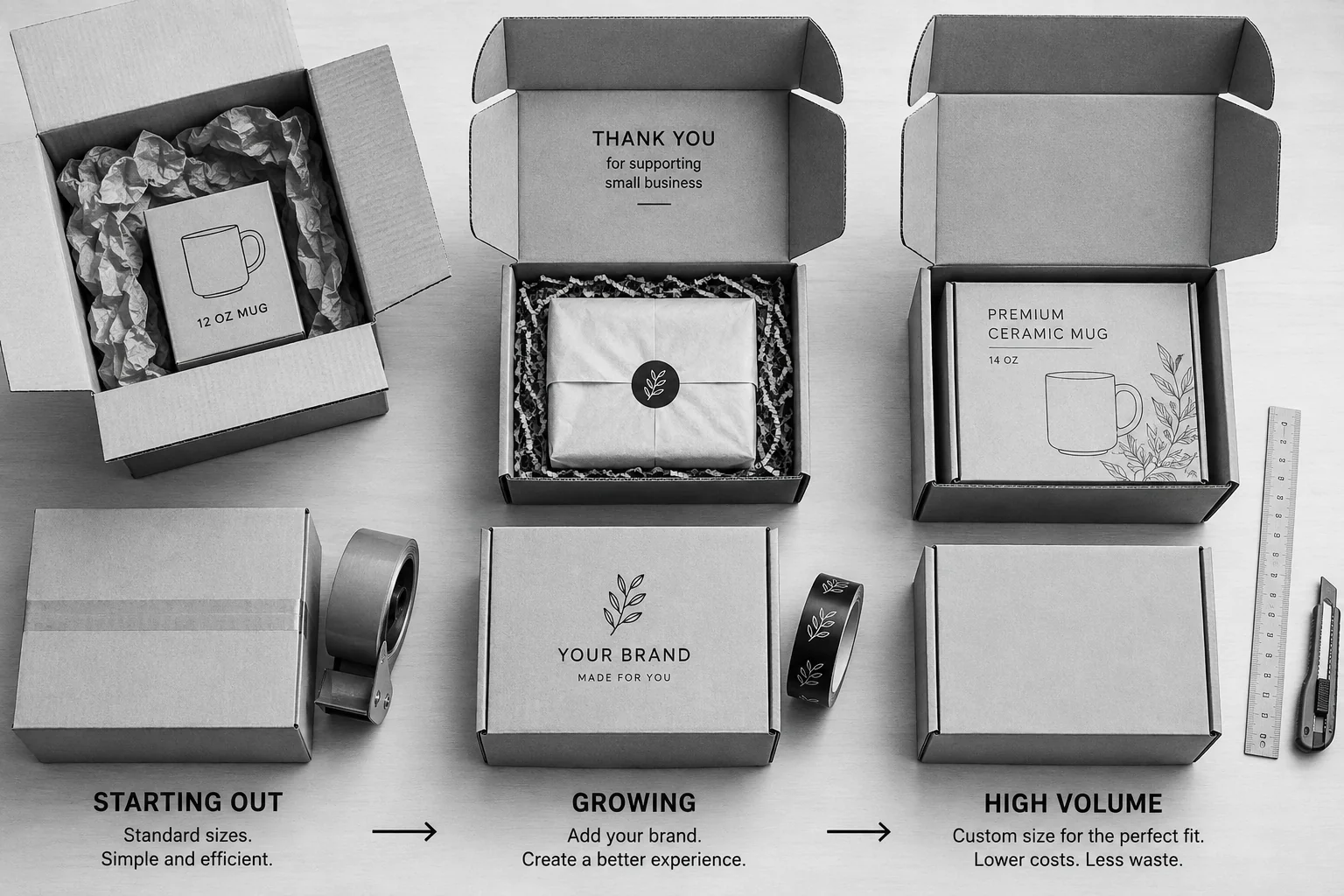
Custom Boxes, a Saltbox partner, publishes sizing guidance and a set of calculators you can run your own dimensions and volumes through. Those figures are theirs rather than ours, and per-unit pricing moves with run size and construction, so get a real quote before you commit to anything.
Those figures are theirs rather than ours. For runs under 5,000 boxes, you can see pricing and order directly on their site, which makes a small test run easy. Above that, per-unit pricing moves with run size and construction, so get a quote before you commit.
Stage 3: one to five thousand orders a month
The goal is fewer sizes covering more SKUs, and a pack process somebody else can run.
This is the discipline stage, and it's where most brands quietly go wrong. A new product arrives, doesn't quite fit the existing boxes, and gets a size of its own. Two years later you're carrying seven sizes, your pack station is a wall of cardboard, and nobody can remember which box the bundle goes in.
The good version runs the other direction. You go back to the SKU-to-box map and ask a harder question: what's the smallest number of sizes that covers the catalog without shipping air?
Here's the cost nobody counts. A box size isn't a line on a purchase order. It's:
- another reorder point to manage, and another stockout to have
- another pick face at the pack station, which is physical space you're paying for
- another decision on every single order, which is pack time
- another thing to explain to whoever you hire next
A third box size costs more than the boxes. Sometimes it's still worth it. Just price the whole thing rather than the cardboard.
This is also the first stage where custom dimensions are genuinely defensible, and only if your SKU mix has settled. I ran those thresholds in the first post in this series, so I won't redo the arithmetic. The short version: it turns on your annual parcel spend, and on whether the minimum order represents a few months of inventory or several years of it.
If you're adding inserts, kitting, or bundles here, cost the labor separately from the materials. Kitting is where packaging quietly turns into a headcount question.
Stage 4: five thousand orders a month and up
The goal is packaging as a cost line you actively manage, and a system that survives peak.
At this volume, the price breaks are real money, so you're buying bigger runs, so storage becomes the binding constraint rather than print cost.
Three things change.
Your lineup has to be documented. Version your dielines. Keep a spec sheet with dimensions, board grade, and print files, and put a date on it. At this volume, a reprint that goes out against an old file is a five-figure mistake.
Two locations means one lineup. If you're shipping from more than one building, both need the same boxes in the same sizes, or your pack process forks and your pack times drift apart. Whatever you decide about sizing has to be executable everywhere you ship from.
Seasonal and limited runs become viable, on top of a stable core. The core lineup stays boring and consistent. Variants sit on top of it. Brands that make the core itself seasonal end up storing last October's boxes through next October.
The handoffs where brands lose money
Five patterns worth watching for, in rough order of what they cost.
- Buying custom dimensions before the SKU mix settles. You pay for tooling, the product changes, and you're holding a run that fits nothing.
- Adding a box size instead of fixing a fit problem. Sometimes the answer is changing how the product sits inside the box you already have.
- Rebranding the box before the run is used up. Either burn the inventory or take the write-off deliberately. The bad version is discovering it later.
- Letting the supplier pick the size. They'll quote what they already run. Your own shipping data should pick the size.
- Ordering a year of inventory to hit a price break with nowhere to put it. That tier is only cheaper if the storage is free, and storage is never free.
Where the boxes live during a changeover
The part nobody plans for is the switch itself.
For a few weeks in every stage change, you're holding two lineups at once: the old boxes you're burning down and the new run that just landed. Neither fits the space you budgeted, because you budgeted for one lineup. That's the week packaging stops being a design question and becomes a floor space question.
It's also when the work spikes. A new box usually means new photography, sometimes new inserts, and a pack process that has to be retaught while orders keep going out the door.
That's the version Saltbox members hand off. The run gets received on the dock instead of in a driveway, it lives in your warehouse suite instead of your hallway, and the content studio is on site for the week you need new photography of it. If the changeover lands on top of peak, S.O.S. — Saltbox Operations Support is an on-demand team for exactly that kind of week, and Saltbox Fulfillment covers kitting and inserts if you'd rather not run the changeover yourself.
Your box lineup should get simpler as you grow, not more elaborate. Most brands learn that the expensive way, one size at a time.

Room to run your next packaging change
Saltbox members receive packaging on the dock, store the run in their suite, and shoot it on site.
Book a tourFrequently asked questions
Once you're consistently shipping a few hundred orders a month and your product dimensions have stopped moving. Printed stock sizes are the right first step because some suppliers start around a hundred units, so you get the brand upgrade without committing to tooling or a size you might outgrow. A simple one-color print on a stock kraft box can make sense even earlier, since some minimums start around a hundred units.
The fewest that cover your catalog without shipping air. Most brands accumulate sizes as they add products and never consolidate. Build a SKU-to-box map, then ask which sizes you could remove rather than which you could add.
Void fill is the earliest signal. If you're routinely filling space to stop products moving, the box is bigger than the product needs. The carrier invoice will tell you the same thing later and more expensively, and the first post in this series walks through how to check that against your labels.
Not automatically. Time the change to when the current run is nearly used up, or decide consciously to write off what's left. A rebrand that strands a pallet of boxes is an avoidable cost.
More than the boxes. You're adding a reorder point, a pick face at the pack station, a decision on every order, and a training step for the next person you hire. Price all of that, then decide.
Once your SKU mix has settled and your parcel volume is high enough that per-shipment savings clear the tooling and the minimum order. That's an arithmetic question rather than a taste one, and the earlier post in this series runs the numbers.
For Her
For Him
For Pets
For Anyone



Related posts
Learn from businesses improving their operational efficiency. Explore how Saltbox’s expert support and flexible spaces drive their growth.


How your box design should grow with your business
Packaging isn't one decision, it's four handoffs. Here's what to change at each stage, and the mistakes that cost the most at each one.
How much of the U.S. can you reach in two days from Chicago?
One Midwest node covers about 68% of the country in two days of ground transit. Here's exactly which two-thirds, and which third it misses.
2026 peak season shipping surcharges: what FedEx, UPS, USPS, and Amazon are charging
Additional handling went up about 6%. The fee on every single order went up 25%. Here’s the full 2026 surcharge picture, and what it costs you per order.
Related terms
Learn from businesses improving their operational efficiency. Explore how Saltbox’s expert support and flexible spaces drive their growth.