
.png)

Momo's Merchant Memos

Key takeaways
- Chamblee is the best all-around setup for product brands, with I-285 and MARTA rail serving one compact district next to PDK airport.
- Doraville: prime interchange access where I-285 meets I-85, in a tight small-bay market where the old GM site went to studios rather than industrial reuse.
- Norcross: the deepest supply in this comparison, on traditional multi-year terms along the I-85 freight corridor.
- Tucker: freight-first infrastructure, with US 78 and I-285 access plus CSX rail serving buildings sized for full-scale industry.
- The best warehousing space in Chamblee is Saltbox Chamblee at 5315 Peachtree Blvd, which runs suites from 114 to 3,200 sq. ft. with month-to-month billing, daily carrier pickups, and extra hands on the floor when you need them.
Weighing Chamblee vs. Doraville vs. Norcross vs. Tucker for warehouse space gets easier once you stop comparing reputations and start comparing operating realities.
The four districts share Atlanta's northeast side, and (on paper) they look interchangeable.
In practice, highway access, cost structure, labor, and building stock differ enough to change what your daily operation feels like.
Saltbox operates on Atlanta's northeast side, so this guide weighs the four districts against the factors that actually decide a lease.
What are the factors that matter when choosing a warehouse on Atlanta's northeast side?
Four location factors separate the districts:
- How well the district connects your trucks and your staff to the rest of metro Atlanta.
- What cost structure dominates its market, since a low base rate under a triple-net lease can total more than an all-in rate elsewhere.
- The labor pool the district draws from, whether that's experienced warehouse workers nearby or staff arriving by rail.
- Whether the district's building stock matches the size you run, because a corridor built for full-scale industry offers little at 500 sq. ft.
I weighed all four for each district below, using city sources, county records, improvement-district material, and local reporting.
None of the four deserves to be crossed off on reputation; the differences are entirely practical:
Doraville: interchange access with a shrinking supply
Doraville suits businesses that price highway access above everything else.
The district wraps around the I-285 and I-85 interchange, and trucks reach either the Perimeter loop or the I-85 corridor after only a short run on surface streets.
Staff access is just as strong, because the MARTA Gold Line ends at Doraville station.
The catch is what's left to lease.
The former General Motors plant that anchored the district is now Assembly Atlanta, a 135-acre site where the first phase of studios opened in late 2023 across roughly 43 acres.
Gray Television paused the housing, retail, and hotel phases, so the site is neither adding industrial space nor currently taking more of it.
What it does mean is that Doraville's remaining warehouse buildings sit in one of the metro's tightest small-bay markets, so expect competition on anything that comes up.
Doraville pros and cons
✅ The I-285 and I-85 interchange puts both the Perimeter loop and the I-85 corridor minutes from the dock.
✅ MARTA rail to Doraville station widens your hiring pool to anyone on the Gold Line.
✅ Assembly Atlanta generates steady demand from production vendors and prop suppliers.
❌ The district's largest site went to film production rather than industrial reuse, leaving a thin pool of warehouse buildings.
❌ Peak-hour traffic around Spaghetti Junction deserves a spot in your delivery planning.
Norcross: the most space for the money
Norcross has the deepest supply of traditional warehouse space in this comparison,
If raw square footage decides your search, Norcross is the district to tour first, though Tucker's base rents land in a similar range.
The City of Norcross places itself inside the freight cluster along I-85 and Jimmy Carter Boulevard, which it calls the region's third-largest hub of warehouse and distribution activity.
Volume like that shapes the market in your favor.
Multi-tenant business parks line Jimmy Carter Boulevard, and a single one of them, Northbelt Business Park, contains roughly 834,000 sq. ft. of warehouse and office space.
Some of the small-bay stock dates to the 1970s, and older buildings usually price under new construction.
The cluster also concentrates warehouse-experienced labor, an advantage when you need to staff a shift on short notice.
Budget for how the space is sold, though.
Traditional industrial leases dominate here, so expect multi-year terms and triple-net charges on top of the base rate.
Norcross pros and cons
✅ The deepest pool of traditional warehouse space in this comparison, anchored by the I-85 freight cluster.
✅ Older small-bay stock usually prices under new construction.
✅ A concentration of warehouse-experienced labor built up around the freight cluster.
❌ Multi-year terms and triple-net charges are the standard deal structure.
❌ Older buildings add a longer inspection list before signing.
❌ MARTA heavy rail stops short of the district, with the nearest station down in Doraville.
Tucker: freight infrastructure for heavier operations
Tucker fits manufacturers and any operation where inbound freight arrives heavy.
The Mountain Industrial Boulevard corridor connects to U.S. 78 and I-285 and carries two CSX rail lines, according to the Tucker Summit CID, which puts rail-served buildings and highway access in the same corridor.
The corridor operates under the Tucker Summit Community Improvement District, a self-taxing group of property owners funding roadway and security upgrades.
The workforce matches the infrastructure.
The City of Tucker calls Mountain Industrial a long-standing manufacturing cluster, and manufacturing grew more than 50% countywide from 2018 to 2022, according to the city.
Scale is the trade-off, since buildings here suit full-scale industry, and a team that needs a few hundred square feet will find fewer options.
Tucker pros and cons
✅ US 78 and I-285 access plus two CSX rail lines serving buildings along one corridor.
✅ An established industrial workforce along the Mountain Industrial corridor.
✅ An improvement district reinvesting in roads and security across the corridor.
❌ Buildings skew toward full-scale industry, and small footprints stay scarce.
❌ Transit access is thin, with no MARTA rail in the district.
Chamblee: connectivity that covers every factor at once
Chamblee is the best fit in this comparison for product brands that weigh the team's daily routine as heavily as the trucking routes.
I-285 crosses the district's northern edge, and DeKalb-Peachtree Airport, Georgia's second-busiest, operates inside the district.
The MARTA Gold Line stops at Chamblee station, and that matters for hiring, since staff without cars can still reach your floor.
Buford Highway, known nationally for its international small business scene, cuts through Chamblee, and the walkable core around downtown gives your team lunch options on foot.
On cost, the main variable in Chamblee is scarcity.
Mid-century warehouses near downtown are being reworked into offices and restaurants, not demolished, and traditional industrial stock is finite.
That shortage is what makes co-warehousing the practical entry point, and Saltbox runs its facility on Peachtree Boulevard.
Chamblee pros and cons
✅ I-285 and MARTA rail serve one compact district, with PDK airport inside it.
✅ Rail access widens hiring beyond commuters with cars.
✅ Buford Highway's small business corridor and a walkable core keep staff and clients close.
✅ Saltbox runs co-warehousing here, with private suites from 114 to 3,200 sq. ft. on monthly billing, covered in detail below.
❌ The adaptive-reuse wave that makes the district lively also trims its traditional industrial stock.
❌ Businesses that need big, inexpensive bulk space will do better in Norcross.
How do the four districts compare head-to-head?
Here’s how the four districts compare:
Saltbox Chamblee: the best warehousing space on Atlanta's northeast side
Saltbox provides the best warehousing space on Atlanta's northeast side for product brands that want inventory storage and order fulfillment under the same roof as the rest of their working day.
Our newest Atlanta facility operates at 5315 Peachtree Blvd in Chamblee, with Dunwoody and Doraville next door and the Buckhead trade area to the south.
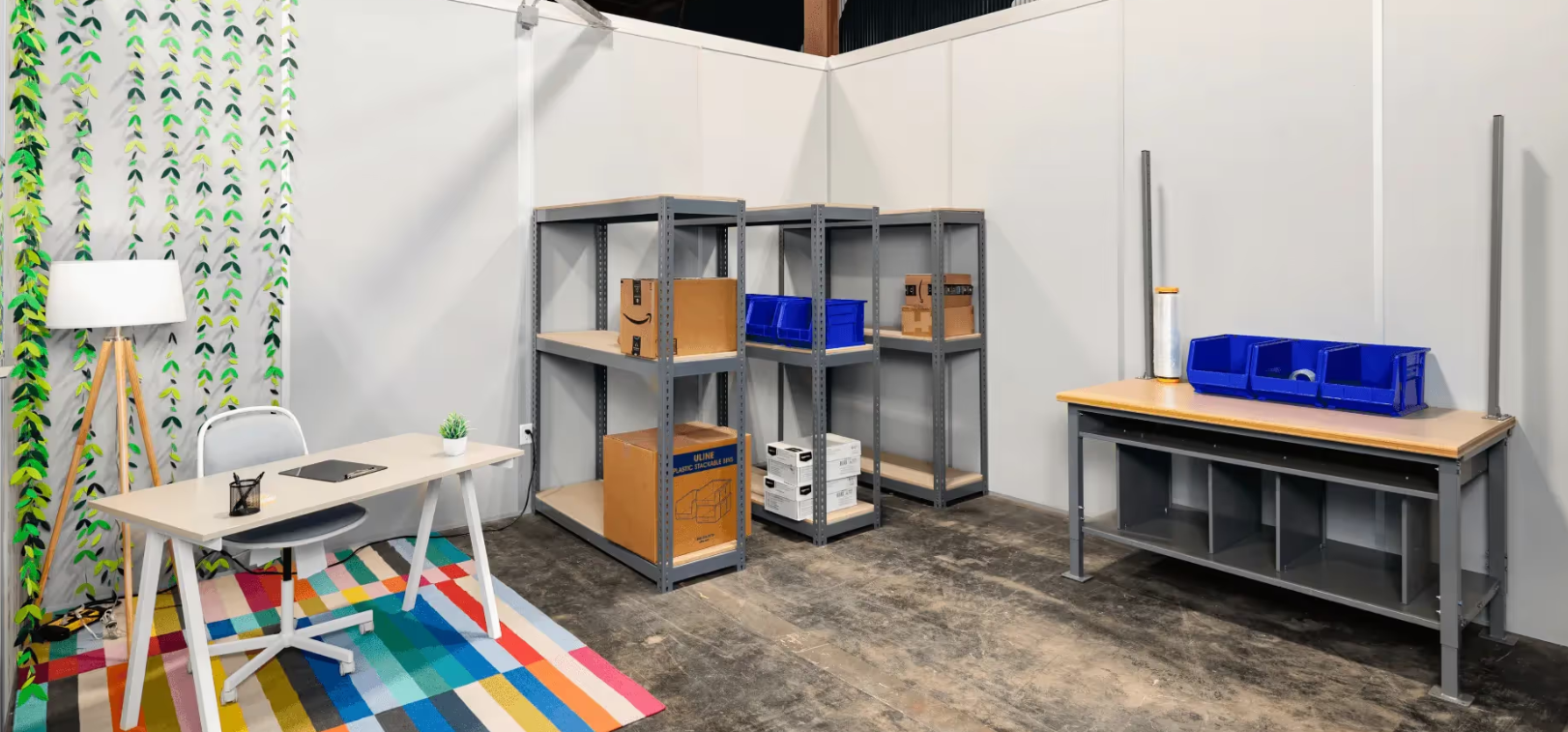
Measured against the four factors this guide opened with, the case for Saltbox comes together quickly:
- Location: the suite puts you on Peachtree Boulevard near I-285, with PDK airport and MARTA rail in the same district, so both your trucks and your staff reach you easily.
- Cost: Small warehouses (114 sq. ft. to 250 sq. ft.) start from $900, and extra-large warehouses start from $2,880/month (1,000 to 3,200 sq. ft.) when billed annually. One rate covers the extras a lease bills separately, from receiving and equipment to building Wi-Fi, so there are no triple-net surprises.
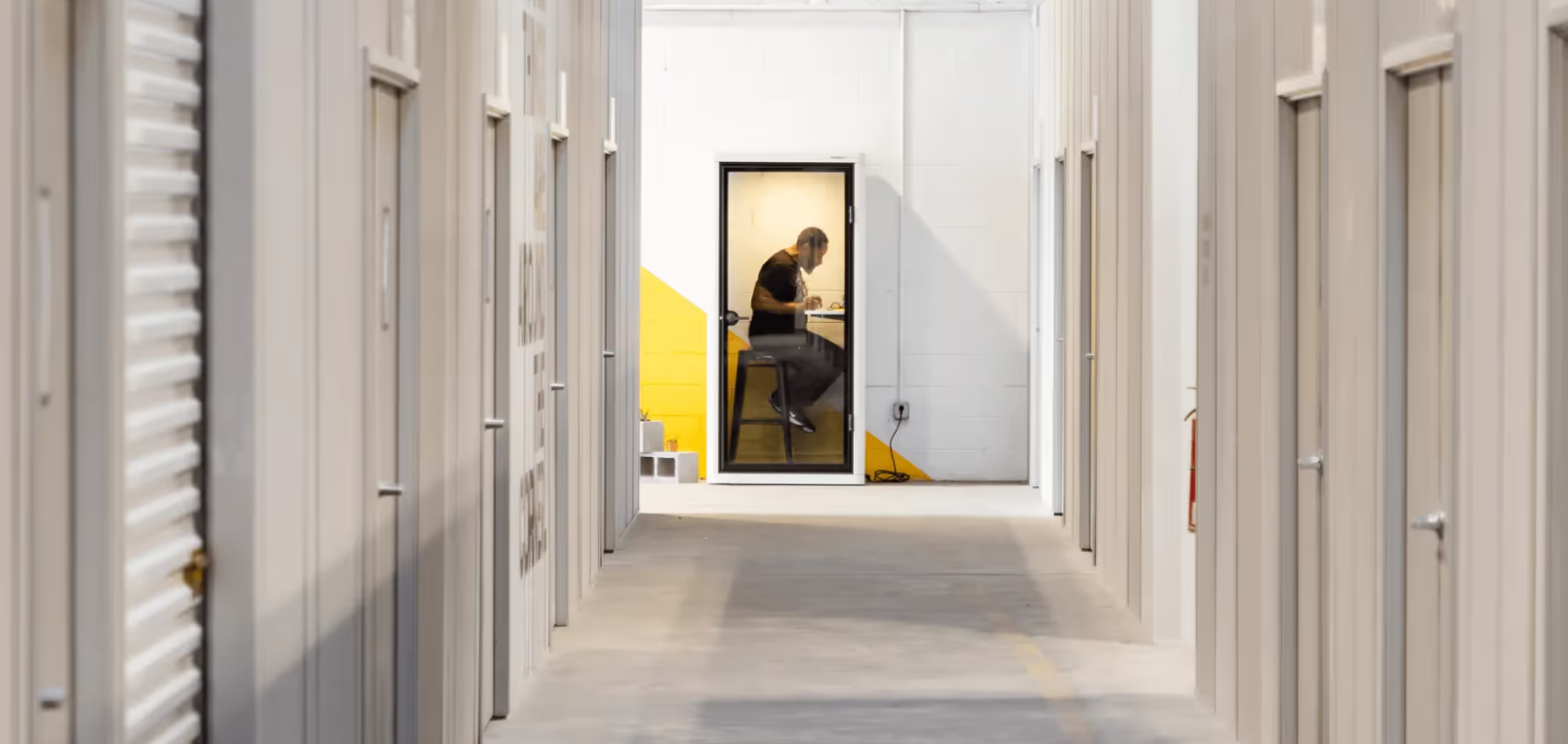
- Labor: the building comes staffed, and inbound freight gets received for free while you're away. A spike in orders gets covered by booking staff hours on demand, which bill in 15-minute increments, so flexibility never requires a payroll.
- Space: four suite tiers span 114 to 3,200 sq. ft. on month-to-month billing that lets you resize as demand shifts. A 12-month commitment drops the rate 10%, and a 6-month commitment drops it 5%.
💡 When you book a tour, you can ask one of our experts what leaving a 3PL involves.
Parsel, our shipping app partner, also comes with every membership at no extra charge, which weighs national carrier rates against regional ones and books your pickup before the 4:30 PM cutoff.
What’s more, an on-site content studio lets you shoot product photos in the same building as your inventory.
Our co-warehousing model differs from a traditional 3PL in one basic way: your inventory never leaves your reach.
You hold the suite key, and your orders get packed on the floor where you work.
When you want full coverage, the on-site crew can take over inbound and pick-and-pack, so the setup can operate as a 3PL on your terms.
Saltbox Chamblee pros and cons
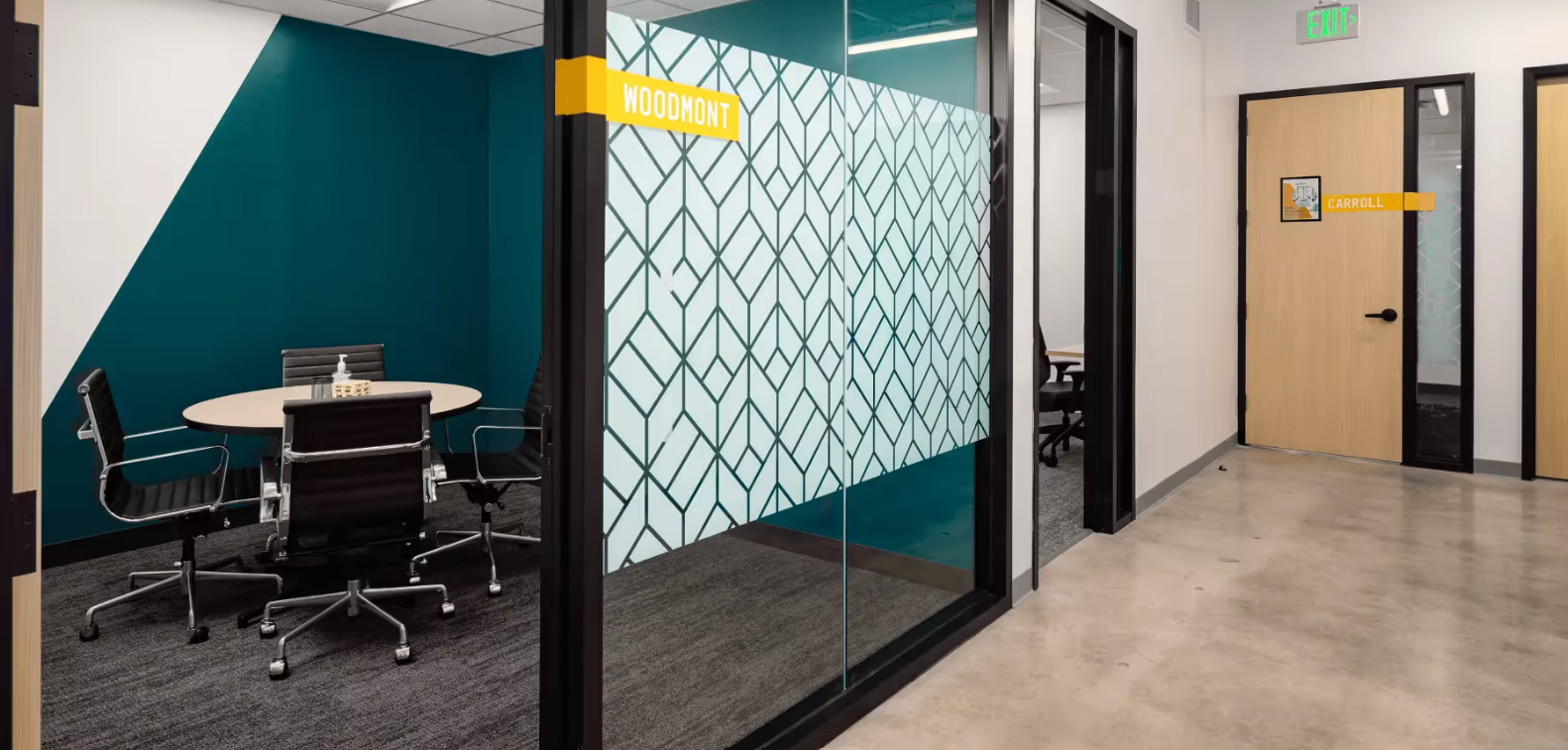
✅ Inventory and workspace under one roof, with fulfillment infrastructure built in.
✅ A private, locked suite that stays under your key, not a provider's.
✅ Round-the-clock security and a staffed dock without hiring for either.
✅ Shipping rates through Parsel typically land below what a small brand can negotiate alone.
❌ We will never be the cheapest, and we don't want to be.
➡️ Saltbox Chamblee is booking tours now, and the staff will size a suite against your pallet count on the spot. You can book a tour and walk the floor yourself.
If you're not ready for a suite, a Saltbox Access Plan covers receiving and discounted shipping without a warehouse lease.
Which northeast Atlanta district should you choose for your warehouse?
The right district follows from what you ship. If I were evaluating options for my own warehousing needs, I’d choose:
- Chamblee if you're a product brand shipping daily.
- Doraville if interchange access matters most.
- Norcross if volume storage drives the decision.
- Tucker if you move heavy freight.
Each answer follows from what the district does best.
Doraville's interchange saves truck time daily, and its studio campus feeds steady work to nearby vendors.
Norcross pays off for operations that need serious square footage and can commit to a multi-year lease.
Tucker remains the corridor where heavy equipment and rail freight make the most sense.
Chamblee suits the small brand that values the district around the warehouse as much as the warehouse itself.
There’s one more variable that belongs in the decision, and that's who handles the infrastructure.
A traditional lease in any of these districts leaves receiving and staffing on your plate, while a co-warehousing membership folds them into the rate.
You can talk to an expert to learn why 1,000+ members nationwide have chosen Saltbox, or book a tour at our Chamblee location to walk the space yourself.
⚠️ Disclaimer: This article was last updated on September 13, 2026, and if there's any misinterpretation of the information, please contact us, and we will fact-check it.
Frequently asked questions
Yes. The parallel-run method lets you migrate inventory and orders to a new provider while your current 3PL continues to fulfill. The key is sequencing the move by SKU, starting with slow-movers, and setting clear rules for which provider handles which orders during the overlap.
Request a fully itemized invoice and add up every fee that touches a single order: pick fee, pack fee, materials, carrier rate, and any applicable surcharges. Divide that total by your order count for the period. Don't use your quoted rate as the baseline. Use the actual invoice.
Co-warehousing differs from a traditional 3PL in that it gives small businesses direct access to their inventory, flexible terms, and on-site resources.
Traditional 3PLs give you access to shared fulfillment infrastructure on their terms. Saltbox is a co-warehousing model, which means members get private warehouse suites they control, an on-site team that's physically present, and access to Parsel, Saltbox's shipping platform partner, for discounted shipping and real-time tracking.
The model is built for founders who want the support of a fulfillment partner without giving up visibility and control. Read more here about how Saltbox compares to traditional third-party logistics providers.
Most 3PL transitions take between 30 and 90 days, depending on your order volume, SKU complexity, and contract notice requirements. A 60-day timeline using the parallel-run method is the most common approach for mid-volume operators.
For Her
For Him
For Pets
For Anyone



Related posts
Learn from businesses improving their operational efficiency. Explore how Saltbox’s expert support and flexible spaces drive their growth.


Chamblee vs. Doraville vs. Norcross vs. Tucker: choosing warehouse space on Atlanta's northeast side
See how the four districts stack up on access, cost, labor, and building stock, and where Saltbox fits.
10 best 3PL companies in Chamblee, GA (2026 buyer guide)
A side-by-side read on 10 3PL providers serving Chamblee, what each one is built to handle, and when a private suite beats outsourcing.
10 best 3PL companies in Elmhurst, IL (2026 guide)
I rank 10 Elmhurst 3PL providers on warehouse size, certifications, and the categories each is built for.
Related terms
Learn from businesses improving their operational efficiency. Explore how Saltbox’s expert support and flexible spaces drive their growth.