.webp)


Key takeaways
- Palisades Logistics and Crane Worldwide Logistics publish the largest Seattle-area storage figures in this guide, the first in food-grade space and the second in a building positioned between the Ports of Seattle and Tacoma.
- NXTPoint Logistics and Terminal Transfer run mid-sized buildings, the first under a mile from Seattle-Tacoma International Airport and the second close to the I-5 corridor and paired with a larger Portland warehouse.
- Acme Distribution and Argents Express work the Tacoma end of the corridor, one with an outdoor yard for bulk goods and the other with customs and fulfillment under a single owner.
- Modern Logistics and XPDEL both sell fulfillment around the metro, and neither publishes square footage or dock detail for a Seattle building.
- Buske Logistics says openly that its nearest fulfillment center is outside the city, and BlueGrace Logistics covers Seattle through freight management with no warehouse of its own here.
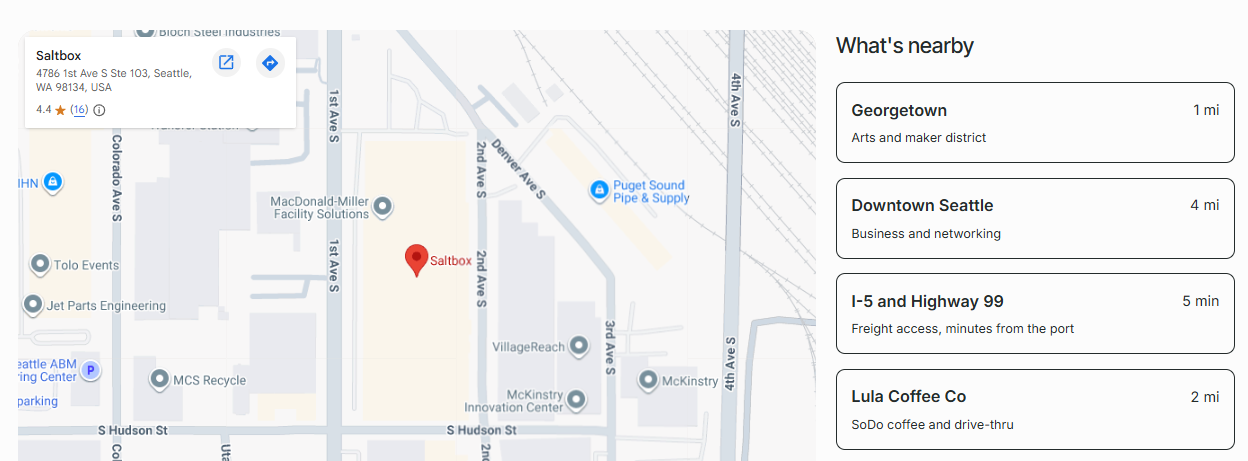
- Saltbox's co-warehousing is the best alternative to a 3PL in Seattle for brands that want to take back control and run fulfillment themselves. Private warehouse suites and offices are at 4786 1st Ave S Suite 103.
Looking for the best 3PL companies in Seattle, WA to store your inventory and ship your orders out of the Puget Sound port gateway?
In this guide, I'll cover 10 third-party logistics providers working the Seattle market in 2026 and what each one publishes about its buildings and its services.
I'll also show where running fulfillment from your own suite beats handing it off.
What are the best 3PL companies in Seattle in 2026?
The best 3PL companies in Seattle in 2026 are Crane Worldwide Logistics, Palisades Logistics, and NXTPoint Logistics.
Here's how the 10 providers compare:
#1: Crane Worldwide Logistics
Best for: Importers and exporters that want racked storage and freight forwarding from the same provider between the Ports of Seattle and Tacoma.
Locations: 1 Seattle-area warehouse at 3101 W Valley Highway E in Sumner, WA, inside a global office network.
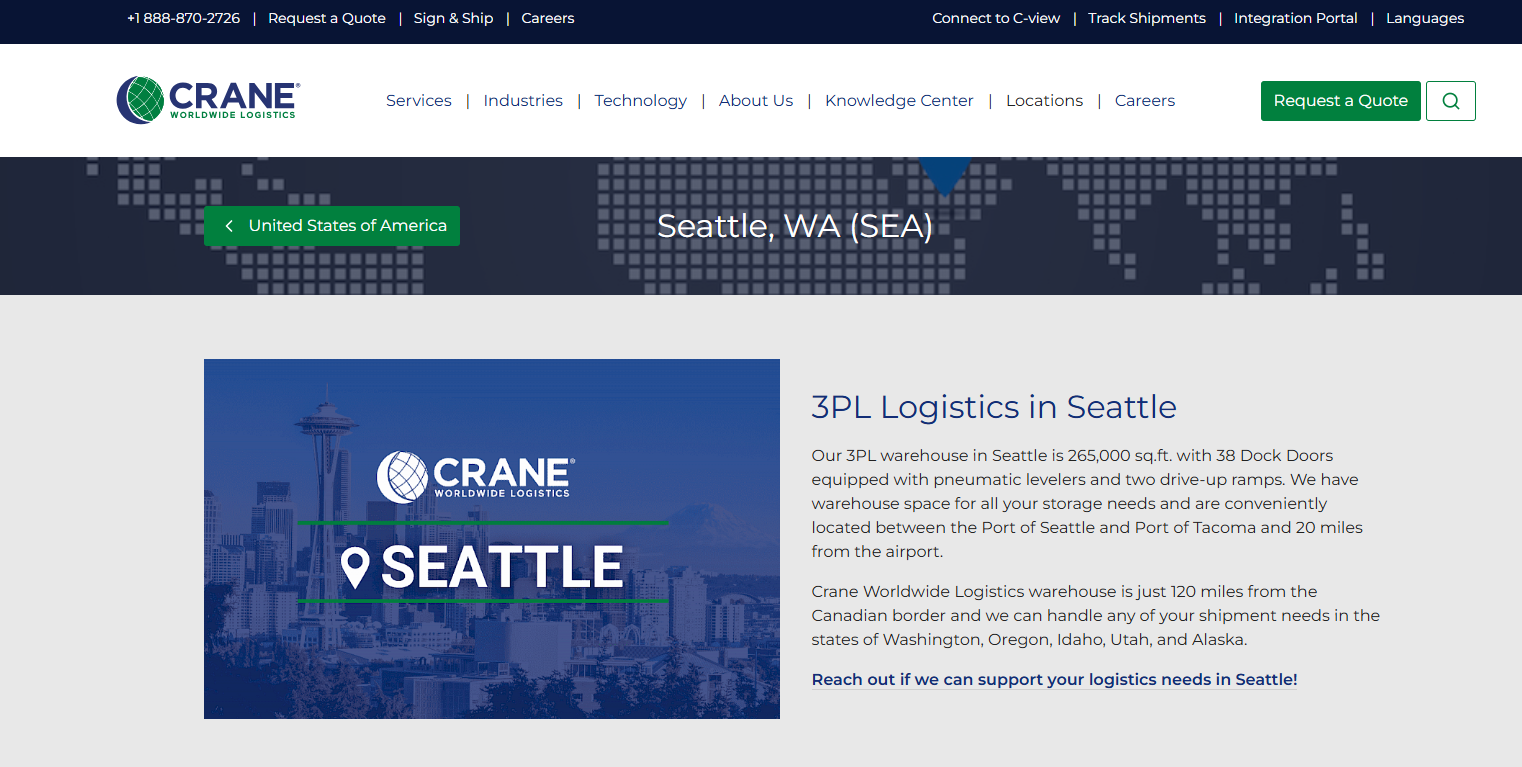
The Seattle number Crane Worldwide Logistics publishes is 265,000 sq. ft., worked through a 38-door dock.
The company puts that building between the Port of Seattle and the Port of Tacoma, around 20 miles from the airport and 120 miles from the Canadian border.
Amenities and benefits
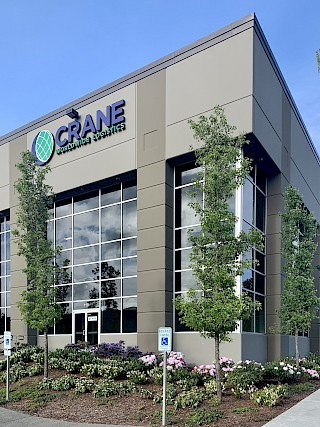
- A dock face of 38 doors on pneumatic levelers, two drive-up ramps, and 265,000 sq. ft. of warehouse behind them.
- One building covering customized project work, kitting, pick and pack, consolidation, transload, cross-dock, distribution, and bulk and racked storage.
- Air and ocean freight on both the import and export side, rail and road freight, and domestic truck brokerage covering full truckload, less than truckload, white glove, and over-the-road moves.
- Specialized cargo work covering project freight, oversized loads, and hazardous materials, with letters of credit handled on the trade side.
- Inventory tracked on a warehouse management system, with ocean containers worked through a cross-dock function.
- Trade Advisory, a consultation service the company offers on import and export questions.
Pricing
Pricing is quoted here, not published. A client advocate builds the number once your request lands, working from your freight mix and how much of the warehouse you would occupy.
Pros and cons
✅ 265,000 sq. ft. under one roof, with 38 doors on the dock.
✅ One provider handling the forwarding, the customs paperwork, and the storage, with a global office network behind it.
✅ Published coverage for Washington, Oregon, Idaho, Utah, and Alaska, which suits distribution across the Northwest.
❌ Parcel-level ecommerce work is secondary to freight forwarding here, so a DTC brand shipping small orders will find a closer fit further down this list.
Saltbox is the best alternative to a 3PL in Seattle for brands that want to run fulfillment themselves
Saltbox Seattle gives you a private warehouse suite in SoDo at 4786 1st Ave S Suite 103, with your own key, month-to-month billing, and on-site help when you want it. With a 3PL, your inventory goes into a building you do not walk into
Someone else decides how your orders get packed, and what it costs when you want that changed.
Saltbox keeps both of those decisions with you.
Your suite at 4786 1st Ave S Suite 103 in SoDo is private, you hold the key, and billing is month-to-month with no annual lock-in
How much of the packing our on-site team takes on is your call. And the best part? The Port of Seattle is close by, with I-5 and Highway 99 both minutes away.
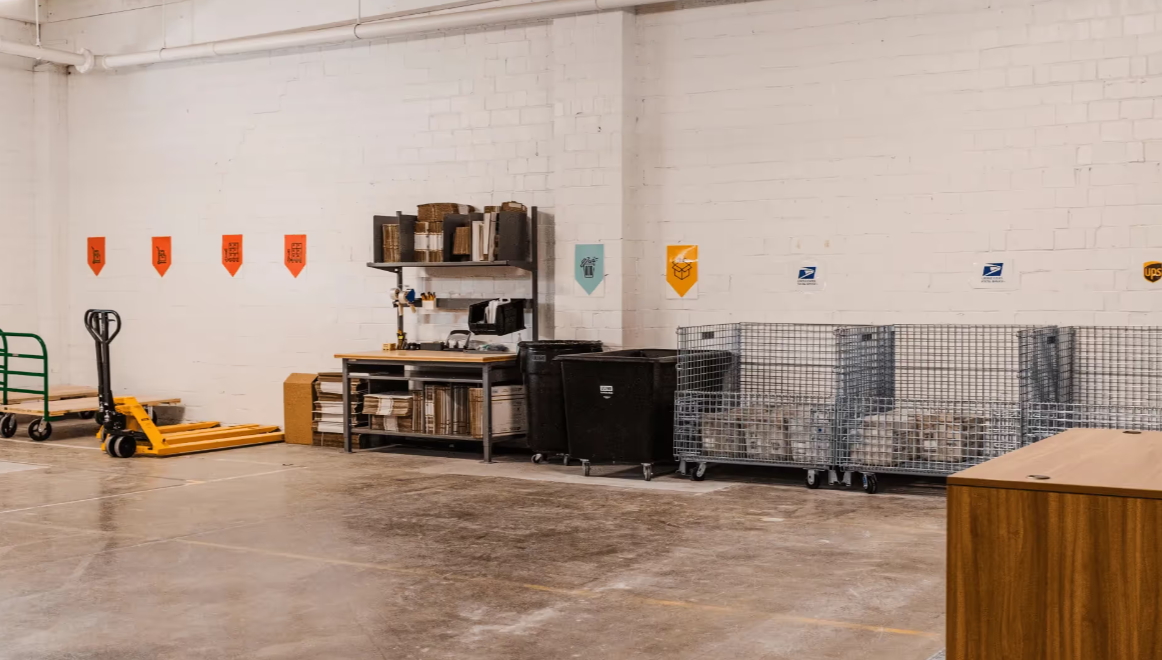
How does Saltbox compare to a 3PL?
The gap opens across six things, starting with who is allowed to open the door:
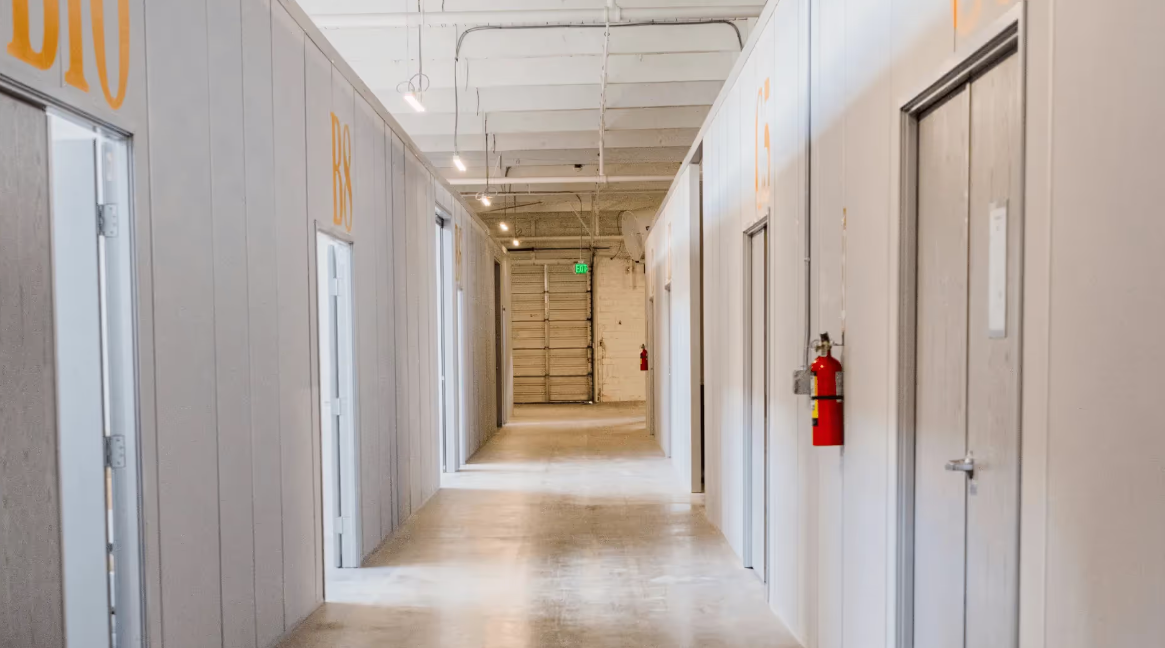
What you get at Saltbox Seattle
Here's what a membership covers at our SoDo location:
- A private suite that is yours alone, from 60 to 2,030 sq. ft., holding up to 126 pallets at the largest size.
- Month-to-month billing, which means a quiet quarter costs you a suite size and nothing more.
- Inventory receiving included, with our team inbounding freight and parcels as they land.
- Daily carrier pickups at the dock, which takes the post office run off your week.
- Extra hands on the floor when you need them through S.O.S. (Saltbox Operations Support), our on-demand operations crew, with Saltbox Fulfillment available when you want the whole order handled.
- Shared space that comes with the membership: a content studio, conference rooms, a kitchen, printing, high-speed Wi-Fi, in-suite power, 24/7 security, and the Saltbox Entrepreneurs Club.
- Access to Parsel, our partner shipping platform, with savings of up to 30% on shipping fees and the price of every label on screen before an order leaves
- Private offices for the days when your team needs desks as well as dock space.
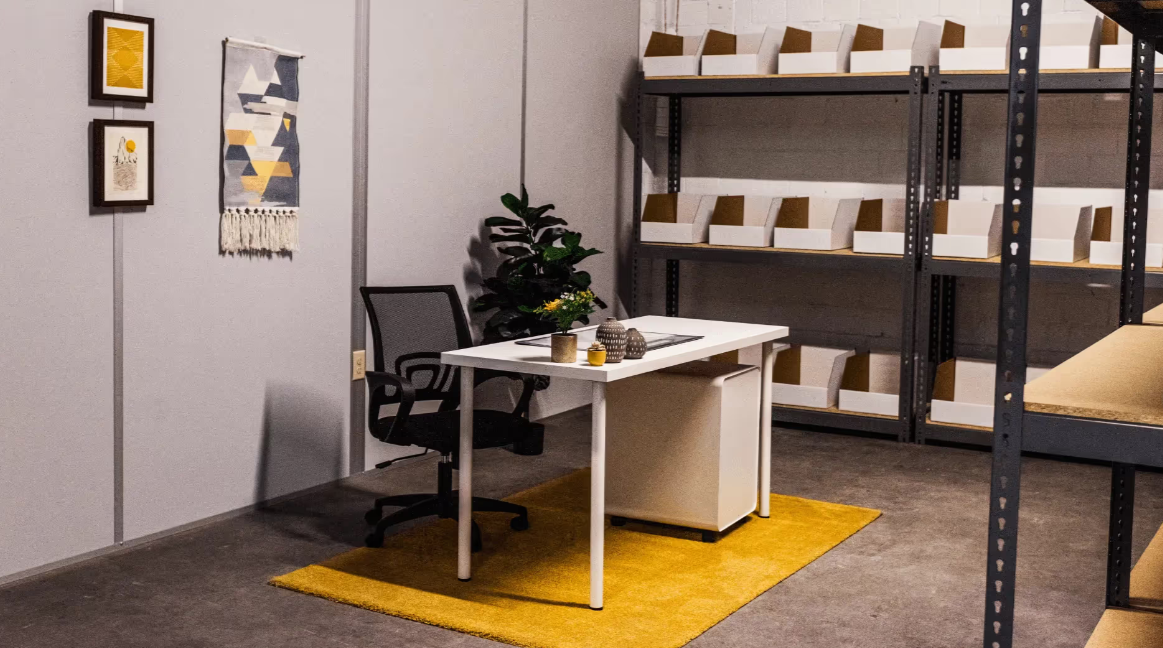
Saltbox pricing in Seattle
Here’s how much it costs to get started with Saltbox Seattle:
- Starter warehouse from $420/month, covering 60 to 90 sq. ft., up to 5 pallets, and 1 to 2 employees.
- Extra Small warehouse from $420/month, covering 100 to 250 sq. ft., up to 15 pallets, and 1 to 2 employees.
- Small warehouse from $1,810/month, covering 260 to 500 sq. ft., up to 30 pallets, and 1 to 3 employees.
- Medium warehouse from $2,730/month, covering 510 to 840 sq. ft., up to 52 pallets, and 1 to 4 employees.
- Large warehouse from $4,640/month, covering 1,110 to 1,350 sq. ft., up to 84 pallets, and 1 to 10 employees.
- Extra Large warehouse from $7,540/month, covering 1,610 to 2,030 sq. ft., up to 126 pallets, and 1 to 50 employees.
- Add-ons run alongside that, with 24/7 access at $299/month, additional member access at $99/month, and equipment and furnishing rentals available month-to-month.
➡️ Inventory receiving starts as soon as you have keys.
Book a tour to see the SoDo building, or begin with Access Plans if you want the address and the dock before you want a suite.
#2: Palisades Logistics
Best for: Food, beverage, and general merchandise companies that need public or contract warehousing in food-grade space around Seattle.
Locations: Seattle public warehousing delivered through partner operations, with a head office at 12 Lower Center Street in Clinton, NJ.
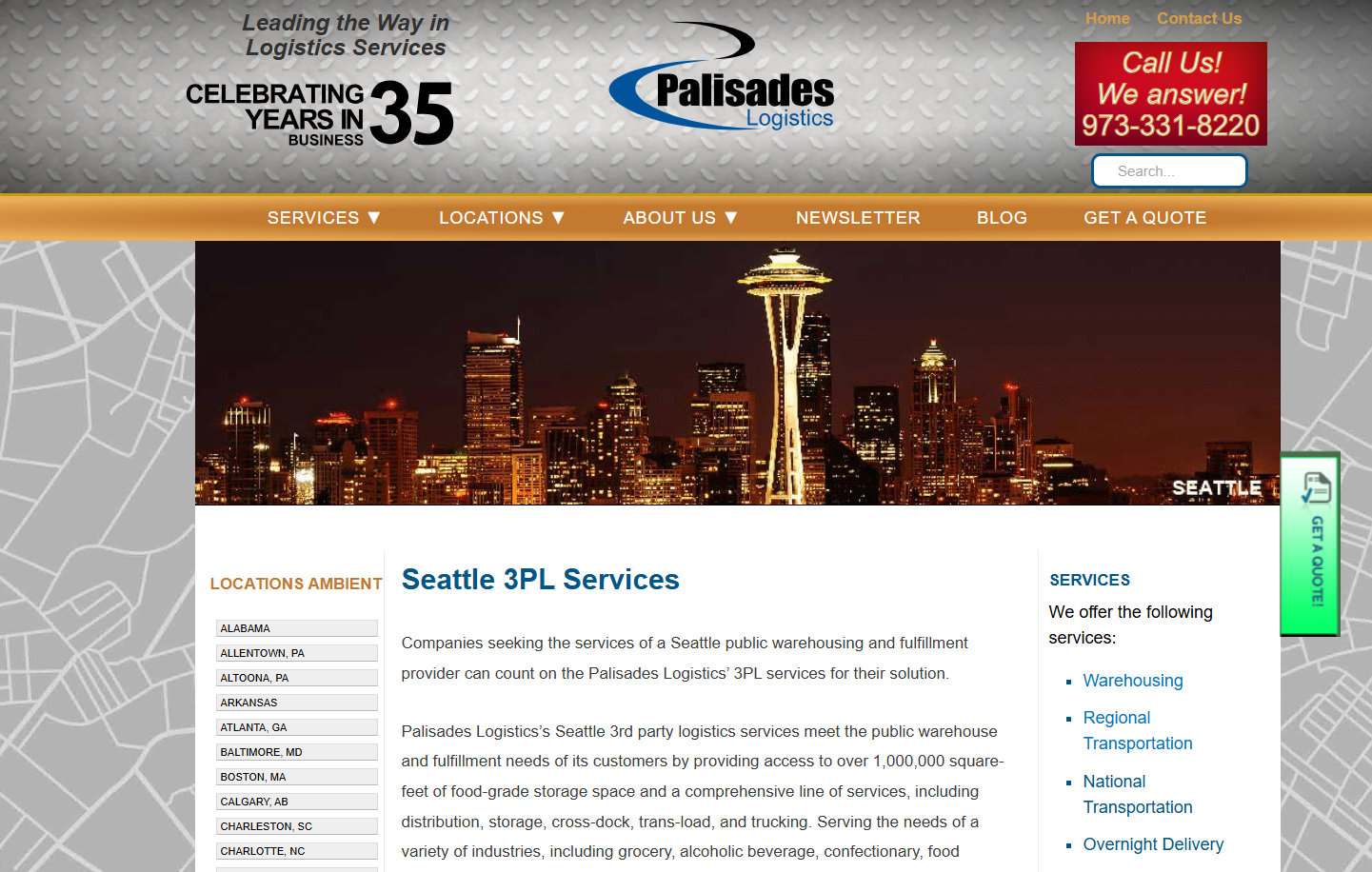
Customers of Palisades Logistics in Seattle get access to more than 1,000,000 sq. ft. of food-grade storage.
Approximately 300,000 sq. ft. of that total is temperature-controlled, which brings chilled and ambient inventory under one provider.
Amenities and benefits

- More than 1,000,000 sq. ft. of food-grade storage, with approximately 300,000 sq. ft. of it temperature-controlled.
- Public warehousing, contract warehousing, pool distribution, regional transportation, drayage, and transloading sold as one line of services.
- Rail-served space with rail loading and unloading, alongside customs-bonded space and alcoholic beverage storage.
- Accellos WMS runs the operation, with Radio Frequency (RF) data scanning and bar code capability on the floor.
- Around-the-clock operations and multi-vendor consolidation for customers running continuous distribution.
- ISO 9001:2000 certification and an AIB Superior rating held by Oregon Transfer Company, the Seattle partner operation.
Pricing
A free quote is the published route to a figure.
The page treats ambient and temperature-controlled space as different offerings, so a quote would reflect which one you need.
Pros and cons
✅ More than 1,000,000 sq. ft. of food-grade storage, the largest Seattle-area figure published by any provider in this guide.
✅ Certifications covering ISO 9001:2000 and an AIB Superior rating at the partner facilities.
✅ Customs-bonded and temperature-controlled space available inside the same service line.
❌ Seattle operations run through a partner company, Oregon Transfer Company, which puts a second party in the relationship.
#3: NXTPoint Logistics
Best for: Brands moving import volume off the Port of Seattle that also deliver heavy or over-dimensional goods to homes.
Locations: 1 warehouse in Burien, WA, with Suddath Global Logistics named in the site footer.
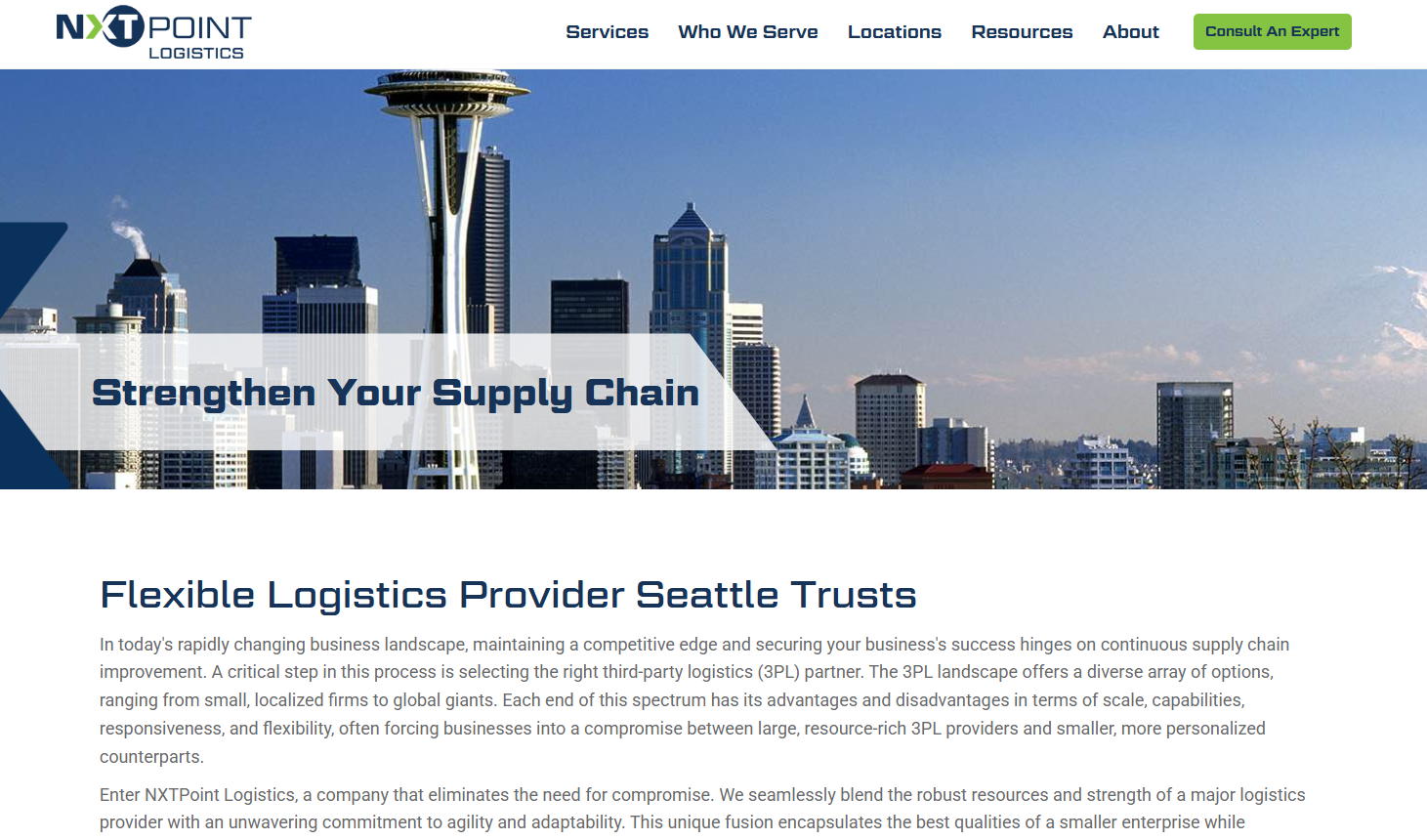
Under a mile north of Seattle-Tacoma International Airport, NXTPoint Logistics operates a 72,000 sq. ft. warehouse in Burien that the company describes as brand-new.
The same company handles transportation, project logistics, final mile delivery, and distribution center services, so one provider can cover the inbound leg and the doorstep.
Amenities and benefits
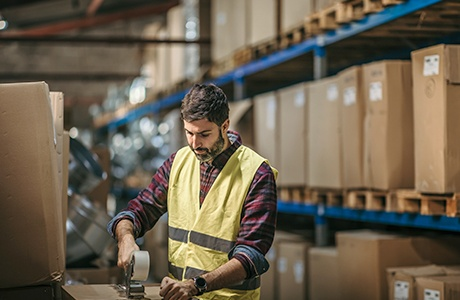
- A 72,000 sq. ft. Burien facility, under 1 mile north of Seattle-Tacoma International Airport and under 10 miles south of the Port of Seattle.
- Warehousing, distribution, and fulfillment handled alongside transportation and freight management.
- Final-mile home delivery built for heavy, over-dimensional items: appliances, mattresses, furniture, electronics, and exercise equipment.
- Logistics project management for furniture, fixtures, and equipment projects, which the company illustrates with decor and digital menu boards.
- A task management application tracking goods from manufacturer to destination, alongside inventory management software and a real-time warehouse management system.
- ISO 9001 certification, with SmartWay participation and Inbound Logistics Top 100 listings among the credentials shown.
Pricing
New business goes through a consultation before any number appears.
A brand taking warehousing alone will see a different number from one bundling in final-mile delivery.
Pros and cons
✅ A named Seattle-area warehouse close to both the airport and the Port of Seattle.
✅ Heavy, over-dimensional goods are covered all the way to the customer's door, not just to the carrier.
✅ Suddath Global Logistics named in the footer, with ISO 9001 among the published credentials.
❌ At 72,000 sq. ft., the Burien building is smaller than the two options above it, which caps deep pallet storage.
❌ The Burien listing stops at square footage, so dock counts, ceiling heights, and site certifications have to come from a call.
#4: Terminal Transfer
Best for: Brands distributing across the Pacific Northwest that want Seattle and Portland storage plus delivery from one company.
Locations: 2 warehouses, 75,000 sq. ft. in Seattle and 250,000 sq. ft. in Portland, OR, both close to the I-5 corridor.
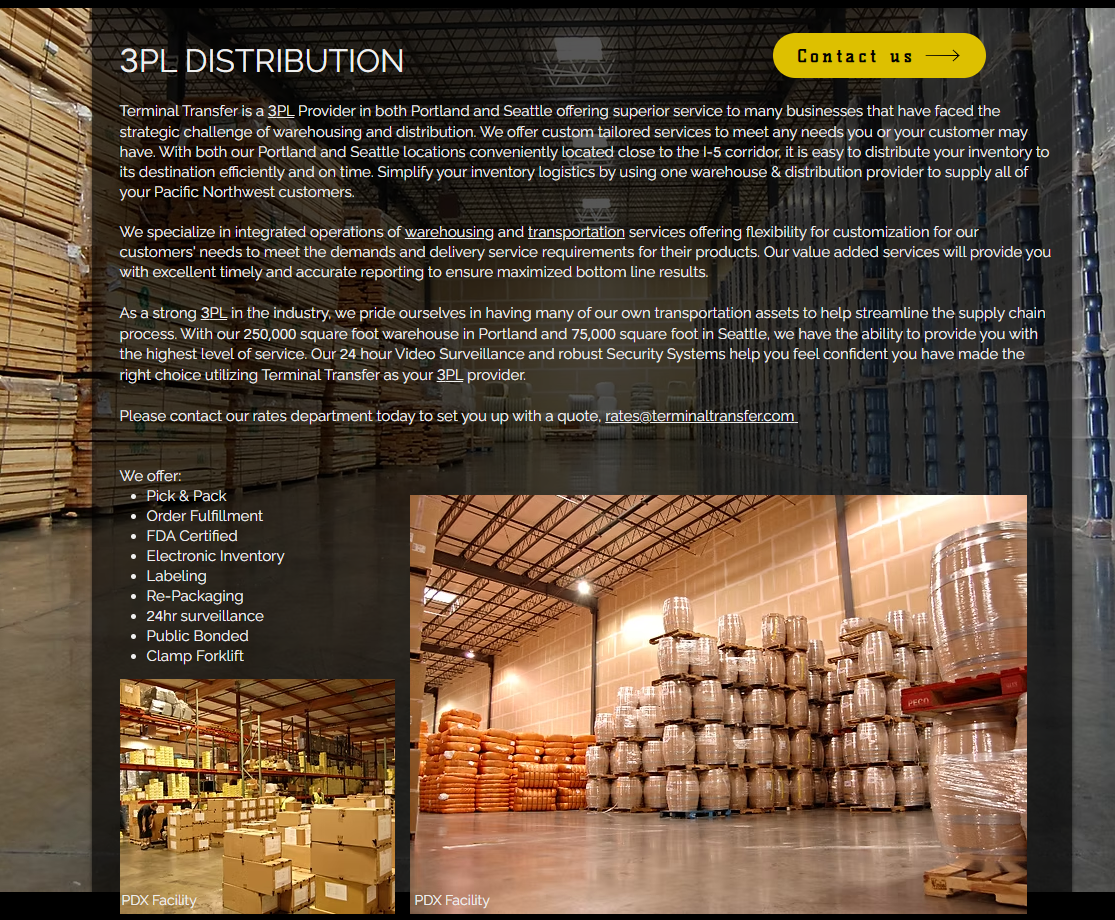
Terminal Transfer covers the Pacific Northwest from two buildings, 75,000 sq. ft. in Seattle and 250,000 sq. ft. in Portland.
Many of the transportation assets belong to the company, which keeps storage and the delivery leg inside one operation.
Amenities and benefits
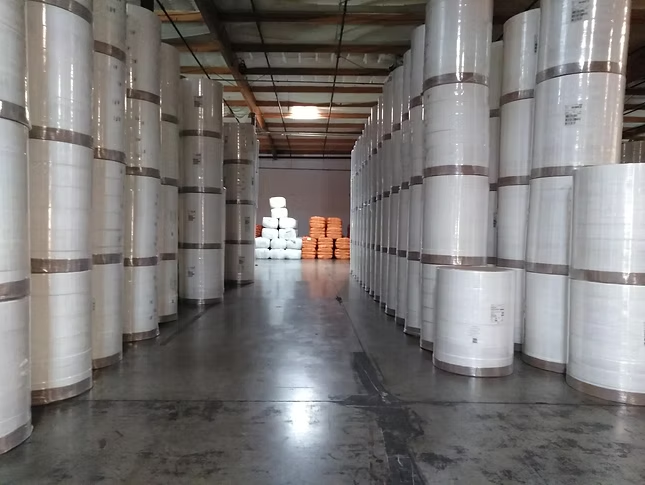
- 75,000 sq. ft. in Seattle and 250,000 sq. ft. in Portland, both positioned close to the I-5 corridor.
- Pick and pack, order fulfillment, labeling, and re-packaging handled in house.
- The published capability list includes public bonded space and FDA certified handling.
- Electronic inventory records, clamp forklift handling, and 24-hour video surveillance backed by security systems.
Pricing
Quotes come from a dedicated rates department, reachable by email.
A brand splitting inventory across both buildings would be quoted on the pair, not on Seattle alone.
Pros and cons
✅ Seattle and Portland storage from one company, which suits distribution up and down the corridor.
✅ Company-owned transportation assets behind much of the delivery work.
✅ Public bonded space listed alongside FDA certified handling.
❌ At 75,000 sq. ft., Seattle is the smaller of the company's two warehouses.
#5: Acme Distribution
Best for: Building materials suppliers and manufacturers that need covered storage plus an outdoor yard near the Port of Tacoma.
Locations: 1 warehouse at 4512 70th Ave East Suite #400 in Fife, WA, run from a head office in Aurora, CO.
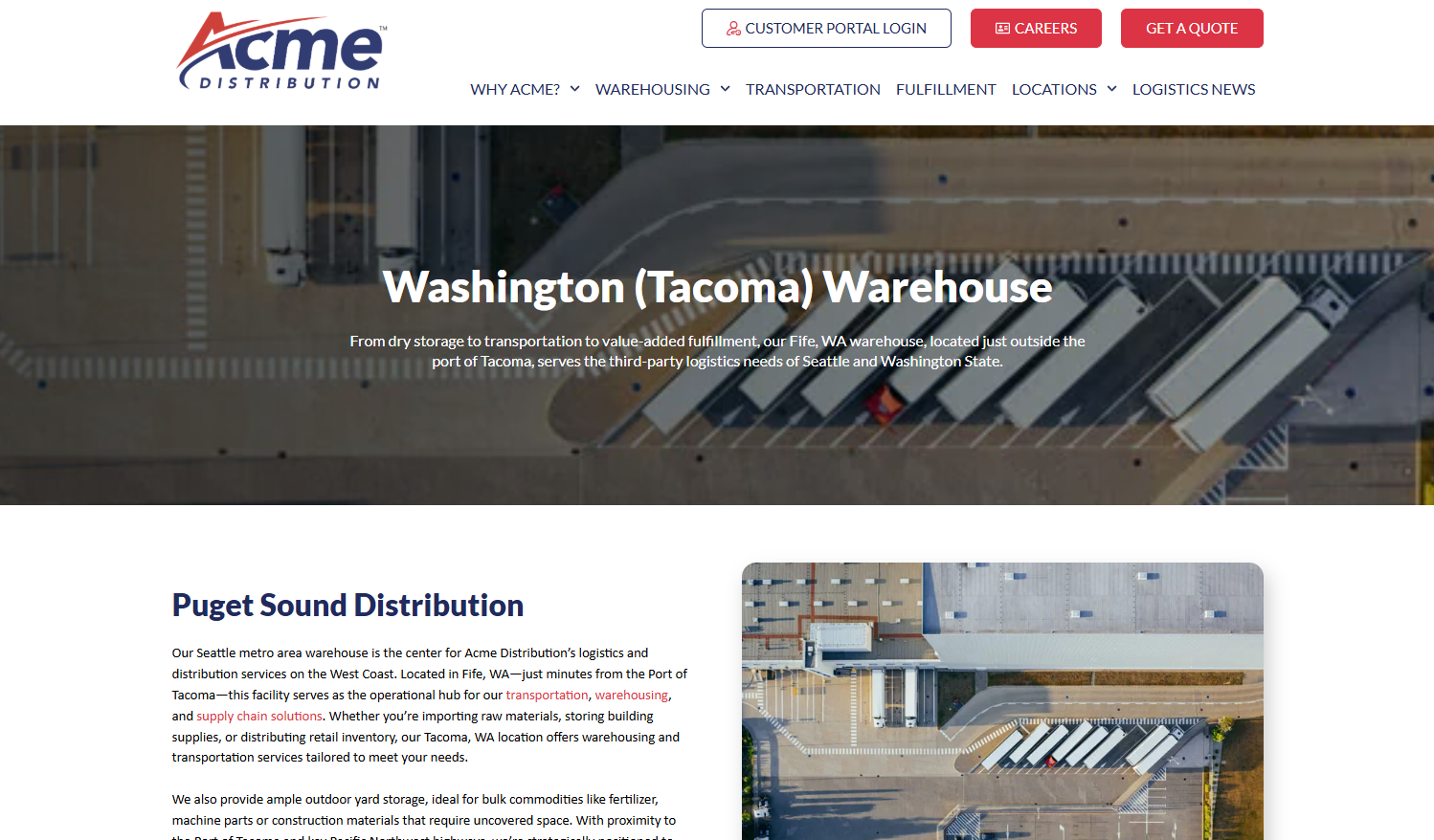
Outdoor yard storage separates the Acme Distribution warehouse in Fife from the rest of this guide, where no other provider publishes uncovered space.
That building works as the company's West Coast hub, minutes from the Port of Tacoma, and it serves Seattle along with the rest of Washington State.
Amenities and benefits
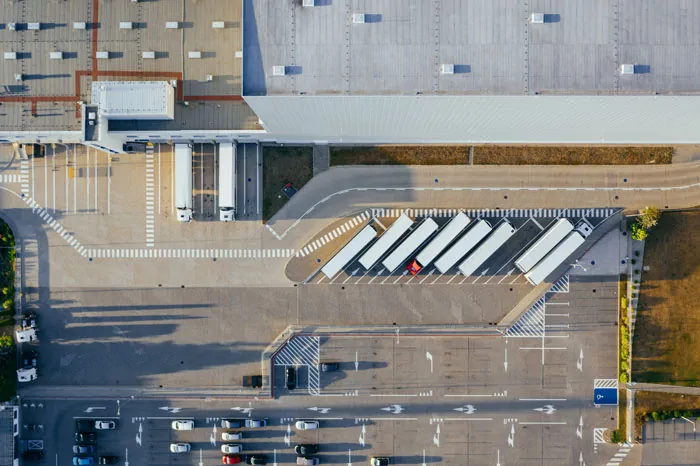
- Standard dry, conditioned, and industrial supply storage, plus outdoor yard space for bulk commodities such as fertilizer, machine parts, or construction materials.
- Storage configured as rack, bulk, flow, or conveyor, with staging docks sized for inbound and outbound work.
- A production line covering light manufacturing, labeling, shrink packing, module and product assembly, co-packing, and on-site pick and pack.
- Pick-to-voice handling, double carriage forklifts, roller bed trailers, and carton specific labeling across the floor.
- A dedicated fleet of six trucks covering drayage, freight brokerage, and regional deliveries.
- Warehouse planning support that runs from needs assessments to CAD drawings before anything moves in.
Pricing
Nothing is posted publicly. Yard space and covered storage are different products here, so a quote will reflect the split between them.
Pros and cons
✅ Covered warehouse space and outdoor yard storage at the same address.
✅ Co-packing, light manufacturing, and product assembly available on the same floor as the storage.
✅ Its own fleet of six trucks for drayage and regional delivery close to the Port of Tacoma.
❌ Fife is at the Tacoma end of the corridor, which adds a run for brands working out of Seattle.
#6: Argents Express
Best for: Importers that want customs, transportation, and fulfillment handled by one company that owns its warehouses.
Locations: 1 Seattle to Tacoma building at 927 E. 11th Street Suite 200 in Tacoma, WA, with sites in Chicago, Charleston, and Hilton Head Island.
Argents Express owns and operates the warehouses across its network, which keeps the building and the service with one company.
The Seattle listing for Argents Express resolves to a Tacoma address near both ports and Sea-Tac Airport, and the company states that distinction openly on the page.
Amenities and benefits
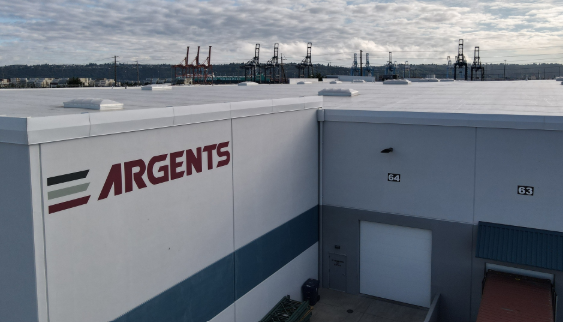
- The company sells fulfillment, transportation, and customs together, and it owns and operates the warehouses behind them.
- A Tacoma building covering the whole Seattle to Tacoma market, close to SEA-TAC Airport and to both the Seattle and Tacoma ports.
- A tracking portal, inventory management, and online bill pay open to customers.
- A network-wide claim from the company that clients average 22% faster transit times.
Pricing
Custom quotes only, with no rates shown anywhere on the site.
Importers clearing freight through the company would be quoted differently from those using the warehouse alone.
Pros and cons
✅ Company-owned and operated warehouses, which Argents Express describes as no middlemen.
✅ Customs clearance, trucking, and fulfillment all fall inside one relationship for import freight.
✅ A named Tacoma address with port and airport access published up front.
❌ The building is in Tacoma and not Seattle, which the company states plainly, so same-city pickup is off the table.
#7: Modern Logistics
Best for: Seattle-area businesses that want warehousing and transportation coordinated by a locally based provider.
Locations: 1 headquarters at 1075 Andover Park E in Seattle, WA.
The only address Modern Logistics publishes is in Seattle, and the offer there runs from inventory management and storage through to transportation and order fulfillment.
The company positions itself on expedited delivery at what it calls industry leading rates.
Amenities and benefits

- Warehousing and storage, with transportation management, order fulfillment, and inventory management available on the same account.
- Automated inventory management, predictive analytics, and real-time tracking named as the technology underneath it.
- Logistics strategies built per client and aligned to specific business goals.
- Green practices across the operation, including eco-friendly packaging and energy-efficient warehouses.
- A support team you can call directly on (206) 226-8080 or email at the Seattle office.
Pricing
The route to a number is a phone call to the Seattle office. The company describes its rates as industry-leading, with no figure attached to that.
Pros and cons
✅ A Seattle address and a direct line to the team that would handle your account.
✅ Storage and trucking run off a single account, which keeps the contact list short.
✅ Stated green practices covering packaging and warehouse energy use.
❌ With no facility specifications, certifications, or service levels on the site, all the diligence happens on the call.
#8: XPDEL
Best for: Ecommerce sellers who want technology-led fulfillment across the suburbs ringing Seattle.
Locations: A Seattle fulfillment center marketed by the company, with a corporate address at 2625 Townsgate Road Ste. 330 in Westlake Village, CA.
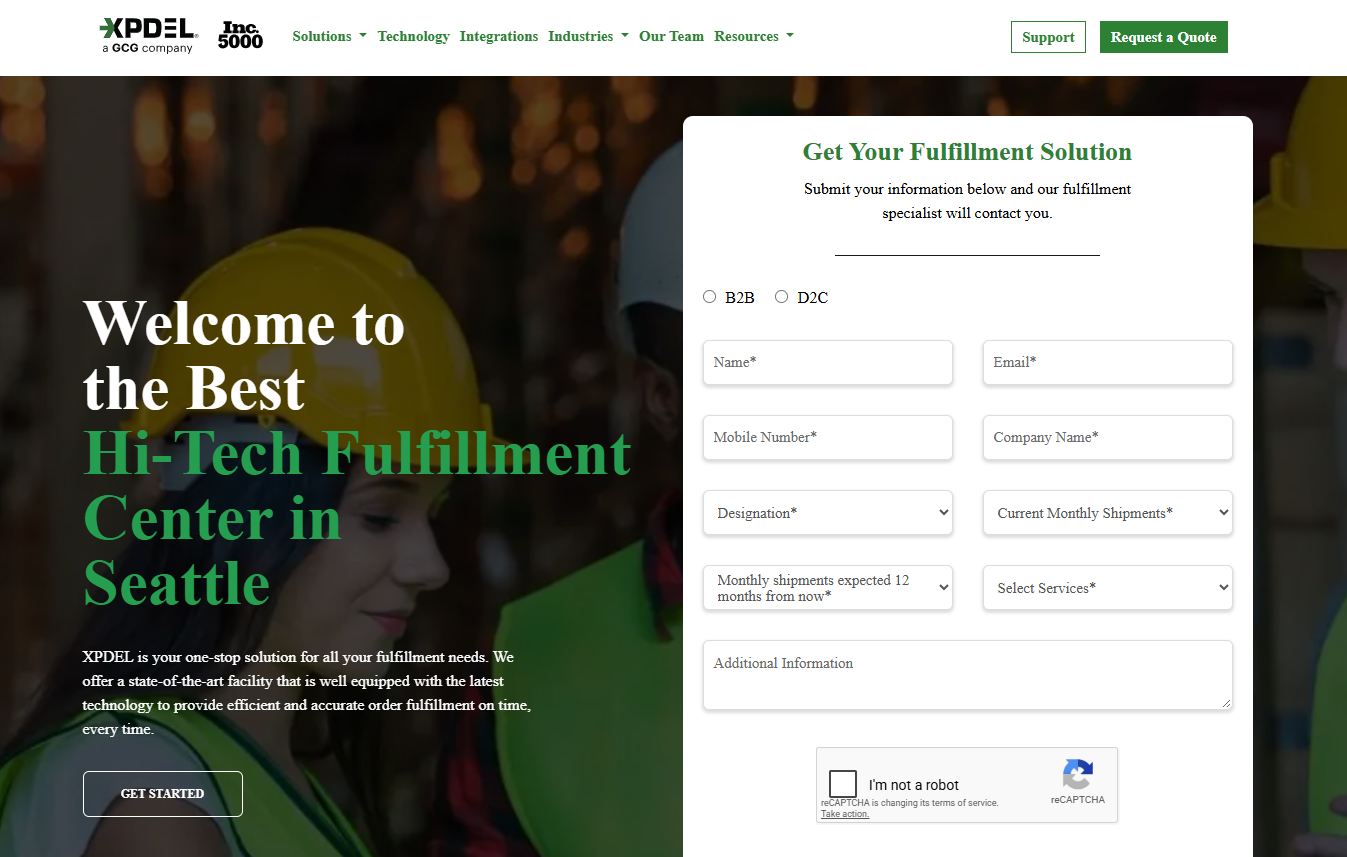
Technology is the pitch at XPDEL, which markets a Seattle fulfillment center it describes as equipped with the latest technology.
The company's published coverage names 15 cities around the metro, among them Bellevue, Redmond, Renton, Tukwila, and Burien.
Amenities and benefits
- Beyond fulfillment, the company also takes on returns, transportation, and managed labor.
- Section 321 De Minimis support for low-value shipments crossing into the U.S.
- Named industry coverage for rental and subscription products; fashion, apparel, and sports; health, wellness, and beauty; and food and beverage.
- End-to-end shipment visibility promised through the company's own technology, with locations listed in the United States, Canada, Amsterdam, and India.
- A managed labor model, offered for brands that want XPDEL staff running the floor work.
Pricing
The quote form asks two questions that matter: your current monthly shipments and the volume you expect a year out.
Those two numbers will shape whatever offer comes back.
Pros and cons
✅ Section 321 De Minimis handling for brands importing low-value shipments.
✅ Managed labor solutions available alongside the fulfillment service.
✅ A published metro service area naming 15 cities around Seattle.
❌ Pricing is not published.
#9: Buske Logistics
Best for: Retail suppliers shipping into Amazon, Costco, or Target that can work from a facility outside the city.
Locations: A fulfillment center near Seattle, which the company states is not inside the city itself.
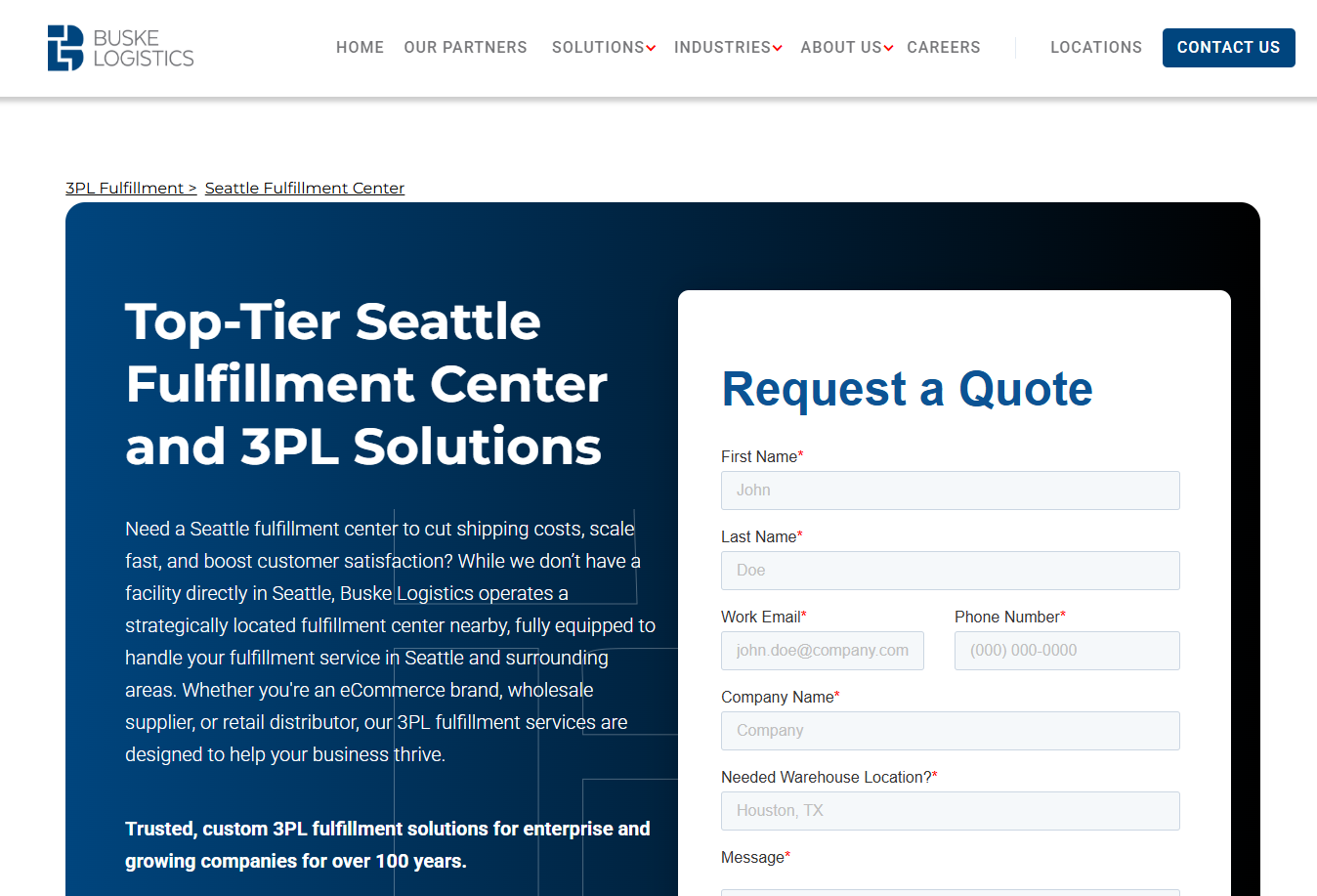
Buske Logistics says on its Seattle page that it has no facility directly in the city and covers the market from a fulfillment center nearby.
What comes with that is more than 100 years of operating history and a retail compliance program aimed squarely at chargebacks.
Amenities and benefits
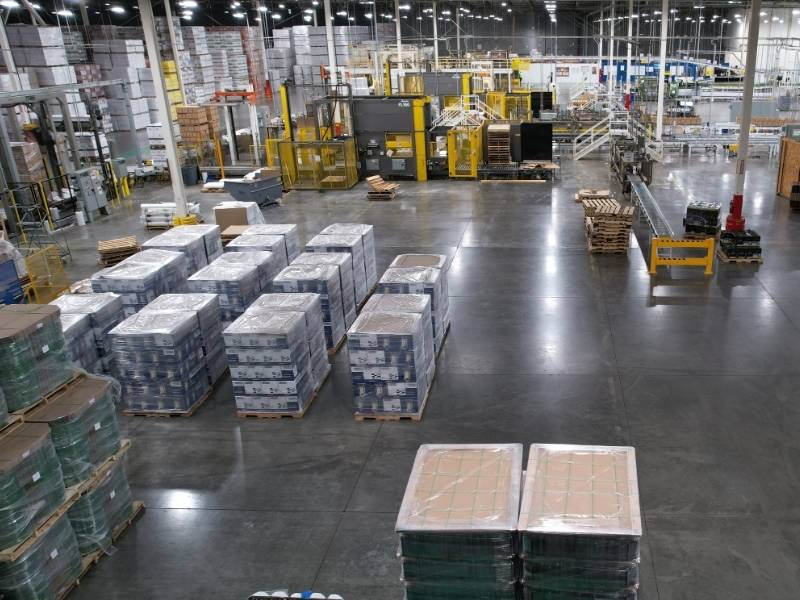
- Retail compliance covering ASNs, barcode labeling, and pallet configuration for retailers including Amazon, Costco, and Target.
- FBA prep alongside DTC and B2B order fulfillment, kitting, assembly, and custom packaging.
- Storage in FDA-registered facilities, which opens the door to supplements and food.
- Inventory visibility with FIFO and FEFO rules, lot tracking, and expiration monitoring.
- Connections into Shopify, BigCommerce, Amazon, NetSuite, and major ERP systems, with EDI and API options on top.
- Cross-docking and transloading are both offered, and returns run through reverse logistics that covers restocking and inspection.
Pricing
A ‘get started’ form opens the conversation, and pricing follows from there.
Brands routing into big-box retailers should expect the compliance work to weigh on the number.
Pros and cons
✅ Retail compliance work built around big-box routing guides, with FBA prep beside it.
✅ FDA registration on the facilities, which matters for supplement and food brands.
✅ More than 100 years of operating history, under private ownership.
❌ The delivery window of 1 to 2 days across the Pacific Northwest and the U.S. is a company figure, with no service level published behind it.
#10: BlueGrace Logistics
Best for: Seattle shippers moving palletized freight who need mode selection and carrier management before they need storage.
Locations: 8 offices across the U.S. and Mexico, with no Seattle warehouse of its own.
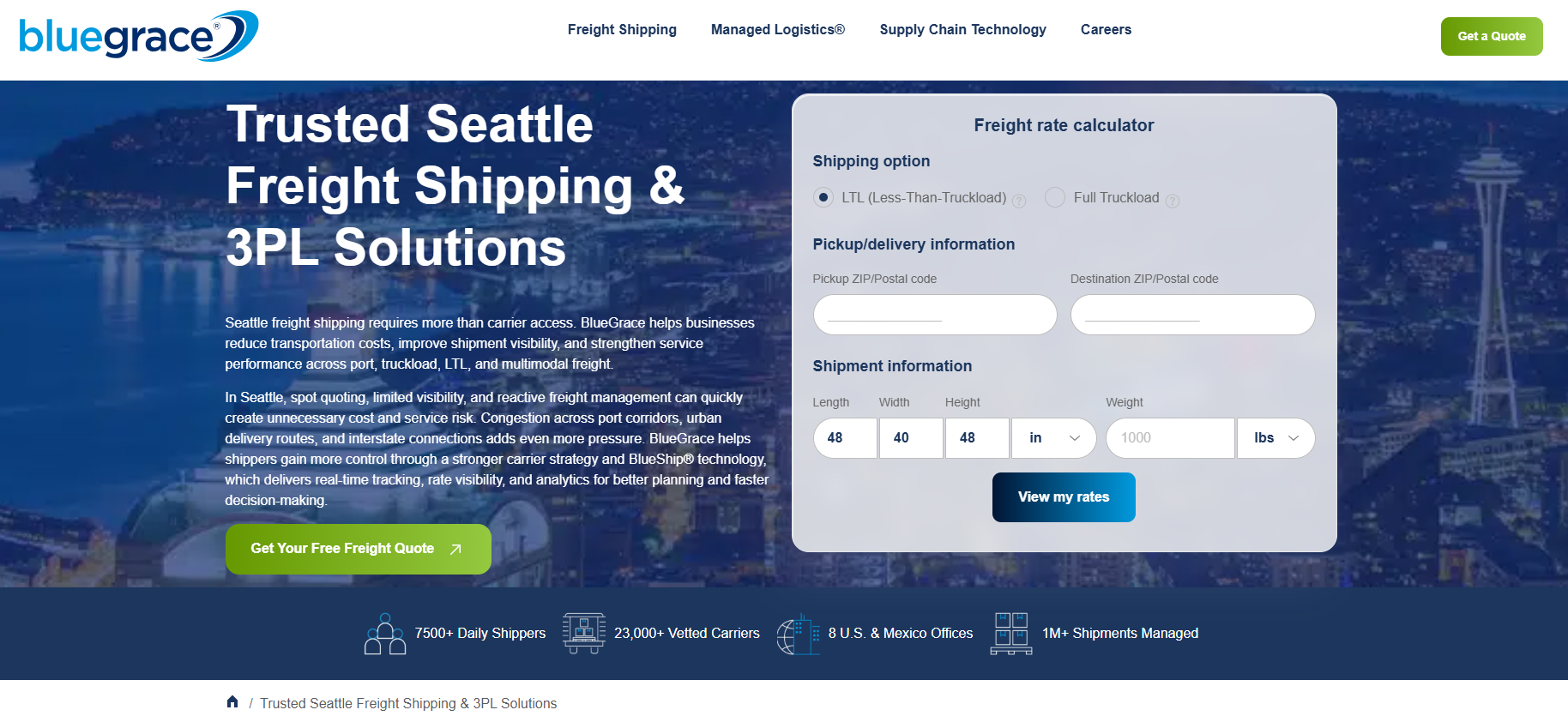
BlueGrace Logistics comes at the Seattle market through freight management, covering LTL, full truckload, expedited, and intermodal moves.
BlueShip, the company's transportation management technology, carries tracking, rating, and exception management across all of those modes.
Amenities and benefits
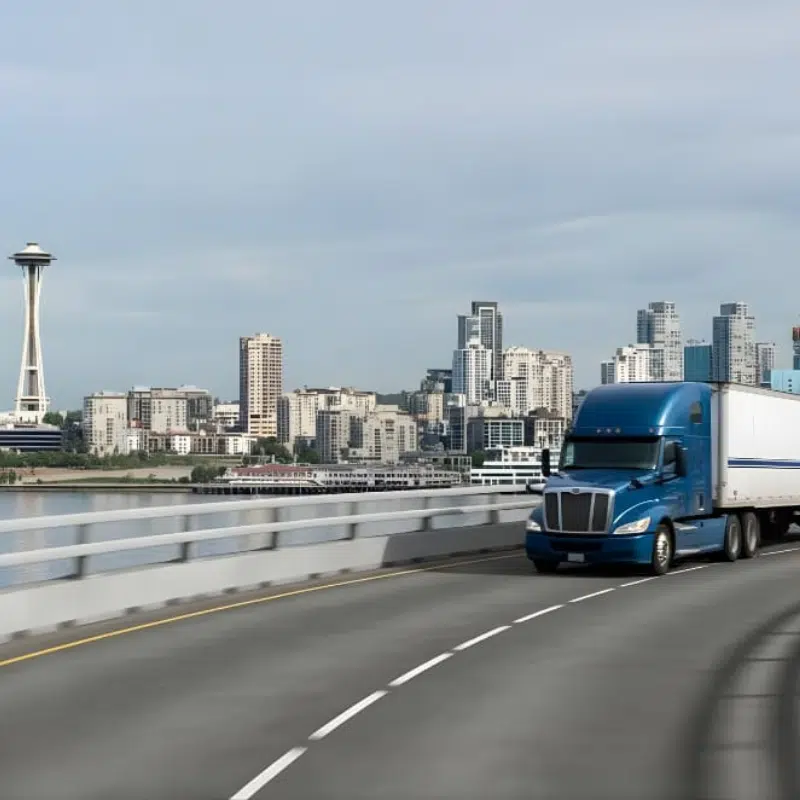
- Control over how LTL freight is classified, which carrier takes it, and what accessorial charges attach.
- Specialized, refrigerated, flatbed, and dry van truckload options weighed on cost and service.
- Expedited freight using team service, exclusive-use options, sprinter vans, and straight trucks.
- Intermodal and port-linked freight strategies for container-linked shipments moving through the Northwest Seaport Alliance gateway.
- BlueShip for centralized shipment visibility, milestone tracking, exception management, and carrier performance review by lane.
- A carrier base the company puts at more than 23,000 vetted carriers, serving more than 7,500 daily shippers.
Pricing
A freight rate calculator on the site covers LTL and full truckload estimates.
Program work and managed logistics engagements get scoped on their own terms.
Pros and cons
✅ A freight rate calculator published on the site, alongside a density calculator.
✅ Mode selection and carrier management across LTL, truckload, expedited, and intermodal.
✅ BlueShip pulling tracking, rating, and exception management into one view.
❌ The Seattle offer described on the page is freight-led, so storage and fulfillment are not part of it.
❌ With no warehouse of its own here, your inventory still needs a home somewhere else in this list.
Why are Seattle brands looking past the 3PL model?
Seattle brands look past the 3PL model once custom work starts getting quoted as an exception and the agreement term outlasts the forecast it was written around.
The 10 providers above are a real answer for a lot of product businesses.
Between them, you can find food-grade public warehousing, customs-bonded space, port drayage, outdoor yard storage, final-mile delivery for heavy goods, and freight management across four modes.
No growing brand stands that up alone.
One profile feels this more than the rest: a business growing at a steady clip that has not yet hit the order count those economics assume.
➡️ The points below describe common industry practice in outsourced fulfillment, and none of them is attributed to the providers named above.
Custom work is priced as an exception
Anything outside a standard pack gets treated as a project, which means a separate quote and a place in someone else's queue.
Branded inserts, gift notes, bundle builds, and launch kits are the usual candidates.
A brand that runs two or three of those a quarter ends up negotiating each one.
Storage rates often climb during peak season too.
Inbound timing runs on someone else's calendar
Receiving appointments and put-away schedules belong to the provider, not to you.
That works while containers land on schedule.
When a vessel slips or a truck misses its window, your launch date moves with it and you find out through a support queue.
The commitment outlasts the forecast behind it
Two- to three-year terms are standard in warehousing and fulfillment contracts, and a monthly volume floor often comes attached.
Your business can change shape inside a quarter, through a discontinued line or a sudden run on one product, and the agreement holds its shape regardless.
Moving to another provider carries its own onboarding bill, and that cost is usually what keeps a brand where it is.
➡️ Not every provider works this way, so ask what a seasonal or one-year arrangement would look like before you assume the longer term.
Tour Saltbox Seattle before you sign your next 3PL agreement
Walking a suite in SoDo shows you what a quote cannot, which is where your pallets would go and how few steps separate them from your desk.
The Seattle market has genuine range behind it, from food-grade public warehousing and customs-bonded space to port drayage and freight-led networks.
Any one of the 10 above is a reasonable call when your category matches the work that provider was set up for.
Here is what a Saltbox membership changes:
- A private suite that is yours alone, and stock you can put your hands on.
- One membership rate, with S.O.S. hours billed only for the help you actually use.
- Month-to-month billing, with no annual lock-in.
- Kitting and insert swaps done when you want them done, with no project quote in between.
- Private offices and conference rooms in the same building as your stock.
- Parsel rates across major and regional carriers, with the label price on screen before anything ships.
Saltbox Seattle is open now at 4786 1st Ave S Suite 103, minutes from the Port of Seattle, with memberships starting at $420/month.
Book a tour to see the suites, speak to an expert if you are working through a move off a 3PL, or explore our memberships while you settle on size.
➡️ Everything described here comes from each provider's published pages as of October 13, 2026, and it changes over time. To request a correction, contact marketing@saltbox.com.
Frequently asked questions
Traditional 3PLs give you access to shared fulfillment infrastructure on their terms. Saltbox is a co-warehousing model, which means members get private warehouse suites they control, an on-site team that's physically present, and access to Parsel, Saltbox's shipping platform partner, for discounted shipping and real-time tracking.
The model is built for founders who want the support of a fulfillment partner without giving up visibility and control. Read more here about how Saltbox compares to traditional third-party logistics providers.
Yes. The parallel-run method lets you migrate inventory and orders to a new provider while your current 3PL continues to fulfill. The key is sequencing the move by SKU, starting with slow-movers, and setting clear rules for which provider handles which orders during the overlap.
Request a fully itemized invoice and add up every fee that touches a single order: pick fee, pack fee, materials, carrier rate, and any applicable surcharges. Divide that total by your order count for the period. Don't use your quoted rate as the baseline. Use the actual invoice.
Co-warehousing differs from a traditional 3PL in that it gives small businesses direct access to their inventory, flexible terms, and on-site resources.
In-house fulfillment typically runs $3 to $7 per order, including labor, materials, and space, assuming an efficient layout and trained staff. 3PL fulfillment runs $5 to $12 per order depending on SKU complexity, packaging requirements, and the provider's pricing structure. Most 3PLs bill storage, pick and pack, and shipping separately. Hybrid models blend both: roughly $4 per order for items packed in-house and $8 for those handled by a partner. The right choice depends less on price and more on whether you need direct control of the unboxing experience.


.jpg)