
.webp)


Key takeaways
- The de minimis exemption is currently suspended by executive order and repealed permanently on July 1, 2027, by statute. Both things are true at once.
- The August 13, 2026 ruling did not create new tariffs. It let low-value shipments fall under duties Congress had already imposed.
- An appeal is still possible, but even a successful one would only affect the window between now and July 2027.
- The planning question isn't legal anymore. It's operational: where your inventory sits, how much of it, and in how many places.
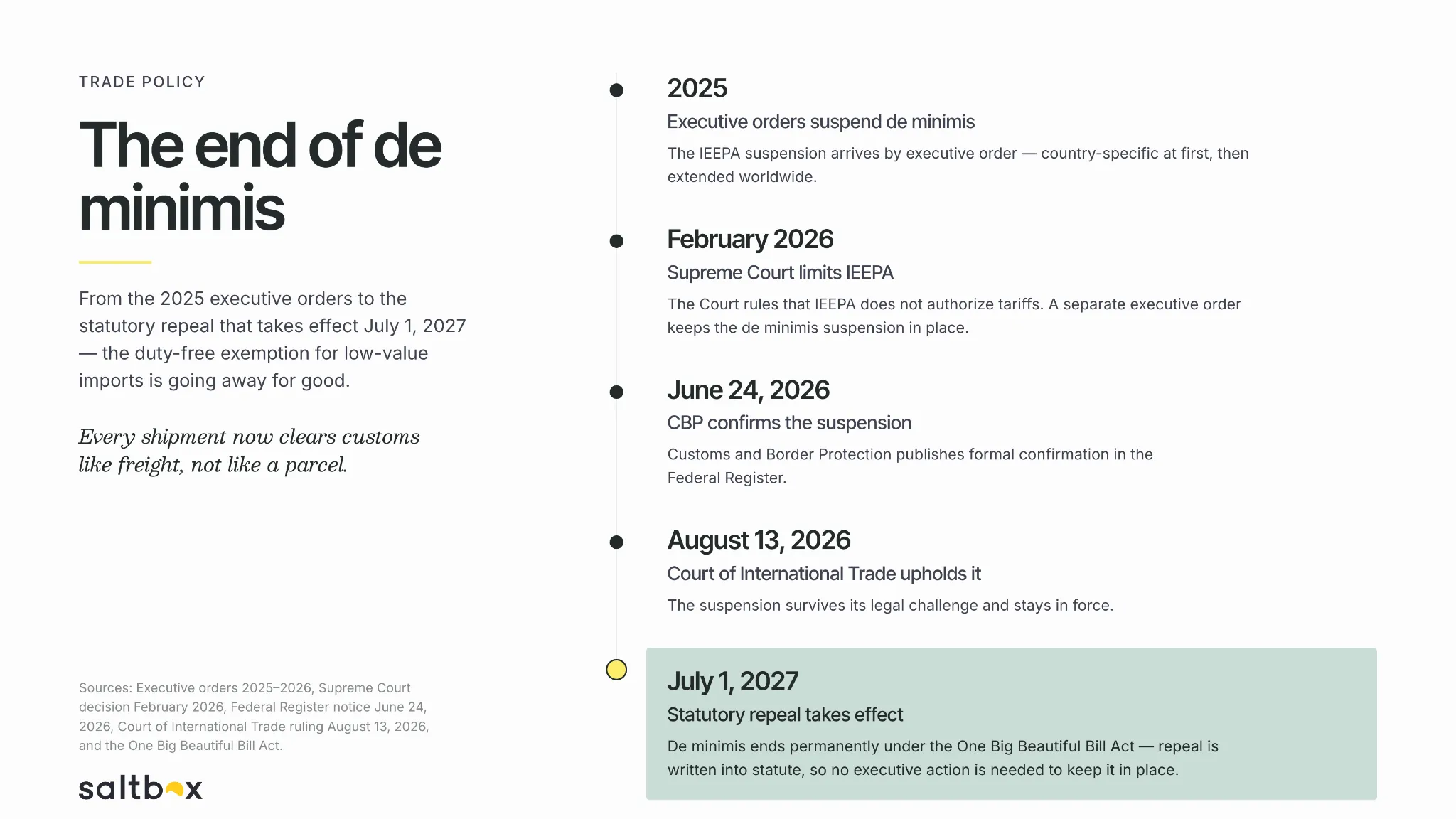
The $800 de minimis exemption is gone. An executive order suspended it, the U.S. Court of International Trade upheld that suspension on August 13, 2026, and the One Big Beautiful Bill Act repeals it permanently on July 1, 2027. Low-value imports now owe existing duties.
I've watched sellers spend the past week reading headlines about a court ruling and trying to work out whether their costs just went up. I want to save you the trouble, because the ruling changed less than the coverage suggested, and the thing that actually reshapes your next two years happened over a year ago, in a bill most people read for other reasons.
Here's the short version. Duty-free entry for shipments under $800 is over. It's over right now by executive order; a federal court just said the President had the authority to do that, and separately, Congress already wrote its permanent end into law with a hard date. If you import inventory, your landed cost math changed. If you were waiting to see how the litigation shook out before adjusting, the waiting isn't buying you much.
Is the end of de minimis really final?
Yes, and it's worth being precise about how, because two separate things ended it.
The first is executive action. Beginning in 2025, the administration invoked the International Emergency Economic Powers Act (IEEPA) to suspend de minimis treatment, first for specific countries, then worldwide. U.S. Customs and Border Protection confirmed that suspension in regulations published in the Federal Register on June 24, 2026.
The second is Congress. The One Big Beautiful Bill Act, signed on July 4, 2025, terminates the de minimis exemption outright, effective July 1, 2027. That repeal is statutory. It doesn't depend on any executive order, any emergency authority, or the outcome of any lawsuit.
So the exemption is suspended now and abolished in 2027. Those are two different mechanisms with two different vulnerabilities, and only one of them was ever really in play in court.
What did the court actually decide on August 13, 2026?
On August 13, 2026, a three-judge panel of the U.S. Court of International Trade held that the President had authority to remove the exemption in the case of Axle of Dearborn, Inc. v. Department of Commerce, Slip Op. 26-94.
The plaintiff, Axle of Dearborn, which operates as Detroit Axle, imports Chinese-manufactured auto parts through a distribution center in Juárez, Mexico, and had built a direct-to-consumer model around structuring individual shipments to land under the $800 threshold. When the suspension hit, the company argued the President lacked authority to remove the exemption by executive order.
The court disagreed, and the reasoning is more interesting than the outcome.
Here's the tension the panel had to resolve. In February 2026, the Supreme Court held in Learning Resources that the International Emergency Economic Powers Act (IEEPA) does not authorize the President to impose tariffs. On the same day that decision came down, a separate executive order was issued maintaining the de minimis suspension. So the obvious question: if IEEPA can't be used to impose tariffs, how can it be used here?
The panel's answer turns on statutory text. IEEPA lets the President "nullify, void, prevent, or prohibit" the exercise of "any right, power, or privilege" involving foreign-held property. And when Congress created the de minimis exemption in Section 321 of the Tariff Act, it described that exemption as a privilege. Privileges are on the list of things IEEPA lets a President nullify. Tariffs aren't.
Which means the exemption's removal isn't a tariff. It's the withdrawal of a privilege that Congress itself labeled as one.
Does this mean my imports face new tariffs?
No, this does not mean your imports will face new tariffs. A lot of news coverage on this topic claims that the ruling means tariffs now apply to all imports regardless of value. That's not true.
No new duty was created. What changed is that low-value shipments are no longer exempt from duties Congress already imposed. The rate you'll owe on a $600 shipment isn't a new rate invented by an executive order or a court. It's the existing rate for that product, now applied to a shipment that previously slipped under the threshold.
The size of the hit comes down to one number: your Harmonized Tariff Schedule (HTS) rate. For example, a $600 shipment classified at 7.5% owes $45.00. The same shipment at 25% owes $150.00. Neither figure is new. What's new is that you owe it on every load, every time.
That distinction matters for planning, because it tells you where to look. Your duty exposure is a function of your product classification and country of origin, not of this ruling. Pull your HTS codes. That's where the number lives.
What changes on July 1, 2027?
On July 1, 2027, the exemption disappears as a matter of law rather than executive discretion.
Between now and then, you're operating under a suspension that rests on emergency authority. After July 1, 2027, you're operating under a statute. From a purely operational standpoint, the day-to-day looks similar, because low-value imports owe duties either way. What changes is the durability. There will no longer be a legal theory under which the $800 window reopens, because the provision creating it will be gone.
If you've been treating this as a policy fight that might swing back, July 1, 2027 is the date that ends the argument.
Could an appeal bring de minimis back?
Detroit Axle can technically appeal to the U.S. Court of Appeals for the Federal Circuit to bring ge minimis back. However, as of August 18, 2026, no appeal has been filed.
Let's game out the best case for importers:
Say the appeal is filed, say it succeeds, and say the Federal Circuit holds the executive order exceeded IEEPA authority. What would that actually buy? A window running from whenever that decision lands until July 1, 2027, when the statutory repeal takes effect regardless.
Federal Circuit appeals routinely run more than a year from docketing to decision. File in the fall of 2026 and a ruling lands uncomfortably close to the statutory repeal date, if not after it. Anyone building an inventory strategy around that outcome is planning around a reprieve that arrives, at best, weeks before the statute closes the door anyway. I wouldn't. The reasonable planning assumption is that duty-free entry under $800 is finished.

Before you rebuild the math
Peak season inventory strategy under tariffs, and what changes when every inbound load clears duty.
Read the guideHow do I recalculate my landed cost right now?
There are four steps I recommend to recalculate your landed cost, in order.
1. Get your classifications right
Pull the HTS code for every SKU you import. Your duty exposure is entirely a function of classification and country of origin. Sellers who never needed this precision because everything landed under $800 are now discovering their codes were approximate.
2. Rebuild landed cost per unit, not per shipment
The old model rewarded splitting orders into sub-$800 parcels. That arbitrage is gone. Recalculate on a per-unit basis including duty, and you'll often find the economics now favor consolidating into larger shipments, the opposite of what you optimized for.
3. Re-examine your fulfillment geography
If your model depended on shipping individual parcels across the border to end customers, the per-shipment duty math likely just broke it. Holding inventory domestically and shipping domestically means clearing customs once on a consolidated load rather than on every order.
4. Look at your minimum order quantities and price floors
Start with any SKU running under a 30 percent gross margin. Those are the ones the new duty line is most likely to push underwater. Rerun them before you commit to a purchase order, not after.
Where should that inventory actually sit?
Clearing customs once instead of on every parcel is the first move when deciding where your inventory should actually sit. The second move is where most sellers stop short.
Consolidating inbound freight solves the duty problem. It doesn't solve the distance problem. If everything lands in one building and your orders are spread across the country, you've traded per-parcel duty for outbound zone costs, and you'll see it on the freight invoice within a quarter.
We had a Saltbox member shipping everything out of Seattle. Their orders weren't in Seattle. A hub in Dallas would have saved them tens of thousands of dollars a year on outbound alone, and that math got sharper the moment consolidated inbound freight became the only sane way to import. Another member relocated to Atlanta specifically because there was a Saltbox there.
The move is to clear one consolidated load, then cross-dock it to the cities your orders actually concentrate in. One customs event, multiple last-mile origins. Even a 3PL can't offer that unless it happens to sit where your customers are, and most of them sit in the middle of the country because that's what's cheapest for them, not for you.
Should I hold more inventory in the U.S.?
For a lot of the brands I talk to, yes, you should hold more inventory in the U.S. I want to be straight about why.
The end of de minimis penalizes shipment frequency across the border. Every parcel that crosses is a customs event. Consolidate into fewer, larger inbound shipments and clear duty once, then fulfill domestically, and you've removed both the per-shipment duty exposure and the customs delay from your customer's delivery window.
The trade-off is real, and I won't pretend otherwise. Domestic inventory means committing capital to stock sitting in a building, and it means having somewhere to put it. That's a genuine cost, and for brands under a few hundred orders per month, the numbers may not clear.
What I'd push back on is treating dollars per square foot as the deciding number. The cost of holding inventory domestically isn't the space. It's space, plus the labor to receive, count, pick, and pack it, plus the systems to know what you have, plus what your own hours are worth. Sellers who compare a warehouse quote against their current arrangement on square footage alone tend to miss where the money actually goes.
If you'd rather not hire for that side of it, Saltbox Fulfillment covers pick-and-pack after onboarding, and Saltbox Operations Support (SOS) handles receiving and counting a consolidated inbound load without you adding headcount to do it.
Here's the part worth holding onto. Duty is the cost. Distribution is the offset. The brands that come out of the next two years ahead won't be the ones that found a workaround. They'll be the ones that treated a forced change in inbound freight as the reason to finally put inventory where their orders already are, and ended up with faster delivery windows and lower outbound freight than they had back when de minimis was still in play.
Rethinking where your inventory sits?
The end of de minimis changes the math on cross-border fulfillment. If you're weighing domestic inventory against per-shipment duty, let's walk through your volume and figure out what actually pencils.
Speak to an expertFrequently asked questions
Duty-free treatment for shipments under $800 is currently suspended by executive order, upheld by the U.S. Court of International Trade on August 13, 2026. The One Big Beautiful Bill Act repeals it permanently, effective July 1, 2027.
No. The court held that removing the exemption imposes no new duties. Low-value shipments are simply now subject to tariffs Congress had already enacted. Your rate depends on your product's HTS classification and country of origin.
Section 321 of the Tariff Act, 19 U.S.C. § 1321(a)(2)(C), let goods valued at $800 or less, imported by one person on one day, enter free of duties and import taxes. An anti-fragmentation rule blocked splitting a single order into separate lots.
Detroit Axle can appeal to the Federal Circuit, and no appeal has been filed as of August 18, 2026. But the statutory repeal takes effect July 1, 2027 regardless of how litigation resolves, so any reprieve would be temporary.
Reclassify every imported SKU, rebuild landed cost per unit rather than per shipment, consolidate inbound freight, and reassess whether holding inventory domestically, in more than one city, now costs less than paying duty on every cross-border parcel.
For Her
For Him
For Pets
For Anyone


Related posts
Learn from businesses improving their operational efficiency. Explore how Saltbox’s expert support and flexible spaces drive their growth.


How your box design should grow with your business
Packaging isn't one decision, it's four handoffs. Here's what to change at each stage, and the mistakes that cost the most at each one.
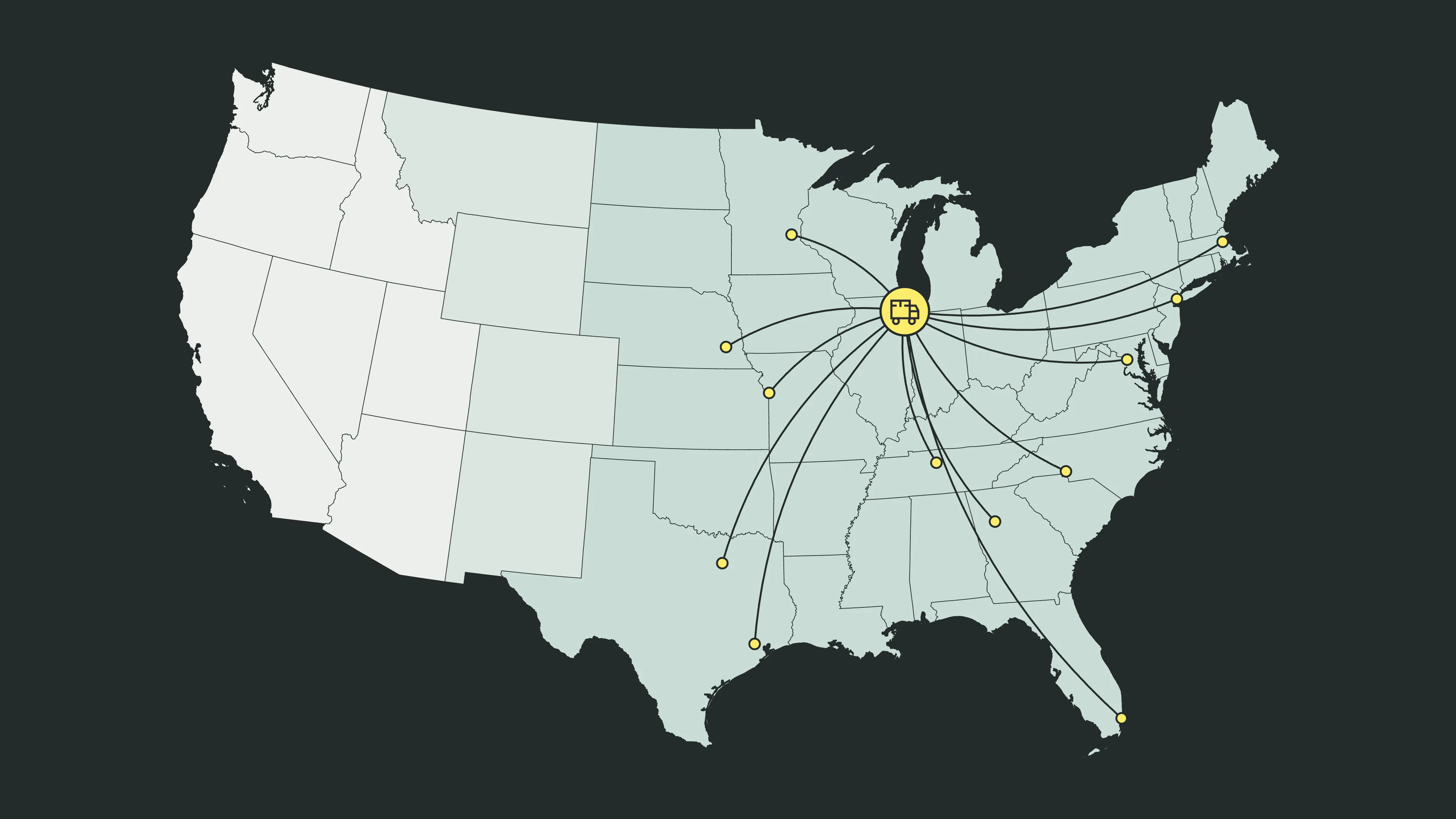
How much of the U.S. can you reach in two days from Chicago?
One Midwest node covers about 68% of the country in two days of ground transit. Here's exactly which two-thirds, and which third it misses.
2026 peak season shipping surcharges: what FedEx, UPS, USPS, and Amazon are charging
Additional handling went up about 6%. The fee on every single order went up 25%. Here’s the full 2026 surcharge picture, and what it costs you per order.
Related terms
Learn from businesses improving their operational efficiency. Explore how Saltbox’s expert support and flexible spaces drive their growth.