
.webp)


Key takeaways
- Chamblee is the strongest small-bay submarket in north metro Atlanta: inside I-285, real supply in small sizes, and the shortest last-mile into the city. Doraville, Tucker, and Norcross are the alternatives.
- Most brands moving out of a garage need far less space than they think. 200 to 2,000 square feet covers the majority.
- Dock access matters even if you only ship parcels, because it governs how you receive.
- The real dividing line between options isn't size or price. It's whether anyone is there to help you operate.
Every few weeks I talk to someone in metro Atlanta who's hit the same wall. Inventory is in the garage, the dining room, and increasingly the kids' room. A pallet showed up last Tuesday, and the driver wanted a liftgate they didn't have. They've started searching "small warehouse space for rent Atlanta," and what comes back is a wall of commercial real estate listings written for people leasing 40,000 square feet.
That's the gap this guide is for. Here's where small space actually exists in metro Atlanta, how much of it you probably need, and what to look at before you sign anything.
Where is small warehouse space actually located in metro Atlanta?
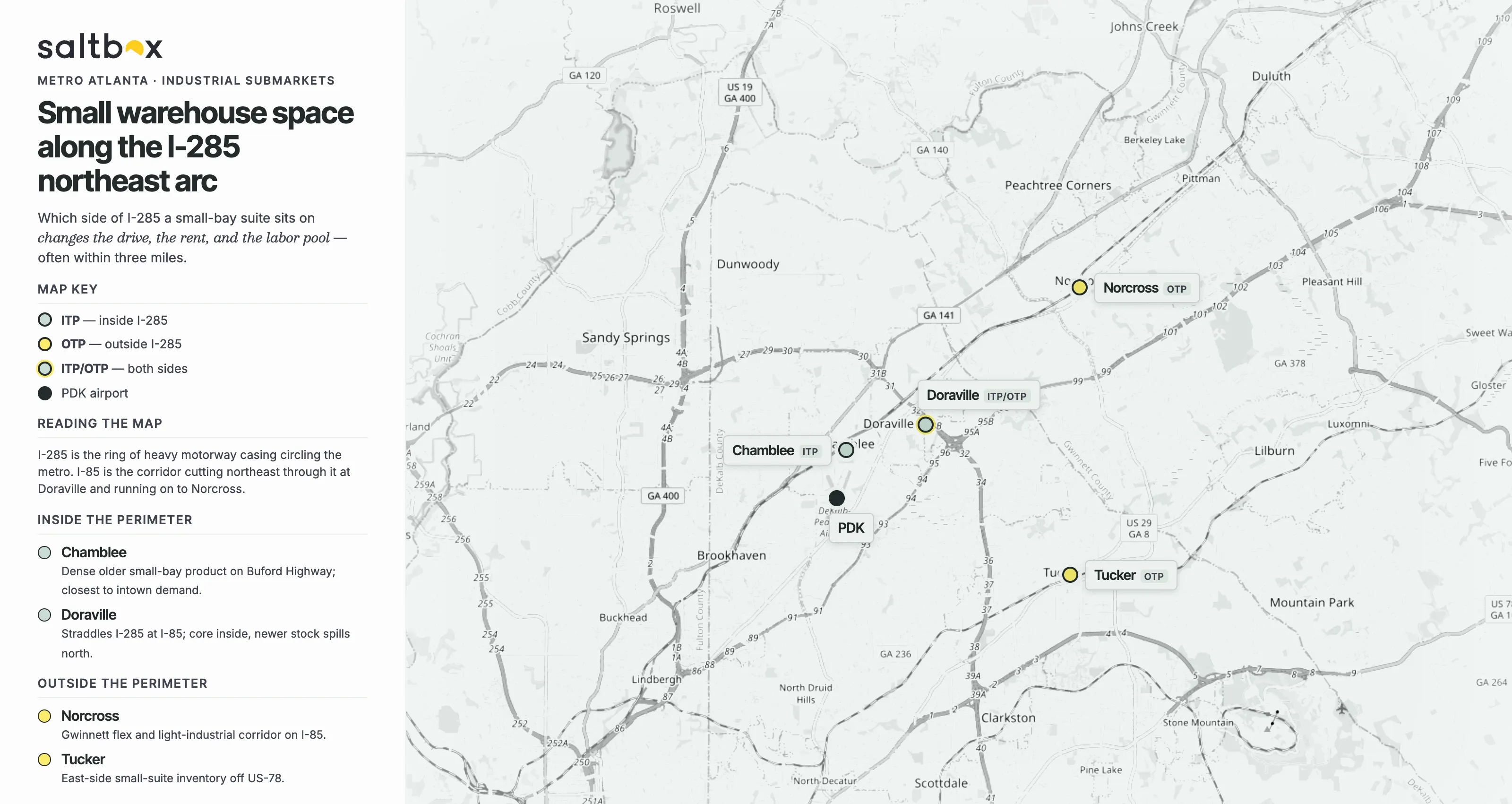
Metro Atlanta's industrial inventory is organized around the interstates, and small-bay space, the kind that comes in hundreds rather than tens of thousands of square feet, concentrates in the older industrial corridors inside and just outside I-285.
The deepest concentration sits on the northeast side, north of the city along the I-285 corridor. Here's how the four submarkets compare, in the order I'd actually look at them.
- Chamblee (DeKalb County, ZIP 30341). The one I'd start with. Older industrial stock along Peachtree Boulevard and Buford Highway subdivides into genuinely small suites, and it sits inside I-285, which almost nothing else on this list does. Inside the perimeter means shorter last-mile distances into in-town Atlanta and better positioning relative to carrier sort facilities. DeKalb-Peachtree Airport is adjacent, and I-285 access at Chamblee-Tucker Road is immediate. It's also the only one of the four where you can get operational support instead of just keys.
- Doraville (DeKalb County). Chamblee's neighbor along Buford Highway, also inside the perimeter. Similar building vintage, similar subdividing, occasionally a little cheaper because it's marginally further from town. A reasonable fallback if nothing in Chamblee is open in your size.
- Tucker (DeKalb County). East side of I-285 near the I-85 junction. Solid highway access, thinner small-bay supply. Worth a look if your customers skew east.
- Norcross (Gwinnett County). The most raw square footage per dollar on this list, and the furthest out. You're outside the perimeter, which adds distance to every in-town delivery, and the buildings tend to be sized for operations larger than yours. If rate per square foot is the only number you're optimizing, Norcross wins it. That's usually the wrong number to optimize.
South and west of the city, around Hartsfield-Jackson and along I-20, you'll find enormous industrial capacity, but it's built for regional distribution. Landlords are generally not interested in subdividing to 500 square feet.
The pattern to take away: if you need a small amount of space and you want to stay close to your customers, you're looking at the northeast corridor.
The short version: Chamblee. Inside the perimeter, real small-bay supply, the best last-mile position of the four, and the only one where somebody else can sign for your freight.
How much space does a product-based business really need?
The amount of space a product-based business needs is less than you think. This is the most common miscalculation I see.
Rough guide by stage:
- 200 to 500 square feet. You're consolidating out of a garage or spare bedroom. A handful of SKUs, orders in the dozens to low hundreds per month, inventory that fits on a few pallets and some shelving.
- 500 to 1,500 square feet. You're running a real operation. Multiple SKUs, a packing station, receiving pallets regularly, maybe one or two people helping.
- 1,500 to 5,000 square feet. Meaningful volume, dedicated staff, inventory depth that requires actual racking and a system to track it.
Two things people forget when estimating:
- Vertical space. A 400-square-foot suite with 20-foot clear height holds dramatically more on racking than the floor area suggests, which is why ceiling height belongs in your comparison.
- Working space. Inventory isn't the only thing in the room. You need somewhere to pack, somewhere to stage outbound, and room to move a pallet jack. Brands that size purely to inventory volume end up cramped within a quarter.
A useful reality check: if you're not sure whether you need 500 or 1,500 square feet, you probably need 500 and the ability to grow without renegotiating a lease.

Still running your business from home?
Before you sign anything, get the space you already have working properly. This guide walks through optimizing a home setup, managing inventory in tight quarters, and the signals that tell you it's time to move.
Get the guideWhat should I inspect before signing anything?
Before you sign anything, walk the space and check these specifically. I've watched people skip most of this list and regret it inside two months.
- Dock or grade-level access. Can a 53-foot trailer actually reach the door? Is there a dock, or a ramp, or nothing?
- Clear height. Measure to the lowest obstruction, meaning sprinkler heads, ductwork, and lighting, not to the roof deck.
- Power. Amps and phase. Heat sealers, shrink wrap machines, and label printers all want more than a standard outlet delivers.
- Climate. Is the space conditioned? Atlanta summers will damage candles, cosmetics, chocolate, adhesives, and anything with a temperature spec on the label.
- Building hours. Can you get in at 6 a.m. to pack, or on a Sunday during Q4?
- Carrier access. Will UPS and FedEx pick up here on a daily scheduled route, or are you driving to a drop-off point every afternoon?
- Who receives your freight when you're not there. This one determines whether "flexible space" is actually flexible. If a pallet arrives Tuesday at 10 a.m. and you're at your day job, what happens to it?
- Restroom and water. Genuinely worth confirming. Not every small industrial space has them.
- Term and exit. Month-to-month, annual, or multi-year? What does leaving early cost?

Does dock access matter if I only ship parcels?
Yes, dock access matters even if you only ship parcels, and the reason is the direction people forget.
If every order you send goes out as a parcel, you might reasonably conclude a dock is irrelevant. But dock access governs how inventory arrives. Your inbound freight almost certainly comes on pallets, and a truck without a liftgate needs a dock or a ramp to unload. Without one, you're paying a liftgate fee on every inbound delivery, or hand-unloading a pallet in a parking lot.
Liftgate fees are one of those costs that don't look like much per occurrence and add up to a real number across a year of receiving. If you're bringing in pallets at any regularity, dock access pays for itself on the inbound side alone.
What's the difference between a lease, a storage unit, and a flex warehouse?
Leases, storage units, and flex warehouses are three different products, and the differences aren't mainly about size.
A traditional industrial lease gets you space and nothing else. You handle utilities, insurance, liability, maintenance, and build-out. Terms typically run three to five years. Anybody can get 15,000 square feet; the part that surprises people is that managing it is close to a full-time job in itself. If a pipe bursts, that's your problem.
A storage unit is cheap and straightforward, and it isn't built for shipping. Most self-storage facilities restrict commercial operations, won't accept freight deliveries, have no dock, and won't let carriers pick up on a route. If you're storing inventory and nothing else, it can work. The moment you're fulfilling orders, it stops working.
A flex or co-warehousing space sits between them: a private suite with a shared dock, shorter terms, and utilities included. The category has real variation, and the variable that matters most is whether there's an on-site operations team or you're simply handed the keys.
That's the question I'd put to every option you're considering: when a pallet arrives, and you're not there, is there a person who handles it? Most of this category doesn't do that. Space is table stakes at this point. Staff is the part that's hard to find.
Come see what an operations team looks like
Saltbox Atlanta, Chamblee has private warehouse suites inside I-285, a shared dock, daily carrier pickups, and people on site who sign for your freight. Walk it for 30 minutes and compare it against whatever else you're considering.
Book a tour at Saltbox ChambleeWhat does Chamblee offer that other northeast-side submarkets don't?
Position, mainly.
Chamblee sits inside I-285, which distinguishes it from Norcross and most of the northeast corridor's small-bay supply. For a brand shipping to customers, inside-the-perimeter means shorter last-mile distances into in-town Atlanta and better positioning relative to carrier sort facilities. For a founder, it means a shorter commute, which matters more than people admit when you're going in six days a week during Q4.
The area's older industrial stock along Peachtree Boulevard and Buford Highway subdivides well, so small suites are genuinely available rather than theoretical. PDK is adjacent. I-285 access is immediate.
Saltbox operates a co-warehousing location in Atlanta, Chamblee, with private warehouse suites, dock access, daily carrier pickups, and an operations team on site. Our members get a photo studio and conference rooms in the same building, plus Saltbox Fulfillment when they want pick-and-pack handled, and Saltbox Operations Support (SOS) when they need labor on demand rather than an outside hire. We're part of a network of 1,000+ members nationwide, which matters if you ever add a second node.
How do I know I've outgrown my garage?
There are a few signals that indicate you’ve outgrown your garage, in rough order of how often I hear them:
- A pallet arrived, and you had nowhere to put it.
- You're paying liftgate fees because a truck can't unload at your house.
- Inventory has spread into rooms that belong to your family.
- You've turned down a wholesale order because you couldn't hold the volume.
- Q4 means packing until 1 a.m. because there's only one station and it's you.
- Your homeowner's insurance wouldn't cover the inventory if something happened, and you know it.
- You're driving to a carrier drop-off every afternoon instead of having pickups come to you.
If you recognize three or more of these, the constraint isn't your ambition. It's your square footage. You deserve better than your garage.
Ready to stop guessing about square footage?
Reading listings only gets you so far. Standing in a suite, measuring to the sprinkler head, and watching a pallet come off a truck tells you in ten minutes what a spreadsheet won't.
Atlanta, Chamblee has small private suites inside I-285, a shared dock with daily carrier pickups, and a team on site who receives your freight whether or not you're in the building. If you're weighing it against a lease, a storage unit, or staying home another quarter, come walk it first.
Frequently asked questions
Start with Chamblee, in DeKalb County just inside I-285. Older industrial stock along Peachtree Boulevard and Buford Highway subdivides into suites as small as 200 square feet. Doraville and Tucker are nearby alternatives, and Norcross offers more space per dollar but sits outside the perimeter.
Most brands leaving a garage need 200 to 500 square feet. Growing operations with a packing station and regular pallet receiving usually need 500 to 1,500. Factor in ceiling height and working space, not just inventory volume.
In the metro Atlanta small-bay market, that budget generally lands you a few hundred square feet, varying by submarket, ceiling height, and what's included. Compare total cost of operating rather than rate alone. Utilities, insurance, and receiving labor often exceed the difference in rent.
Yes. Dock access governs how inventory arrives, not how it leaves. Inbound pallet freight needs a dock or ramp, and without one you'll pay liftgate fees on every delivery.
Usually not. Most self-storage facilities prohibit commercial operations, won't accept freight, have no dock, and don't permit carrier pickups. Storage-only works; fulfillment doesn't.
Inside. Chamblee sits within the perimeter in DeKalb County, ZIP 30341, with immediate I-285 access and DeKalb-Peachtree Airport adjacent, closer to in-town customers than northeast-side submarkets outside the perimeter.
For Her
For Him
For Pets
For Anyone



Related posts
Learn from businesses improving their operational efficiency. Explore how Saltbox’s expert support and flexible spaces drive their growth.


How your box design should grow with your business
Packaging isn't one decision, it's four handoffs. Here's what to change at each stage, and the mistakes that cost the most at each one.
How much of the U.S. can you reach in two days from Chicago?
One Midwest node covers about 68% of the country in two days of ground transit. Here's exactly which two-thirds, and which third it misses.
2026 peak season shipping surcharges: what FedEx, UPS, USPS, and Amazon are charging
Additional handling went up about 6%. The fee on every single order went up 25%. Here’s the full 2026 surcharge picture, and what it costs you per order.
Related terms
Learn from businesses improving their operational efficiency. Explore how Saltbox’s expert support and flexible spaces drive their growth.